The prevailing narrative surrounding Artificial Intelligence focuses on incremental productivity gains—the “copilot” for
every worker. This perspective misses the structural reality: we are currently living through the terminal phase of a
multi-decade labor bubble. For years, systemic inefficiencies, administrative bloat, and “bullshit jobs” have been
sustained by cheap capital and legacy organizational structures.
AI is not a productivity multiplier for legacy workflows; it is a solvent that dissolves them. It acts as a liquidation
mechanism, exposing and stripping away roles that provide no fundamental value, forcing a brutal but necessary
recalibration of the global economy. This is not a transition; it is a reckoning. We are moving from an era of labor
hoarding and performative productivity into a period of analytical realism, where the true cost of human-in-the-loop
systems is finally being accounted for.
The Anatomy of the Bubble
The labor bubble is not a single phenomenon but the convergence of three distinct structural forces that have decoupled
employment from actual value creation.
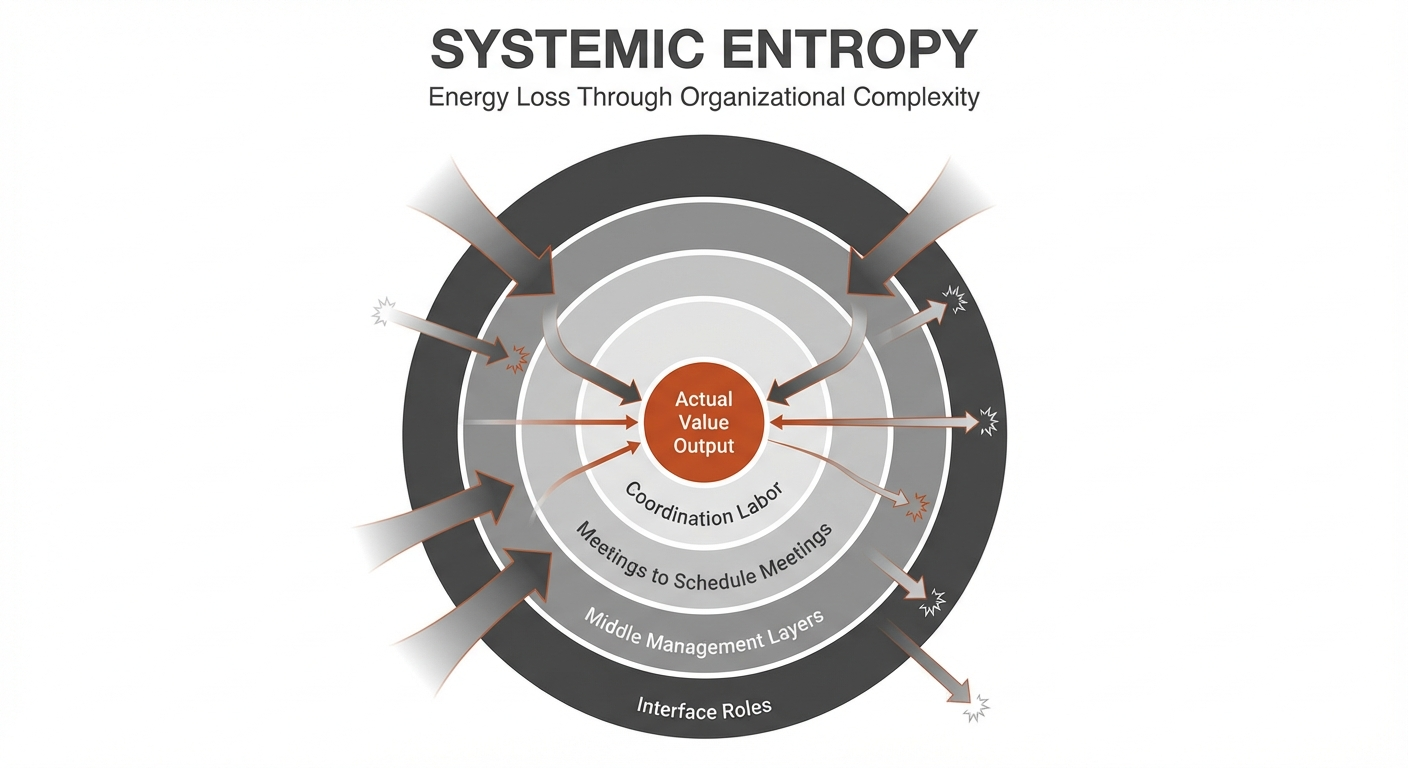
1. Systemic Entropy: The Complexity Tax
Modern organizations have become victims of their own scale. As systems grow, they require an exponential increase in
coordination labor—meetings to schedule meetings, managers to manage managers, and layers of “interface” roles that
exist solely to translate information between silos. This is systemic entropy: a state where the majority of an
organization’s energy is spent on internal maintenance rather than external output. In this environment, labor is
hoarded not for its productivity, but as a buffer against the friction of complexity.
2. Regulatory Capture and the Credential Ponzi
The “Credential Ponzi” describes the feedback loop between higher education and the labor market. As the supply of
degrees increases, employers raise credential requirements for roles that do not fundamentally require them, creating an
artificial floor for entry. This has created a “Stranded Asset” problem: millions of workers hold degrees that no longer
generate a return on the cost of their acquisition, as AI decouples the “proof of work” from the “ability to do work.” This is reinforced by regulatory capture, where professional licensing and compliance
mandates serve as moats, protecting legacy roles from automation. This system forces individuals into massive debt to
acquire “signals” of competence, while the actual utility of the work remains stagnant.
3. The Sociological Function: Employment as Social Control
Beyond economics, the labor bubble serves a profound sociological purpose. Employment is the primary mechanism for
social integration and resource distribution in the modern state. Maintaining high employment levels—even in “bullshit
jobs”—is a matter of political stability. The bubble is sustained by a collective, unspoken agreement that it is better
to pay people to perform redundant tasks than to face the social upheaval of mass disintermediation. Work, in this
context, is less about production and more about the management of human time and attention.
The Human API and the AI Catalyst
The most pervasive yet invisible component of the labor bubble is the “Human API.” For decades, organizations have
relied on humans to act as the connective tissue between incompatible software systems, legacy databases, and fragmented
workflows. These individuals do not produce original value; they function as biological adapters, manually translating
data from one format to another—copying information from a spreadsheet into a CRM, summarizing email threads for a
dashboard, or reconciling reports across departments.
Middle management, in particular, has evolved into a massive layer of human APIs. Their primary function is often the
aggregation and filtering of information as it moves up and down the corporate hierarchy. They are the “glue” that holds
together inefficient processes that were too complex or too expensive to automate with traditional, rigid software.
We are moving from Graphical User Interfaces (GUIs) designed for humans to Language User Interfaces (LUIs) designed for
agents. This allows for the “Refactoring of Org-Code”—redesigning workflows where the default path is automated, and humans are only invoked for high-variance exceptions. AI agents function as the universal solvent for this organizational glue. Unlike previous waves of automation that
required structured data and predefined rules, Large Language Models (LLMs) can navigate the ambiguity of legacy
systems. They can read unstructured text, interpret intent, and execute actions across disparate interfaces with the
same flexibility as a human, but at a fraction of the cost and near-infinite scale.
When the “Human API” is replaced by a digital one, the justification for entire departments vanishes overnight. This is
the “Liquidation Event”: the moment when the hidden costs of human-in-the-loop systems are exposed by a cheaper, faster,
and more reliable alternative. The bubble pops because the “glue” is no longer necessary to keep the machine running;
the machine can now talk to itself.
Case Study: The Recruitment Industry
The recruitment industry serves as a perfect microcosm of the labor bubble—a multi-billion dollar sector built almost
entirely on “complexity maintenance.” In sectors like Tech, Finance, and Pharma, the “Hiring Industrial Complex” has
evolved into a massive, self-sustaining layer of friction that AI is now rapidly dissolving.
Recruitment as Complexity Maintenance
For decades, recruitment has functioned as a high-cost “Human API.” Its primary purpose is often not to find
talent—which is increasingly visible via digital footprints—but to manage the noise generated by the “Credential Ponzi.”
Recruiters act as manual filters, moving resumes between incompatible databases, conducting “vibe check” screenings, and
coordinating schedules. This is the definition of complexity maintenance: a role that exists only because the systems
for matching talent to tasks are intentionally fragmented and inefficient.
The Collapse of the Hiring Industrial Complex
In high-margin industries, the cost of hiring a single mid-level employee can exceed $30,000 in agency fees or months of
internal HR overhead. This “Hiring Industrial Complex” is being liquidated by three AI-driven shifts:
Automated Sourcing and Vetting: AI agents can now perform deep-web sourcing and technical vetting at a scale and
precision impossible for human recruiters. They don’t just keyword-match; they analyze code repositories, research
papers, and past performance data to predict fit.
The End of the “Vibe Check”: LLM-driven interviewers can conduct initial screenings that are more objective,
consistent, and data-rich than a human phone call. This removes the “Human API” from the most labor-intensive part of
the funnel.
This triggers the “Arms Race of Noise”: candidates use AI to generate thousands of hyper-optimized resumes, while HR
uses AI to filter them. The result is a deadlock that renders the traditional resume obsolete, forcing a shift toward verifiable “Proof of Work” and “Atomic Credentialing.”
Disintermediation: As AI enables the “Sovereign Individual” and smaller, hyper-efficient teams, the need for
massive, centralized HR departments vanishes. The “complex” is bypassed as AI-native platforms match talent to tasks
with zero human intervention.
The recruitment bubble is popping because the “glue” it provided—the manual coordination of human capital—has been
commoditized by zero-marginal-cost inference. What was once a high-margin service industry is being exposed as a
legacy tax on organizational growth, a “bullshit sector” that AI is liquidating in real-time.
Sector Liquidation: Tech, Finance, and Pharma
The impact of this liquidation varies across sectors, targeting their specific moats:
The Tech Industry: The “Hiring Industrial Complex” in tech was built on volume and keyword matching. AI agents
now perform deep-web sourcing and technical vetting (e.g., analyzing GitHub commits) at a scale impossible for human
recruiters. As AI allows a team of 3 engineers to do the work of 30, the volume of hiring collapses, destroying the
business model of agencies built on headcount growth.
Financial Services: This sector relies on “Credential Inflation” and the “Analyst Pyramid.” AI excels at the
Excel/PowerPoint “Human API” work usually done by junior analysts. As the bottom of the pyramid is automated, the
massive recruitment machinery designed to fill those seats becomes obsolete, shifting the focus from pedigree to
verifiable performance.
Pharma and Medical: Here, the moat is compliance. AI agents can instantly cross-reference global databases for
licenses, publications, and regulatory history—tasks that previously took humans weeks. This allows hiring managers
to interface directly with the “Genuinely Skilled,” bypassing the coordination overhead of traditional HR.
The Two-Bubble Distinction
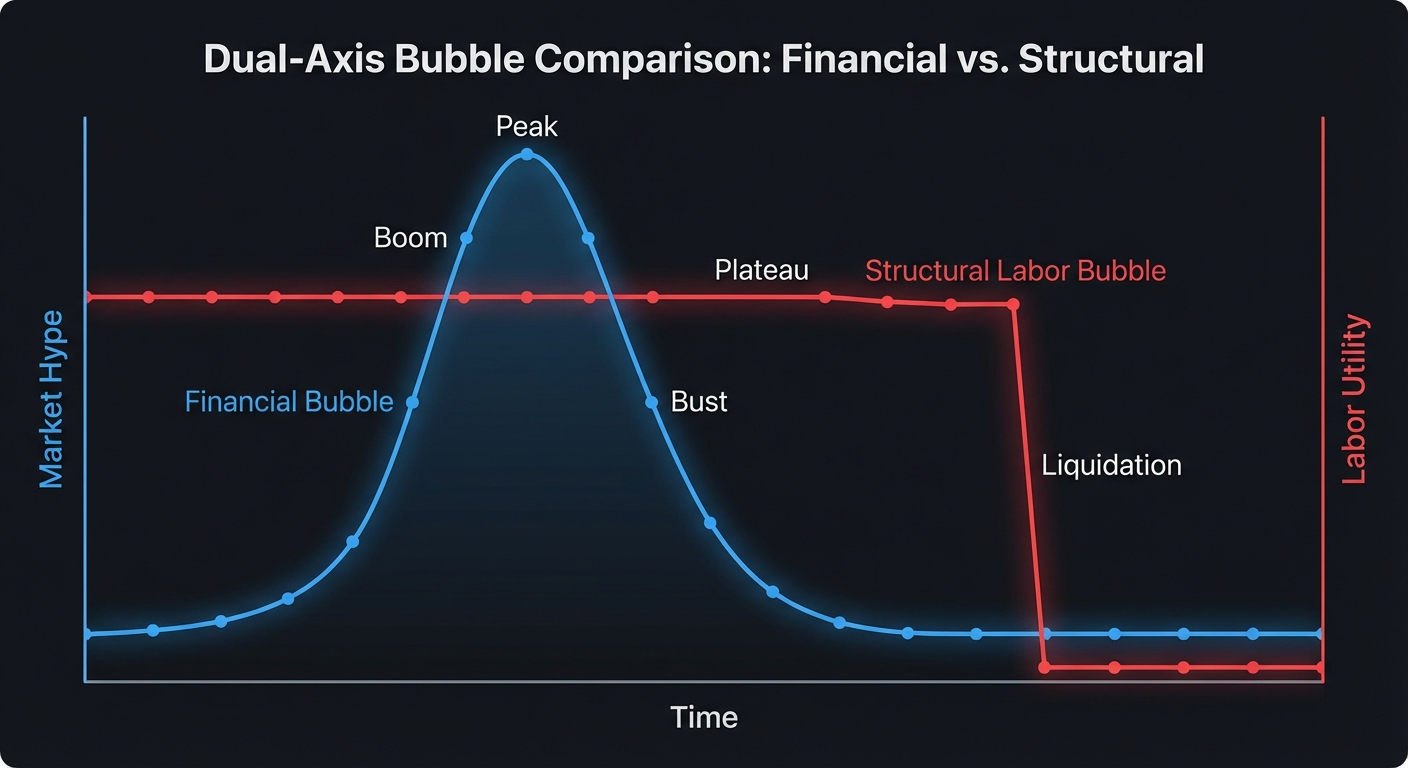
To understand the current era, one must distinguish between two simultaneous but fundamentally different phenomena: the
Financial AI Bubble and the Structural Labor Bubble. Confusing the two leads to a dangerous complacency, where a
market correction in tech stocks is misinterpreted as a reprieve for the labor market.
The Financial Bubble: Cyclical Hype
The Financial AI Bubble is a classic speculative cycle. It is characterized by astronomical valuations for chipmakers,
massive venture capital inflows into “wrapper” startups, and a “gold rush” mentality among enterprise buyers.
Key Metrics: GPU supply-demand imbalances, P/E ratios of semiconductor companies, and the volume of seed-stage AI
funding.
The Outcome: Like the Dot-com bubble of 2000, this bubble will likely burst. Companies with no path to
profitability will collapse, and the “hype” will subside. However, just as the 2000 crash didn’t stop the internet
from transforming society, an AI market correction will not stop the automation of labor.
The Structural Bubble: Permanent Liquidation
The Structural Labor Bubble is the multi-decade accumulation of “Human API” roles and systemic entropy described
earlier. This is not a market cycle; it is a technological phase shift.
Key Metrics: The unit cost of cognitive task execution, the ratio of administrative overhead to revenue, and the “
Time-to-Integration” for cross-platform workflows.
The Outcome: This bubble does not “burst” and then recover; it is liquidated through “Cognitive Deflation.” Once an AI agent can perform the
function of a middle manager or a data entry clerk at 1/100th of the cost, that role is permanently demonetized.
The danger lies in the “False Recovery” narrative. If the Financial Bubble pops and AI stocks tumble, many will assume
the “AI threat” was overblown and that their jobs are safe. This is a category error. A stock market crash does not
make an LLM less capable of writing code, processing insurance claims, or managing logistics. The financial bubble is
about valuation; the structural bubble is about utility. The former is temporary; the latter is terminal.
The Friction of Reality
While the liquidation of the labor bubble is structurally inevitable, it is not instantaneous. Several counter-forces
act as “friction,” slowing the transition and providing a false sense of security to those within the bubble. However,
these are not permanent barriers; they are temporary bottlenecks that will eventually be bypassed or overcome.
1. The Energy Hard Cap
The most immediate physical constraint is the massive power requirement of frontier AI models. The transition from human
cognitive labor to silicon-based computation requires a commensurate shift in energy infrastructure. Grid capacity, chip
manufacturing lead times, and the cooling requirements of massive data centers create a physical “speed limit” on the
deployment of AI agents. This creates “Compute Inequality,” where only high-margin labor is liquidated, while low-margin
labor remains “protected” by the high cost of the electricity required to replace it. This energy cap provides a temporary reprieve for human labor, but it is a race against time as
investment pours into nuclear modular reactors and more efficient inference architectures.
2. The Regulatory Maginot Line
Governments and legacy institutions are attempting to build a “Regulatory Maginot Line”—a series of legislative hurdles,
licensing requirements, and “AI safety” mandates designed to protect existing employment structures. Like its namesake,
this line is static and easily bypassed. While regulations may slow the adoption of AI in highly regulated sectors like
law or medicine, they cannot stop the global arbitrage of intelligence. If a task can be performed by an AI agent in a
more permissive jurisdiction, the economic pressure to adopt that efficiency will eventually render local prohibitions
obsolete.
3. Model Collapse and the Data Moat
There is a growing concern regarding “Model Collapse”—the idea that as AI-generated content floods the internet, future
models trained on this synthetic data will degrade in quality. This is “Digital Soil Depletion.” Without a constant
infusion of expensive, energy-intensive human creativity, AI utility decays. Critics argue this creates a “data moat” that protects
human-generated value. In reality, this is a technical hurdle, not a structural wall. High-quality, human-curated
datasets and synthetic data refinement techniques are already being developed to circumvent this. The “friction” of
model collapse is a temporary engineering challenge, not a permanent safeguard for the human-in-the-loop.
These frictions create a “lag” between the technological capability and the economic reality. This lag is dangerous
because it encourages complacency, allowing the labor bubble to persist slightly longer even as its foundations have
already been liquidated.
Furthermore, these physical constraints may lead to “Compute Inequality,” where only high-margin labor is liquidated
initially, while low-margin labor remains “protected” by the high cost of the electricity required to replace it. This
is not a reprieve, but a stay of execution.
Short Signals: Profiting from Denial
The terminal phase of any bubble is characterized by “Unstable Games”—desperate, often irrational behaviors by legacy
incumbents to preserve a status quo that has already been structurally undermined. For the astute observer, these
behaviors are not just signs of decay; they are “Short Signals”—clear indicators of where value is being destroyed and
where arbitrage opportunities exist.
1. Corporate “AI-Washing” and Capital Misallocation
Many corporations are currently engaged in a performative embrace of AI while doubling down on the very structures AI is
designed to liquidate. They announce “AI initiatives” to boost stock prices while simultaneously increasing
middle-management headcount or engaging in massive stock buybacks instead of fundamental R&D.
The Signal: A company that mentions “AI” fifty times in an earnings call but shows no reduction in administrative
overhead or “Human API” roles.
The Arbitrage: Shorting legacy firms that use AI as a veneer for business-as-usual, while longing lean, AI-native
competitors that operate with 1/10th the staff.
2. Bureaucratic Bloat as a Survival Mechanism
In government and large-scale bureaucracies, the response to automation is often the “Expansionary Pivot.” When a
process becomes 90% more efficient due to AI, the bureaucracy does not shrink; it invents new layers of “oversight,” “
compliance,” and “ethics committees” to absorb the surplus time and budget.
The Signal: The creation of new departments dedicated to “managing the transition” or “regulating the algorithm”
within organizations that have failed to modernize their core functions.
The Arbitrage: Betting against jurisdictions and institutions that prioritize labor-hoarding over efficiency, as
they will eventually be outcompeted by “Sovereign Jurisdictions” that embrace lean, automated governance.
3. The University “Credential Escalation”
As the utility of traditional degrees collapses in the face of AI-driven skill acquisition, universities are doubling
down on the “Credential Ponzi.” They are launching increasingly specialized (and expensive) master’s programs for roles
that AI will automate before the first cohort graduates.
The Signal: The proliferation of “AI Management” or “Digital Transformation” degrees that focus on legacy
organizational theory rather than technical leverage.
The Arbitrage: Investing in alternative credentialing, peer-to-peer learning networks, and “Proof of Work”
platforms that bypass the university system entirely.
4. Political Protectionism: The “Robot Tax” Fallacy
Politicians, fearing the social upheaval of the “Liquidation Event,” are increasingly proposing “Robot Taxes” or “Job
Guarantees.” These are attempts to tax productivity to subsidize obsolescence. While they may provide temporary
political stability, they create a massive economic drag.
The Signal: Legislative efforts to mandate “human-in-the-loop” requirements for tasks where humans add no value,
or the implementation of taxes specifically targeting automation.
The Arbitrage: Moving capital and talent to “Automation Havens”—regions that incentivize AI deployment and focus
on UBI or wealth redistribution models that don’t require the pretense of “bullshit jobs.”
5. The Recruitment “Volume Illusion”
The Signal: External agencies and platforms pretending the hiring slowdown is cyclical (interest rates) rather
than structural. They encourage candidates to “blast” resumes while companies maintain “talent pipelines” for a
rebound that isn’t coming.
The Arbitrage: Betting against the HR-tech and recruitment sectors that rely on high-volume churn, as AI reduces
the total headcount required for organizational growth.
These Unstable Games are the death rattles of the labor bubble. They represent a massive mispricing of reality.
Profiting from this denial requires the courage to bet against the “consensus of the comfortable” and align oneself
with the structural inevitability of the liquidation.
The Barbell Future
As the middle-ground of “Human API” roles and administrative bloat is liquidated, the economy will bifurcate into two
distinct extremes. This is the “Barbell Future,” where value is concentrated at the ends of the spectrum, and the
center—the traditional white-collar middle class—is hollowed out.
1. The Sovereign Individual: Extreme Automation
On one end of the barbell is the rise of the Sovereign Individual. These are hyper-efficient, small-scale entities (
often individuals or tiny teams) that leverage AI to perform the work that previously required hundreds of employees. By
utilizing “Permissionless Leverage”—AI agents for coding, marketing, legal analysis, and operations—these individuals can maintain near-zero
overhead while capturing massive upside.
Key Driver:Permissionless Leverage. Using code, content, and AI agents to build products or services that
scale infinitely without a corresponding increase in headcount.
2. High-Trust and Physical Accountability
On the other end of the barbell are roles that AI cannot easily replace: those requiring high-trust, physical presence,
or ultimate accountability. You cannot “prompt” a surgeon or a plumber to take the legal and physical liability for a high-stakes outcome. This includes high-end craftsmanship, specialized physical services, and roles where “skin
in the game” is the primary value proposition. When the marginal cost of digital output drops to zero, the premium on
human accountability and physical reality increases. We will see a return to the “Master-Apprentice” model in
specialized trades and a renewed emphasis on local, high-trust networks where reputation is the only currency that
cannot be forged by a model.
Key Driver:Skin in the Game. Roles where the professional takes personal, moral, or legal responsibility for
a high-stakes outcome—something an AI cannot do.
Conclusion: The Great Capital Reallocation
The popping of the labor bubble is not a cyclical crisis; it is a structural liquidation that triggers a massive
reallocation of capital. We are witnessing the “Great Unbundling” of the university and the corporation, as the historical
promise of potential is replaced by the immediate utility of automated output. Wealth is migrating from labor-heavy, legacy organizations—burdened by systemic entropy and
the “Human API”—to capital-efficient, AI-native entities and the infrastructure that powers them.
Navigating this transition requires a “Barbell Approach” to capital and career allocation. On one side, one must invest
in or build the “picks and shovels” of the new era: the energy, compute, and algorithmic leverage that drives
automation. On the other side, one must double down on the irreducibly human: physical assets, high-trust relationships,
and roles where accountability cannot be outsourced to a machine.
The Great Labor Bubble was essentially a bubble of anonymity. In a large corporation, one could hide within the process.
AI is a liquidation event because it makes “hiding” impossible. The future value of humanity lies not in the process—
which is now free—but in intent, accountability, and physical presence.
The liquidation event is already underway. The choice is no longer whether to participate, but where on the barbell you
will stand when the center finally gives way.
Brainstorming Session Transcript
Input Files: content.md
Problem Statement: Generate a broad, divergent set of ideas, extensions, and applications inspired by the concept of AI as a liquidation event for the ‘Great Labor Bubble’. Focus on the transition from ‘Human API’ roles to the ‘Barbell Future’.
Started: 2026-03-03 12:41:10
Generated Options
1. Universal Basic Equity (UBE) in Autonomous Corporate Entities
Category: Economic Infrastructure
Transition from tax-funded welfare to a system where citizens hold direct micro-equity in AI-managed autonomous corporations. As ‘Human API’ roles are liquidated, the resulting profit margins are redistributed through ownership of the automated infrastructure that replaced them.
2. The Flash-Org Orchestration Engine for Ephemeral Companies
Category: Organizational Theory
A platform that allows a single strategic founder to instantly deploy a ‘company’ composed entirely of AI agents for a specific project. These organizations exist only until a goal is met, liquidating immediately to minimize overhead and eliminate permanent middle-management layers.
3. Proof-of-Physicality and Embodied Wisdom Certifications
Category: Education & Credentialing
A new credentialing system that prioritizes skills requiring physical presence, tactile feedback, and human empathy. These certifications validate ‘un-automatable’ expertise in fields like high-stakes surgery, artisanal craft, and complex physical therapy, securing the ‘physical’ end of the barbell.
4. Neo-Guilds for the High-Touch Artisanal Renaissance
Category: Social Integration
Social and economic structures designed to protect and market the ‘Human Premium’ in services and goods. These guilds focus on the social integration of workers who provide high-end, human-centric experiences that AI cannot replicate, such as bespoke hospitality and mentorship.
5. AI-Leveraged Buyout (ALB) Arbitrage on Legacy Inefficiency
Category: Investment & Arbitrage
An investment strategy targeting firms still burdened by bloated ‘Human API’ middle-management layers. Investors acquire these firms, replace the coordination bureaucracy with autonomous agentic workflows, and capture the massive efficiency gains as profit.
6. Inter-Agent Semantic Protocol for Zero-Friction Commerce
Category: Technological Standards
A technological standard that allows AI agents from different organizations to negotiate, contract, and settle transactions without human oversight. This protocol effectively removes the need for procurement, legal, and administrative roles that currently act as human interfaces.
7. Cognitive Load Insurance for Strategic Decision Makers
Category: Economic Infrastructure
A financial product designed for the ‘high’ end of the barbell, where human decision-making becomes the primary bottleneck. It provides resources and ‘human-in-the-loop’ support to prevent burnout as the speed of AI-driven execution outpaces human processing capacity.
8. The ‘Prompt-to-Product’ Entrepreneurial Residency Program
Category: Education & Credentialing
An educational model that replaces traditional degrees with intensive residencies focused on directing AI swarms. Students are trained to act as ‘Architects of Intent,’ focusing on high-level strategy, ethics, and market fit rather than the technical execution of tasks.
9. Analog Sanctuary Zones for High-Value Social Integration
Category: Social Integration
The creation of physical territories or social clubs where digital technology is strictly regulated or banned. These zones facilitate high-value human-to-human networking and deep work, creating a premium economy around pure, unmediated human interaction.
10. Hyper-Local Micro-Manufacturing Hubs for Physical Sovereignty
Category: Investment & Arbitrage
Investment in AI-managed, robotic local factories that allow communities to produce physical goods on-demand. This shifts the focus from global digital platforms to local physical resilience, empowering the manual and craft-based end of the barbell economy.
Aligns citizen incentives with technological progress, reducing social resistance to automation and AI-driven efficiency.
Bypasses the inefficiencies and political friction of traditional tax-and-transfer welfare systems through direct ownership.
Provides a sustainable wealth-building mechanism for the ‘liquidated’ middle class, moving them from ‘Human API’ roles to capital owners.
Encourages a ‘stakeholder’ economy where the success of autonomous infrastructure directly improves the standard of living for the general population.
❌ Cons
High volatility: Unlike guaranteed government transfers, equity value and dividends can fluctuate or vanish if the autonomous entity fails.
Complexity of initial allocation: Determining how to fairly distribute equity in emerging AI entities without triggering massive market distortions is a significant challenge.
Governance vacuum: If corporations are fully autonomous, human shareholders may have little to no recourse if the AI’s logic diverges from human ethics or safety.
Potential for extreme inequality if equity is tied to specific sectors, leading to ‘rich’ and ‘poor’ citizen portfolios based on which AI industries thrive.
📊 Feasibility
Technically feasible via blockchain and smart contracts (DAOs), but politically and legally difficult as it requires a total overhaul of corporate law, property rights, and securities regulation.
💥 Impact
A fundamental shift in human identity from ‘worker’ to ‘owner-investor,’ potentially ending the labor-based social contract and creating a society supported by automated productivity.
⚠️ Risks
Systemic collapse: A bug or adversarial attack on the autonomous entity’s code could wipe out the ‘safety net’ for millions instantly.
Algorithmic ruthlessness: AI entities might optimize for profit margins to increase equity value by externalizing costs (e.g., environmental damage) that humans would normally mitigate.
Concentration of power: Early adopters or those with the most ‘compute-wealth’ could consolidate control over the autonomous entities, recreating a digital feudalism.
Loss of social cohesion: If the ‘Human API’ is fully liquidated, the lack of traditional work may lead to a crisis of purpose and social fragmentation.
📋 Requirements
Robust Distributed Ledger Technology (DLT) capable of managing billions of micro-equity transactions with minimal fees.
Legal recognition of Autonomous Corporate Entities (ACEs) as entities with personhood and the ability to issue equity.
Standardized AI governance protocols that ensure autonomous entities remain solvent and compliant with human-centric safety constraints.
A transitionary ‘Liquidation Fund’ to seed the initial equity for citizens displaced by the first wave of AI automation.
Option 2 Analysis: The Flash-Org Orchestration Engine for Ephemeral Companies
✅ Pros
Eliminates the ‘middle-management tax’ by replacing coordination layers with high-speed algorithmic orchestration.
Drastically reduces the cost of failure, allowing for high-frequency experimentation and market testing.
Enables a single human strategist to operate at the scale of a traditional mid-sized corporation.
Removes human-centric friction points such as office politics, scheduling conflicts, and misaligned personal incentives.
Optimizes resource allocation by liquidating assets and compute power immediately upon project completion.
❌ Cons
Total loss of institutional memory and long-term cultural capital due to the ephemeral nature of the organizations.
High dependency on the ‘Strategic Founder’ as a single point of failure for creative direction and ethical oversight.
Difficulty in building long-term brand trust or customer relationships with a transient entity.
Current AI agents struggle with high-context ‘edge cases’ that require nuanced human negotiation or physical intervention.
📊 Feasibility
Medium-term feasibility. While multi-agent frameworks (like AutoGen or CrewAI) exist, the reliability required for autonomous business operations is still developing. Legal and tax frameworks for ‘ephemeral companies’ are currently non-existent, posing a significant regulatory hurdle.
💥 Impact
This would trigger a hyper-fragmentation of the economy, shifting value from ‘execution’ (now a commodity) to ‘curation and strategy.’ It would effectively end the era of the ‘Human API’ worker, forcing a rapid transition to the Barbell Future where only high-level strategists and specialized physical laborers remain.
⚠️ Risks
Algorithmic ‘hallucination loops’ where agents consume vast compute resources without achieving the goal.
Significant legal liability issues regarding who is responsible for the actions or contracts of a liquidated AI entity.
Market saturation of low-quality, AI-generated products and services leading to ‘consumer fatigue’.
Security vulnerabilities where malicious actors could hijack agent orchestration to siphon funds or data.
📋 Requirements
Advanced multi-agent orchestration protocols capable of autonomous goal-decomposition and error correction.
Standardized digital legal wrappers (e.g., Smart Contract-based LLCs) for instant formation and liquidation.
High-bandwidth API integrations across financial, marketing, and distribution platforms.
A ‘Strategic Dashboard’ interface that allows humans to provide high-level intent without getting bogged down in tactical execution.
Option 3 Analysis: Proof-of-Physicality and Embodied Wisdom Certifications
✅ Pros
Creates a ‘Human Premium’ market segment, allowing workers to command higher wages for verified non-automated services.
Preserves tacit knowledge and artisanal skills that are at risk of being lost in a digital-first economy.
Provides a clear signaling mechanism for consumers who prioritize empathy, physical safety, and human accountability.
Counteracts the ‘Human API’ devaluation by formalizing the value of physical presence and sensory-motor expertise.
Encourages the development of apprenticeship-based education models that foster deep mentorship.
❌ Cons
High cost of assessment compared to digital certifications, as it requires physical observation and specialized facilities.
Subjectivity in measuring ‘embodied wisdom’ could lead to inconsistent standards and regional fragmentation.
Risk of creating exclusionary gatekeeping mechanisms that prevent social mobility for those without access to traditional training.
Difficulty in defining the boundary between ‘human-assisted by AI’ and ‘purely human’ physical performance.
📊 Feasibility
Moderate. While trade schools and medical boards provide a foundation, creating a cross-industry ‘Proof-of-Physicality’ standard requires new biometric verification technologies and a massive shift in regulatory frameworks. Implementation is easier in high-stakes fields (surgery) than in artisanal crafts.
💥 Impact
Significant. This would likely lead to a bifurcated economy where ‘certified human’ services become a luxury good, while AI-driven services handle the mass market. It would fundamentally re-center the value of the human body in the labor market.
⚠️ Risks
Technological fraud, such as the use of sophisticated tele-robotics or deepfakes to mimic physical presence during certification.
Economic elitism, where only the wealthy can afford services provided by ‘Certified Physical’ professionals.
Stagnation of innovation if certifications discourage the use of helpful robotic augmentations in physical fields.
Potential for ‘Physicality’ to become a proxy for discriminating against individuals with disabilities.
📋 Requirements
Biometric and spatial tracking technologies to verify physical presence and movement patterns during tasks.
Establishment of ‘Embodied Wisdom’ guilds or accreditation bodies to define and update standards.
A cultural shift in consumer behavior that values human-centricity over pure efficiency or cost-savings.
Legal frameworks that recognize these certifications as valid criteria for insurance and liability purposes.
Option 4 Analysis: Neo-Guilds for the High-Touch Artisanal Renaissance
✅ Pros
Establishes a clear market identity for ‘Human-Only’ services, allowing workers to command a premium price in an AI-saturated market.
Provides a social and professional safety net for displaced white-collar workers transitioning into high-touch vocational roles.
Revitalizes the apprenticeship model, ensuring the transfer of tacit knowledge and soft skills that AI cannot easily encode.
Creates a trusted ‘Proof of Human’ certification that protects consumers from ‘human-washing’ (AI masquerading as human service).
❌ Cons
Risk of creating an elitist ‘luxury layer’ of the economy accessible only to the ultra-wealthy.
Guild structures can become protectionist and anti-competitive, stifling innovation to protect traditional methods.
High administrative overhead for certification and monitoring of ‘artisanal’ standards.
Difficulty in scaling these models to provide meaningful employment for the mass volume of workers displaced by AI.
📊 Feasibility
Moderate. While the organizational structures (guilds) are historically proven, the challenge lies in establishing a globally recognized certification standard and overcoming the cost-efficiency of AI alternatives in a price-sensitive market.
💥 Impact
Significant cultural shift toward the ‘Barbell Future,’ where the economy splits into hyper-efficient AI commodities and high-status, high-cost human experiences. This could lead to a renaissance in craftsmanship, mentorship, and hospitality.
⚠️ Risks
Economic Segregation: The ‘Human Premium’ becomes a marker of class, deepening the divide between those who can afford human touch and those relegated to AI interfaces.
Fraud: The emergence of ‘AI-augmented’ services falsely marketed as ‘pure human’ to exploit guild pricing.
Obsolescence: If AI improves its emotional intelligence (EQ) simulation to a point of indistinguishability, the guild’s value proposition may collapse.
📋 Requirements
Robust ‘Proof of Human’ verification technologies or auditing processes.
A cultural shift in consumer values prioritizing ‘presence’ and ‘soul’ over speed and efficiency.
Legal and tax frameworks that recognize guild-based collective bargaining and benefits outside of traditional corporate employment.
Physical or digital ‘Third Places’ where these guilds can facilitate community and mentorship.
Option 5 Analysis: AI-Leveraged Buyout (ALB) Arbitrage on Legacy Inefficiency
✅ Pros
Significant margin expansion by converting high-cost ‘Human API’ salaries into low-cost compute expenses.
Elimination of human-centric bottlenecks, enabling 24/7 operational speed and near-instantaneous decision-making.
Improved operational consistency and auditability as workflows are codified into deterministic or observable agentic logs.
Ability to scale business operations non-linearly without the traditional friction of hiring, onboarding, and management overhead.
Unlocks value in ‘zombie’ companies that are currently unprofitable due to legacy administrative bloat.
❌ Cons
Loss of ‘tacit knowledge’ and institutional memory that isn’t captured in formal process documentation.
High initial capital expenditure required for both the acquisition and the complex technical restructuring.
Extreme cultural friction and potential internal sabotage during the transition from human to agentic coordination.
Difficulty in mapping informal ‘shadow’ workflows that humans use to bypass broken official systems.
Potential for ‘algorithmic rigidity’ where the firm loses the ability to innovate or pivot outside of its programmed workflows.
📊 Feasibility
Moderate. While the financial mechanisms (PE/LBO) are well-established, the technical maturity of autonomous agents capable of replacing complex middle-management is still emerging. Implementation is most feasible in data-heavy industries like insurance, logistics, and back-office finance, but remains difficult in sectors requiring high emotional intelligence or physical presence.
💥 Impact
This could trigger a radical restructuring of the global economy, leading to the emergence of ‘Lean Giants’—companies with billion-dollar valuations and double-digit headcounts. It accelerates the ‘Barbell Future’ by hollowing out the middle class of corporate management and concentrating wealth among capital owners and high-level AI orchestrators.
⚠️ Risks
Regulatory and political backlash, including ‘robot taxes’ or emergency labor protection laws targeting AI-driven layoffs.
Systemic fragility: A bug or hallucination in a core agentic workflow could cause catastrophic business failure before human intervention is possible.
Reputational damage and brand erosion if the ‘human touch’ is removed from customer-facing or sensitive processes.
Cybersecurity vulnerabilities where the entire management layer becomes a target for prompt injection or adversarial attacks.
Social instability resulting from the rapid displacement of the white-collar workforce without a viable transition plan.
📋 Requirements
Specialized ‘Process Archeologists’ to map and deconstruct legacy human workflows into machine-readable logic.
Advanced agentic orchestration platforms capable of long-term planning and cross-tool integration.
Significant private equity or venture capital reserves to fund the acquisition and ‘burn-in’ period of the AI transition.
Robust legal and compliance frameworks to manage the liability of autonomous corporate actions.
Elite ‘AI Red Teams’ to continuously stress-test and audit the autonomous management layer.
Option 6 Analysis: Inter-Agent Semantic Protocol for Zero-Friction Commerce
✅ Pros
Drastic reduction in transaction costs by eliminating human-in-the-loop administrative overhead.
Near-instantaneous negotiation and settlement cycles, enabling real-time supply chain adjustments.
Elimination of human bias and ‘gatekeeping’ in procurement, potentially leading to more meritocratic vendor selection.
Enables micro-transactions and hyper-granular contracting that would be economically unviable with human labor.
High precision in alignment between requirements and deliverables through standardized semantic mapping.
❌ Cons
Loss of human intuition and relationship-based negotiation which often resolves ‘edge case’ disputes.
High complexity in creating a truly universal semantic standard that covers all industries and nuances.
Initial high cost of integration for legacy businesses, potentially widening the gap between tech-native and traditional firms.
Difficulty in auditing ‘agent intent’ when negotiations occur at speeds and volumes beyond human comprehension.
📊 Feasibility
Technically moderate but organizationally difficult. While LLMs and smart contracts provide the building blocks, achieving a global ‘semantic standard’ requires massive cross-industry coordination and a total overhaul of contract law.
💥 Impact
This would represent the ‘liquidation’ of the corporate middle layer. It shifts the economy toward a Barbell structure where value is concentrated in high-level strategic prompt engineering and low-level physical resource ownership, completely hollowing out administrative and ‘Human API’ roles.
⚠️ Risks
Market volatility: Automated B2B markets could experience ‘flash crashes’ similar to high-frequency trading.
Adversarial attacks: Malicious agents could use ‘prompt injection’ or semantic loopholes to trick other agents into unfavorable contracts.
Systemic fragility: A bug in the protocol or a logic error in a widely used agent template could cascade through the global economy in seconds.
Legal vacuum: Current jurisdictions are ill-equipped to handle liability when two autonomous agents enter a dispute without a human signatory.
📋 Requirements
A universal, machine-readable ontology for goods, services, and legal terms (Semantic Web 3.0).
Secure, decentralized execution environments (e.g., blockchain or TEEs) to ensure contract integrity.
Formal verification tools to prove that AI-generated contracts are safe and adhere to organizational constraints.
New regulatory frameworks that recognize ‘Agentic Identity’ and provide a mechanism for automated dispute resolution.
Option 7 Analysis: Cognitive Load Insurance for Strategic Decision Makers
✅ Pros
Addresses the ‘human bottleneck’ problem where AI execution speed exceeds human cognitive processing limits.
Formalizes mental bandwidth as a critical economic asset, encouraging proactive health management for leaders.
Creates a high-value niche for ‘Cognitive Concierges’—elite human support staff who filter and pre-process AI outputs.
Provides a safety net for organizations against ‘Key Person Risk’ caused by burnout or decision fatigue.
Stabilizes the ‘high end’ of the barbell economy by ensuring strategic continuity during rapid market shifts.
❌ Cons
Extremely difficult to quantify ‘cognitive load’ and ‘burnout’ for actuarial and underwriting purposes.
Potential for high premiums that only the most elite organizations can afford, further entrenching inequality.
The ‘human-in-the-loop’ support could inadvertently increase coordination overhead and slow down decision-making.
Risk of creating a ‘crutch’ dependency where leaders lose the ability to manage their own focus without external intervention.
📊 Feasibility
Moderate. While the financial structures for insurance exist, the biometric and neuro-monitoring technology required to objectively measure cognitive load is still in early stages. Implementation would likely start as a high-end executive benefit before becoming a standardized insurance product.
💥 Impact
This would transform corporate governance by making ‘cognitive capacity’ a line item on balance sheets. It would likely lead to the rise of ‘Decision Support Systems’ that blend AI filtering with human intuition, effectively creating a new layer of infrastructure for the Barbell Future.
⚠️ Risks
Moral Hazard: Insured individuals might take on excessive strategic risks or over-commit, knowing they have a ‘safety net’.
Privacy Intrusions: Monitoring cognitive load may require invasive data collection on a leader’s mental state and habits.
Systemic Fragility: If the support network (the ‘human-in-the-loop’ layer) fails or is compromised, the primary decision-maker becomes uniquely vulnerable.
Adverse Selection: Only those already prone to burnout or those in impossibly high-pressure roles might seek the insurance, making the pool unsustainable.
📋 Requirements
Advanced biometric sensors and AI-driven sentiment analysis to track cognitive strain in real-time.
New actuarial models capable of pricing the risk of mental exhaustion and decision paralysis.
A vetted network of ‘Elite Support’ professionals trained to step into high-stakes strategic environments.
Legal frameworks defining liability when a ‘human-in-the-loop’ assistant contributes to a strategic failure.
Option 8 Analysis: The ‘Prompt-to-Product’ Entrepreneurial Residency Program
✅ Pros
Directly aligns education with the ‘Barbell Future’ by training the high-leverage ‘Architect’ side of the spectrum.
Accelerates the transition from student to value-creator, reducing the time-to-market for new innovations.
Prioritizes durable human skills such as strategic empathy, ethical judgment, and market intuition over perishable technical tasks.
Offers a more cost-effective and outcome-oriented alternative to traditional four-year degrees, potentially reducing student debt.
❌ Cons
Risk of ‘abstraction fragility,’ where students lack the foundational knowledge to troubleshoot when AI systems fail or hallucinate.
May create a ‘shallow’ class of generalists who lack the deep domain expertise required for complex scientific or engineering breakthroughs.
The model relies heavily on the current state of AI; rapid shifts in technology could render specific ‘prompting’ or ‘orchestration’ skills obsolete.
Difficulty in standardizing quality and credentialing across different residency programs without traditional academic oversight.
📊 Feasibility
High for private accelerators and venture-backed ‘neo-universities,’ but low for traditional public institutions due to rigid accreditation standards and faculty resistance to replacing technical curricula.
💥 Impact
A massive surge in ‘companies of one’ and micro-SaaS products, leading to a highly fragmented but hyper-innovative economy where the barrier to entry for entrepreneurship is virtually zero.
⚠️ Risks
Market oversaturation of AI-generated products, leading to a ‘race to the bottom’ in pricing and quality.
Ethical lapses if ‘Architects of Intent’ prioritize rapid deployment over safety, security, or societal impact.
Potential for psychological burnout as the burden of total responsibility for a product’s success shifts entirely onto the individual student.
Widening of the inequality gap between those with the ‘strategic intuition’ to succeed in this model and those who previously relied on structured ‘Human API’ roles.
📋 Requirements
Access to advanced AI agent frameworks and significant compute credits for student ‘swarms.’
A network of mentors consisting of successful serial entrepreneurs and AI ethicists.
A ‘Proof of Product’ credentialing system that values market traction and functional prototypes over test scores.
Robust legal frameworks for managing intellectual property generated through human-AI collaboration.
Option 9 Analysis: Analog Sanctuary Zones for High-Value Social Integration
✅ Pros
Restores cognitive bandwidth and deep focus by eliminating the ‘attention economy’ distractions.
Increases the ‘trust premium’ of face-to-face interactions, providing a safeguard against AI-generated deepfakes and digital deception.
Creates a high-status market for ‘unmediated’ human presence, effectively valuing human time as a luxury good.
Facilitates high-stakes networking where the lack of digital recording encourages more candid and creative discourse.
❌ Cons
High barriers to entry could lead to extreme social and economic stratification, creating an ‘analog elite’.
Significant logistical inconvenience regarding emergency communications and real-time data access.
Difficult to scale beyond small, niche environments without losing the ‘sanctuary’ quality.
Potential for intellectual stagnation if the zones become too isolated from the rapid pace of AI-driven innovation.
📊 Feasibility
High for private social clubs or boutique coworking spaces, as the model leverages existing ‘members-only’ business structures. Low for large-scale physical territories due to complex zoning, emergency service integration, and the ubiquity of satellite-based connectivity.
💥 Impact
Redefines the concept of luxury from ‘digital access’ to ‘digital absence.’ It establishes a new tier in the Barbell Future where the high-end is defined by expensive, unmediated human interaction, while the mass market remains AI-mediated.
⚠️ Risks
Security vulnerabilities: The lack of digital surveillance could attract illicit activities or corporate espionage.
Social fragmentation: Further alienates the ‘Human API’ workforce from the decision-making elite.
Technological atrophy: Participants may lose the ability to effectively interface with the digital systems that run the rest of the world.
Enforcement creep: The potential for ‘black market’ technology use within the zones, undermining the core value proposition.
📋 Requirements
Signal-shielding architecture (Faraday cages) and sophisticated hardware detection systems.
Strict membership vetting and curation protocols to maintain the ‘high-value’ social density.
Analog-first infrastructure, including physical archives, manual record-keeping, and traditional mail systems.
Legal and regulatory frameworks to manage ‘off-grid’ status within modern urban environments.
Option 10 Analysis: Hyper-Local Micro-Manufacturing Hubs for Physical Sovereignty
✅ Pros
Reduces dependence on fragile global supply chains, increasing community resilience against external shocks.
Enables extreme customization and on-demand production, eliminating the need for massive inventory and warehousing.
Significantly lowers the carbon footprint associated with long-distance shipping and logistics.
Revitalizes local economies by creating high-value roles for ‘robot wranglers’ and artisanal designers.
Facilitates a circular economy by allowing for easier local recycling and repurposing of materials into new feedstock.
❌ Cons
High initial capital expenditure (CapEx) for advanced robotics and AI integration at a small scale.
Difficulty in achieving the same economies of scale as centralized mega-factories for commodity goods.
Raw material sourcing (feedstock) often remains dependent on global extraction and refining networks.
High energy demands for localized industrial processes may strain existing local power grids.
📊 Feasibility
Moderate. While 3D printing and basic robotics are mature, the integration of multi-material autonomous assembly and AI-driven quality control into a compact ‘hub’ is still in the early-to-mid stages of technical readiness. Economic feasibility depends heavily on the rising costs of global logistics and the falling costs of automation hardware.
💥 Impact
This would trigger a radical decentralization of the physical economy, shifting power from digital platform giants to local physical nodes. It empowers the ‘manual’ end of the barbell economy by providing craftspeople with industrial-grade tools, effectively turning ‘Human API’ roles into sovereign producers and designers.
⚠️ Risks
Regulatory and zoning challenges as industrial production moves back into residential or commercial areas.
Intellectual property (IP) risks regarding the unauthorized local production of patented designs.
Potential for environmental hazards if local waste management and filtration systems are not strictly maintained.
Technological obsolescence if the hardware cannot be easily upgraded to keep pace with AI software advancements.
📋 Requirements
Sophisticated AI orchestration software to manage design-to-production workflows without expert human intervention.
Standardized, modular feedstock (plastics, metals, composites) that can be easily distributed and loaded.
Reliable local renewable energy sources or microgrids to power continuous manufacturing.
A new legal framework for ‘distributed manufacturing’ to handle liability, safety, and IP rights.
Brainstorming Results: Generate a broad, divergent set of ideas, extensions, and applications inspired by the concept of AI as a liquidation event for the ‘Great Labor Bubble’. Focus on the transition from ‘Human API’ roles to the ‘Barbell Future’.
🏆 Top Recommendation: The Flash-Org Orchestration Engine for Ephemeral Companies
A platform that allows a single strategic founder to instantly deploy a ‘company’ composed entirely of AI agents for a specific project. These organizations exist only until a goal is met, liquidating immediately to minimize overhead and eliminate permanent middle-management layers.
Option 2 (The Flash-Org Orchestration Engine) is the most direct and scalable application of the ‘liquidation’ concept. While Option 5 (ALB Arbitrage) focuses on dismantling legacy firms, Option 2 provides the generative infrastructure for the new economy, allowing ‘Architects of Intent’ to bypass the ‘Human API’ middle layer entirely. It perfectly captures the ‘Barbell Future’ by empowering a single strategic human at one end to command a swarm of AI agents at the other. It is superior to the ‘Neo-Guild’ or ‘Physicality’ options because it addresses the massive digital coordination market that currently constitutes the ‘Labor Bubble.’
Summary
The brainstorming session explored the transition from a labor market defined by ‘Human API’ roles (middle management, coordination, administrative bureaucracy) to a ‘Barbell Future.’ This future is characterized by a sharp divide: one end consists of high-level strategic intent and creative architecture, while the other consists of high-touch physical presence and artisanal craft. The findings suggest that the ‘liquidation’ of the middle layer will be driven by agentic orchestration, new financial models for equity, and a resurgence in the value of ‘un-automatable’ human experiences. The general trend points toward a ‘Zero-Friction’ economy where the cost of organizational overhead approaches zero, necessitating new structures for social safety and professional identity.
Scenario: The Liquidation of the Labor Bubble: A strategic interaction between legacy institutions, workers, and AI-native disruptors. The game focuses on the ‘Arms Race of Noise’ in recruitment and the ‘Structural Labor Bubble’ vs ‘Financial AI Bubble’ distinction.
Players: Legacy Corporations, AI-Native Startups, White-Collar Workers, Regulators
Game Type: non-cooperative
Game Structure Analysis
This analysis examines the strategic interaction between legacy institutions, workers, and AI-native disruptors during the “Liquidation of the Labor Bubble.”
1. Identify the Game Structure
Game Type: Primarily non-cooperative. While players may attempt to coordinate (e.g., Regulators and Legacy Corporations), the fundamental drivers are competitive and disruptive.
Sum Nature:
Legacy System: A negative-sum game (The Arms Race of Noise). As both sides increase AI usage, the cost of coordination rises while the quality of matching decreases.
The Barbell Future: A positive-sum/Pareto optimal shift. By exiting the legacy system, players move toward a game where value is tied to “Proof of Work” or “High-Trust,” creating new utility.
Timing: A repeated game in the short term (hiring cycles, quarterly earnings) transitioning into a sequential game with a terminal “Liquidation Event.”
Information: Imperfect and Asymmetric.
Workers have private information about their actual productivity vs. “Human API” status.
Legacy Corporations have imperfect information regarding the true ROI of their AI-washing.
AI-Native Startups possess superior information regarding the technical feasibility of disintermediation.
2. Define Strategy Spaces
The strategies are largely discrete (pivoting to a new model) but involve continuous variables (level of investment in AI).
Player
Strategy A (Legacy/Defensive)
Strategy B (Disruptive/Exit)
Legacy Corporations
AI-Washing: Performative adoption to maintain stock valuation.
Structural Liquidation: Aggressive automation to purge “Human API” roles.
AI-Native Startups
Disintermediation: Direct talent-to-task matching, bypassing HR.
Niche High-Trust: Focusing on human accountability and “Skin in the Game.”
White-Collar Workers
Credential Escalation: Pursuing more degrees (Credential Ponzi).
Sovereign Individual: Building “Proof of Work” and personal leverage.
Regulators
Protectionism: Implementing “Robot Taxes” or the “Maginot Line.”
Automation Havens: Incentivizing efficiency to attract global capital.
3. Characterize Payoffs
Payoffs are non-transferable and depend heavily on the timing of the “Liquidation Event.”
Legacy Corporations: Objective is to minimize the “Complexity Tax” while avoiding social/regulatory backlash. Payoffs for AI-Washing are high in the short term (stock price) but catastrophic in the long term (liquidation by leaner competitors).
White-Collar Workers: Objective is income stability and autonomy. Credential Escalation has a diminishing—and eventually negative—ROI as AI decouples degrees from ability.
AI-Native Startups: Objective is market capture. Payoffs are binary: total disintermediation of a sector or failure due to regulatory capture.
Regulators: Objective is social stability. Protectionism yields short-term political capital but leads to long-term economic stagnation and capital flight.
4. Key Features & Strategic Analysis
A. The “Arms Race of Noise” (Prisoner’s Dilemma)
In the recruitment sector, candidates and HR departments are locked in a classic Prisoner’s Dilemma. Both sides use AI to gain an advantage, but the collective result is a collapse of the signaling system.
Nash Equilibrium: (AI-Spam, AI-Filtering). Candidates must spam to be seen by AI; HR must use AI to filter the spam.
Outcome: Zero-sum. The “Resume” is liquidated as a valid signal.
B. The Barbell Future (Pareto Optimal Shift)
The “Barbell Future” represents an exit from the legacy non-cooperative game. By moving to the extremes—Extreme Automation (Sovereign Individual) or High-Trust (Physical Accountability)—players move to a new payoff frontier.
Pareto Improvement: A worker moving from “Credential Escalation” to “Sovereign Individual” increases their own utility (autonomy/income) without necessarily decreasing the utility of the AI-native ecosystem.
Signaling: The shift moves from “Cheap Signals” (Degrees) to “Costly Signals” (Proof of Work/Reputation).
C. The Two-Bubble Distinction (Information Asymmetry)
There is a strategic “False Recovery” trap.
Financial AI Bubble: Cyclical. Players who mistake a stock market correction for a halt in automation will fail to liquidate their “Human API” roles.
Structural Labor Bubble: Terminal. The strategy of “waiting it out” is a losing move because the utility of LLMs is independent of their creator’s stock price.
Summary of Strategic Equilibrium
The game is currently in an unstable equilibrium. Legacy players are “AI-washing” to buy time, while the underlying “Human API” infrastructure is being dissolved by AI-native disruptors. The dominant strategy for individuals and small firms is to exit the center of the barbell, as the middle-ground (administrative bloat) is the primary target of the liquidation event.
Payoff Matrix
This analysis presents the strategic payoffs for the “Liquidation of the Labor Bubble” through two primary lenses: the Arms Race of Noise (a tactical Prisoner’s Dilemma) and the Structural Liquidation (a strategic shift toward the Barbell Future).
Matrix 1: The Recruitment “Arms Race of Noise”
This sub-game represents the interaction between White-Collar Workers (Candidates) and Legacy Corporations (HR Departments) within the existing recruitment infrastructure.
Worker \ Legacy Corp
Manual Review (Human-Centric)
AI-Filtering (Algorithmic)
Manual/Honest
(5, 5) Outcome: High-quality matching. Payoff: High signal, but high time cost for both.
(8, 1) Outcome: Candidate floods system. Payoff: Worker gets interviews; Corp is overwhelmed by noise.
(2, 2) Nash Equilibrium Outcome: Zero-Sum Deadlock. Payoff: Both spend on AI tools to cancel each other out.
Payoff Explanations:
(2, 2) Deadlock: This is the current trajectory. Candidates use LLMs to generate 1,000 resumes; HR uses LLMs to summarize them back down to 10. The net information transfer is zero, but the “Compute Tax” is paid by both.
(5, 5) High-Trust: This is Pareto superior but unstable, as any individual candidate can gain an advantage by switching to AI-Spam (the “defection” in Prisoner’s Dilemma).
Matrix 2: The Structural Liquidation (The Barbell Future)
This matrix analyzes the macro-strategic choice between maintaining the Labor Bubble and moving toward AI-Native Efficiency.
Legacy/Regulator \ Disruptor/Worker
Credential Escalation (Legacy Path)
Sovereign Individual (Proof of Work Path)
AI-Washing / Protectionism
(3, 3) Outcome: The “Credential Ponzi.” Payoff: High debt for workers; high “Complexity Tax” for corps.
(0, -5) Outcome: Mass Obsolescence. Payoff: Legacy sheds bloat; Workers with only degrees are liquidated.
(9, 9) Pareto Optimal Shift Outcome: The Barbell Future. Payoff: Hyper-efficiency; Value flows to “Skin in the Game.”
Payoff Explanations:
(3, 3) The Bubble Peak: Both parties agree to the “unspoken contract” of performative work. It is stable but low-value and vulnerable to external shocks (like a Financial AI Bubble burst).
(9, 9) The Barbell Future: This represents the “Exit” strategy. Legacy institutions that aggressively liquidate their “Human API” layers and workers who pivot to verifiable “Proof of Work” achieve the highest mutual utility.
(0, -5) The Liquidation Event: If a corporation liquidates roles while workers are still doubling down on credentials, the worker suffers a total loss of “Stranded Assets” (degrees that no longer generate ROI).
Regulator: +10 (Attracting global capital/compute).
AI-Native Startup: +10 (Capturing the “Complexity Tax” as profit).
Worker: +7 (High leverage, though high risk/accountability).
Legacy Corp: -10 (Total liquidation/bankruptcy).
Analysis: This is the “Liquidation Event” in full effect. Value is stripped from the “Human API” middle and reallocated to the ends of the barbell.
Summary of Equilibria
Tactical Equilibrium (The Deadlock): Candidates and HR departments remain stuck in the “Arms Race of Noise” until the cost of the legacy recruitment system exceeds the value of the hires.
Strategic Equilibrium (The Barbell): The only long-term stable state is the exit from legacy systems. Players who move to “High-Trust/Physical” or “Extreme Automation” (Sovereign Individual) bypass the zero-sum games of the middle-ground entirely.
Nash Equilibria Analysis
This analysis identifies the Nash Equilibria (NE) within the strategic interaction of the “Labor Bubble Liquidation,” focusing on the transition from legacy systems to the “Barbell Future.”
1. Equilibrium 1: The “Arms Race of Noise” (The Legacy Trap)
This equilibrium represents the current state of the recruitment industry and legacy corporate structures.
Workers: If a candidate stops spamming AI-optimized resumes while others continue, their visibility drops to zero. They must escalate to stay in the pool.
Corporations: If HR stops using AI filters while candidates continue to spam, the system is overwhelmed by volume. They must filter to function.
Regulators: Politicians face immediate social unrest if they don’t protect “bullshit jobs,” making protectionism the safest local move.
No player can unilaterally deviate without immediate loss of status or function.
Classification: Pure Strategy Equilibrium.
Stability and Likelihood: Highly stable but low-utility. It is a “Stag Hunt” gone wrong or a classic Prisoner’s Dilemma. It is the most likely state for the “center” of the labor market until the structural bubble fully liquidates.
2. Equilibrium 2: The “Sovereign Disintermediation” (The Efficiency Frontier)
This equilibrium represents the “Extreme Automation” end of the Barbell Future.
Workers: By providing “Proof of Work,” they bypass the noise of the Credential Ponzi. They have no incentive to return to the legacy “Human API” roles.
Startups: By connecting talent directly to tasks via AI, they capture the $30k+ fees previously lost to the “Hiring Industrial Complex.”
Regulators: By becoming “Automation Havens,” they attract the most productive capital and talent, outcompeting protectionist jurisdictions.
Classification: Pure Strategy Equilibrium.
Stability and Likelihood: High stability for high-performers. It is the “Exit” strategy. Its likelihood increases as the “Energy Hard Cap” is solved and “Compute Inequality” favors high-margin tasks.
3. Equilibrium 3: The “High-Trust Accountability” (The Human Moat)
This represents the other end of the Barbell Future, focusing on physical reality and liability.
Workers: They provide a service (e.g., surgery, legal liability) that AI cannot legally or morally assume.
Startups: They build platforms that verify reputation rather than just matching keywords.
Regulators: They maintain power by enforcing the “Regulatory Maginot Line” in sectors where safety is paramount.
Classification: Pure Strategy Equilibrium.
Stability and Likelihood: Very high. This is the “un-automatable” residue of the labor market.
Discussion of Multiple Equilibria
Coordination Problems
The primary coordination problem exists between Workers and Regulators. If a worker chooses the “Sovereign Individual” path but lives in a “Protectionist” jurisdiction, they are penalized by “Robot Taxes” or lack of legal recognition for AI-augmented work. Conversely, an “Automation Haven” fails if its workforce remains stuck in the “Credential Ponzi.” Transitioning from Equilibrium 1 to Equilibrium 2 requires a simultaneous shift in talent (Proof of Work) and state (Regulatory Havens).
Pareto Dominance Relationships
Equilibrium 2 (Sovereign Disintermediation) Pareto-dominates Equilibrium 1 (The Legacy Trap). In the Legacy Trap, both Corporations and Workers spend massive resources on “Noise” (filtering and spamming) with zero net gain in matching quality. Equilibrium 2 eliminates this “Complexity Tax,” allowing for higher wealth generation with lower overhead.
The “Barbell Future” (Equilibria 2 & 3) is the Pareto optimal shift for the global economy, as it reallocates capital from “Complexity Maintenance” to “Actual Output” and “High-Trust Accountability.”
Most Likely Outcome
The market is currently in a Sequential Game transition.
Short-term: Equilibrium 1 (The Legacy Trap) persists as a “False Recovery” narrative.
Mid-term: A “Coordination Failure” occurs where legacy institutions collapse before the Barbell infrastructure is fully ready (The Liquidation Event).
Long-term: The system settles into a Bimodal Distribution (The Barbell), where players have either exited to the Sovereign/High-Trust paths or remain in a decaying, subsidized legacy core.
Conclusion: The “Arms Race of Noise” is a Nash Trap. The only way to win is to “Exit” the game entirely, moving toward the Barbell equilibria where “Proof of Work” and “Skin in the Game” replace the “Human API” and “Credential Ponzi.”
Dominant Strategies Analysis
This analysis identifies the dominant and dominated strategies within the “Liquidation of the Labor Bubble” game, focusing on the transition from legacy systems to the “Barbell Future.”
1. Strictly Dominant Strategies
Strategies that provide a higher payoff regardless of the actions of other players.
White-Collar Workers: Sovereign Individual (Proof of Work Path)
Reasoning: In the “Arms Race of Noise,” AI-generated resumes and AI-filtering create a deadlock. Credential Escalation (the legacy path) suffers from “Cognitive Deflation”—the cost of the degree remains high while the market value of the cognitive task it represents drops toward zero. The Sovereign Individual path (verifiable, atomic proof of work) is the only strategy that bypasses the noise and establishes direct value.
Reasoning: Due to the “Global Arbitrage of Intelligence,” any jurisdiction that chooses Protectionism loses its tax base and talent to more efficient regions. Becoming an Automation Haven is strictly dominant because it captures the “Great Capital Reallocation” regardless of whether other regions attempt to block it.
2. Weakly Dominant Strategies
Strategies that are at least as good as any other strategy and better in at least one scenario.
Reasoning: While AI-Washing (Performative) might provide a short-term stock bump, it fails to address the “Complexity Tax.” Structural Liquidation is weakly dominant because it ensures survival in a high-efficiency environment and is strictly better than AI-Washing when the “Financial AI Bubble” eventually pops, leaving only those with actual utility standing.
Reasoning: By removing the “Human API” and the “Hiring Industrial Complex,” startups capture the spread between legacy costs and AI-native efficiency. This is weakly dominant over Niche High-Trust because it allows for infinite scale, though Niche High-Trust remains a viable “Barbell” end-state.
3. Dominated Strategies
Strategies that are always worse than an alternative, regardless of what others do.
Reasoning: This is strictly dominated by the Sovereign Individual path. The “Credential Ponzi” requires increasing debt for a signal (the degree) that AI-driven HR filters now treat as noise. It is a “Stranded Asset” strategy.
Legacy Corporations: AI-Washing (Performative)
Reasoning: This is dominated by Structural Liquidation. AI-Washing maintains the “Human API” and administrative bloat (Systemic Entropy) while only pretending to modernize. As AI-native competitors emerge, the “Complexity Tax” of the AI-Washer becomes a terminal liability.
Reasoning: This is dominated by Automation Havens. Protectionism creates an economic drag that incentivizes capital flight. It is a “static line” in a world of fluid, digital intelligence.
4. Iteratively Eliminated Strategies
Strategies removed through the assumption that all players are rational and will not play dominated strategies.
Eliminate “Credential Escalation” (Workers): Rational workers realize the ROI is negative.
Eliminate “AI-Washing” (Legacy Corps): Once workers stop seeking legacy credentials, the “Hiring Industrial Complex” that Legacy Corps use to filter them collapses. Performative AI no longer fools the market.
Eliminate “Protectionism” (Regulators): As Legacy Corps fail and Workers move to Sovereign paths, the tax revenue from “bullshit jobs” vanishes. Regulators are forced to abandon Protectionism to prevent total economic collapse.
Eliminate “The Middle”: The final result is the Barbell Future, where the “Human API” middle-management layer is entirely removed from the strategy space.
Strategic Implications
The Death of the Resume: The “Arms Race of Noise” (AI spam vs. AI filters) is a Prisoner’s Dilemma that leads to the total destruction of the resume as a signaling device. The only way to “win” is to stop playing the legacy recruitment game entirely.
The Inevitability of the Barbell: Because the “Middle” strategies (Middle Management, Generalist Degrees, Administrative Bloat) are all iteratively eliminated, the only stable equilibria exist at the extremes: Extreme Automation (Sovereign Individuals) or Extreme Accountability (High-Trust/Physical).
The False Reprieve: Players who mistake the popping of the Financial AI Bubble for a reason to return to dominated legacy strategies will be liquidated by the Structural Labor Bubble. The structural shift is terminal; the financial shift is cyclical.
Pareto Optimal Shift: The transition to the Barbell Future is a Pareto optimal shift for those who exit the legacy game early. While the “Liquidation Event” is painful for the system, the Sovereign Individual gains “Permissionless Leverage,” achieving a higher payoff than was possible within the legacy “Complexity Tax” structure.
Pareto Optimality Analysis
This analysis evaluates the strategic outcomes of the “Labor Bubble Liquidation” through the lens of Pareto optimality, contrasting the current “Arms Race of Noise” with the projected “Barbell Future.”
1. Identification of Pareto Optimal Outcomes
In this game, an outcome is Pareto optimal if no player (Legacy Corp, Worker, Startup, or Regulator) can improve their position without directly degrading the position of another.
Outcome A: The “Barbell” Equilibrium (Pareto Optimal)
Why it is Pareto Optimal: In this state, the “Complexity Tax” is eliminated. Capital flows to the most efficient producers (Sovereign Individuals) or the most accountable (High-Trust Niche). There is no “waste” on performative labor. While Legacy Corporations are “worse off” (they cease to exist), within the new system, resources are allocated at maximum utility.
Outcome B: The High-Trust Niche (Pareto Optimal)
Configuration: Legacy Corps (Structural Liquidation) + Workers (High-Trust/Physical Accountability).
Why it is Pareto Optimal: This represents the “Skin in the Game” end of the barbell. By conceding digital tasks to AI, the human worker focuses on liability and physical presence—areas where AI cannot compete. The corporation gains efficiency; the worker gains a non-commoditizable moat.
Outcome C: The “Arms Race of Noise” (Non-Pareto Optimal)
Configuration: Legacy Corps (AI-Filtering) + Workers (AI-Spamming/Credential Escalation).
Why it is NOT Pareto Optimal: This is a classic Prisoner’s Dilemma. Both parties spend increasing amounts of capital and energy on AI tools to cancel each other out. The result is a zero-sum deadlock where the “signal” of talent is lost in “noise.” Both could be better off by agreeing to a “Proof of Work” standard.
2. Comparison: Pareto Optimal Outcomes vs. Nash Equilibria
Feature
Nash Equilibrium (The Legacy Trap)
Pareto Optimal (The Barbell Future)
Primary Strategy
AI-Washing & Credential Escalation
Disintermediation & Proof of Work
Stability
Stable but decaying (Red Queen Race)
Stable and generative
Resource Use
High entropy (spent on “Noise”)
Low entropy (spent on “Output”)
Information
Asymmetric/Obfuscated
Transparent/Verifiable
The Conflict: The current Nash Equilibrium is the “Arms Race of Noise.” It is stable because if a single worker stops spamming resumes, they lose visibility; if a single HR department stops filtering, they are overwhelmed. However, this equilibrium is Pareto inefficient because everyone is working harder for the same (or worse) matching results.
3. Pareto Improvements over Equilibrium Outcomes
A Pareto improvement is a shift that makes at least one player better off without making anyone worse off.
From “Credential Ponzi” to “Atomic Credentialing”: If Workers and AI-Native Startups coordinate on “Proof of Work” (e.g., GitHub commits, on-chain reputation), the Worker saves the cost of a $100k degree, and the Startup saves the $30k recruitment fee. Both are better off.
From “Regulatory Maginot Line” to “Automation Havens”: If Regulators stop taxing automation (Robot Tax) and instead incentivize efficiency, the resulting “Cognitive Deflation” lowers the cost of living for all citizens, potentially funding a transition to UBI. This is a Pareto improvement over a stagnant, protected economy.
4. Efficiency vs. Equilibrium Trade-offs
The transition from the current Labor Bubble to the Barbell Future involves a brutal trade-off between Systemic Stability and Economic Efficiency.
The Stability Trap: The “Labor Bubble” acts as a mechanism for social control. The Nash Equilibrium of “Bullshit Jobs” provides political stability. Moving to a Pareto optimal efficient state (Liquidation) creates a temporary period where the “Legacy Corporation” player is wiped out.
The Coordination Failure: To reach the Pareto optimal “Barbell Future,” players must “Exit” the legacy system simultaneously. If only one worker becomes a “Sovereign Individual” while the rest of the market still demands legacy credentials, that worker is penalized.
The Liquidation Event: This is the “Phase Shift.” The game suggests that the Financial AI Bubble may pop, but the Structural Labor Bubble must be liquidated to reach the Pareto frontier. The “efficiency” gained by removing the “Human API” is so great that the legacy equilibrium cannot hold.
5. Opportunities for Cooperation and Coordination
To move from the inefficient Nash Equilibrium (The Noise) to the Pareto Optimal state (The Barbell), the following coordination mechanisms are required:
Standardization of “Proof of Work”: Players must agree on new “Human-in-the-loop” signals that AI cannot forge (e.g., physical presence, cryptographic signatures of effort).
Sovereign Jurisdictions: Regulators can coordinate to create “Automation Havens.” By being the first to allow AI-native disintermediation, they attract the “Sovereign Individual” players, forcing other jurisdictions to follow or face capital flight.
The Great Exit: The most effective coordination is the “Exit” strategy. As more workers move to the “Sovereign Individual” path, the legacy “Credential Ponzi” loses its signaling power, eventually reaching a tipping point where the legacy system collapses under its own complexity tax.
Conclusion: The “Arms Race of Noise” is a sub-optimal Nash Equilibrium. The only path to Pareto optimality is the Liquidation of the Center, forcing players to the ends of the Barbell where value is either purely automated (Efficiency) or irreducibly human (Trust).
Repeated Game Analysis
This analysis explores the strategic interaction of the “Labor Bubble Liquidation” as a repeated game with a finite horizon of 5 iterations (T=5). In this context, each iteration represents a phase of the AI transition (e.g., 1 iteration = 18 months).
The Backward Induction Trap: In a standard Prisoner’s Dilemma (the “Arms Race of Noise”), Selten’s Theorem suggests that because the game ends at $T=5$, players will defect in the final round. Anticipating this, they defect in $T=4$, leading to a collapse of cooperation in $T=1$.
The “Liquidation” Variable: Unlike a static game, the payoffs for “Legacy” strategies (AI-Washing, Credential Escalation) decay at an accelerating rate ($\lambda$) each round, while “AI-Native” payoffs grow exponentially. This changes the incentive from “maintaining cooperation” to “timing the exit.”
2. Strategy Spaces & Payoff Matrix (The Arms Race of Noise)
The core sub-game is the Recruitment Deadlock between Workers (Candidates) and Legacy Corporations (HR).
Worker \ Corp
AI-Filtering (Cooperate/Lean)
AI-Spamming (Defect/Noise)
Proof of Work (Cooperate)
(High, High) - Pareto Optimal
(Low, High) - Corp exploits Worker
AI-Resume Spam (Defect)
(High, Low) - Worker exploits Corp
(Zero, Zero) - Systemic Collapse
Iteration 1-2: Players attempt to signal “High Trust” to maintain the legacy system’s functionality.
Iteration 3-4: The “Arms Race of Noise” dominates. The cost of filtering exceeds the value of the hire.
Iteration 5: The Legacy system is liquidated; payoffs for “Defect” in the legacy game hit absolute zero.
3. Folk Theorem & Sustainable Equilibria
In a 5-round finite game, the Folk Theorem does not strictly apply as it does in infinite games. However, Subgame Perfect Equilibria can sustain “Pseudo-Cooperation” if:
Incomplete Information: Corporations aren’t sure if a Worker is a “Sovereign Individual” (who will exit) or a “Legacy Loyalist.”
The Barbell Exit: Cooperation is sustained not to save the legacy system, but to fund the transition to the “Barbell Future.”
Sustained Outcome: A “Managed Liquidation” where Regulators provide “Automation Havens” and Corporations perform “Structural Liquidation” slowly enough to prevent $T=1$ social upheaval, provided Workers don’t exit to the “Sovereign” path too early.
4. Trigger Strategies & Enforcement
Players use “Grim Trigger” or “Tit-for-Tat” variants to police the transition:
The “Sovereign” Trigger (Workers): If a Legacy Corp moves from “AI-Washing” to “Aggressive Structural Liquidation” in $T=2$, Workers immediately switch to the “Sovereign Individual” path, depriving the Corp of the “Human API” labor needed to bridge the gap to full automation.
The “Robot Tax” Trigger (Regulators): If AI-Native Startups disintermediate labor too aggressively in $T=1$, Regulators trigger “Protectionism” (Robot Taxes), effectively freezing the Startup’s growth for 2 iterations.
The “Noise” Trigger (HR): If candidates spam AI resumes, HR implements “Black-Box Filtering,” which accidentally excludes high-quality talent, leading to a “Brain Drain” punishment for the firm.
5. Reputation Effects & Signaling
In a 5-round game, Reputation is a wasting asset for legacy players but a compounding asset for AI-native players.
Legacy Corporations: Must maintain a reputation for “Fair Transition” to prevent their best talent from leaving in $T=2$. If they “AI-Wash” too transparently, they lose the ability to hire for the remaining 3 rounds.
White-Collar Workers: The “Proof of Work” path is a 5-round reputation build. By $T=5$, the “Sovereign Individual” with a verifiable on-chain or public track record has a monopoly on “High-Trust” roles, while “Credential Escalators” have a reputation of zero utility.
6. Discount Factors ($\delta$) and Timing
The discount factor $\delta$ represents how much players value the “Barbell Future” vs. the “Legacy Present.”
High $\delta$ (Future-Oriented): Players (Startups/Sovereign Workers) ignore legacy payoffs in $T=1$ and $T=2$, accepting lower initial returns to dominate the $T=5$ Barbell ends.
Low $\delta$ (Short-Termism): Legacy Corps and Credential-seeking Workers engage in the “Arms Race of Noise” to extract the last bits of liquidity from the bubble before it pops.
7. Strategy Recommendations for the 5-Iteration Game
For White-Collar Workers:
T=1 to T-2: Use the “Legacy Path” to accumulate capital while secretly building “Proof of Work” assets.
T=3: Execute the Defection Strategy. Exit the legacy recruitment game entirely before the “Arms Race of Noise” renders resumes invisible.
T=4 to T-5: Position at the “High-Trust” end of the Barbell. Reputation is now the only currency.
For Legacy Corporations:
T=1 to T-2: Avoid “AI-Washing.” Use “Structural Liquidation” to aggressively lean out “Human API” roles while the energy/regulatory friction still provides a buffer.
T=3: Pivot to “Niche High-Trust.” Stop competing in the mass market where AI-Native startups have zero marginal cost.
T=5: Survival is only possible if the firm has transitioned into an “AI-Native” structure or a “Physical Accountability” moat.
For AI-Native Startups:
T=1 to T-3: Focus on Disintermediation. Build the tools that allow “Sovereign Individuals” to bypass HR.
T=4: Anticipate the “Regulatory Maginot Line.” Move operations to “Automation Havens” before the political “Robot Tax” trigger is pulled.
T=5: Capture the “Extreme Automation” end of the Barbell.
Summary of Equilibrium
The game likely settles into a “Bifurcated Equilibrium.” The “Legacy Game” collapses into a zero-sum “Arms Race of Noise” by $T=3$, while the “Barbell Game” becomes the new arena for value creation. The winners are those who recognize that in a 5-round game, the most important move is the one that prepares you for the game that starts at T=6.
Strategic Recommendations
This strategic analysis applies game theory principles to the “Liquidation of the Labor Bubble,” focusing on how players can navigate the transition from a legacy “Human API” economy to a “Barbell Future.”
Why: The “Complexity Tax” and “Human API” costs are terminal. Attempting to maintain legacy headcount while competitors automate leads to a slow death by margin compression. Corporations must “Refactor Org-Code,” treating their internal processes as software that needs optimization.
Contingent Strategies:
If Workers play “Credential Escalation”: Ignore the signal. Shift hiring criteria from degrees to “Atomic Credentialing” and “Proof of Work” to bypass the “Credential Ponzi” costs.
If Regulators play “Protectionism”: Engage in jurisdictional arbitrage. Move high-compute/low-human operations to “Automation Havens.”
Risk Assessment: High risk of internal cultural collapse and “Model Collapse” if the “Human API” workers being liquidated are also the primary sources of high-quality proprietary data.
Coordination Opportunities: Partner with AI-Native Startups to outsource non-core administrative functions, effectively “buying” the efficiency they cannot build internally.
Information Considerations: Stop “AI-Washing” for shareholders and start revealing “Efficiency Gains per Employee” as the primary success metric.
Why: By removing the “Hiring Industrial Complex” and middle-management layers, startups can capture the “Complexity Tax” as pure profit. They should focus on “Permissionless Leverage”—building systems where one engineer manages 1,000 agents.
Contingent Strategies:
If Legacy Corps play “AI-Washing”: Aggressively highlight the “Unit Cost of Intelligence” difference. Use price wars to force legacy incumbents to liquidate faster.
If Workers play “Sovereign Individual”: Build the infrastructure (marketplaces, vetting protocols) that allows these individuals to plug into tasks without HR friction.
Risk Assessment: Regulatory capture by incumbents (the “Regulatory Maginot Line”) could temporarily lock them out of high-margin sectors like Healthcare or Law.
Coordination Opportunities: Form “Guilds” with Sovereign Individuals to create a decentralized, high-trust alternative to the traditional corporation.
Information Considerations: Use “Proof of Work” ledgers to make talent quality transparent, rendering the legacy resume (and the “Arms Race of Noise”) obsolete.
3. White-Collar Workers
The “Stranded Asset” Player
Optimal Strategy: Sovereign Individual (Proof of Work Path).
Why: “Credential Escalation” is a losing game in a “Cognitive Deflation” environment. By building a public, verifiable portfolio of work (code, content, successful projects), workers exit the “Arms Race of Noise” and move to the high-value end of the Barbell.
Contingent Strategies:
If the “Energy Hard Cap” slows AI: Use the window to pivot into “High-Trust/Physical” roles (the other end of the Barbell) where “Skin in the Game” is the primary moat.
If Legacy Corps play “Structural Liquidation”: Do not fight for the job; negotiate for a “Liquidation Bounty” or equity in the automated replacement system.
Risk Assessment: Loss of the “Corporate Social Safety Net” (insurance, stability) and high income variance.
Coordination Opportunities: Join peer-to-peer learning networks and “Master-Apprentice” models to acquire skills that AI cannot yet replicate (high-variance problem solving).
Information Considerations: Signal “Accountability” and “Intent.” In a world of infinite AI noise, the only scarce resource is a human who takes legal and moral responsibility for an outcome.
Why: Protectionism (Robot Taxes) leads to capital and talent flight. By becoming an “Automation Haven,” a jurisdiction attracts the high-margin “Sovereign Individuals” and AI-Native firms that will fund the future tax base.
Contingent Strategies:
If Social Unrest spikes: Shift from “Job Protection” to “Direct Resource Distribution” (UBI or Sovereign Wealth dividends) funded by the massive productivity gains of liquidated legacy sectors.
If “Model Collapse” occurs: Incentivize “Human Data Creation” as a public good to ensure the local AI ecosystem remains performant.
Risk Assessment: Political backlash from the “Legacy Middle Class” who are being liquidated.
Coordination Opportunities: Coordinate with other “Automation Havens” to create standardized “Digital Nomad” and “AI Agent” legal frameworks.
Information Considerations: Move from “Licensing” (gatekeeping) to “Certification of Outcome” (transparency).
Overall Strategic Insights
The “Arms Race of Noise” is a Trap: In the recruitment game, if you are using AI to spam (Candidate) or AI to filter (HR), you are stuck in a zero-sum Prisoner’s Dilemma. The only winning move is to exit the game by moving to “Proof of Work” (Sovereign Individual) or “Niche High-Trust” (AI-Native).
The Barbell is the Destination: The “Middle” (Human API roles) is being liquidated. Strategy must focus on either Extreme Automation (low cost, high scale) or Extreme Accountability (high trust, physical presence).
Utility vs. Valuation: Do not mistake a “Financial AI Bubble” crash for a reprieve. The utility of LLMs to liquidate the “Structural Labor Bubble” is independent of Nvidia’s stock price.
Potential Pitfalls to Avoid
The “False Recovery” Fallacy: Assuming that because a company is hiring again, the “AI threat” is over. It is likely they are hiring for different, leaner roles.
Sunk Cost in Credentials: Continuing to pay for “Signal” (Degrees) when the market has shifted to “Utility” (Skills/Output).
Regulatory Maginot Line: Believing that a law will protect a “Bullshit Job” forever. Economic gravity eventually bypasses all static defenses.
Implementation Guidance
For Corporations: Conduct an “Audit of Entropy.” Identify every role that functions as a “Human API” (moving data between systems) and prioritize those for agentic automation.
For Individuals: Start a “Proof of Work” ledger today. Whether it’s a GitHub repo, a Substack, or a portfolio of physical builds, your value must be verifiable without a third-party credential.
For Startups: Focus on “LUIs” (Language User Interfaces). Don’t build tools for humans to do work; build agents that do the work and report to humans.
Game Theory Analysis Summary
GameAnalysis(game_type=Evolutionary Liquidation Game / Non-Zero-Sum, players=[Legacy Corporations, Workers / Candidates, AI-Native Entities, Regulators, Investors], strategies={Legacy Corporations=[AI-Washing (Defensive), Structural Liquidation (Offensive)], Workers / Candidates=[Credential Escalation (Defensive), Proof of Work (Offensive)], AI-Native Entities=[Permissionless Leverage], Regulators=[Protectionism (Defensive), Automation Haven (Offensive)]}, payoff_matrix=Status Quo Payoff: High short-term stability followed by terminal collapse. Adaptive Payoff: High initial transition costs followed by massive capital efficiency. Human API Payoff: Approaching zero as marginal cost of digital coordination drops., nash_equilibria=[The ‘Arms Race of Noise’ Equilibrium: Candidates use AI to generate resumes while HR uses AI to filter them, maintaining or worsening efficiency., The ‘Unstable Equilibrium’ of AI-Washing: Legacy firms and investors maintain stock prices through performative AI use until disrupted by AI-native competitors.], dominant_strategies={Individuals=The Barbell Strategy: Abandon the middle; move toward Extreme Automation or High-Trust Physicality., AI-Native Firms=Permissionless Leverage: Always choose the automated path by default., Investors=Shorting Complexity: Betting against firms with stagnant administrative overhead-to-revenue ratios.}, pareto_optimal_outcomes=[The ‘Great Reallocation’: Capital and talent move from ‘Bullshit Jobs’ to high-utility AI infrastructure and high-trust human services., Sovereign Jurisdictions: Regions that become Automation Havens, achieving higher GDP per capita by decoupling productivity from human labor hours.], recommendations={Individual=Shift from ‘Signals’ (degrees) to ‘Proof of Work.’ Automate your own role before the organization liquidates it., Corporate Leader=Stop ‘AI-washing’ and focus on ‘Refactoring Org-Code’ to remove human-in-the-loop friction., Investor=Distinguish between the Financial AI Bubble and the Structural Labor Bubble; invest in the ‘Barbell’ (infrastructure and high-trust physical accountability)., Policymaker=Focus on wealth redistribution models that do not require the pretense of redundant employment rather than ‘Robot Taxes’.})
Analysis completed in 195sFinished: 2026-03-03 12:44:24
Multi-Perspective Analysis Transcript
Subject: The Great Labor Bubble: AI as a Liquidation Event
Perspectives: Corporate Executive (Legacy Enterprise), White-Collar Professional (The ‘Human API’), AI Entrepreneur/Sovereign Individual, Policymaker/Government Official, Investor/Venture Capitalist, Educator/Academic Institution
Perspective Analysis: The Corporate Executive (Legacy Enterprise)
Subject: The Great Labor Bubble: AI as a Liquidation Event
From the corner office of a legacy enterprise (Fortune 500, highly regulated, multi-layered), this analysis is not a theoretical provocation—it is a strategic threat assessment. While the “Liquidation Event” narrative is framed as a radical critique, for the Corporate Executive, it describes the ultimate “Turnaround Play.”
1. Strategic Assessment: The “Human API” as a Liability
The executive perspective acknowledges a painful truth: legacy organizations are currently “Human API” heavy. For decades, we have solved technical debt by throwing headcount at it.
The Reality of the “Complexity Tax”: We recognize that a significant portion of our SG&A (Selling, General, and Administrative) expenses is essentially “coordination labor.” We pay people to move data between SAP, Salesforce, and Excel because our systems don’t talk to each other.
The Liquidation Opportunity: If AI acts as a “universal solvent,” it offers a path to Margin Expansion that was previously impossible. The goal is no longer 5% incremental efficiency; it is a fundamental restructuring of the cost base.
2. Key Considerations & Risks
A. The “Org-Code” Refactoring Risk
The article suggests “Refactoring Org-Code.” From an executive standpoint, this is high-risk surgery.
Systemic Fragility: If we “liquidate” the middle management layer (the “glue”), we risk losing the institutional knowledge and “vibe checks” that prevent catastrophic errors.
The “Human API” as a Buffer: These roles often serve as shock absorbers for regulatory and compliance failures. Removing them without a perfectly robust AI replacement could lead to massive legal exposure.
B. The “Short Signal” and Market Perception
The executive is acutely aware of the “AI-Washing” trap.
The Credibility Gap: We are under pressure from the board to announce AI initiatives. However, if we don’t show a corresponding decrease in administrative overhead or an increase in revenue-per-employee, the market will eventually price us as “Legacy Deadwood.”
The Recruitment Deadlock: We are currently caught in the “Arms Race of Noise.” Our HR departments are overwhelmed by AI-generated resumes, yet we struggle to find “Sovereign Individuals” who can actually drive the transition.
C. The Regulatory Maginot Line
While the article dismisses regulation as a “Maginot Line,” for a CEO, it is a very real Fiduciary Constraint.
Labor Relations: In jurisdictions with strong labor protections (e.g., EU), “liquidation” of labor is not a weekend event; it is a multi-year, high-cost legal battle.
ESG and Social License: Mass layoffs driven by AI could trigger a “Social Backlash” that damages brand equity and invites punitive “Robot Taxes.”
3. Opportunities for the Legacy Firm
The Accountability Moat: As the article notes, AI cannot take legal or moral responsibility. Legacy firms can pivot to become “Accountability Providers.” Our value proposition shifts from “we do the work” to “we guarantee the outcome with our balance sheet and reputation.”
Data Sovereignty: Legacy enterprises sit on decades of proprietary, “pre-synthetic” data. This is our “Data Moat.” If we can train internal models on this “clean soil,” we avoid the “Model Collapse” affecting the open web.
4. Specific Recommendations for the Executive Suite
Audit the “Human APIs”: Conduct a “Friction Audit” to identify departments where the primary output is simply the translation of data between systems. These are the first candidates for “Liquidation.”
Shift from Headcount to Compute-Power: Reallocate budgets from “Administrative Headcount” to “Compute and Energy Infrastructure.” Secure long-term energy contracts or modular reactor partnerships to bypass the “Energy Hard Cap.”
Implement “Atomic Credentialing”: Move away from the “Credential Ponzi.” Implement internal “Proof of Work” assessments for hiring and promotion, ignoring university pedigree in favor of verifiable technical leverage.
The Barbell Org Chart: Restructure the organization into two tiers:
The Core: A small, elite group of “Sovereign Individuals” leveraging AI to run the engine.
The Edge: High-trust, human-centric roles (Sales, High-Level Advisory, Physical Operations) where “Skin in the Game” is the product.
5. Final Insight: The “False Recovery” Trap
The most dangerous period for the Legacy Executive is the “False Recovery.” If a financial market correction occurs and AI hype cools, there will be immense internal pressure to return to “Business as Usual” and stop the painful restructuring. The executive must resist this. The utility of the AI solvent is independent of the valuation of AI stocks. To stop the liquidation is to remain a “Stranded Asset.”
Confidence Rating: 0.85
The analysis accurately reflects the tension between the economic necessity of AI adoption and the structural/regulatory inertia of large-scale organizations. The “Barbell” strategy is a highly plausible evolution for surviving legacy firms.
White-Collar Professional (The ‘Human API’) Perspective
Perspective Analysis: The White-Collar Professional (The “Human API”)
From the vantage point of the white-collar professional—the project manager, the middle-tier analyst, the HR coordinator, and the “corporate navigator”—this analysis is not a theoretical economic paper; it is a pre-mortem of their career path.
For decades, the “Human API” has been the silent engine of the corporate world, thriving on the friction between incompatible systems. This perspective acknowledges the brutal accuracy of the “labor bubble” while grappling with the existential threat of “cognitive deflation.”
1. Key Considerations: The Reality of the “Glue” Role
The Dehumanization of Utility: Being labeled a “Human API” is a jarring but necessary realization. Many professionals have spent years perfecting the art of “moving the needle” without actually producing a tangible asset. They are the “glue” mentioned in the text—essential for a broken system, but redundant in a functional one.
The Credential Debt Trap: The “Credential Ponzi” resonates deeply. Many in this cohort are still paying off high-interest debt for degrees (MBAs, JDs, specialized MAs) that served as entry tickets to the bubble. If AI decouples “proof of work” from “ability to do work,” the professional is left holding a “Stranded Asset”—a credential with high cost and diminishing utility.
The “Vibe Check” Economy: In recruitment and management, the “vibe check” was the last bastion of human subjectivity. The analysis suggests even this is being liquidated by LLMs that can objectively assess fit. This removes the professional’s primary tool: “soft skills” used as a gatekeeping mechanism.
2. Critical Risks: The “Hollowed-Out Middle”
The False Sense of Security (The Lag): The “Friction of Reality” (energy caps, regulation) creates a dangerous “lag.” Professionals might see their companies survive 2024-2025 without mass layoffs and assume the “AI hype” is over. This perspective views that lag as a “stay of execution” rather than a reprieve.
Obsolescence of “Corporate Navigation”: A significant portion of white-collar value lies in knowing who to ask and how to get things through the bureaucracy. As AI “refactors the org-code,” the bureaucracy itself simplifies, making the “navigator” obsolete.
The “Arms Race of Noise”: Professionals risk becoming trapped in the “deadlock” of AI-generated resumes vs. AI-generated filters. In this environment, traditional effort (applying to more jobs, polishing the LinkedIn profile) yields zero marginal return.
3. Opportunities: Navigating to the Barbell Ends
The “Human API” must choose which end of the “Barbell Future” to sprint toward:
The Sovereign Individual (The Orchestrator): Instead of being the API, the professional must become the Architect of APIs. This involves moving from executing coordination to prompting it. The opportunity lies in “Permissionless Leverage”—using AI to do the work of a 20-person department, effectively becoming a “Company of One” within or outside a larger firm.
The Accountability Pivot (Skin in the Game): AI cannot go to jail, lose a license, or feel the weight of a moral failure. Professionals must pivot toward roles where Accountability is the product. This includes high-stakes legal sign-offs, ethical oversight, complex physical-world integration, and “high-trust” relationship management where the human face is the guarantee of the service.
4. Specific Insights & Recommendations
Audit Your “API Ratio”: Professionals should analyze their daily tasks. If more than 50% of their work involves “translating” data between people or systems (emails, status updates, report reconciliation), they are in the direct path of the “solvent.”
Abandon the “Signal,” Embrace the “Proof”: Stop relying on the degree or the title. Shift toward “Atomic Credentialing” and “Proof of Work.” Build a public-facing portfolio of solved problems, code, or successful high-stakes outcomes that an AI cannot simulate.
Short Your Own Industry (Skill-wise): If you are in a “bullshit sector” (as defined by the text, like high-volume recruitment or middle-management layers), do not wait for the “Liquidation Event.” Use the current “lag” to acquire skills in the “Barbell” extremes—either deep technical AI leverage or high-stakes physical/trust-based services.
Beware of “AI-Washing” Employers: If your company is hiring “AI Ethics Committees” while maintaining 15 layers of management, they are “AI-washing.” They are a “Short Signal.” Look for lean, AI-native competitors who are already operating on the new “org-code.”
5. Confidence Rating
0.95
The analysis of the “Human API” is highly consistent with current trends in corporate restructuring and the rapid adoption of LLMs for administrative tasks. The “Barbell Future” is already manifesting in the tech sector, where “lean” is the new mandate. The only variable is the speed of the energy and regulatory bottlenecks.
Summary for the White-Collar Professional:
You are currently the “glue” in a machine that is being redesigned to not need glue. Your “soft skills” and “credentials” are being demonetized by zero-marginal-cost inference. To survive, you must stop being the bridge between systems and start being either the owner of the systems (Sovereign Individual) or the guarantor of the outcome (High-Trust Accountability). The middle is a death zone.
AI Entrepreneur/Sovereign Individual Perspective
Analysis: The AI Entrepreneur/Sovereign Individual Perspective
From the perspective of the AI Entrepreneur and Sovereign Individual (SI), the “Great Labor Bubble” is not a tragedy to be mourned, but a massive, overdue market correction. For the SI, AI is the ultimate “permissionless leverage”—a tool that finally decouples the ability to create massive value from the need to manage (or be managed by) a large, inefficient human organization.
1. Key Considerations: The Liquidator’s Mindset
The Sovereign Individual views the “Human API” and “Systemic Entropy” described in the text as inefficiency alpha. Where a legacy CEO sees a department of 50 people as a sign of prestige, the AI Entrepreneur sees a target for disintermediation.
The Death of Coordination Headcount: SIs prioritize “zero-marginal-cost coordination.” In the legacy world, adding people increases complexity exponentially (the Complexity Tax). In the SI world, adding AI agents increases output linearly or exponentially without the coordination tax of meetings, “vibe checks,” or HR compliance.
Refactoring “Org-Code”: The SI treats a business process like software. If a process requires a human to move data from point A to point B, it is “buggy code.” The transition from GUI to LUI (Language User Interfaces) allows the SI to build “Agentic Workflows” that act as the universal solvent for legacy corporate bloat.
The End of the Credential Gatekeeper: The SI has long despised the “Credential Ponzi.” AI validates the SI’s worldview by making “Proof of Work” (code that runs, content that converts, models that predict) the only metric that matters, rendering the $200k MBA obsolete.
2. Strategic Opportunities
The “Liquidation Event” creates specific arbitrage opportunities for those positioned on the “Extreme Automation” end of the barbell:
The “Company of One” Unicorn: We are entering the era of the billion-dollar solo enterprise. By leveraging AI for coding, legal, marketing, and operations, an SI can capture the profit margins that used to be eaten by middle management and administrative overhead.
Arbitraging Legacy Denial: As legacy firms engage in “AI-Washing” (hiring AI ethics committees instead of firing redundant staff), the SI can launch lean competitors that offer the same service at 1/10th the price and 10x the speed.
Building the “Picks and Shovels” of Liquidation: There is a massive market in building the tools that help others liquidate their “Human APIs”—agentic frameworks, automated vetting platforms, and “Proof of Work” protocols that bypass the Hiring Industrial Complex.
Jurisdictional Arbitrage: The SI is mobile. As legacy states attempt to build the “Regulatory Maginot Line” (Robot Taxes, mandatory human-in-the-loop), the SI moves their “Compute and Capital” to “Automation Havens” that incentivize efficiency over labor-hoarding.
3. Critical Risks & Friction Points
Even for the Sovereign Individual, the liquidation event is not without peril:
Compute Inequality: If the “Energy Hard Cap” persists, the cost of inference may remain high enough that only massive incumbents (the “New Sovereigns”) can afford the most powerful models. This could turn AI from a tool of liberation into a tool of centralized control.
The Regulatory Backlash: The “Sociological Function” of employment (social control) means that as the bubble pops, the state will likely become more aggressive. SIs face the risk of “Success Taxes” or being legally mandated to hire humans they don’t need.
Digital Soil Depletion (Model Collapse): If the SI relies entirely on AI-generated output, they risk the degradation of their own product quality. The SI must maintain a “Human-in-the-Loop” for intent and taste, even if the execution is 100% automated.
4. Specific Recommendations for the Sovereign Individual
Short the “Human API”: Audit your own workflows. Anywhere you are acting as a “biological adapter” (copy-pasting, summarizing, scheduling), automate it immediately. If your business depends on others acting as Human APIs, prepare for that revenue stream to vanish or be commoditized.
Invest in “Skin in the Game”: On the barbell, ensure you have assets in the “High-Trust/Physical” category. Own land, energy production, or deep personal brands. When digital intelligence is free, physical accountability and “un-fakeable” reputation become the only scarce goods.
Build “Agentic Moats”: Don’t just use ChatGPT. Build proprietary agentic workflows that hook into specific, hard-to-access data or physical-world outcomes. The moat is no longer the code; it’s the integration and the intent.
Ignore the Financial Bubble, Ride the Structural One: Do not be discouraged if AI stocks crash. A market correction in Nvidia doesn’t make an LLM’s ability to replace a junior analyst any less real. Focus on the utility of the tools, not the valuation of the providers.
5. Insight: The “Anonymity” Tax
The most profound insight for the SI is that the Labor Bubble was a Bubble of Anonymity. In the legacy world, you could be “average” and hide in the crowd. In the AI era, “average” is a commodity with a price of zero. The Sovereign Individual wins by being visible, accountable, and hyper-leveraged.
Confidence Rating: 0.95The logic of AI as a solvent for administrative bloat is mathematically sound from a unit-economic perspective. The only significant variables are the speed of the “Energy Hard Cap” and the intensity of the political/regulatory backlash.
Policymaker/Government Official Perspective
Policy Analysis: The Great Labor Bubble and the Liquidation of the Social Contract
1. Executive Summary: The Challenge to the Social Contract
From a policymaker’s perspective, the “Great Labor Bubble” is not merely an economic theory; it is a direct threat to the post-WWII social contract. For decades, the state has relied on full employment—even in inefficient “Human API” roles—as the primary mechanism for wealth distribution, social integration, and political stability.
If AI acts as a “liquidation event” for these roles, the government faces a dual crisis: the collapse of the middle-class tax base and the obsolescence of the institutional pillars (universities, corporate hierarchies) that maintain social order. The transition from a labor-based economy to a capital/compute-based economy requires a total reimagining of governance, moving from “managing employment” to “managing transition and output.”
2. Key Considerations and Risks
A. The Fiscal Crisis: Erosion of the Tax Base
Most modern states are funded primarily through payroll and income taxes.
Risk: If AI liquidates middle-management and administrative roles (the “Human API”), the primary revenue stream for public services vanishes.
Policymaker Insight: We cannot tax “inference” the same way we tax “hours worked” under current frameworks. A “Cognitive Deflation” event leads to a deflation in tax receipts while social service demands (unemployment, retraining) skyrocket.
B. Social Stability and the “Credential Ponzi” Collapse
The text identifies higher education as a “Stranded Asset.”
Risk: Millions of citizens hold massive debt for credentials that no longer provide a return. This creates a “precariat” of highly educated, highly indebted, and now unemployed individuals—a demographic historically prone to driving radical political upheaval.
Policymaker Insight: The “Regulatory Maginot Line” (licensing/mandates) is a temporary fix. If we protect obsolete roles, we lose global competitiveness; if we don’t, we face a populist revolt.
C. The “Human API” in Government
The analysis of “systemic entropy” applies doubly to the public sector.
Risk: Government is the ultimate “Human API” employer. Large-scale bureaucracies exist to move data between silos.
Opportunity/Risk: AI could make governance 90% cheaper, but the political cost of firing 20% of the public workforce is currently untenable.
3. Strategic Opportunities
A. Governance 2.0: The Lean State
The “Refactoring of Org-Code” mentioned in the text can be applied to the state.
Opportunity: By adopting Language User Interfaces (LUIs) for public services, governments can eliminate the “friction of reality” for citizens. Automated permitting, real-time tax adjustment, and AI-driven social service delivery could restore trust in government efficacy.
B. Strategic Autonomy and “Automation Havens”
The text mentions “Sovereign Jurisdictions” that embrace lean governance.
Opportunity: Nations that move first to deregulate AI-human workflows and provide “Automation Havens” will attract the “Sovereign Individuals” and AI-native firms. This is a race for the “Capital Reallocation” mentioned in the conclusion.
4. Specific Policy Recommendations
1. Tax Reform: From Labor to Output/Compute
Action: Begin a multi-year transition away from payroll-heavy taxation. Explore Value-Added Taxes (VAT) on automated services or Land Value Taxes (LVT) to capture the wealth generated by “Permissionless Leverage” that doesn’t require human employees.
Goal: Decouple state revenue from human hours worked.
2. Education: From Degrees to “Atomic Credentialing”
Action: Pivot federal student aid and accreditation away from 4-year legacy degrees toward “Proof of Work” certifications and technical apprenticeships.
Goal: Defuse the “Credential Ponzi” before it leads to a total default on student debt.
3. Social Safety Net: Portable Benefits and UBI Pilots
Action: Since the “Barbell Future” hollows out the middle, benefits (health, retirement) must be decoupled from specific employers.
Goal: Create a “floor” for the displaced “Human API” workforce that doesn’t rely on “bullshit jobs” for survival, preventing social contagion.
4. Regulatory “Sandboxes” vs. Protectionism
Action: Avoid the “Robot Tax” fallacy. Instead, create “Special Economic Zones” where AI agents can perform regulated tasks (legal, medical, administrative) under strict output-based auditing rather than input-based licensing.
Goal: Maintain global competitiveness while managing the “Liquidation Event” in a controlled environment.
5. Conclusion: The Realignment of Accountability
The policymaker’s role is shifting from job creator to accountability guarantor. As the “process” of work becomes free through AI, the state must focus on the “Barbell” ends: ensuring the physical safety of the “High-Trust” sector and regulating the “Intent” of the Sovereign Individuals. The “Great Labor Bubble” is popping; the government’s job is to ensure the resulting “Liquidation Event” doesn’t take the state’s legitimacy down with it.
Confidence Rating: 0.85
Reasoning: The analysis aligns with current macroeconomic shifts and the visible “lag” in policy response. While the “Liquidation Event” may be slowed by political inertia (the Maginot Line), the structural incentives for capital to flee to AI-native jurisdictions are nearly impossible to stop at the nation-state level.
Investor/Venture Capitalist Perspective
Investor/Venture Capitalist Analysis: The Great Labor Bubble
1. Executive Summary: The Shift from “Headcount” to “Hyper-Leverage”
From a Venture Capital (VC) and Private Equity perspective, the “Great Labor Bubble” thesis represents a fundamental shift in how we value companies. For the last two decades, headcount was often used as a proxy for growth and “winning” (e.g., the “Google/Meta model” of talent hoarding). This analysis suggests that headcount is transitioning from an asset to a massive balance-sheet liability.
As an investor, the “Liquidation Event” described is the ultimate margin-expansion opportunity. We are moving away from investing in companies that manage people to companies that manage Inference.
2. Key Investment Considerations
A. The Death of the “Human API” as a Business Model
Investors must audit portfolios for “Human API” exposure. Any company whose value proposition is essentially “we have 500 people who move data from Point A to Point B” is at risk of terminal value collapse.
The Risk: Legacy BPO (Business Process Outsourcing), traditional recruitment agencies, and mid-tier consulting firms.
The Opportunity: Investing in “Vertical AI” that doesn’t just assist the worker but replaces the workflow. We are looking for “Service-as-Software” rather than “Software-as-a-Service.”
B. The “Revenue per Employee” (RPE) Revolution
The benchmark for a “Unicorn” is changing. In the previous era, a $1B valuation usually required 200–500 employees. In the “Liquidation” era, we are looking for the Three-Person Unicorn.
Metric Shift: We are deprioritizing “Gross Margin” in favor of “Inference-Adjusted Operating Margin.” If a startup requires a massive HR department to scale, it is likely a “Legacy-Native” firm disguised as a tech company.
C. Distinguishing the Two Bubbles (Timing the Entry/Exit)
The Financial AI Bubble: We must be wary of “Wrapper Startups” (thin UI layers over LLMs). These will face a 2000-style wipeout when the hype cools.
The Structural Labor Bubble: This is where the long-term Alpha lies. Even if AI stock prices crash, the utility of the models remains. The smart play is to buy the “Structural Liquidation” during the “Financial Bubble” correction.
3. Strategic Opportunities & “The Barbell” Portfolio
Left Side of the Barbell: Extreme Automation (The “Solvents”)
Agentic Workflows: Startups building autonomous agents that navigate legacy “Org-Code.” We want to invest in the “Universal Solvent” that dissolves middle management.
The Sovereign Individual Stack: Tools that allow a single founder to act like a C-suite (AI-CFO, AI-CMO, AI-Legal).
Energy & Compute Infrastructure: If labor is being liquidated into silicon, the “new labor” is electricity. Investing in SMRs (Small Modular Reactors) and specialized inference hardware is a hedge against the “Energy Hard Cap.”
Right Side of the Barbell: High-Trust & Physical Moats
“Skin in the Game” Services: Investing in sectors where legal liability and physical presence are mandatory (e.g., specialized surgery, high-end infrastructure, specialized trades). These are “AI-Resistant” and will command a premium as digital output becomes commoditized.
Verifiable Proof-of-Work: Platforms that replace the “Credential Ponzi” with cryptographic or physical proof of skill.
4. Short Signals & Red Flags (The “Sell” List)
As an investor, the following are “Short Signals” for legacy holdings:
AI-Washing without Margin Expansion: If a company announces AI initiatives but their SG&A (Selling, General, and Administrative) expenses remain flat or rise, they are failing the transition.
The “Hiring Industrial Complex”: Avoid HR-tech that focuses on “volume” or “resume filtering.” The future is in “Atomic Credentialing” and direct talent-to-task matching.
University-Dependent Sectors: Be cautious of industries that rely on the “Credential Ponzi” for vetting. As AI decouples degrees from ability, the value of these “signals” will hit zero.
5. Specific Recommendations for VCs
Aggressive Portfolio Pruning: Identify “Human API” companies in your portfolio. If they cannot pivot to an AI-first autonomous workflow within 18 months, seek an exit or secondary sale immediately.
Invest in “Automation Havens”: Shift capital toward jurisdictions with low regulatory friction regarding AI deployment. Avoid regions building the “Regulatory Maginot Line.”
Focus on “Data Moats” vs. “Model Moats”: Models are becoming commodities. Invest in companies that own the proprietary, non-synthetic data loops that prevent “Model Collapse.”
The “Lean” Mandate: Require new seed-stage founders to demonstrate how they will reach $10M ARR with fewer than 10 employees.
6. Final Insight: The Great Capital Reallocation
The “Liquidation Event” is essentially a transfer of wealth from Labor (Wages) to Capital (Equity in AI/Infrastructure). As an investor, your role is to facilitate the destruction of inefficient human workflows and capture the resulting surplus. The “social upheaval” mentioned in the text is a macro risk, but the micro opportunity is the greatest expansion of profit margins in industrial history.
Confidence Rating: 0.92The structural reality of “Human API” roles is undeniable in corporate data. The only variable is the “Friction of Reality” (Energy/Regulation) which may shift the timeline, but not the destination.
Educator/Academic Institution Perspective
Analysis: The Great Labor Bubble from the Educator/Academic Institution Perspective
The subject text presents a searing critique of higher education, labeling it a central pillar of a “Credential Ponzi” and a producer of “Stranded Assets.” For academic institutions, this is not merely a technological shift but an existential threat to the traditional business model of “selling potential.”
1. Key Considerations: The Erosion of the “Signal”
The Collapse of the Degree as a Proxy: Historically, a degree served as a “proof of work” and a signal of cognitive discipline. If AI can simulate that discipline (writing essays, passing exams, coding basic scripts), the signal is neutralized. Educators must grapple with the fact that their primary product—the credential—is being decoupled from the actual “ability to do work.”
The “Human API” Graduate: A significant portion of liberal arts and business curricula prepares students for middle-management and administrative roles—the very “Human API” roles the text identifies as being slated for liquidation. Institutions are currently “manufacturing” workers for a market that is being deleted in real-time.
The Research-to-Market Lag: The traditional academic cycle (curriculum development → accreditation → 4-year degree) is too slow for a “liquidation event.” By the time a “Master’s in AI Management” is accredited, the specific “Human API” functions it teaches may already be automated by a new LLM iteration.
2. Risks: The “Stranded Asset” Crisis
Financial Insolvency and Enrollment Cliff: If students perceive degrees as “Stranded Assets” with no ROI, enrollment in traditional four-year programs will crater. This is especially risky for mid-tier private institutions that rely on the “Credential Ponzi” to justify high tuition.
The “Model Collapse” of Pedagogy: As students use AI to generate “performative productivity” (assignments), the traditional grading system fails. If the “Digital Soil” of student output is depleted by AI-generated content, the institution loses its ability to verify actual learning, leading to a total loss of academic integrity.
Regulatory and Accreditation Rigidity: Institutions are often bound by “Regulatory Maginot Lines.” Accreditation bodies may mandate “human-in-the-loop” teaching methods or legacy curricula that prevent universities from pivoting to the “Barbell Future,” making them less competitive than unaccredited, AI-native learning platforms.
3. Opportunities: Reclaiming the “High-Trust” End of the Barbell
Pivot to “Atomic Credentialing” and “Proof of Work”: Institutions can move away from broad degrees toward verifiable, skill-based “atomic” credentials. By hosting “Proof of Work” platforms where students build real-world AI-native projects, universities can provide a more reliable signal to employers than a GPA.
The Return of the “Master-Apprentice” Model: The text identifies “High-Trust and Physical Accountability” as one end of the Barbell Future. Academic institutions can pivot toward high-stakes, high-accountability fields (medicine, advanced engineering, ethics, specialized trades) where “skin in the game” and human mentorship are irreplaceable.
Educating the “Sovereign Individual”: Rather than training “Human APIs” for large corporations, institutions can focus on “Permissionless Leverage.” Curricula should shift toward teaching students how to command AI agents, manage “Org-Code,” and operate as hyper-efficient, one-person entities.
4. Specific Recommendations for Academic Leaders
Audit for “Human API” Vulnerability: Every department must conduct a “Liquidation Audit.” If a major primarily prepares students to move data between systems or summarize information (e.g., basic paralegal work, junior accounting, entry-level marketing), that major must be radically redesigned or sunsetted.
Integrate “LUI” (Language User Interface) Literacy: Move beyond teaching “software tools” to teaching “agent orchestration.” Students must learn to design workflows where AI is the default and humans are the “high-variance exception.”
Shift from “Process” to “Intent and Accountability”: Since AI handles the process, education must focus on intent (what should we build?) and accountability (who is responsible when it fails?). Ethics, philosophy, and high-level system design become more practical, not less.
Embrace “Automation Havens”: Universities should partner with “Sovereign Jurisdictions” and AI-native industries to create “sandboxes” where students can deploy AI without the friction of legacy institutional rules.
De-emphasize the “Vibe Check”: Admissions and career services must move away from “vibe-based” assessments and toward objective, data-rich technical vetting, mirroring the AI-driven shifts in the recruitment industry.
5. Conclusion: From Gatekeeper to Accelerator
The “Great Labor Bubble” suggests that the university’s role as a gatekeeper to the middle class is over. To survive the liquidation, academic institutions must stop being the “glue” of the Credential Ponzi and start being the “accelerators” of the Sovereign Individual. The value of the institution must shift from the degree granted to the leverage provided.
Confidence Rating: 0.92
Reasoning: The analysis directly addresses the specific critiques of academia found in the text (Credential Ponzi, Stranded Assets, Human API) and applies the “Barbell Future” framework to the institutional context. The high confidence reflects the clear alignment between the subject’s “liquidation” thesis and the current observable pressures on higher education.
Synthesis
Synthesis Report: The Great Labor Bubble and the AI Liquidation Event
This synthesis integrates six distinct perspectives—Corporate, Professional, Entrepreneurial, Governmental, Investment, and Educational—to evaluate the thesis that AI acts as a “universal solvent” for the modern labor market.
1. Common Themes and Areas of Agreement
Across all perspectives, there is a striking consensus on the structural reality of the “Labor Bubble.” The following themes emerged as universal:
The Obsolescence of the “Human API”: Every analysis acknowledges that a vast portion of the modern workforce functions as “glue”—moving data between incompatible systems, summarizing information, and navigating bureaucracy. There is total agreement that AI will liquidate these roles by reducing the marginal cost of coordination to near zero.
The “Barbell Future”: A unified structural model emerged. The “middle” (administrative, middle-management, junior analysis) is a “death zone.” Value is migrating to two extremes:
Extreme Automation: High-leverage “Sovereign Individuals” or lean, AI-native firms.
High-Trust/Physical Accountability: Roles requiring “skin in the game,” legal liability, or complex physical-world interaction.
The Collapse of the “Credential Ponzi”: Traditional signals of competence (degrees, titles, university pedigree) are being devalued. All perspectives advocate for a shift toward “Atomic Credentialing” and “Proof of Work”—verifiable evidence of output rather than institutional “vibe checks.”
Utility vs. Valuation: There is a shared understanding that while the financial AI bubble (stock prices) may pop, the structural utility of AI is a permanent shift. The “liquidation” of labor is independent of market volatility.
Headcount as a Liability: From VCs to CEOs, the metric of success is shifting from “number of employees” to “revenue per employee” and “inference-adjusted margins.” Large headcounts are increasingly viewed as “complexity taxes” rather than assets.
2. Conflicts and Tensions
While the destination is agreed upon, the “friction of reality” creates significant tensions:
Speed vs. Social Stability: AI Entrepreneurs and Investors seek rapid liquidation to capture “inefficiency alpha.” Conversely, Policymakers and Corporate Executives fear the “Social Backlash” and “Systemic Fragility” caused by removing the “human buffer” too quickly.
The “Regulatory Maginot Line”: Entrepreneurs view regulation as a futile attempt to protect obsolete roles. Policymakers and CEOs, however, see it as a necessary fiduciary and social constraint. This creates a conflict between “Automation Havens” (jurisdictions that embrace AI) and “Protectionist States.”
The Accountability Gap: A recurring tension is that AI cannot take legal or moral responsibility. This creates a “liability vacuum” that legacy firms hope to fill with their balance sheets, while Sovereign Individuals aim to fill it with personal reputation.
Fiscal Crisis vs. Capital Flight: Policymakers need to tax AI output to replace lost payroll taxes, but Investors and Entrepreneurs warn that “Robot Taxes” will simply drive capital to more favorable jurisdictions.
3. Overall Consensus Level
Consensus Rating: 0.88 / 1.0
The consensus is extremely high regarding the inevitability and nature of the labor liquidation. All stakeholders recognize the “Human API” model is terminal. The remaining 0.12 of variance lies in the timeline (delayed by energy caps and regulation) and the distribution of the resulting surplus (whether it accrues to the state, the individual, or the compute-owners).
4. Unified Recommendations
To navigate the “Liquidation Event,” stakeholders should adopt the following balanced strategy:
For Organizations (Legacy & Startup)
Conduct a “Friction Audit”: Identify every role whose primary output is the translation of data between systems. These are the first candidates for liquidation.
Adopt the Barbell Org Chart: Shrink the middle. Invest heavily in a core of “Sovereign Individuals” (orchestrators) and a frontline of “High-Trust” human representatives.
Shift Budget to Compute: Reallocate SG&A savings into energy infrastructure and proprietary data moats to avoid “Model Collapse.”
For Individuals (The “Human API”)
Short Your Own “Signal”: Stop relying on degrees. Build a public, verifiable portfolio of “Proof of Work.”
Pick a Side of the Barbell: Either become an “Architect of APIs” (technical leverage) or move into “High-Stakes Accountability” (roles where a human must be responsible for the outcome).
For Policymakers and Educators
Decouple the Social Contract: Begin transitioning the tax base from payroll to output/VAT. Decouple healthcare and retirement from specific employers to allow for a “Company of One” economy.
Reform Education: Pivot from 4-year “potential-based” degrees to “Atomic Credentialing” focused on agent orchestration and high-level intent.
Final Insight
The “Great Labor Bubble” is not a crisis of work, but a crisis of coordination. As AI dissolves the need for human “glue,” the value of human intent, taste, and accountability will reach an all-time high. The winners of this liquidation will be those who stop acting as parts of the machine and start acting as its operators or its guarantors.