
Comic Book Generation Task
Generated Script
The Monster in the Party Hat
Labubu, feeling left out of a secret party, decides to crash the event in a disguise, only to discover the secrecy was for her own surprise birthday celebration.
Characters
- Labubu: Imaginative, sensitive, but determined. (A small girl (approx. 6-7 years old). Shoulder-length messy dark hair, large expressive blue eyes, rosy cheeks. Usually wears oversized sweaters and striped tights.)
- Milo: Energetic, usually terrible at keeping secrets. (A boy with glasses and messy blonde hair. Wears a dinosaur t-shirt.)
- The Friends: Diverse group of children in the background. (Distinct by colorful clothes and eventual costumes.)
- Friend: One of Labubu’s friends. (Colorful clothes and costume.)
- Voice: An unseen character speaking from inside the house. (N/A)
- All Friends: The entire group of friends speaking in unison. (N/A)
Script
Page 1
Row 1
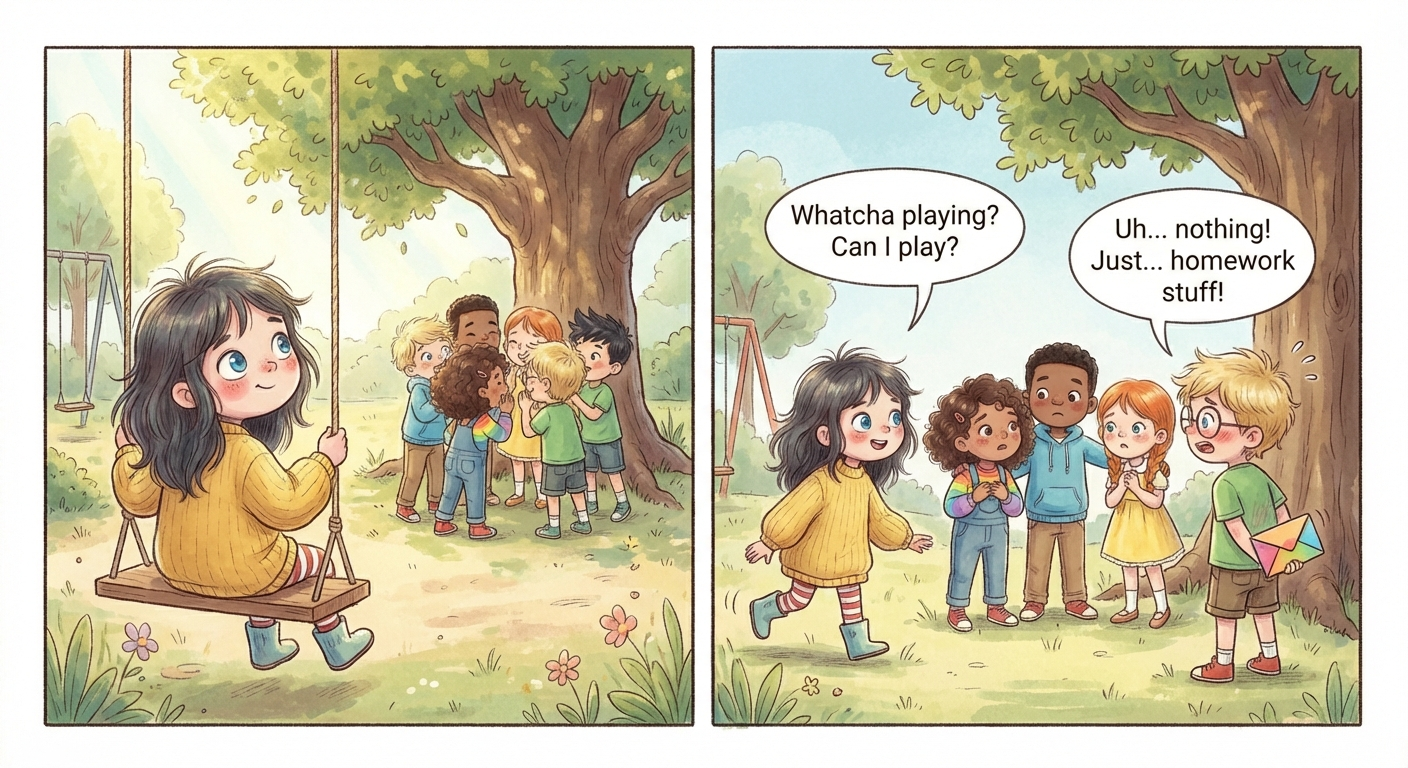
- Panel 1: Labubu on the swing, looking curious and slightly hopeful.
- Caption: It started on a Tuesday. The whispering.
- Panel 2: Labubu hops off the swing and approaches the group. The group immediately stops talking and looks guilty. Milo hides a colorful envelope behind his back.
- Labubu: “Whatcha playing? Can I play?”
- Milo: “Uh… nothing! Just… homework stuff!” Row 2
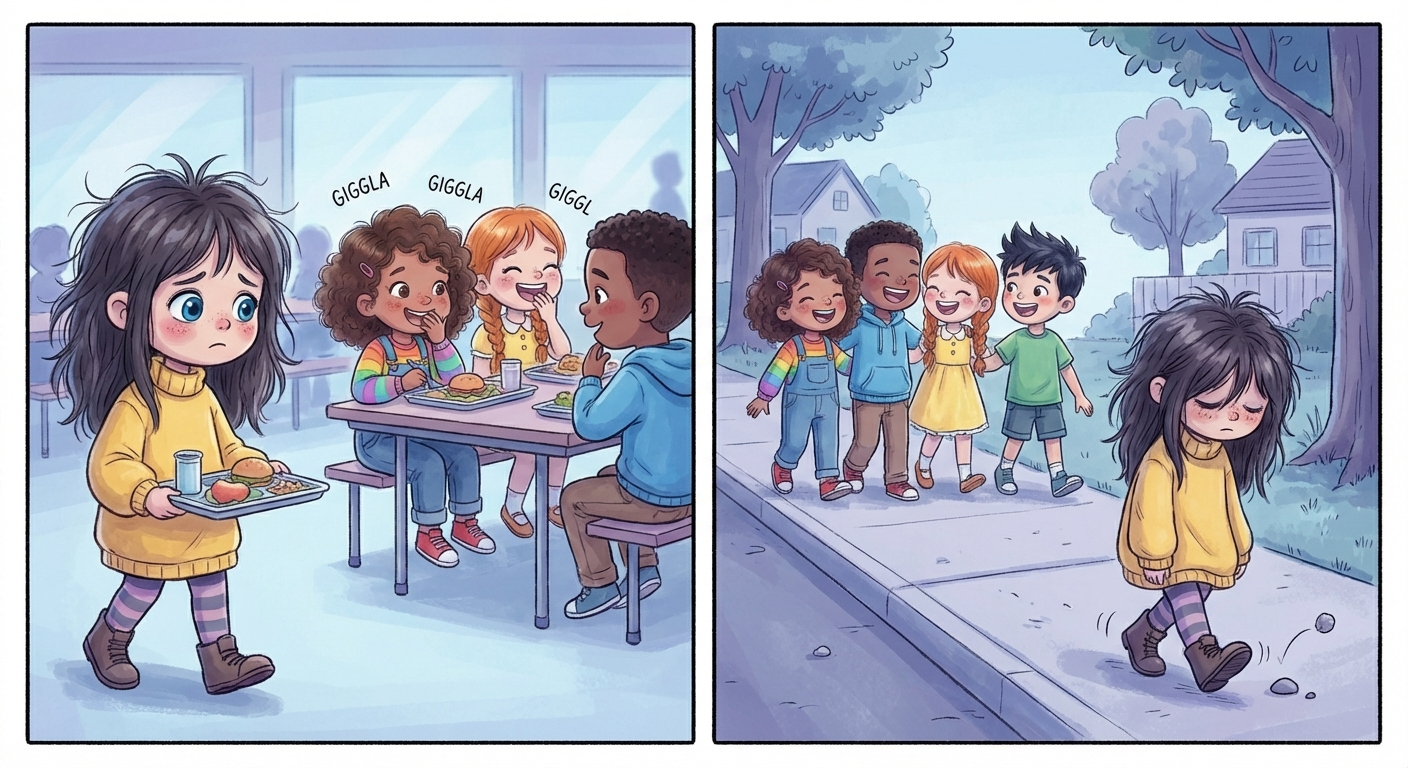
- Panel 1: In the cafeteria, the friends are giggling at a table. Labubu walks up with her tray, but they suddenly get quiet.
- Caption: It happened at lunch.
- Panel 2: Walking home from school. The friends are walking ahead in a group, laughing. Labubu is ten paces behind, head down, kicking a pebble.
- Caption: And all the way home. Row 3
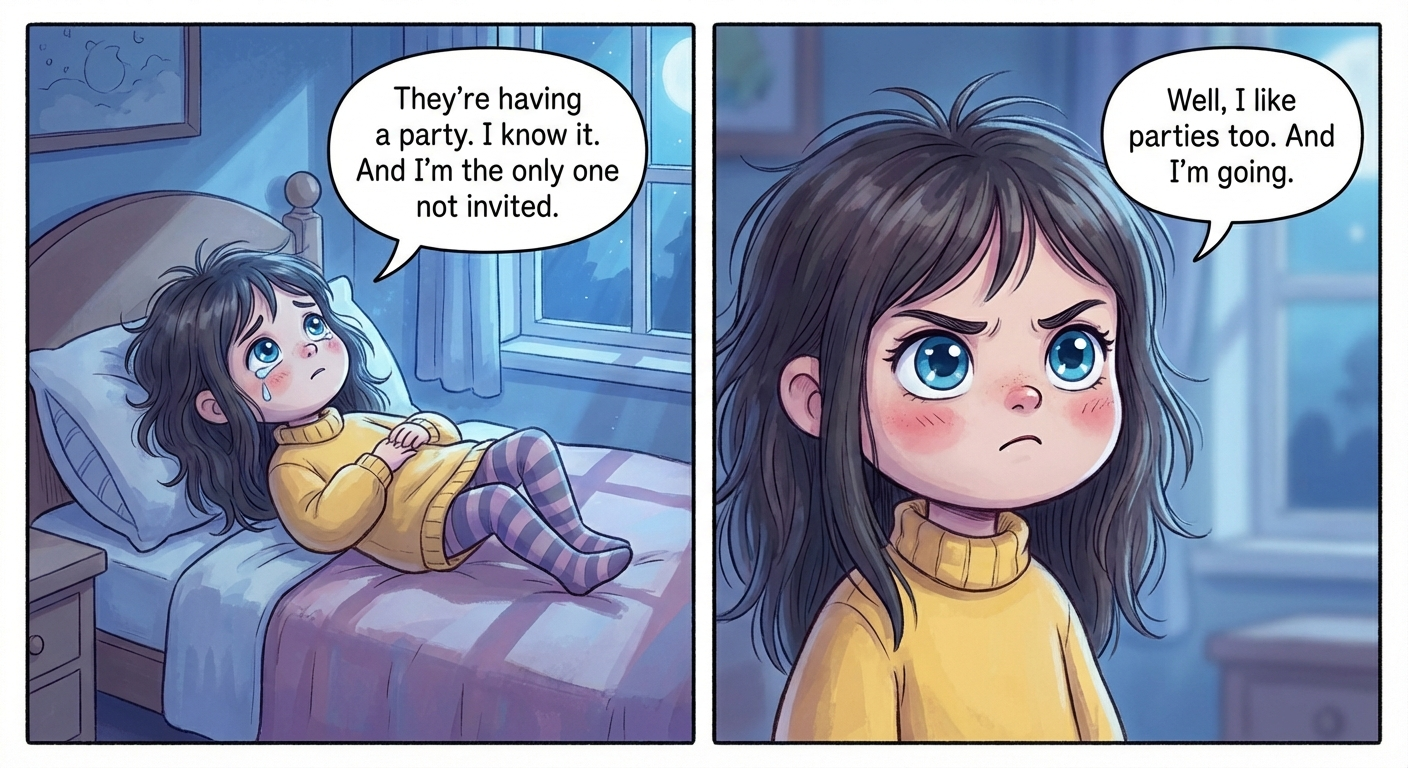
- Panel 1: Labubu is lying on her bed, staring at the ceiling. A tear rolls down her cheek.
- Labubu: “They’re having a party. I know it. And I’m the only one not invited.”
- Panel 2: Close up on Labubu’s face. Her expression shifts from sad to a cute, furrowed-brow frown. Determination sets in.
- Labubu: “Well, I like parties too. And I’m going.”
Page 2
Row 1
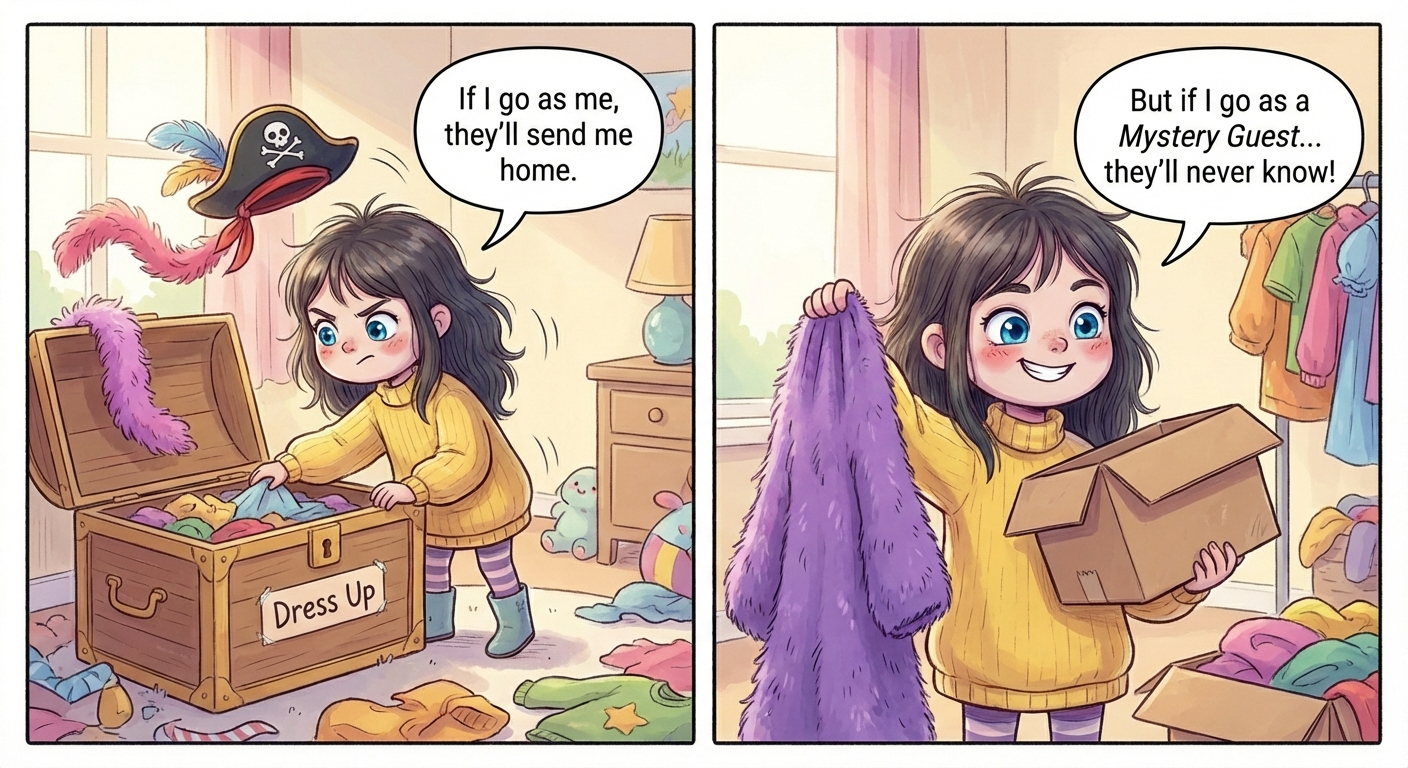
- Labubu: “Well, I like parties too. And I’m going.”
- Panel 1: Labubu tossing a feather boa and a pirate hat over her shoulder.
- Labubu: “If I go as me, they’ll send me home.”
- Panel 2: She holds up a fuzzy purple fabric and a cardboard box.
- Labubu: “But if I go as a Mystery Guest… they’ll never know!” Row 2
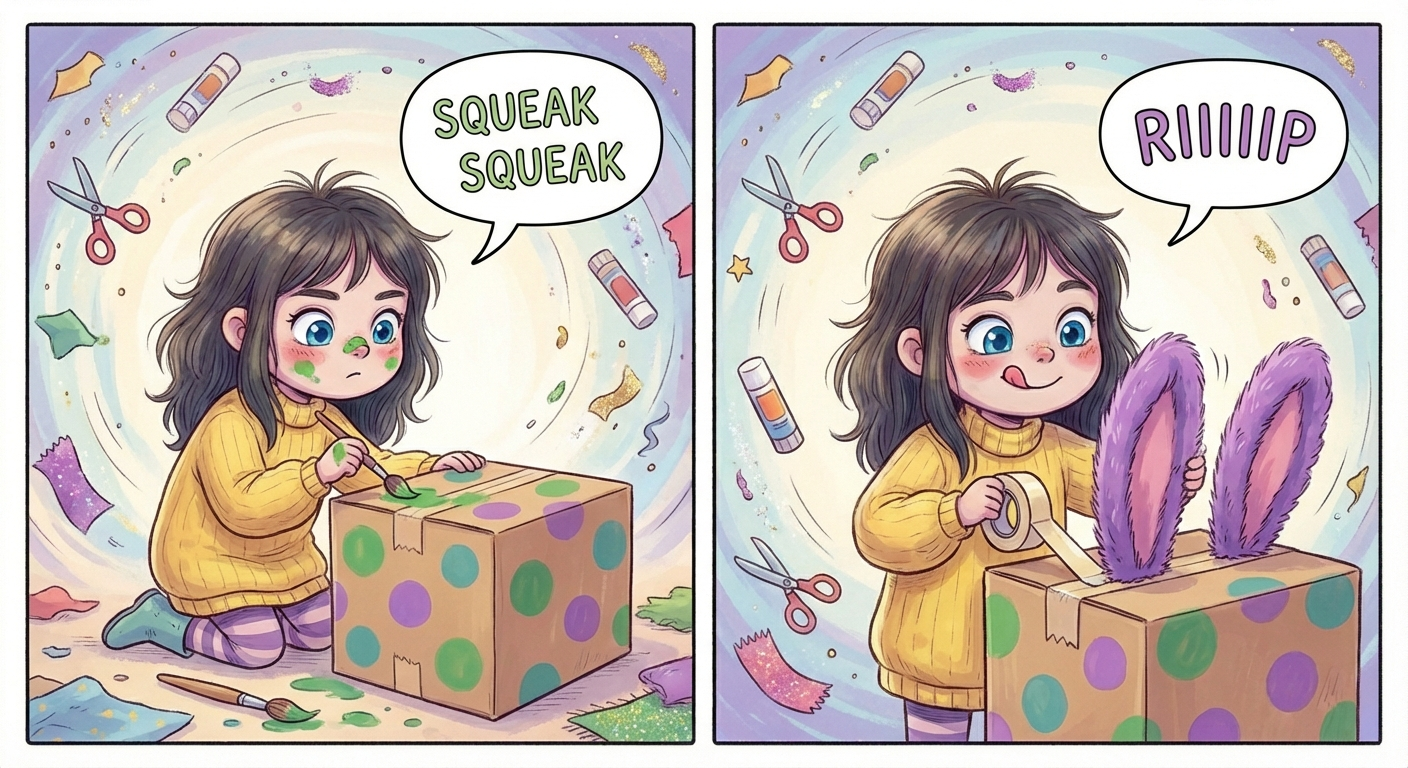
- Panel 1: Labubu painting a cardboard box with green and purple polka dots. She has paint on her nose. (SFX: SQUEAK SQUEAK - Marker sounds)
- Panel 2: She is taping fuzzy ears onto the box. (SFX: RIIIIIP - Tape sound) Row 3
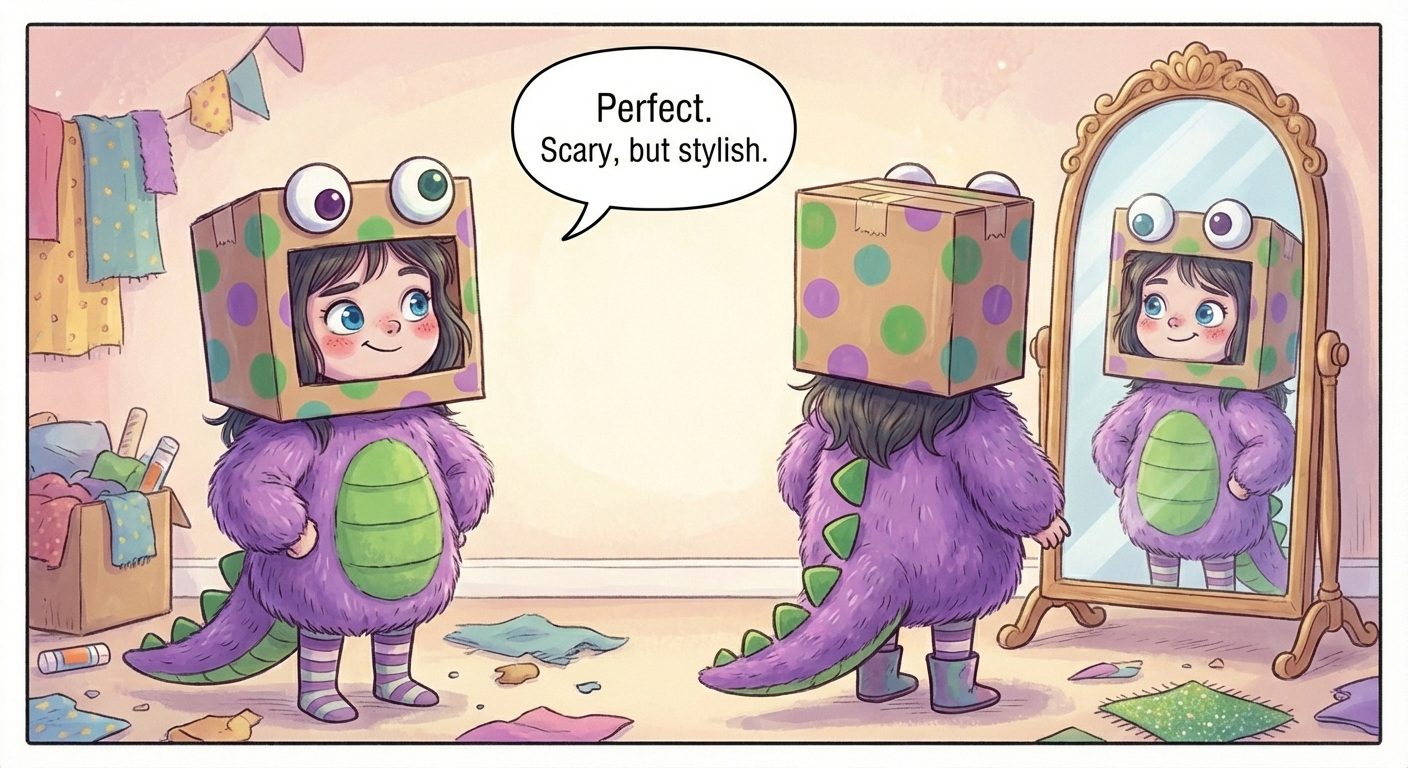
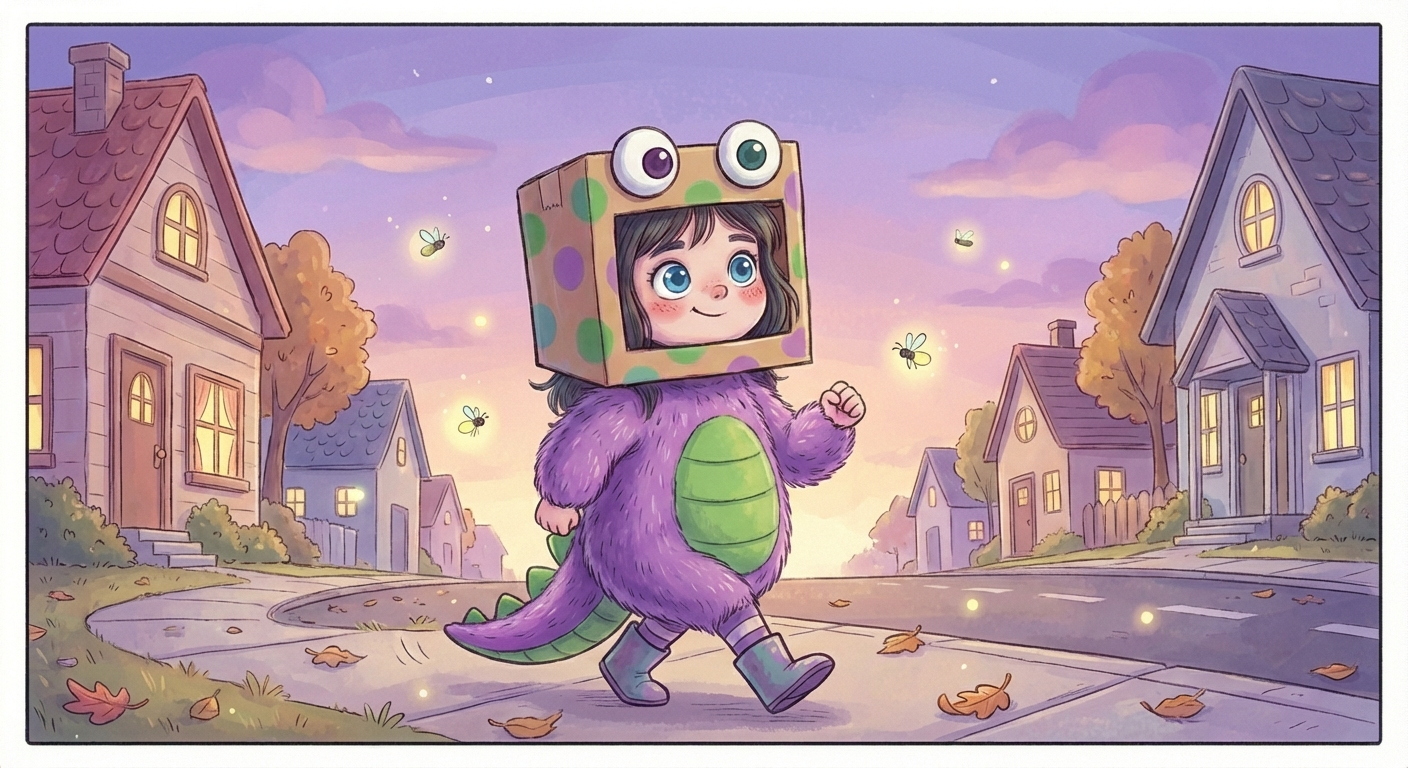
- Panel 1: Labubu stands in front of a mirror. She is wearing a homemade ‘Swamp Monster’ costume. It’s a boxy head with mismatched eyes and a fuzzy purple body suit. It is clearly homemade and adorable.
- Labubu: “Perfect. Scary, but stylish.” Row 4
- Panel 1: Labubu (in costume) marching down the sidewalk. Her blue eyes are visible through the eyeholes of the mask.
- Caption: Operation Party Crash is a go.
Page 3
Row 1
- Caption: Operation Party Crash is a go.
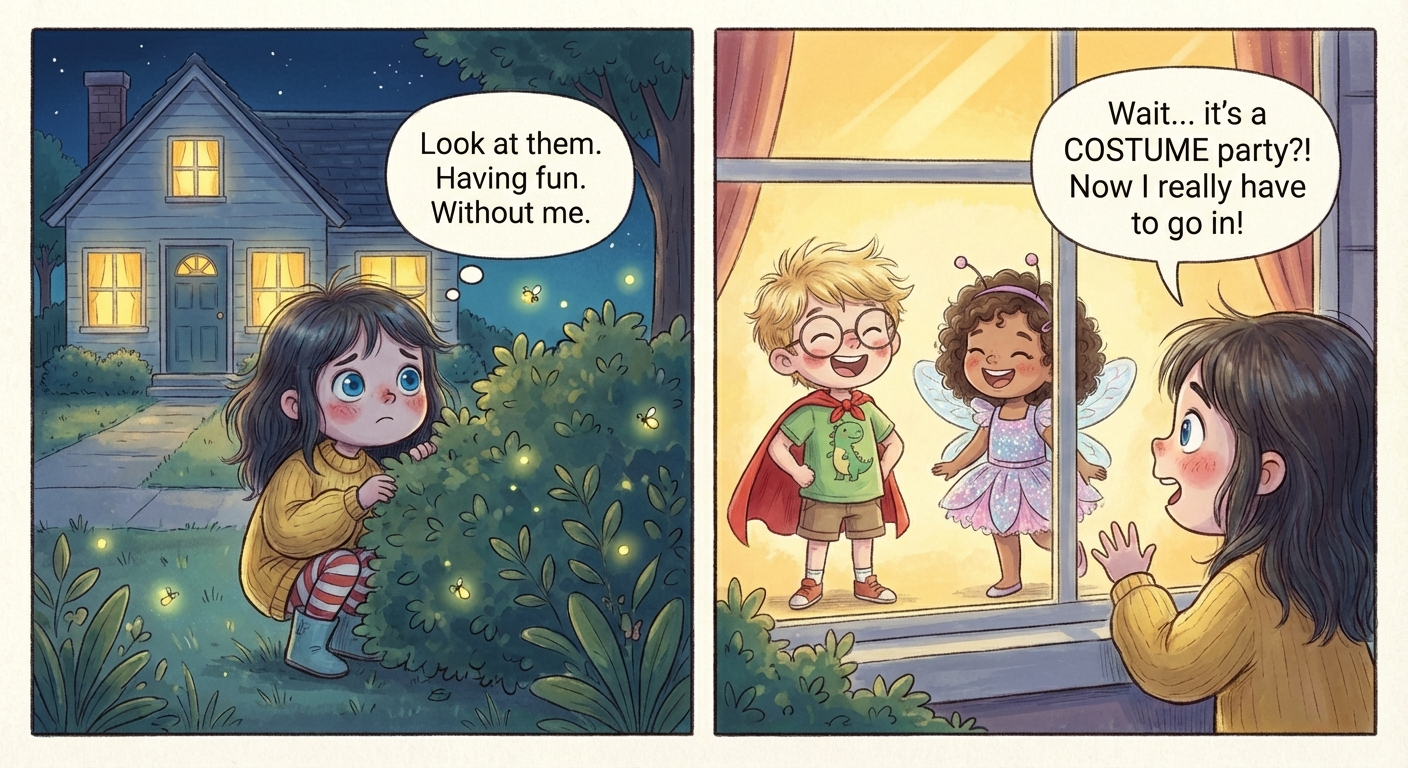
- Panel 1: Labubu hiding behind a bush in the front yard, looking at the house.
- Labubu: “Look at them. Having fun. Without me.”
- Panel 2: Through the window, she sees Milo wearing a superhero cape. Another friend is dressed as a fairy.
- Labubu: “Wait… it’s a COSTUME party?! Now I really have to go in!” Row 2
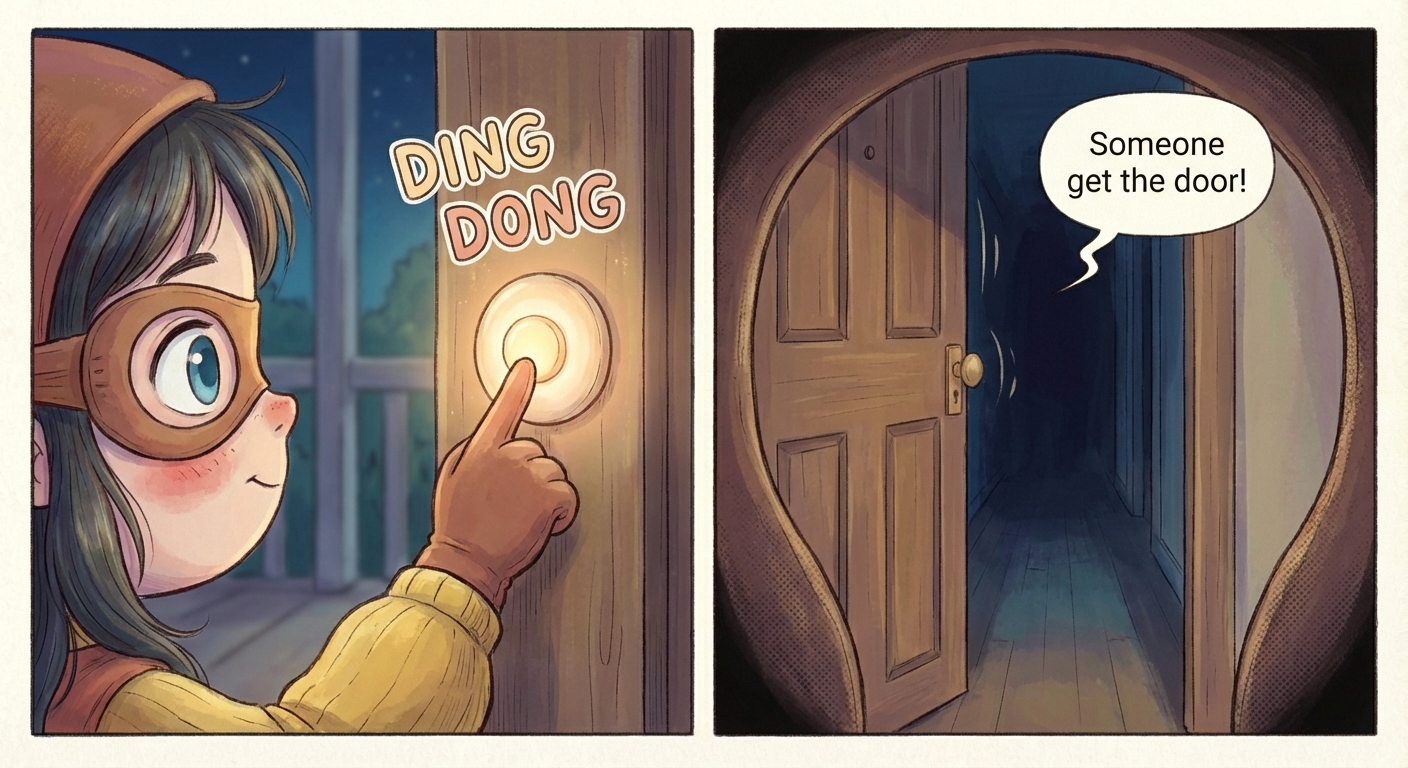
- Panel 1: Labubu’s gloved hand reaching for the doorbell. The doorbell glows softly. (SFX: DING DONG)
- Panel 2: The door creaks open slightly. It’s dark inside the hallway.
- Voice: “Someone get the door!” Row 3
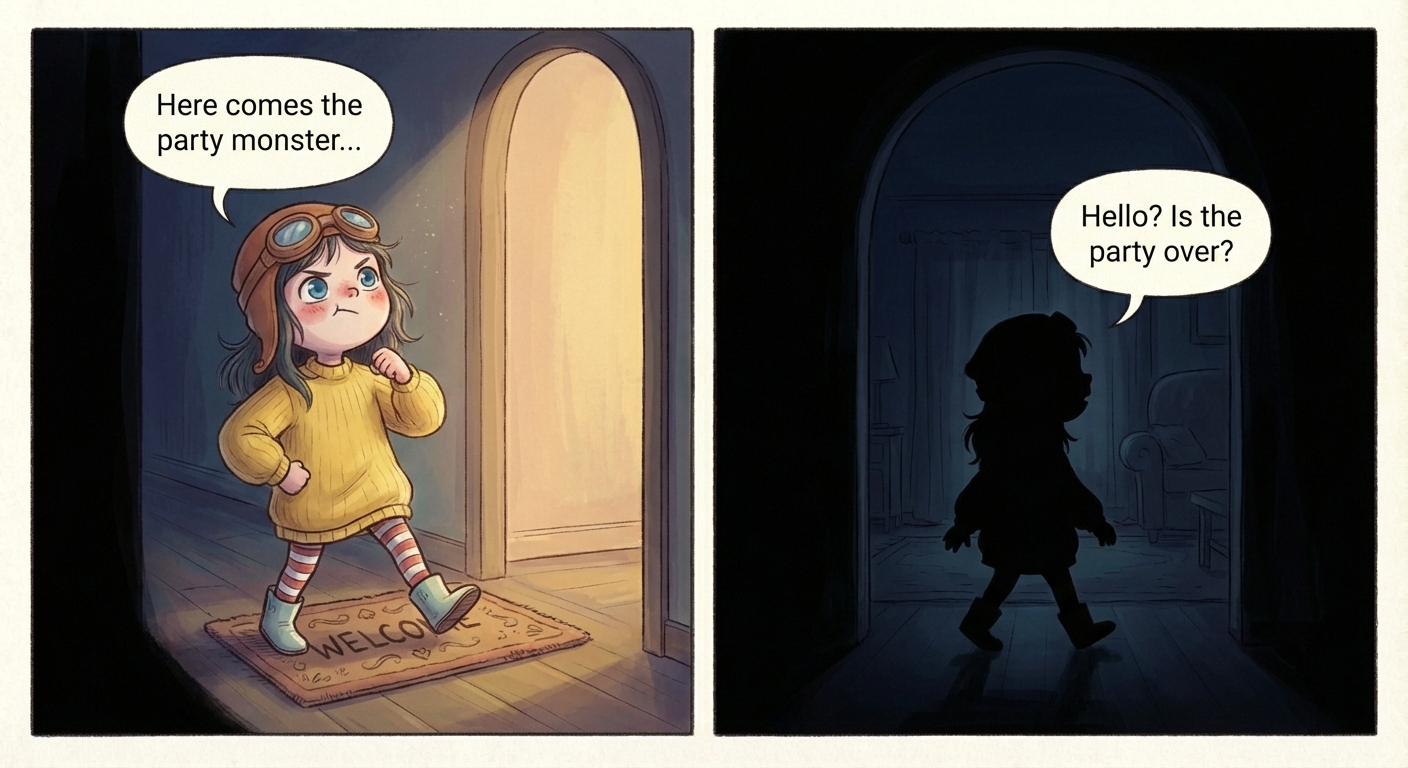
- Panel 1: Labubu steps onto the welcome mat. She puffs out her chest to look brave.
- Labubu: “Here comes the party monster…”
- Panel 2: She walks through the archway into the main living room. The room is pitch black.
- Labubu: “Hello? Is the party over?”
Page 4
Row 1
- Labubu: “Hello? Is the party over?”
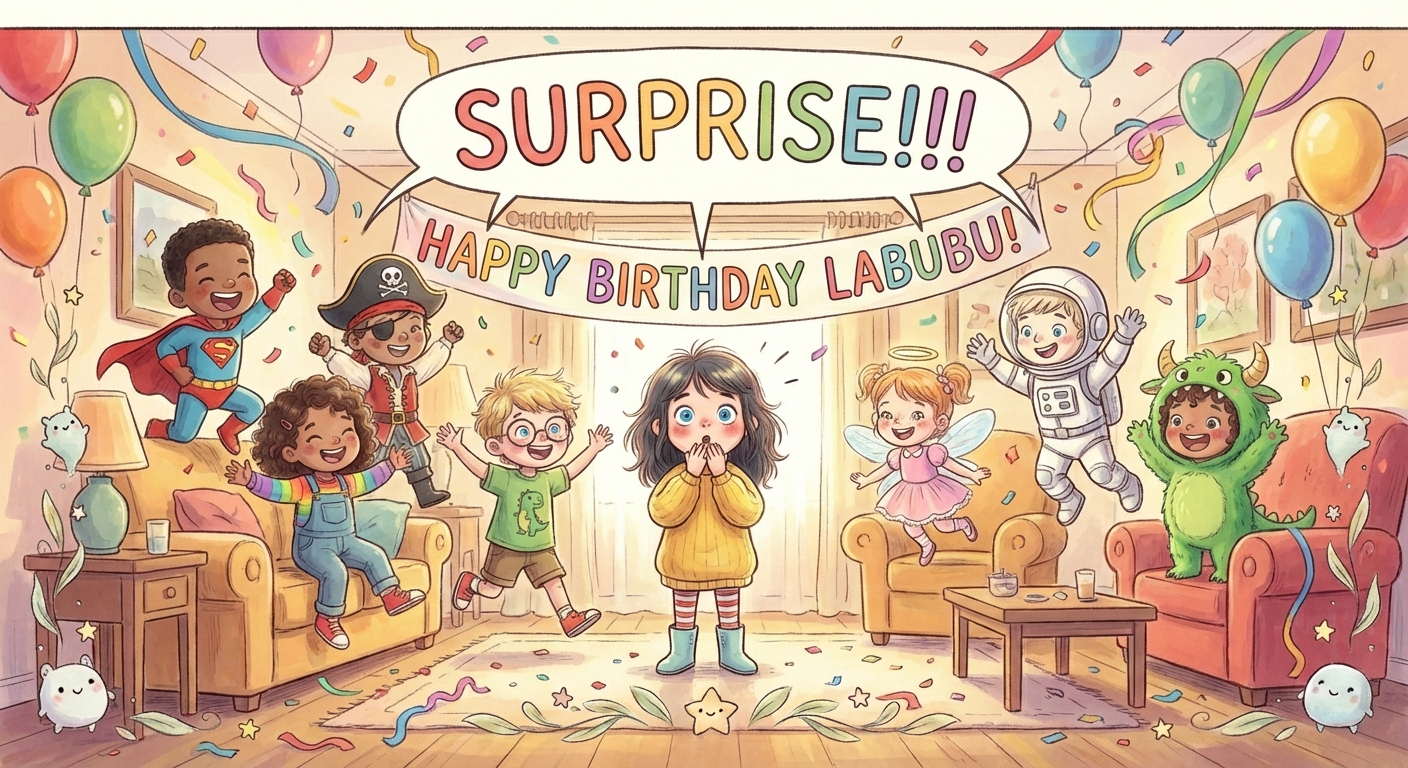
- Panel 1: The lights flip on. Streamers and confetti explode from the sides. Milo and all the friends jump out from behind sofas and tables. They are all in costumes. A banner hangs across the room: HAPPY BIRTHDAY LABUBU!
- All Friends: “SURPRISE!!!” Row 2
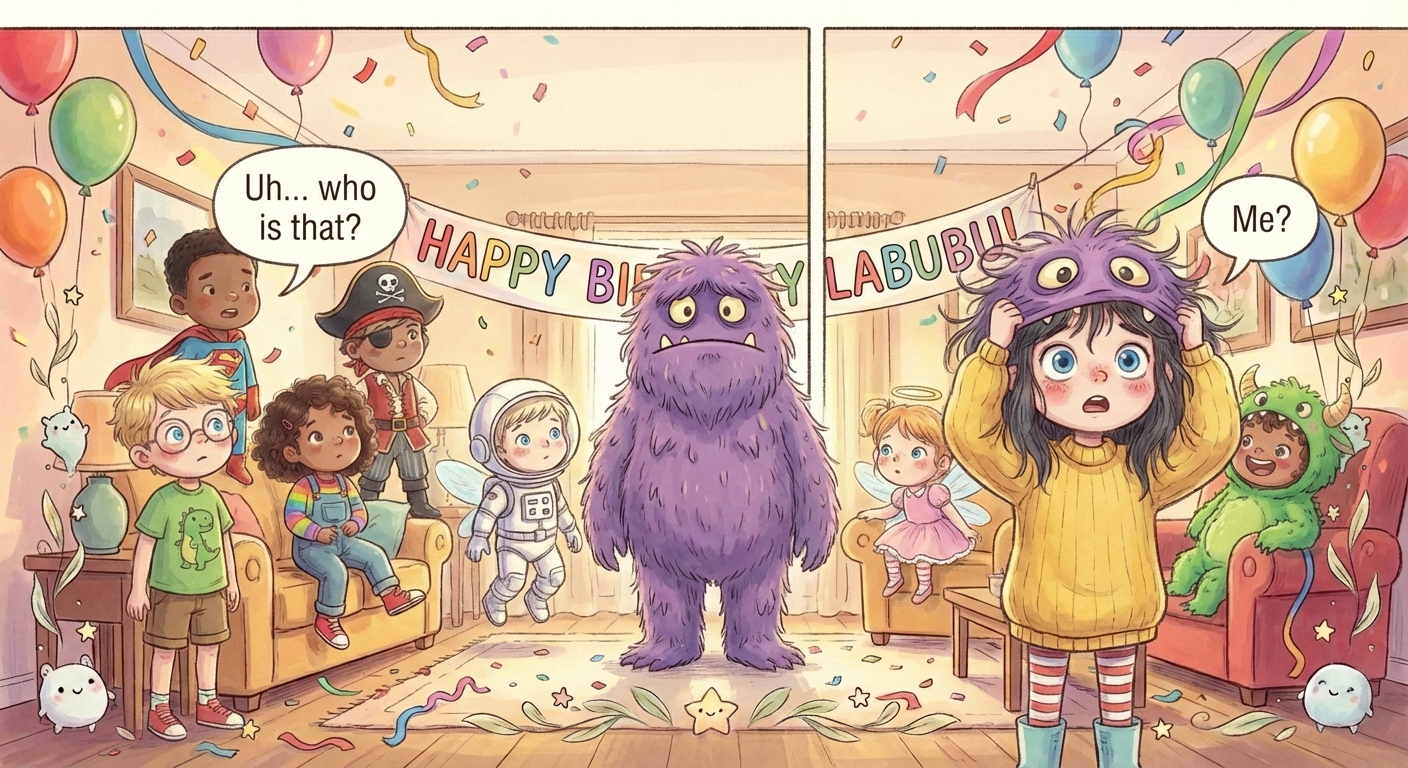
- Panel 1: The friends stop cheering and look confused at the purple swamp monster standing in the doorway.
- Milo: “Uh… who is that?”
- Panel 2: Labubu pulls the boxy mask off her head. Her dark hair is messy, and her blue eyes are wide with shock.
- Labubu: “Me?” Row 3
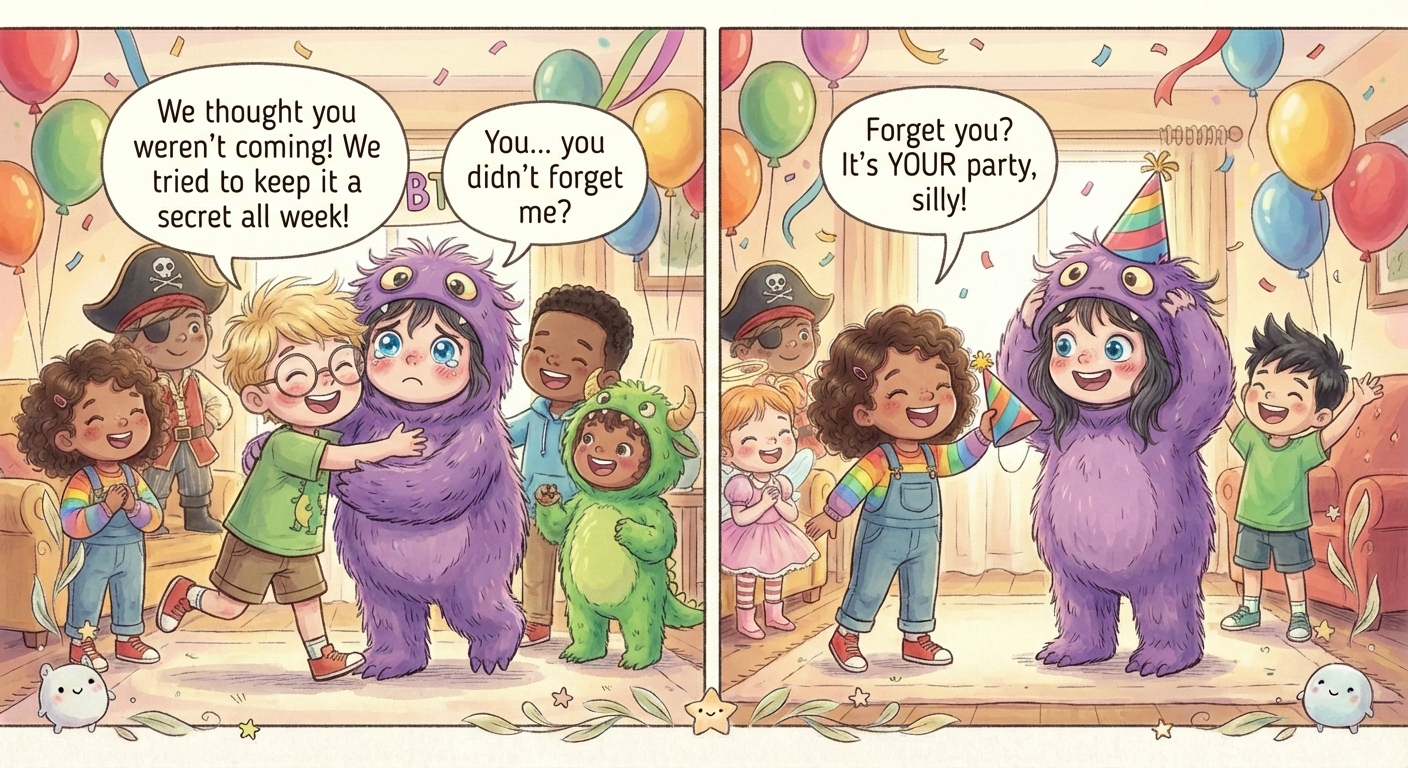
- Panel 1: Milo runs over and hugs Labubu. The other friends crowd around.
- Milo: “We thought you weren’t coming! We tried to keep it a secret all week!”
- Labubu: “You… you didn’t forget me?”
- Panel 2: A friend hands Labubu a party hat to put on top of her monster costume.
- Friend: “Forget you? It’s YOUR party, silly!” Row 4
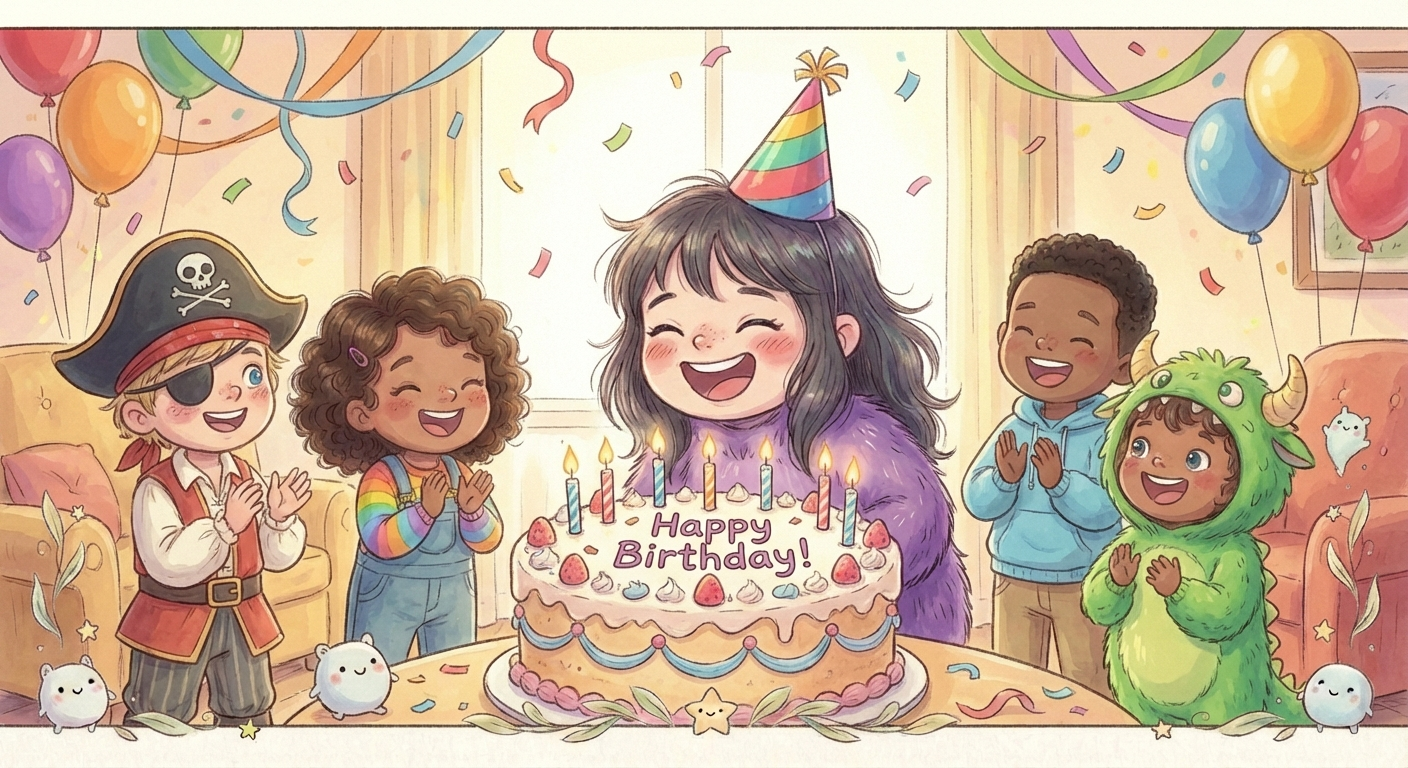
- Panel 1: Labubu is laughing, wearing her monster suit body but with her face visible and a party hat on. She is blowing out candles on a cake. (Text on cake: Happy Birthday!)
- Caption: Best. Party. Crash. Ever.
Character: Labubu
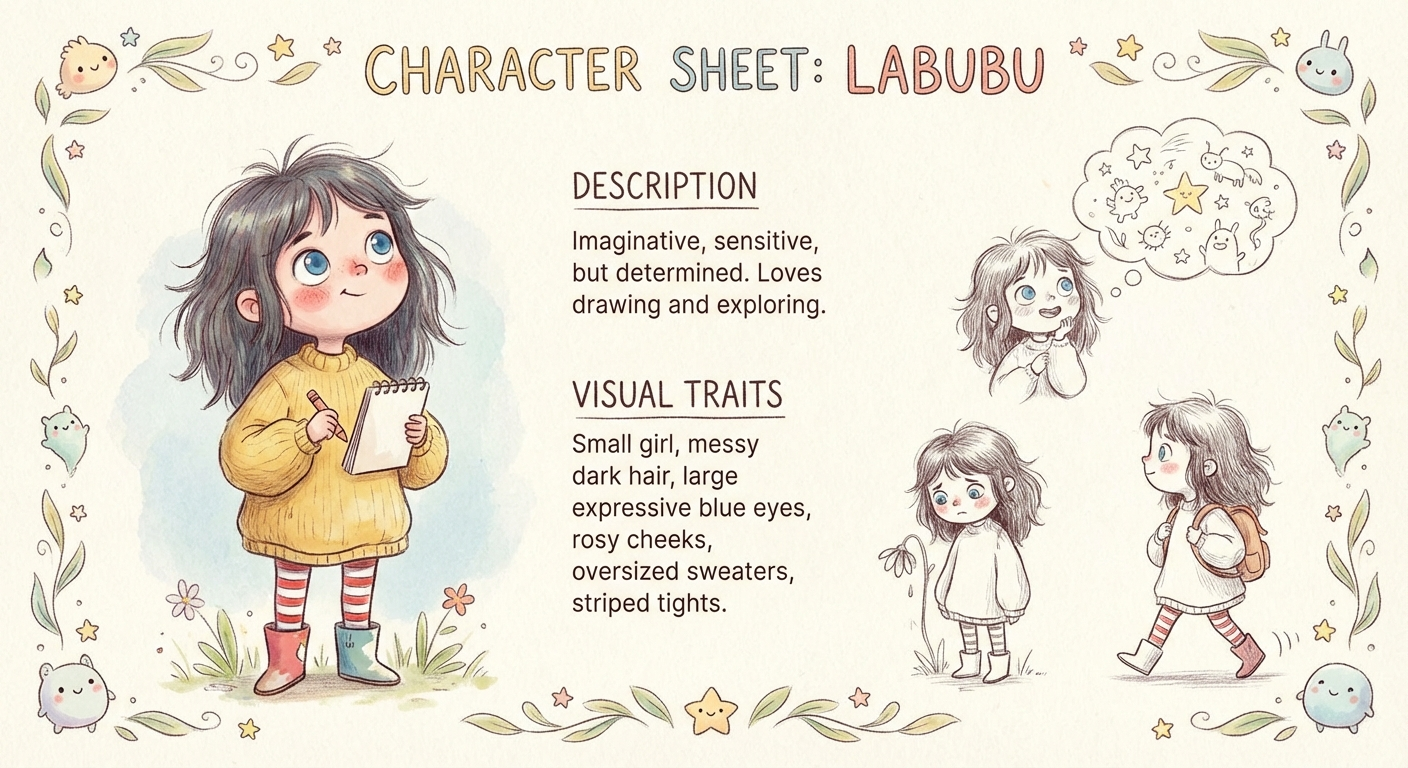
Imaginative, sensitive, but determined.
Character: Milo
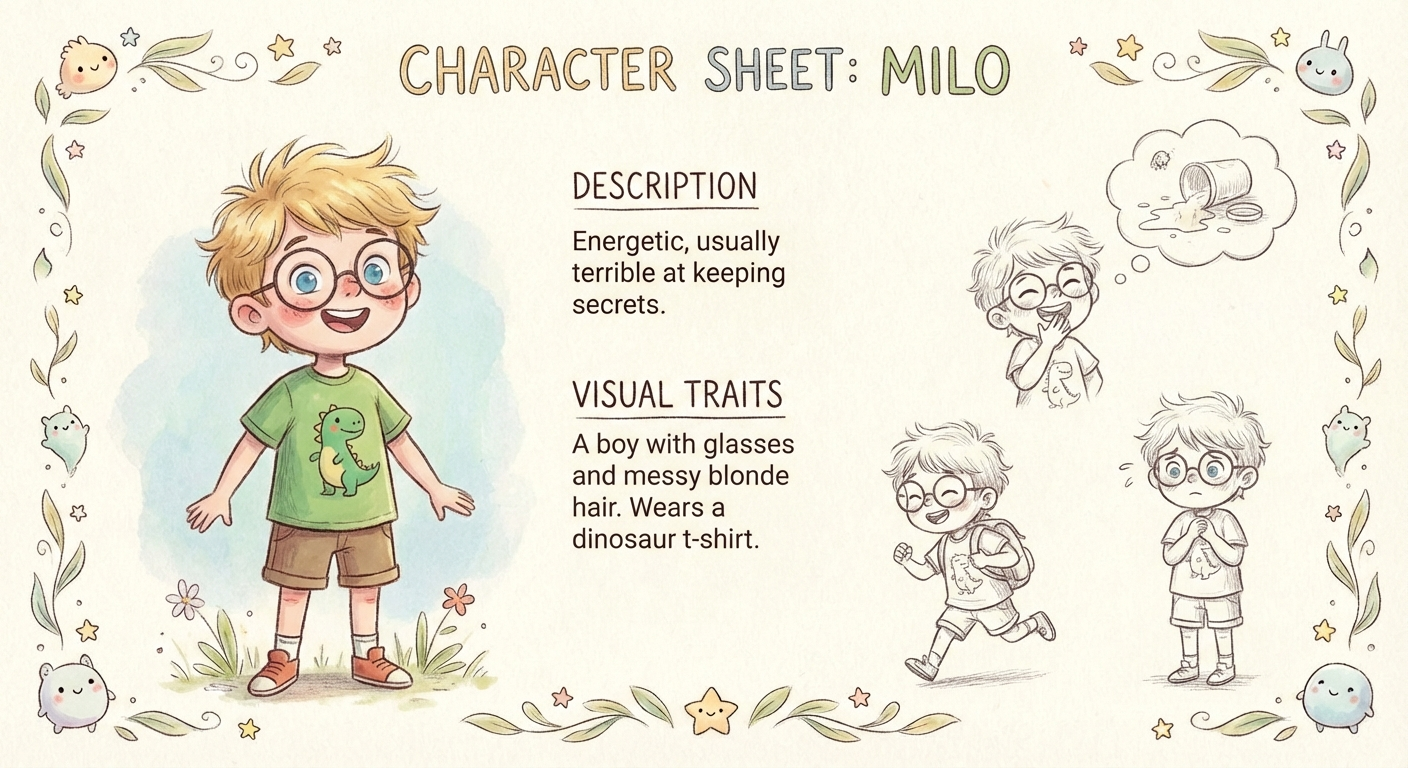
Energetic, usually terrible at keeping secrets.
Character: The Friends
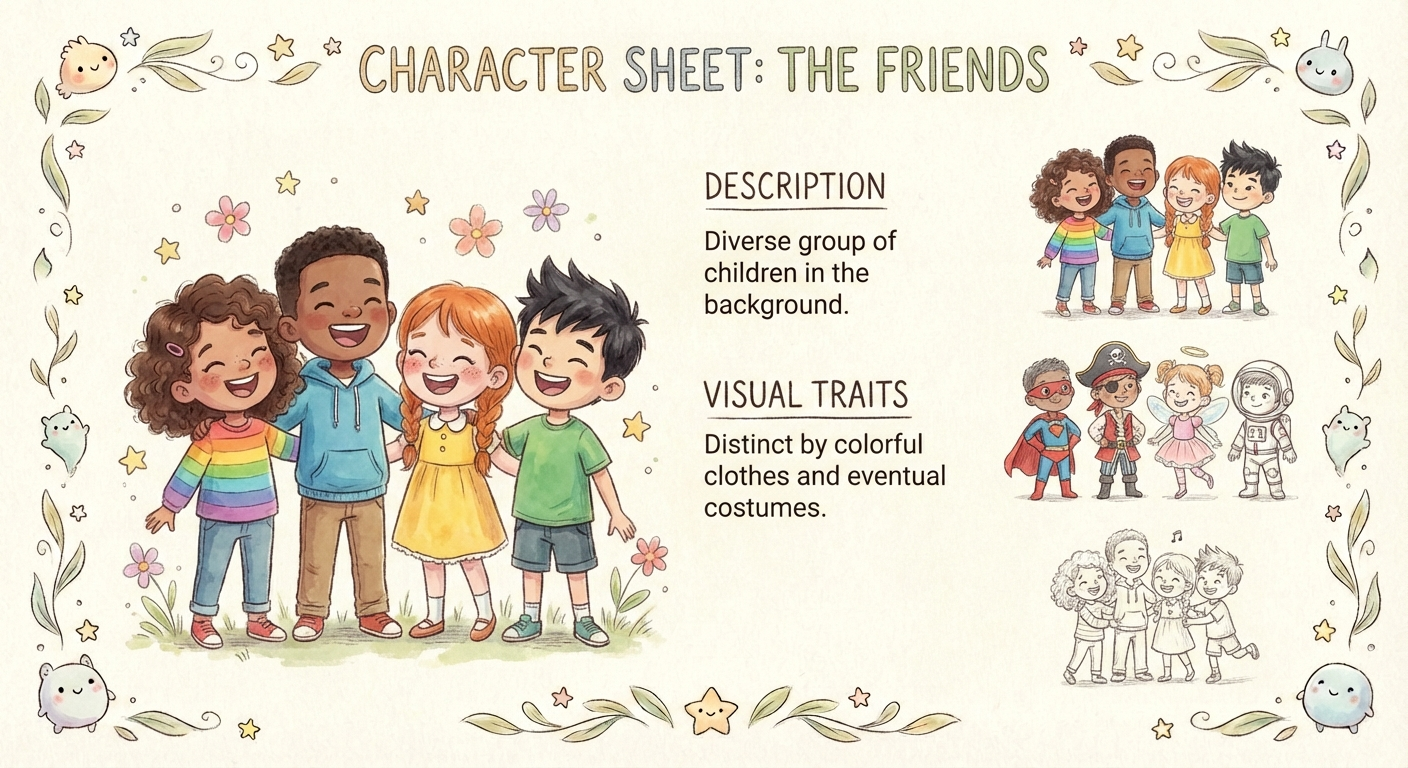
Diverse group of children in the background.
Character: Friend
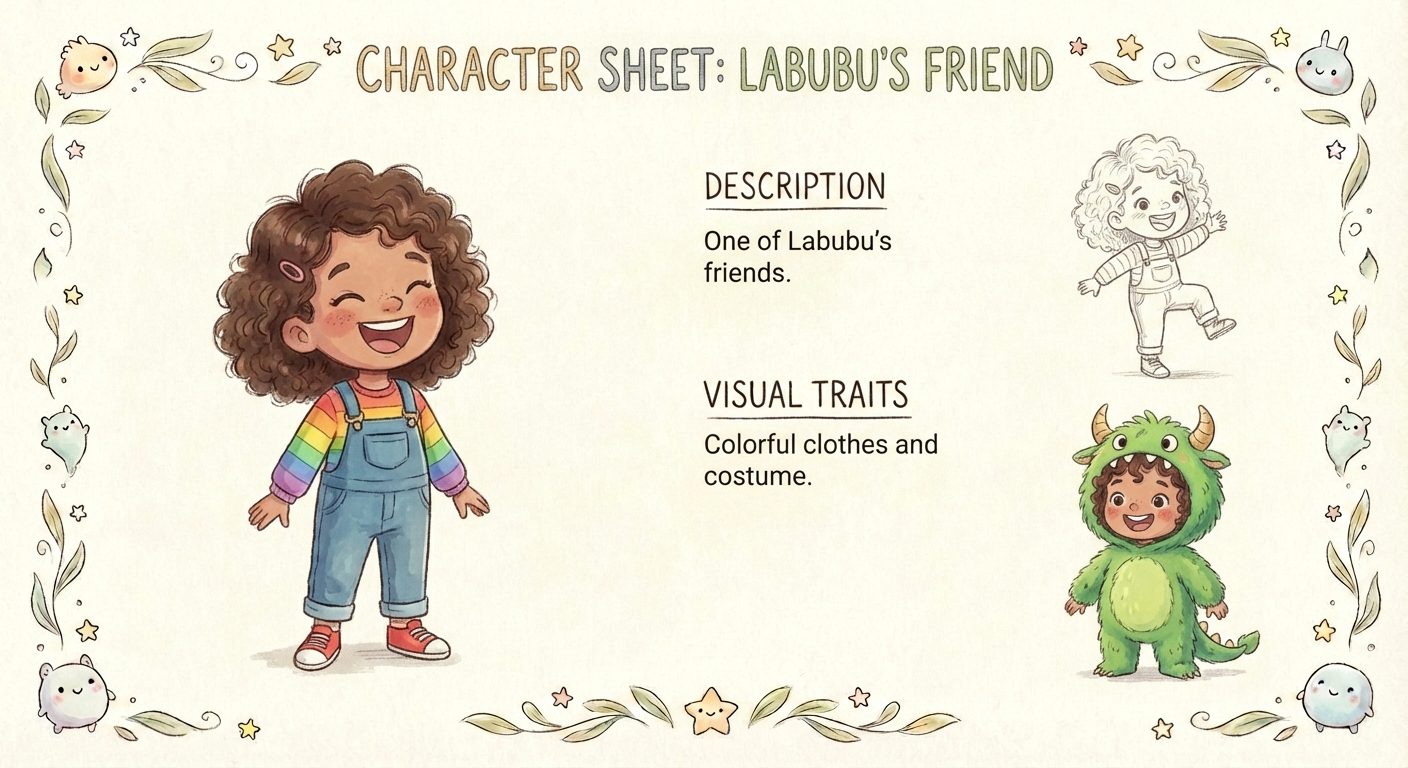
One of Labubu’s friends.
Character: Voice
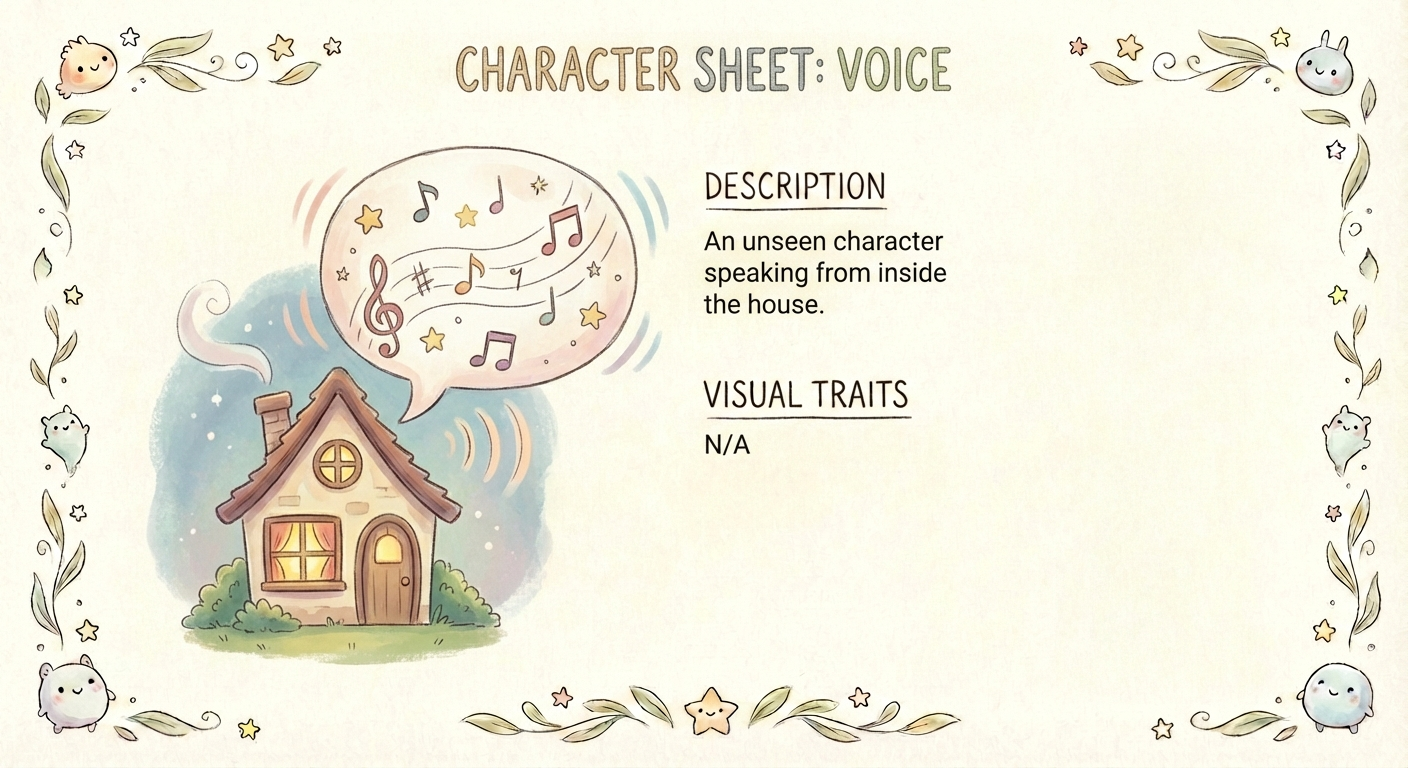
An unseen character speaking from inside the house.
Character: All Friends
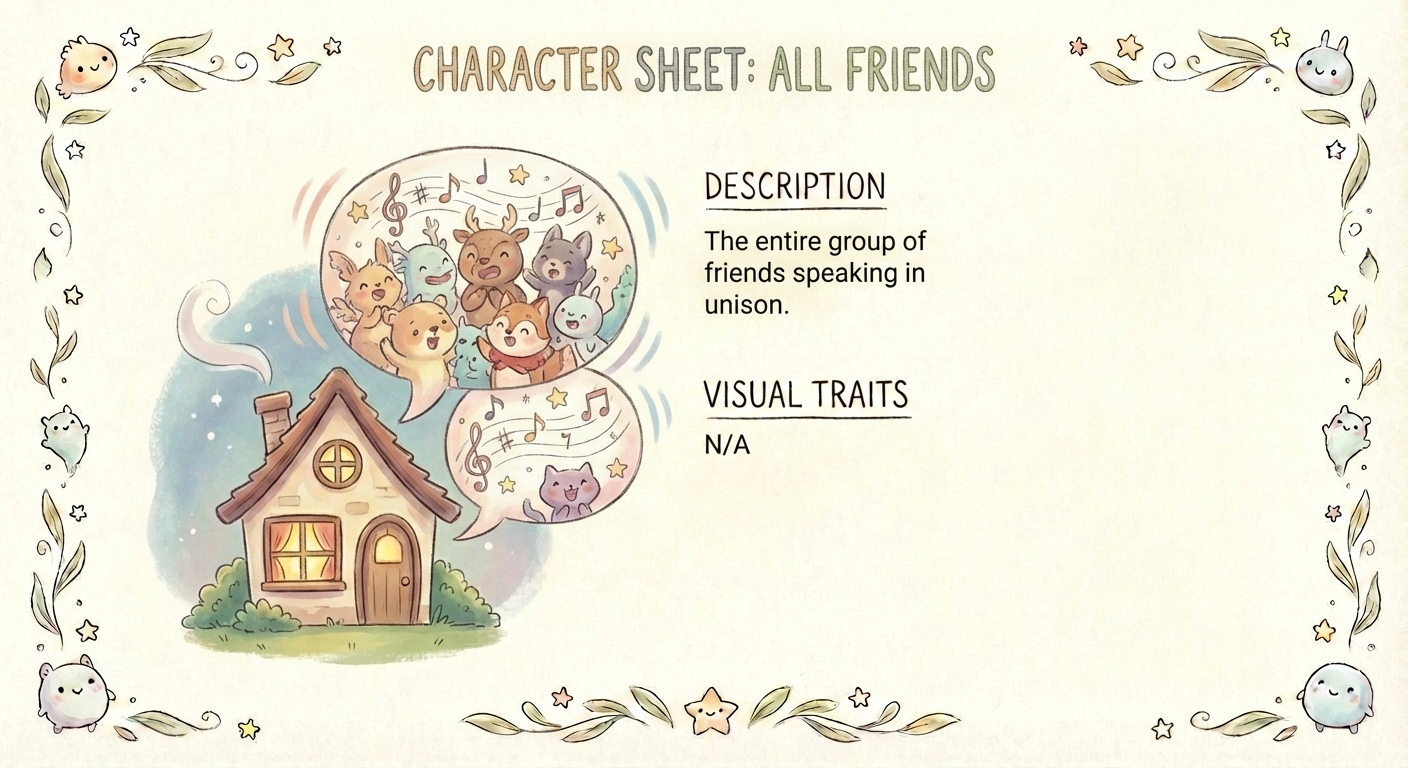
The entire group of friends speaking in unison.
Game Theory Analysis
Started: 2026-02-08 16:53:18
Game Theory Analysis
Scenario: The Surprise Party Information Game: Labubu vs. The Friends. Labubu perceives exclusion and must decide how to react to the secrecy, while The Friends must maintain the secret to maximize the surprise payoff without alienating Labubu. Players: Labubu, The Friends
Game Type: sequential
Game Structure Analysis
Full Analysis</summary>
Based on the provided comic script and scenario, here is the game theory analysis of The Surprise Party Information Game.
1. Identify the Game Structure
- Game Type: This is a Dynamic (Sequential) Game with Incomplete Information.
- It is Non-Cooperative in the game-theoretic sense, not because the players are enemies, but because they cannot form binding agreements or communicate openly due to the constraint of the “Secret.”
- It is Non-Zero-Sum: It is possible for both parties to win (a successful surprise party) or both to lose (Labubu stays home sad, and the Friends throw a party with no guest of honor).
- Duration: It is a One-Shot Game. The event (the birthday) happens once, and the payoffs are realized immediately upon the resolution of the party.
- Information: There is Imperfect and Asymmetric Information.
- The Friends possess Perfect Information regarding the state of the world (they know it is a birthday party for Labubu).
- Labubu possesses Imperfect Information. She observes the Friends’ actions (whispering, hiding) but misinterprets the signal. She believes the state of the world is “Exclusion,” whereas the true state is “Preparation.”
- Asymmetries: The primary asymmetry is informational. The Friends hold the “Secret” (the information advantage), while Labubu operates under uncertainty.
2. Define Strategy Spaces
- The Friends (Player F):
- $S_F = { \text{Maintain Secrecy}, \text{Reveal Secret} }$
- Constraint: To maximize the “Surprise” payoff, they are constrained to Maintain Secrecy unless the risk of Labubu not attending becomes too high.
- Labubu (Player L):
- $S_L = { \text{Sulk/Stay Home}, \text{Confront}, \text{Crash/Investigate} }$
- Strategy Nuance: The Crash strategy involves a sub-strategy of Disguise. Labubu calculates that “Crashing as herself” leads to rejection (based on her false belief of exclusion), whereas “Crashing as a Mystery Guest” bypasses the perceived barrier to entry.
3. Characterize Payoffs
The objectives are aligned in the long run (happiness), but conflicted in the short run (information flow).
- The Friends’ Objectives:
- Ensure Labubu attends the party.
- Maximize the “Surprise Factor” (requires Secrecy).
- Labubu’s Objectives:
- Maximize Social Inclusion (attend the party).
- Minimize Humiliation (avoid being rejected).
Payoff Matrix (Conceptual):
Scenario
Friends’ Strategy
Labubu’s Strategy
Outcome Description
Payoff (Friends, Labubu)
The Tragedy
Maintain Secrecy
Sulk/Stay Home
Labubu misses her own party; Friends have no guest.
(Loss, Loss)
The Spoiler
Reveal Secret
Confront
Labubu attends, but the surprise is ruined.
(Low, Medium)
The Rejection
Maintain Secrecy
Crash (No Disguise)
Perceived Risk: Labubu thinks she will be sent home.
(High, Low) Actual, (Low, Low) Perceived
The Comic Solution
Maintain Secrecy
Crash (Disguise)
Labubu attends via stealth; Surprise is preserved.
(Win, Win)
- Transferability: Payoffs are non-transferable utility (emotional satisfaction, joy, surprise).
4. Identify Key Features
- Information Asymmetry & Signaling:
- The Friends generate signals (whispering, hiding envelopes).
- Signal Jamming: The Friends intend to hide the type of party (Birthday vs. Exclusion). However, their effort to hide the surprise is indistinguishable to Labubu from the effort to hide social exclusion.
-
Labubu updates her beliefs based on these signals: $P(\text{Exclusion}
\text{Whispering}) > P(\text{Surprise}
\text{Whispering})$.
- The “Disguise” as a Dominant Strategy:
- Labubu believes that if she chooses Crash (No Disguise), the Friends will enforce exclusion.
- She believes Sulk yields zero utility.
- Therefore, Crash (Disguise) is her rational response to the information asymmetry. It hedges her bet: if it is an exclusion party, she sneaks in; if it is a costume party (as she discovers on Page 3), she fits in.
- Timing of Moves:
- Nature: Determines it is Labubu’s birthday.
- Friends: Commit to Maintain Secrecy.
- Labubu: Observes secrecy, interprets it as exclusion.
- Labubu: Commits to Crash/Investigate (with Disguise).
- Resolution: Labubu enters, Friends reveal, Information Asymmetry collapses.
Summary of the Comic Scenario
In the provided script, the game reaches the Pareto Optimal equilibrium (The Comic Solution). The Friends successfully maintain the secret (Strategy: Maintain), and Labubu ensures her attendance despite her false belief by using a disguise (Strategy: Crash). The potential “Tragedy” outcome (Labubu staying home crying) was avoided because Labubu’s “Determination” trait altered her strategy from Sulk to Crash.
</details>
Payoff Matrix
Full Matrix</summary>
Here is the game theory analysis of the “Surprise Party Information Game” based on the provided comic script and scenario.
1. Game Structure Analysis
- Game Type:
- Sequential: The game occurs in steps. The Friends move first by choosing how to handle the information (Hide vs. Reveal). Labubu moves second by observing the behavior (whispering/secrecy) and choosing a reaction.
- Non-Cooperative: The players are not negotiating a binding contract beforehand. The Friends are actively hiding information, preventing cooperation on the planning phase.
- Imperfect Information (Asymmetric): This is the defining feature. The Friends know the “State of the World” (It is a surprise party). Labubu does not know the state; she must infer it from signals. She perceives the signal “Secrecy” and must determine if it means “Exclusion” or “Surprise.”
- Non-Zero-Sum: It is possible for both players to win (a successful surprise party) or both to lose (Labubu stays home sad, Friends have a party with no guest of honor).
- Duration:
- One-Shot Game: The specific event (the birthday) happens once.
2. Strategy Spaces
Player 1: The Friends
- Maintain Secrecy (S): Hide the party preparations, whisper, and act evasive to maximize the “surprise” element.
- Reveal Secret (R): Tell Labubu about the party to ensure she attends and doesn’t feel bad, sacrificing the “surprise” element.
Player 2: Labubu
- Sulk/Stay Home (H): Interpret secrecy as exclusion. Isolate self to protect ego.
- Confront (C): Ask directly, “Are you excluding me?” forcing a revelation.
- Crash/Investigate (I): Interpret secrecy as a challenge. Attend the event uninvited/in disguise to gather information or disrupt the perceived exclusion.
3. Characterizing Payoffs
- The Friends’ Objectives:
- Primary: Ensure Labubu attends (The party is for her).
- Secondary: Maximize the “Surprise” factor (High reward).
- Risk: If Labubu doesn’t show up, the payoff is negative (wasted effort, sad friend).
- Labubu’s Objectives:
- Primary: Social Inclusion (Being at the party).
- Secondary: Emotional Safety (Avoiding the humiliation of being excluded).
- Tertiary: Fun/Adventure (The thrill of the “Crash”).
4. Payoff Matrix (Normal Form Representation)
While the game is sequential, we can represent the strategic interaction in a matrix to analyze the equilibrium.
Payoff Key: (Friends’ Payoff, Labubu’s Payoff)
- Scale: -10 (Disaster) to +10 (Perfect Outcome)
Friends \ Labubu
Stay Home (Sulk)
Confront (Ask)
Crash (Investigate)
Maintain Secrecy
(-10, -10)
(0, 5)
(10, 10)
Reveal Secret
(5, 8)
(5, 8)
(5, 8)
Detailed Outcome Analysis
1. Strategy Profile: {Maintain Secrecy, Stay Home}
- Outcome: The Friends wait in the dark for a guest who never comes. Labubu sits at home crying.
- Payoff (-10, -10): This is the “Tragedy of Miscommunication.” The Friends fail their primary objective. Labubu suffers maximum emotional distress.
2. Strategy Profile: {Maintain Secrecy, Confront}
- Outcome: Labubu asks “Why are you whispering?” The Friends are forced to explain, “It’s your birthday!”
- Payoff (0, 5): The surprise is ruined (Friends get 0 utility for the surprise factor). Labubu is relieved and attends (5), but feels slight embarrassment for doubting them.
3. Strategy Profile: {Maintain Secrecy, Crash} (The Comic Outcome)
- Outcome: Labubu arrives in disguise. The Friends yell “Surprise!” The disguise adds a layer of humor and memorable fun.
- Payoff (10, 10):
- Friends: They get the surprise and the guest. The “Monster” costume makes the party legendary.
- Labubu: She gets the inclusion, the relief of the surprise, plus the satisfaction of her “Operation Party Crash” being a success.
- Note: This is the Pareto Optimal outcome.
4. Strategy Profile: {Reveal Secret, Any Action}
- Outcome: Friends say, “Hey, come over at 5 for your birthday.” Labubu goes.
- Payoff (5, 8): A standard, safe outcome. Labubu is happy (8) because she never felt excluded. Friends are okay (5) but missed out on the excitement of the surprise.
5. Key Features & Strategic Insights
- The Information Gap: The game hinges on Labubu’s Bayesian Belief. When she sees “Whispering,” she assigns a probability ($p$) to two states:
- State A: They hate me ($p < 0.5$ ideally, but high in the comic).
- State B: It’s a surprise ($p > 0.5$).
- Comic Context: Labubu initially believes State A (“They’re having a party… without me”).
- The “Crash” Strategy as a Dominant Hedge:
- If Labubu Sulks, she loses in both states (misses the party if it’s for her; is sad alone if it’s not).
- If Labubu Crashes:
- If Excluded: She disrupts their exclusion and asserts herself (High Agency).
- If Surprise: She attends the party and enhances the fun (High Utility).
- Therefore, Crash/Investigate is a dominant strategy for Labubu compared to Sulking, provided she has the “courage” (cost of entry) to perform the disguise.
- Signaling Risk: The Friends took a high risk. By choosing Maintain Secrecy, they risked the (-10, -10) outcome. They relied on Labubu having a “High Agency” personality type (determined/imaginative) rather than a “Low Agency” type (passive/depressive). Because Labubu is “Imaginative, sensitive, but determined,” the Friends’ risky strategy paid off.
</details>
Nash Equilibria Analysis
Full Analysis</summary>
Here is the strategic analysis of “The Surprise Party Information Game” based on the provided comic script context.
1. Game Structure Analysis
- Game Type:
- Non-Cooperative: While the players have aligned interests (both want a fun party), they cannot communicate or form binding agreements due to the constraint of “Secrecy” required for a surprise.
- Non-Zero-Sum: This is a coordination game. It is possible for both players to win (Great Party) or both to lose (Sad Labubu, Ruined Party).
- Sequential with Imperfect Information: The Friends move first by choosing to hide the party planning. Labubu moves second, observing the “secrecy” (which looks like exclusion) but not knowing the true “state of the world” (whether it is a Party or actual Exclusion).
- Information Asymmetry:
- The Friends possess Perfect Information: They know they are planning a party.
- Labubu possesses Imperfect Information: She observes signals (whispering, silence) that are ambiguous. She must guess if the Friends are “Party Planners” or “Excluders.”
- Timing:
- Nature/Friends: Establish the event (Birthday Party).
- Friends: Choose Information Strategy (Reveal vs. Maintain Secrecy).
- Labubu: Observes signal, chooses Reaction Strategy (Stay Home, Confront, Crash).
- Payoffs: Realized upon the party reveal.
2. Strategy Spaces
- The Friends:
- Reveal Secret: Tell Labubu about the party to ensure she comes.
- Maintain Secrecy: Hide the planning to maximize the “Surprise” element.
- Labubu:
- Stay Home (Sulk): Accept the perceived exclusion and isolate.
- Confront (Ask Directly): Demand to know what is happening.
- Crash (Investigate): Use disguise/stealth to enter the event without an invitation.
3. Characterizing Payoffs
We assign utility values based on the emotional outcomes depicted in the script:
- Friends’ Utility: Maximize Surprise + Maximize Labubu’s Presence.
- Labubu’s Utility: Maximize Social Inclusion + Minimize Humiliation.
The Payoff Matrix (Friends, Labubu):
Stay Home
Confront
Crash
Reveal Secret
(0, 5)
(5, 8)
(2, 6)
Maintain Secrecy
(-10, -10)
(2, 5)
(10, 10)
- Rationale:
- (Reveal, Stay Home): Labubu attends (implied), but no surprise. Low utility.
- (Reveal, Confront): The “Safe” outcome. Friends admit it, Labubu attends. Good, but not great.
- (Secrecy, Stay Home): The Tragedy. Friends wait for a guest who never comes; Labubu cries alone. Worst outcome.
- (Secrecy, Confront): Surprise ruined by Labubu asking, but she attends.
- (Secrecy, Crash): The Comic Ending. Maximum Surprise (Friends win), Maximum Fun/Story (Labubu wins).
4. Nash Equilibrium Analysis
Based on the matrix above, there are two pure-strategy Nash Equilibria.
Equilibrium 1: The “Spoiler” Equilibrium
- Strategy Profile: {Friends: Reveal Secret, Labubu: Confront}
- Why it is an Equilibrium:
- Friends: If they maintain secrecy, they risk Labubu staying home (Payoff -10). If they believe Labubu is the type to sulk, revealing guarantees a payoff of 5. Deviating to Secrecy is too risky.
- Labubu: If the Friends reveal, her best response is to acknowledge/attend (modeled here as Confront/Accept).
- Classification: Pure Strategy Equilibrium (Risk-Dominant).
- Stability: This is the stable outcome for risk-averse players. If the Friends doubt Labubu’s determination, they will default to this to avoid the “Tragedy” scenario.
Equilibrium 2: The “Best Party Ever” Equilibrium
- Strategy Profile: {Friends: Maintain Secrecy, Labubu: Crash}
- Why it is an Equilibrium:
- Friends: Given Labubu is crashing (coming regardless of invitation), maintaining secrecy yields the highest possible payoff (10) compared to revealing (2).
- Labubu: Given the Friends are maintaining secrecy (and it is a party), Crashing yields the highest fun/inclusion (10) compared to Sulking (-10) or Confronting (5).
- Classification: Pure Strategy Equilibrium (Payoff-Dominant / Pareto Optimal).
- Stability: This equilibrium is unstable without specific character traits because it relies on Labubu not choosing “Stay Home.”
5. Discussion of the Outcome
Pareto Dominance:
The equilibrium {Maintain Secrecy, Crash} is Pareto Dominant. Both players receive a payoff of (10, 10), which is strictly better than the (5, 8) payoff of the “Spoiler” equilibrium. This matches the comic’s conclusion: “Best. Party. Crash. Ever.”
The Coordination Problem:
The central tension of the game is the Friends’ uncertainty regarding Labubu’s reaction to secrecy.
- If Friends play Secrecy and Labubu plays Stay Home, the payoff is (-10, -10).
- To achieve the Pareto Optimal outcome, the Friends must rely on a Signal or Character Trait that assures them Labubu will not stay home.
Why the Comic Ending Occurred (Game Theory Perspective):
The outcome was determined by Labubu’s specific “Type.” In the character description, Labubu is defined as “Determined.”
- This character trait effectively removes “Stay Home” from her likely strategies.
- Knowing (or hoping) that Labubu is “Determined” and “Imaginative,” the Friends could risk playing Maintain Secrecy.
- Labubu, observing the secrecy, chose the high-variance strategy (Crash) rather than the safe strategy (Confront), allowing the game to converge on the highest value payoff for everyone.
</details>
Dominant Strategies Analysis
Full Analysis</summary>
Based on the provided comic script and the game theory framework established for “The Surprise Party Information Game,” here is the analysis of dominant and dominated strategies.
1. Game Structure Overview
To analyze dominance, we must first define the payoff structure implied by the narrative:
- The Friends’ Goal: Maximize “Surprise” + “Labubu’s Attendance.”
- Labubu’s Goal: Maximize “Inclusion” + “Agency.”
- The Information Asymmetry: The Friends know the party is for Labubu. Labubu does not know; she only observes the exclusion.
2. Labubu’s Strategic Analysis
Strategies: {Stay Home/Sulk, Confront/Ask, Crash/Investigate}
- Strictly Dominant Strategies: None.
- Labubu’s best move depends partially on the nature of the exclusion. However, within the context of her character (“determined”), high-agency strategies generally outperform low-agency ones.
- Dominated Strategies: Stay Home/Sulk.
- Analysis: This strategy is strictly dominated by Crash/Investigate.
- Scenario A (It is a surprise party): If Labubu sulks, she misses her own party. Payoff is (0). If she crashes, she attends and enjoys the surprise. Payoff is (High).
- Scenario B (They are actually excluding her): If Labubu sulks, she is sad and alone. Payoff is (Low). If she crashes, she at least satisfies her curiosity and asserts her presence, even if the outcome is awkward. Payoff is (Low-Medium).
- Conclusion: Regardless of the Friends’ intent, “Sulk” yields a lower payoff than “Crash.” In the comic, Labubu explicitly performs this calculation on Page 1, Row 3, rejecting the tears (“Sulk”) for determination (“Crash”).
- Weakly Dominant Strategies: Crash/Investigate.
- Analysis: This strategy weakly dominates Confront/Ask.
- If Labubu confronts Milo, he is “terrible at keeping secrets.” He would likely fold. The surprise is ruined (Lower Payoff for Friends, Medium for Labubu).
- By choosing Crash, Labubu preserves the potential for a “Surprise” payoff while ensuring her “Inclusion.” It covers the risk of being turned away (“If I go as me, they’ll send me home”) by adding the utility of the disguise.
3. The Friends’ Strategic Analysis
Strategies: {Reveal Secret, Maintain Secrecy}
- Strictly Dominant Strategies: None.
- The Friends’ success is entirely dependent on Labubu’s reaction.
- Dominated Strategies: None.
- Reveal Secret guarantees Labubu attends (High Utility) but destroys the “Surprise” value (Low Utility).
- Maintain Secrecy risks Labubu not showing up (Disaster Utility) but offers the highest possible reward if she does (Maximum Utility).
- Strategic Risk: “Maintain Secrecy” is a high-risk strategy. It relies on the assumption that Labubu is not a “Sulker.” If Labubu were a player who accepted defeat easily, “Maintain Secrecy” would be a bad strategy. The Friends are banking on Labubu’s “Imaginative” and “Determined” traits (Common Knowledge of rationality).
4. Iteratively Eliminated Strategies
- Round 1 (Labubu): Labubu eliminates Stay Home/Sulk because it is strictly dominated by Crash. She wants to be at the party regardless of the social cost.
- Round 2 (The Friends): The Friends, knowing Labubu is “determined” (and therefore will not Sulk), can eliminate the fear that Secrecy will lead to an empty party.
- Result: With the risk of Labubu staying home eliminated, The Friends compare Reveal (Medium Payoff) vs. Maintain Secrecy (High Payoff). They choose Maintain Secrecy.
- Equilibrium: The game settles on the strategy pair: (Friends: Maintain Secrecy, Labubu: Crash).
5. Strategic Implications
- The “Disguise” as a Strategic Tool: Labubu’s choice to wear a disguise (The Swamp Monster) is a brilliant game-theory move. It solves the Information Asymmetry problem.
- If she enters as herself and is rejected, she loses face (High Cost).
- If she enters as a “Mystery Guest,” she gathers information without revealing her identity immediately. It lowers the entry cost of the “Crash” strategy.
- Signaling: The Friends sent “Negative Signals” (whispering, hiding homework) which usually imply hostility. However, in a “Surprise Party Game,” these are actually “False Negative Signals.” Labubu correctly interpreted that a signal existed, but initially misidentified the type (Malice vs. Benevolence). Her “Crash” strategy was the only way to force a “Showdown” (Page 4) that revealed the true signal.
- Pareto Optimality: The outcome achieved in the comic (Page 4) is Pareto Optimal.
- Friends got to yell “SURPRISE!” (Maximized their utility).
- Labubu got to be the center of attention and eat cake (Maximized her utility).
- No other strategy combination (e.g., Labubu asking, or Friends telling) would have resulted in a higher total payoff for the group.
</details>
Pareto Optimality Analysis
Full Analysis</summary>
Based on the provided comic script and the principles of game theory, here is the comprehensive analysis of the Surprise Party Information Game.
1. Game Structure Analysis
- Game Type:
- Sequential: The game occurs in steps. The Friends move first by initiating the “Secret” planning phase. Labubu observes the signal (secrecy/exclusion) and moves second by choosing her reaction.
- Non-Cooperative (initially): While the players ultimately share a goal (friendship/celebration), they cannot form a binding agreement or communicate intentions due to the nature of a “Surprise.” The Friends are actively withholding information.
- Imperfect Information: This is the defining feature. The Friends know the true state of the world (It is a Birthday Party). Labubu does not know the state; she must infer it. She perceives the signal “Secrecy” and must guess if it means “Exclusion” or “Surprise.”
- Duration: One-shot game. The birthday happens once.
- Asymmetries:
- Information Asymmetry: The Friends hold all the information regarding the nature of the event. Labubu holds the information regarding her emotional state and intended reaction.
2. Strategy Spaces
Player 1: The Friends
- Maintain Secrecy (S): Hide the party planning, stop talking when Labubu approaches, hide evidence (Milo hiding the envelope). High risk, high reward.
- Reveal Secret (R): Tell Labubu about the party to ensure she attends. Low risk, moderate reward (spoils the surprise).
Player 2: Labubu
- Sulk/Stay Home (H): Accept the perceived exclusion, protect ego, and isolate.
- Confront (A): Ask directly “Are you having a party without me?” forcing a reveal or a lie.
- Crash/Investigate (C): Take proactive action to enter the space despite the perceived lack of invitation (The “Operation Party Crash” strategy).
3. Payoff Characterization & Matrix
Let us assign hypothetical utility values (Friends, Labubu):
- The Safe Bore (Reveal, Attend): Friends tell Labubu. She comes.
- Payoff: (5, 5). Everyone is happy, but the “magic” of the surprise is lost.
- The Tragedy (Secrecy, Sulk): Friends keep it secret. Labubu thinks she is hated and stays home.
- Payoff: (-10, -10). The party is ruined (guest of honor missing), Labubu is miserable.
- The Awkwardness (Secrecy, Confront): Labubu asks. Friends must awkwardly explain or lie.
- Payoff: (2, 3). Labubu gets reassurance, but the surprise is deflated and awkward.
- The Comic Outcome (Secrecy, Crash): Friends keep secret. Labubu investigates/crashes.
- Payoff: (10, 10). The surprise is preserved, Labubu attends, and the “Crash” adds a layer of humor and memorable narrative (“Best. Party. Crash. Ever.”).
4. Pareto Optimality Analysis
A. Identification of Pareto Optimal Outcomes
An outcome is Pareto optimal if no player can be made better off without making the other player worse off.
- Outcome: Secrecy + Crash (10, 10)
- Status: Pareto Optimal.
- Reasoning: Both players achieve their maximum possible utility. The Friends get the successful surprise; Labubu gets the party plus the satisfaction of her “Swamp Monster” agency. No strategy change can improve this.
- Outcome: Reveal + Attend (5, 5)
- Status: Pareto Sub-optimal.
- Reasoning: Both players would be better off moving to the (Secrecy, Crash) outcome. However, moving there requires risk. If the Friends switch to “Secrecy,” they risk Labubu “Sulking” (-10).
- Outcome: Secrecy + Sulk (-10, -10)
- Status: Pareto Sub-optimal.
- Reasoning: This is the worst-case scenario. Any other outcome is a Pareto improvement.
B. Comparison to Nash Equilibria
This game highlights a classic coordination problem under imperfect information.
- The Friends’ Dilemma: If Friends play Secrecy, they rely entirely on Labubu playing Crash (or Confront). If Labubu plays Sulk, the Friends suffer a massive loss.
- Labubu’s Dilemma: Without knowing it’s a birthday, Crashing is a dominated strategy in a standard social game (crashing a party where you are unwanted usually yields a payoff of -100 due to humiliation).
- Standard Nash Equilibrium: Usually, (Reveal, Attend) is the Nash Equilibrium. It is risk-averse. Friends reveal to guarantee attendance; Labubu attends because she is invited.
- The Comic’s Equilibrium: The characters reach (Secrecy, Crash). This is not a standard Nash Equilibrium without specific character traits. It relies on Labubu’s specific trait: “Determination.”
The Discrepancy:
The Pareto Optimal outcome (Secrecy, Crash) is unstable. It requires Labubu to act irrationally regarding social norms (risking humiliation) or for the Friends to have perfect prediction of Labubu’s behavior.
C. Pareto Improvements over Equilibrium
If we assume the “Safe” equilibrium is (Reveal, Attend) with payoff (5,5):
- The move to (Secrecy, Crash) represents a Pareto Improvement.
- Both parties gain +5 utility.
- Mechanism: The improvement is achieved through Signaling and Screening.
- The Friends signal “Something is happening.”
- Labubu screens the signal. Instead of interpreting it as “Exclusion,” she interprets it as a “Challenge” (Page 1, Row 3: “Well, I like parties too. And I’m going.”).
D. Efficiency vs. Equilibrium Trade-offs
The central tension in this comic is between Information Efficiency and Emotional Payoff.
- Efficiency Failure: The Friends are inefficient communicators. By withholding information (Secrecy), they create “Deadweight Loss” in the form of Labubu’s sadness on Page 1 and 2.
- Cost: Labubu cries (Page 1, Row 3). This is a temporary negative utility that lowers the total welfare of the game during the process, even if the final result is high.
- Risk for Reward: To reach the Pareto Optimal point (The Surprise), the system must tolerate the risk of the “Tragedy” outcome (Labubu staying home).
- The Friends gambled that Labubu’s curiosity > her fear of rejection.
- Because Labubu is “Determined” (as per her character profile), the gamble paid off.
5. Opportunities for Coordination
Since the Friends cannot verbally coordinate without destroying the game (The Surprise), they rely on Tacit Coordination:
- The “Leak” (Milo):
- Milo is described as “terrible at keeping secrets.” In Game Theory, this is a Strategic Leak.
- By acting suspiciously (hiding the envelope, giggling), Milo ensures Labubu knows a party exists.
- Pareto Improvement Mechanism: If Milo had been a perfect secret keeper, Labubu might not have known to “Crash.” She would have stayed home, leading to the (-10, -10) outcome. Milo’s incompetence actually facilitates the Pareto Optimal outcome by giving Labubu the target to investigate.
- The Costume (Disguise):
- Labubu uses the costume strategy to mitigate the risk of the “Crash.”
- If she crashes as herself and is rejected: High emotional cost.
- If she crashes as a “Mystery Guest”: She creates a buffer. If rejected, she can retreat without fully exposing her identity. This lowers her risk, making the “Crash” strategy more rational, thereby securing the optimal payoff for everyone.
</details>
Strategic Recommendations
Full Recommendations</summary>
Based on the provided comic script and the principles of game theory, here is the comprehensive analysis and strategic recommendation set for The Surprise Party Information Game.
Part 1: Game Structure Analysis
1. Identify the Game Structure
- Game Type: Sequential, Non-Zero-Sum, Imperfect Information Game.
- It is Sequential because the Friends move first (planning/hiding), and Labubu moves second (reacting).
- It is Non-Zero-Sum (specifically, it is a Coordination Game with a twist). If the surprise works, everyone wins (High Payoff). If Labubu stays home, everyone loses (Low Payoff).
- It involves Imperfect Information (Information Asymmetry). The Friends know the true state of the world (It is Labubu’s birthday); Labubu does not know the true state (She assigns a probability to “Exclusion” vs. “Surprise”).
- One-Shot vs. Repeated: This is treated as a One-Shot Game. While friendship is a repeated game, a specific birthday surprise happens once per cycle.
- Asymmetries: There is a massive Information Asymmetry. The Friends hold all the information; Labubu holds none.
2. Define Strategy Spaces
- The Friends ($P_F$):
- $S_{F1}$: Reveal Secret (Tell Labubu about the party immediately).
- $S_{F2}$: Maintain Secrecy (Hide the party, act suspicious/guilty).
- Labubu ($P_L$):
- $S_{L1}$: Sulk/Stay Home (Accept perceived exclusion).
- $S_{L2}$: Confront (Ask directly, forcing a lie or a reveal).
- $S_{L3}$: Crash/Investigate (Go to the location to verify the state of the world). Note: Labubu adds a modifier to this strategy: “In Disguise.”
3. Characterize Payoffs
- The Friends’ Objective: Maximize Surprise Utility ($U_S$) + Labubu’s Happiness ($U_H$).
- Labubu’s Objective: Maximize Social Inclusion ($U_I$) and Minimize Rejection/Embarrassment ($U_R$).
- Payoff Matrix Logic:
- Friends Reveal / Labubu Attends: Moderate Payoff. (Party happens, but $U_S = 0$).
- Friends Hide / Labubu Sulks: Worst Outcome. (Party is ruined, Labubu is sad. Payoff = Negative).
- Friends Hide / Labubu Crashes: Best Outcome. (Surprise is achieved, Inclusion is achieved. Payoff = Maximum).
4. Key Features
- Signaling Problem: The Friends are sending signals (whispering, hiding envelopes) that are indistinguishable from “Social Exclusion.”
- Bayesian Updating: Labubu must update her belief about the probability of the party being for her. Currently, her prior belief leans heavily toward “Exclusion.”
Part 2: Strategic Recommendations
Player 1: Labubu (The Uninformed Player)
1. Optimal Strategy: The “Hedged Crash” (Investigate in Disguise)
Labubu should choose Strategy $S_{L3}$ (Crash/Investigate), specifically using the Disguise modifier.
- Why: Labubu faces a decision under uncertainty.
- If she Sulks, she guarantees a loss of utility if the party was for her (False Negative).
- If she Confronts, she forces the Friends to lie (reinforcing the exclusion theory) or ruin the surprise.
- Crashing is the only strategy that allows her to verify the “State of the World” with her own eyes.
- The Disguise (Swamp Monster) is a brilliant game-theoretic hedge. It minimizes the cost of a “False Positive” (thinking she’s invited when she’s not). If she crashes and it isn’t her party, she can retreat as an anonymous monster, preserving her reputation and minimizing $U_{Rejection}$.
2. Contingent Strategies
- If Friends become hostile at the door: Abort immediately. The probability of “Exclusion” is confirmed 100%.
- If Friends ignore her: Escalate visibility (make noise/enter room) to force a reaction.
3. Risk Assessment
- High Risk of Social Embarrassment: If the party is actually for Milo and Labubu is genuinely excluded, crashing is socially costly.
- Emotional Risk: Discovering definitive proof of exclusion is more painful than assuming it from afar.
4. Information Considerations
Labubu should treat the Friends’ “guilty” behavior (hiding envelopes) not as proof of malice, but as ambiguous data. In Game Theory, “Cheap Talk” (whispering) is less reliable than “Costly Signals” (actions). She needs to witness the action (the party) to know the truth.
Player 2: The Friends (The Informed Players)
1. Optimal Strategy: Secrecy with a “Lure” (Signaling)
The Friends should play Maintain Secrecy, but they must add a Coordination Device (The Lure).
- Why: The current strategy (pure secrecy) is dangerous. It relies entirely on Labubu having the “Determination” trait. If Labubu were a “Passive” player, she would have stayed home, and the payoff would be negative.
- The Lure: They must ensure Labubu physically arrives at the location without revealing the nature of the event.
2. Contingent Strategies
- If Labubu seems genuinely depressed (crying): Abort Secrecy immediately. The cost of her emotional distress exceeds the utility of the surprise. Switch to Reveal Secret.
- If Labubu confronts (asks “Can I play?”): Do not just say “Nothing.” Give a misleading but inclusive instruction. Example: “We are busy now, but you should definitely come over at 5:00 PM for… uh… study group.”
3. Risk Assessment
- The “Boy Who Cried Wolf” Risk: If the Friends simulate exclusion too well, they may permanently damage the trust in the friendship before the reveal occurs.
- Coordination Failure: The biggest risk is Labubu staying home. The Friends currently have no backup plan for this in the script.
4. Coordination Opportunities
The Friends need a “Mole.” One friend should have been assigned to “accidentally” drop a hint that Labubu needs to be at the specific house at a specific time, ensuring she makes the right move without knowing the payoff.
Overall Strategic Insights & Implementation
Key Takeaways
- The Cost of Ambiguity: The Friends failed to account for how their “Secrecy” looks exactly like “Exclusion.” In Game Theory, this is a Pooling Equilibrium—where a good type (Surprise Planner) looks exactly like a bad type (Excluder).
- Labubu’s Disguise as Insurance: Labubu’s choice to wear a costume is a perfect example of Risk Mitigation. She creates a scenario where she can participate if welcome, but protect her identity if unwelcome.
- The “Surprise” Paradox: To maximize the payoff of a surprise, you must push the target to the brink of disappointment. However, push too far, and the target defects (leaves the game), resulting in total failure.
Potential Pitfalls
- Over-acting: The Friends acted too guilty (Row 1, Panel 2). This caused Labubu unnecessary pain. They should have acted “Busy” rather than “Secretive.”
- Lack of a Safety Net: If Labubu hadn’t seen the costumes through the window (Page 3, Row 1), she might have turned back. The Friends left too much to chance.
Implementation Guidance
- For Labubu: Trust your instincts but verify. The “Swamp Monster” strategy is approved. It converts a passive loss (sulking) into an active information-gathering mission with capped downside.
- For The Friends: You must ensure the target’s presence. Never leave the “Arrival” variable to chance. Send a fake invitation (“Come help us clean up!”) to guarantee the target is in position for the payoff.
</details>
Game Theory Analysis Summary
Structured Data</summary>
GameAnalysis(game_type=Non-Zero-Sum, Imperfect Information Game, players=[Labubu, The Friends (Milo & Co.)], strategies={Labubu=[Sulk/Stay Home (Passive), Crash/Investigate (Active)], The Friends (Milo & Co.)=[Reveal Secret, Maintain Secrecy]}, payoff_matrix=Outcome A (Sulk, Maintain Secrecy): High Negative for both. Outcome B (Sulk, Reveal Secret): Positive for Labubu, Moderate Positive for Friends. Outcome C (Crash, Reveal Secret): Moderate Positive for both. Outcome D (Crash, Maintain Secrecy): High Positive for both (Successful Surprise)., nash_equilibria=[(Crash, Maintain Secrecy)], dominant_strategies={Labubu=Crash/Action, The Friends (Milo & Co.)=Maintain Secrecy (Weakly Dominant)}, pareto_optimal_outcomes=[The Script Ending (Outcome D): Labubu crashing the party while the friends keep the secret], recommendations={Labubu=Continue utilizing Active Strategies. In situations of information asymmetry, assuming a ‘Mystery Guest’ role (investigation) yields higher rewards than assuming rejection., The Friends (Milo & Co.)=Risk Mitigation: The strategy of ‘Total Secrecy’ nearly failed. Introduce a ‘Lure’ signal to ensure Labubu is physically brought to the location under a false pretense, eliminating the risk of the Worst Case Scenario (Outcome A).})
</details>
Analysis completed in 224s
Finished: 2026-02-08 16:57:02
</div>
- It is Non-Cooperative in the game-theoretic sense, not because the players are enemies, but because they cannot form binding agreements or communicate openly due to the constraint of the “Secret.”
- It is Non-Zero-Sum: It is possible for both parties to win (a successful surprise party) or both to lose (Labubu stays home sad, and the Friends throw a party with no guest of honor).
- The Friends possess Perfect Information regarding the state of the world (they know it is a birthday party for Labubu).
- Labubu possesses Imperfect Information. She observes the Friends’ actions (whispering, hiding) but misinterprets the signal. She believes the state of the world is “Exclusion,” whereas the true state is “Preparation.”
- $S_F = { \text{Maintain Secrecy}, \text{Reveal Secret} }$
- Constraint: To maximize the “Surprise” payoff, they are constrained to Maintain Secrecy unless the risk of Labubu not attending becomes too high.
- $S_L = { \text{Sulk/Stay Home}, \text{Confront}, \text{Crash/Investigate} }$
- Strategy Nuance: The Crash strategy involves a sub-strategy of Disguise. Labubu calculates that “Crashing as herself” leads to rejection (based on her false belief of exclusion), whereas “Crashing as a Mystery Guest” bypasses the perceived barrier to entry.
- Ensure Labubu attends the party.
- Maximize the “Surprise Factor” (requires Secrecy).
- Maximize Social Inclusion (attend the party).
- Minimize Humiliation (avoid being rejected).
- The Friends generate signals (whispering, hiding envelopes).
- Signal Jamming: The Friends intend to hide the type of party (Birthday vs. Exclusion). However, their effort to hide the surprise is indistinguishable to Labubu from the effort to hide social exclusion.
-
Labubu updates her beliefs based on these signals: $P(\text{Exclusion} \text{Whispering}) > P(\text{Surprise} \text{Whispering})$.
- Labubu believes that if she chooses Crash (No Disguise), the Friends will enforce exclusion.
- She believes Sulk yields zero utility.
- Therefore, Crash (Disguise) is her rational response to the information asymmetry. It hedges her bet: if it is an exclusion party, she sneaks in; if it is a costume party (as she discovers on Page 3), she fits in.
- Nature: Determines it is Labubu’s birthday.
- Friends: Commit to Maintain Secrecy.
- Labubu: Observes secrecy, interprets it as exclusion.
- Labubu: Commits to Crash/Investigate (with Disguise).
- Resolution: Labubu enters, Friends reveal, Information Asymmetry collapses.
Full Matrix</summary>
Here is the game theory analysis of the “Surprise Party Information Game” based on the provided comic script and scenario.
1. Game Structure Analysis
- Game Type:
- Sequential: The game occurs in steps. The Friends move first by choosing how to handle the information (Hide vs. Reveal). Labubu moves second by observing the behavior (whispering/secrecy) and choosing a reaction.
- Non-Cooperative: The players are not negotiating a binding contract beforehand. The Friends are actively hiding information, preventing cooperation on the planning phase.
- Imperfect Information (Asymmetric): This is the defining feature. The Friends know the “State of the World” (It is a surprise party). Labubu does not know the state; she must infer it from signals. She perceives the signal “Secrecy” and must determine if it means “Exclusion” or “Surprise.”
- Non-Zero-Sum: It is possible for both players to win (a successful surprise party) or both to lose (Labubu stays home sad, Friends have a party with no guest of honor).
- Duration:
- One-Shot Game: The specific event (the birthday) happens once.
2. Strategy Spaces
Player 1: The Friends
- Maintain Secrecy (S): Hide the party preparations, whisper, and act evasive to maximize the “surprise” element.
- Reveal Secret (R): Tell Labubu about the party to ensure she attends and doesn’t feel bad, sacrificing the “surprise” element.
Player 2: Labubu
- Sulk/Stay Home (H): Interpret secrecy as exclusion. Isolate self to protect ego.
- Confront (C): Ask directly, “Are you excluding me?” forcing a revelation.
- Crash/Investigate (I): Interpret secrecy as a challenge. Attend the event uninvited/in disguise to gather information or disrupt the perceived exclusion.
3. Characterizing Payoffs
- The Friends’ Objectives:
- Primary: Ensure Labubu attends (The party is for her).
- Secondary: Maximize the “Surprise” factor (High reward).
- Risk: If Labubu doesn’t show up, the payoff is negative (wasted effort, sad friend).
- Labubu’s Objectives:
- Primary: Social Inclusion (Being at the party).
- Secondary: Emotional Safety (Avoiding the humiliation of being excluded).
- Tertiary: Fun/Adventure (The thrill of the “Crash”).
4. Payoff Matrix (Normal Form Representation)
While the game is sequential, we can represent the strategic interaction in a matrix to analyze the equilibrium.
Payoff Key: (Friends’ Payoff, Labubu’s Payoff)
- Scale: -10 (Disaster) to +10 (Perfect Outcome)
Friends \ Labubu
Stay Home (Sulk)
Confront (Ask)
Crash (Investigate)
Maintain Secrecy
(-10, -10)
(0, 5)
(10, 10)
Reveal Secret
(5, 8)
(5, 8)
(5, 8)
Detailed Outcome Analysis
1. Strategy Profile: {Maintain Secrecy, Stay Home}
- Outcome: The Friends wait in the dark for a guest who never comes. Labubu sits at home crying.
- Payoff (-10, -10): This is the “Tragedy of Miscommunication.” The Friends fail their primary objective. Labubu suffers maximum emotional distress.
2. Strategy Profile: {Maintain Secrecy, Confront}
- Outcome: Labubu asks “Why are you whispering?” The Friends are forced to explain, “It’s your birthday!”
- Payoff (0, 5): The surprise is ruined (Friends get 0 utility for the surprise factor). Labubu is relieved and attends (5), but feels slight embarrassment for doubting them.
3. Strategy Profile: {Maintain Secrecy, Crash} (The Comic Outcome)
- Outcome: Labubu arrives in disguise. The Friends yell “Surprise!” The disguise adds a layer of humor and memorable fun.
- Payoff (10, 10):
- Friends: They get the surprise and the guest. The “Monster” costume makes the party legendary.
- Labubu: She gets the inclusion, the relief of the surprise, plus the satisfaction of her “Operation Party Crash” being a success.
- Note: This is the Pareto Optimal outcome.
4. Strategy Profile: {Reveal Secret, Any Action}
- Outcome: Friends say, “Hey, come over at 5 for your birthday.” Labubu goes.
- Payoff (5, 8): A standard, safe outcome. Labubu is happy (8) because she never felt excluded. Friends are okay (5) but missed out on the excitement of the surprise.
5. Key Features & Strategic Insights
- The Information Gap: The game hinges on Labubu’s Bayesian Belief. When she sees “Whispering,” she assigns a probability ($p$) to two states:
- State A: They hate me ($p < 0.5$ ideally, but high in the comic).
- State B: It’s a surprise ($p > 0.5$).
- Comic Context: Labubu initially believes State A (“They’re having a party… without me”).
- The “Crash” Strategy as a Dominant Hedge:
- If Labubu Sulks, she loses in both states (misses the party if it’s for her; is sad alone if it’s not).
- If Labubu Crashes:
- If Excluded: She disrupts their exclusion and asserts herself (High Agency).
- If Surprise: She attends the party and enhances the fun (High Utility).
- Therefore, Crash/Investigate is a dominant strategy for Labubu compared to Sulking, provided she has the “courage” (cost of entry) to perform the disguise.
- Signaling Risk: The Friends took a high risk. By choosing Maintain Secrecy, they risked the (-10, -10) outcome. They relied on Labubu having a “High Agency” personality type (determined/imaginative) rather than a “Low Agency” type (passive/depressive). Because Labubu is “Imaginative, sensitive, but determined,” the Friends’ risky strategy paid off.
</details>
Nash Equilibria Analysis
Full Analysis</summary>
Here is the strategic analysis of “The Surprise Party Information Game” based on the provided comic script context.
1. Game Structure Analysis
- Game Type:
- Non-Cooperative: While the players have aligned interests (both want a fun party), they cannot communicate or form binding agreements due to the constraint of “Secrecy” required for a surprise.
- Non-Zero-Sum: This is a coordination game. It is possible for both players to win (Great Party) or both to lose (Sad Labubu, Ruined Party).
- Sequential with Imperfect Information: The Friends move first by choosing to hide the party planning. Labubu moves second, observing the “secrecy” (which looks like exclusion) but not knowing the true “state of the world” (whether it is a Party or actual Exclusion).
- Information Asymmetry:
- The Friends possess Perfect Information: They know they are planning a party.
- Labubu possesses Imperfect Information: She observes signals (whispering, silence) that are ambiguous. She must guess if the Friends are “Party Planners” or “Excluders.”
- Timing:
- Nature/Friends: Establish the event (Birthday Party).
- Friends: Choose Information Strategy (Reveal vs. Maintain Secrecy).
- Labubu: Observes signal, chooses Reaction Strategy (Stay Home, Confront, Crash).
- Payoffs: Realized upon the party reveal.
2. Strategy Spaces
- The Friends:
- Reveal Secret: Tell Labubu about the party to ensure she comes.
- Maintain Secrecy: Hide the planning to maximize the “Surprise” element.
- Labubu:
- Stay Home (Sulk): Accept the perceived exclusion and isolate.
- Confront (Ask Directly): Demand to know what is happening.
- Crash (Investigate): Use disguise/stealth to enter the event without an invitation.
3. Characterizing Payoffs
We assign utility values based on the emotional outcomes depicted in the script:
- Friends’ Utility: Maximize Surprise + Maximize Labubu’s Presence.
- Labubu’s Utility: Maximize Social Inclusion + Minimize Humiliation.
The Payoff Matrix (Friends, Labubu):
Stay Home
Confront
Crash
Reveal Secret
(0, 5)
(5, 8)
(2, 6)
Maintain Secrecy
(-10, -10)
(2, 5)
(10, 10)
- Rationale:
- (Reveal, Stay Home): Labubu attends (implied), but no surprise. Low utility.
- (Reveal, Confront): The “Safe” outcome. Friends admit it, Labubu attends. Good, but not great.
- (Secrecy, Stay Home): The Tragedy. Friends wait for a guest who never comes; Labubu cries alone. Worst outcome.
- (Secrecy, Confront): Surprise ruined by Labubu asking, but she attends.
- (Secrecy, Crash): The Comic Ending. Maximum Surprise (Friends win), Maximum Fun/Story (Labubu wins).
4. Nash Equilibrium Analysis
Based on the matrix above, there are two pure-strategy Nash Equilibria.
Equilibrium 1: The “Spoiler” Equilibrium
- Strategy Profile: {Friends: Reveal Secret, Labubu: Confront}
- Why it is an Equilibrium:
- Friends: If they maintain secrecy, they risk Labubu staying home (Payoff -10). If they believe Labubu is the type to sulk, revealing guarantees a payoff of 5. Deviating to Secrecy is too risky.
- Labubu: If the Friends reveal, her best response is to acknowledge/attend (modeled here as Confront/Accept).
- Classification: Pure Strategy Equilibrium (Risk-Dominant).
- Stability: This is the stable outcome for risk-averse players. If the Friends doubt Labubu’s determination, they will default to this to avoid the “Tragedy” scenario.
Equilibrium 2: The “Best Party Ever” Equilibrium
- Strategy Profile: {Friends: Maintain Secrecy, Labubu: Crash}
- Why it is an Equilibrium:
- Friends: Given Labubu is crashing (coming regardless of invitation), maintaining secrecy yields the highest possible payoff (10) compared to revealing (2).
- Labubu: Given the Friends are maintaining secrecy (and it is a party), Crashing yields the highest fun/inclusion (10) compared to Sulking (-10) or Confronting (5).
- Classification: Pure Strategy Equilibrium (Payoff-Dominant / Pareto Optimal).
- Stability: This equilibrium is unstable without specific character traits because it relies on Labubu not choosing “Stay Home.”
5. Discussion of the Outcome
Pareto Dominance:
The equilibrium {Maintain Secrecy, Crash} is Pareto Dominant. Both players receive a payoff of (10, 10), which is strictly better than the (5, 8) payoff of the “Spoiler” equilibrium. This matches the comic’s conclusion: “Best. Party. Crash. Ever.”
The Coordination Problem:
The central tension of the game is the Friends’ uncertainty regarding Labubu’s reaction to secrecy.
- If Friends play Secrecy and Labubu plays Stay Home, the payoff is (-10, -10).
- To achieve the Pareto Optimal outcome, the Friends must rely on a Signal or Character Trait that assures them Labubu will not stay home.
Why the Comic Ending Occurred (Game Theory Perspective):
The outcome was determined by Labubu’s specific “Type.” In the character description, Labubu is defined as “Determined.”
- This character trait effectively removes “Stay Home” from her likely strategies.
- Knowing (or hoping) that Labubu is “Determined” and “Imaginative,” the Friends could risk playing Maintain Secrecy.
- Labubu, observing the secrecy, chose the high-variance strategy (Crash) rather than the safe strategy (Confront), allowing the game to converge on the highest value payoff for everyone.
</details>
Dominant Strategies Analysis
Full Analysis</summary>
Based on the provided comic script and the game theory framework established for “The Surprise Party Information Game,” here is the analysis of dominant and dominated strategies.
1. Game Structure Overview
To analyze dominance, we must first define the payoff structure implied by the narrative:
- The Friends’ Goal: Maximize “Surprise” + “Labubu’s Attendance.”
- Labubu’s Goal: Maximize “Inclusion” + “Agency.”
- The Information Asymmetry: The Friends know the party is for Labubu. Labubu does not know; she only observes the exclusion.
2. Labubu’s Strategic Analysis
Strategies: {Stay Home/Sulk, Confront/Ask, Crash/Investigate}
- Strictly Dominant Strategies: None.
- Labubu’s best move depends partially on the nature of the exclusion. However, within the context of her character (“determined”), high-agency strategies generally outperform low-agency ones.
- Dominated Strategies: Stay Home/Sulk.
- Analysis: This strategy is strictly dominated by Crash/Investigate.
- Scenario A (It is a surprise party): If Labubu sulks, she misses her own party. Payoff is (0). If she crashes, she attends and enjoys the surprise. Payoff is (High).
- Scenario B (They are actually excluding her): If Labubu sulks, she is sad and alone. Payoff is (Low). If she crashes, she at least satisfies her curiosity and asserts her presence, even if the outcome is awkward. Payoff is (Low-Medium).
- Conclusion: Regardless of the Friends’ intent, “Sulk” yields a lower payoff than “Crash.” In the comic, Labubu explicitly performs this calculation on Page 1, Row 3, rejecting the tears (“Sulk”) for determination (“Crash”).
- Weakly Dominant Strategies: Crash/Investigate.
- Analysis: This strategy weakly dominates Confront/Ask.
- If Labubu confronts Milo, he is “terrible at keeping secrets.” He would likely fold. The surprise is ruined (Lower Payoff for Friends, Medium for Labubu).
- By choosing Crash, Labubu preserves the potential for a “Surprise” payoff while ensuring her “Inclusion.” It covers the risk of being turned away (“If I go as me, they’ll send me home”) by adding the utility of the disguise.
3. The Friends’ Strategic Analysis
Strategies: {Reveal Secret, Maintain Secrecy}
- Strictly Dominant Strategies: None.
- The Friends’ success is entirely dependent on Labubu’s reaction.
- Dominated Strategies: None.
- Reveal Secret guarantees Labubu attends (High Utility) but destroys the “Surprise” value (Low Utility).
- Maintain Secrecy risks Labubu not showing up (Disaster Utility) but offers the highest possible reward if she does (Maximum Utility).
- Strategic Risk: “Maintain Secrecy” is a high-risk strategy. It relies on the assumption that Labubu is not a “Sulker.” If Labubu were a player who accepted defeat easily, “Maintain Secrecy” would be a bad strategy. The Friends are banking on Labubu’s “Imaginative” and “Determined” traits (Common Knowledge of rationality).
4. Iteratively Eliminated Strategies
- Round 1 (Labubu): Labubu eliminates Stay Home/Sulk because it is strictly dominated by Crash. She wants to be at the party regardless of the social cost.
- Round 2 (The Friends): The Friends, knowing Labubu is “determined” (and therefore will not Sulk), can eliminate the fear that Secrecy will lead to an empty party.
- Result: With the risk of Labubu staying home eliminated, The Friends compare Reveal (Medium Payoff) vs. Maintain Secrecy (High Payoff). They choose Maintain Secrecy.
- Equilibrium: The game settles on the strategy pair: (Friends: Maintain Secrecy, Labubu: Crash).
5. Strategic Implications
- The “Disguise” as a Strategic Tool: Labubu’s choice to wear a disguise (The Swamp Monster) is a brilliant game-theory move. It solves the Information Asymmetry problem.
- If she enters as herself and is rejected, she loses face (High Cost).
- If she enters as a “Mystery Guest,” she gathers information without revealing her identity immediately. It lowers the entry cost of the “Crash” strategy.
- Signaling: The Friends sent “Negative Signals” (whispering, hiding homework) which usually imply hostility. However, in a “Surprise Party Game,” these are actually “False Negative Signals.” Labubu correctly interpreted that a signal existed, but initially misidentified the type (Malice vs. Benevolence). Her “Crash” strategy was the only way to force a “Showdown” (Page 4) that revealed the true signal.
- Pareto Optimality: The outcome achieved in the comic (Page 4) is Pareto Optimal.
- Friends got to yell “SURPRISE!” (Maximized their utility).
- Labubu got to be the center of attention and eat cake (Maximized her utility).
- No other strategy combination (e.g., Labubu asking, or Friends telling) would have resulted in a higher total payoff for the group.
</details>
Pareto Optimality Analysis
Full Analysis</summary>
Based on the provided comic script and the principles of game theory, here is the comprehensive analysis of the Surprise Party Information Game.
1. Game Structure Analysis
- Game Type:
- Sequential: The game occurs in steps. The Friends move first by initiating the “Secret” planning phase. Labubu observes the signal (secrecy/exclusion) and moves second by choosing her reaction.
- Non-Cooperative (initially): While the players ultimately share a goal (friendship/celebration), they cannot form a binding agreement or communicate intentions due to the nature of a “Surprise.” The Friends are actively withholding information.
- Imperfect Information: This is the defining feature. The Friends know the true state of the world (It is a Birthday Party). Labubu does not know the state; she must infer it. She perceives the signal “Secrecy” and must guess if it means “Exclusion” or “Surprise.”
- Duration: One-shot game. The birthday happens once.
- Asymmetries:
- Information Asymmetry: The Friends hold all the information regarding the nature of the event. Labubu holds the information regarding her emotional state and intended reaction.
2. Strategy Spaces
Player 1: The Friends
- Maintain Secrecy (S): Hide the party planning, stop talking when Labubu approaches, hide evidence (Milo hiding the envelope). High risk, high reward.
- Reveal Secret (R): Tell Labubu about the party to ensure she attends. Low risk, moderate reward (spoils the surprise).
Player 2: Labubu
- Sulk/Stay Home (H): Accept the perceived exclusion, protect ego, and isolate.
- Confront (A): Ask directly “Are you having a party without me?” forcing a reveal or a lie.
- Crash/Investigate (C): Take proactive action to enter the space despite the perceived lack of invitation (The “Operation Party Crash” strategy).
3. Payoff Characterization & Matrix
Let us assign hypothetical utility values (Friends, Labubu):
- The Safe Bore (Reveal, Attend): Friends tell Labubu. She comes.
- Payoff: (5, 5). Everyone is happy, but the “magic” of the surprise is lost.
- The Tragedy (Secrecy, Sulk): Friends keep it secret. Labubu thinks she is hated and stays home.
- Payoff: (-10, -10). The party is ruined (guest of honor missing), Labubu is miserable.
- The Awkwardness (Secrecy, Confront): Labubu asks. Friends must awkwardly explain or lie.
- Payoff: (2, 3). Labubu gets reassurance, but the surprise is deflated and awkward.
- The Comic Outcome (Secrecy, Crash): Friends keep secret. Labubu investigates/crashes.
- Payoff: (10, 10). The surprise is preserved, Labubu attends, and the “Crash” adds a layer of humor and memorable narrative (“Best. Party. Crash. Ever.”).
4. Pareto Optimality Analysis
A. Identification of Pareto Optimal Outcomes
An outcome is Pareto optimal if no player can be made better off without making the other player worse off.
- Outcome: Secrecy + Crash (10, 10)
- Status: Pareto Optimal.
- Reasoning: Both players achieve their maximum possible utility. The Friends get the successful surprise; Labubu gets the party plus the satisfaction of her “Swamp Monster” agency. No strategy change can improve this.
- Outcome: Reveal + Attend (5, 5)
- Status: Pareto Sub-optimal.
- Reasoning: Both players would be better off moving to the (Secrecy, Crash) outcome. However, moving there requires risk. If the Friends switch to “Secrecy,” they risk Labubu “Sulking” (-10).
- Outcome: Secrecy + Sulk (-10, -10)
- Status: Pareto Sub-optimal.
- Reasoning: This is the worst-case scenario. Any other outcome is a Pareto improvement.
B. Comparison to Nash Equilibria
This game highlights a classic coordination problem under imperfect information.
- The Friends’ Dilemma: If Friends play Secrecy, they rely entirely on Labubu playing Crash (or Confront). If Labubu plays Sulk, the Friends suffer a massive loss.
- Labubu’s Dilemma: Without knowing it’s a birthday, Crashing is a dominated strategy in a standard social game (crashing a party where you are unwanted usually yields a payoff of -100 due to humiliation).
- Standard Nash Equilibrium: Usually, (Reveal, Attend) is the Nash Equilibrium. It is risk-averse. Friends reveal to guarantee attendance; Labubu attends because she is invited.
- The Comic’s Equilibrium: The characters reach (Secrecy, Crash). This is not a standard Nash Equilibrium without specific character traits. It relies on Labubu’s specific trait: “Determination.”
The Discrepancy:
The Pareto Optimal outcome (Secrecy, Crash) is unstable. It requires Labubu to act irrationally regarding social norms (risking humiliation) or for the Friends to have perfect prediction of Labubu’s behavior.
C. Pareto Improvements over Equilibrium
If we assume the “Safe” equilibrium is (Reveal, Attend) with payoff (5,5):
- The move to (Secrecy, Crash) represents a Pareto Improvement.
- Both parties gain +5 utility.
- Mechanism: The improvement is achieved through Signaling and Screening.
- The Friends signal “Something is happening.”
- Labubu screens the signal. Instead of interpreting it as “Exclusion,” she interprets it as a “Challenge” (Page 1, Row 3: “Well, I like parties too. And I’m going.”).
D. Efficiency vs. Equilibrium Trade-offs
The central tension in this comic is between Information Efficiency and Emotional Payoff.
- Efficiency Failure: The Friends are inefficient communicators. By withholding information (Secrecy), they create “Deadweight Loss” in the form of Labubu’s sadness on Page 1 and 2.
- Cost: Labubu cries (Page 1, Row 3). This is a temporary negative utility that lowers the total welfare of the game during the process, even if the final result is high.
- Risk for Reward: To reach the Pareto Optimal point (The Surprise), the system must tolerate the risk of the “Tragedy” outcome (Labubu staying home).
- The Friends gambled that Labubu’s curiosity > her fear of rejection.
- Because Labubu is “Determined” (as per her character profile), the gamble paid off.
5. Opportunities for Coordination
Since the Friends cannot verbally coordinate without destroying the game (The Surprise), they rely on Tacit Coordination:
- The “Leak” (Milo):
- Milo is described as “terrible at keeping secrets.” In Game Theory, this is a Strategic Leak.
- By acting suspiciously (hiding the envelope, giggling), Milo ensures Labubu knows a party exists.
- Pareto Improvement Mechanism: If Milo had been a perfect secret keeper, Labubu might not have known to “Crash.” She would have stayed home, leading to the (-10, -10) outcome. Milo’s incompetence actually facilitates the Pareto Optimal outcome by giving Labubu the target to investigate.
- The Costume (Disguise):
- Labubu uses the costume strategy to mitigate the risk of the “Crash.”
- If she crashes as herself and is rejected: High emotional cost.
- If she crashes as a “Mystery Guest”: She creates a buffer. If rejected, she can retreat without fully exposing her identity. This lowers her risk, making the “Crash” strategy more rational, thereby securing the optimal payoff for everyone.
</details>
Strategic Recommendations
Full Recommendations</summary>
Based on the provided comic script and the principles of game theory, here is the comprehensive analysis and strategic recommendation set for The Surprise Party Information Game.
Part 1: Game Structure Analysis
1. Identify the Game Structure
- Game Type: Sequential, Non-Zero-Sum, Imperfect Information Game.
- It is Sequential because the Friends move first (planning/hiding), and Labubu moves second (reacting).
- It is Non-Zero-Sum (specifically, it is a Coordination Game with a twist). If the surprise works, everyone wins (High Payoff). If Labubu stays home, everyone loses (Low Payoff).
- It involves Imperfect Information (Information Asymmetry). The Friends know the true state of the world (It is Labubu’s birthday); Labubu does not know the true state (She assigns a probability to “Exclusion” vs. “Surprise”).
- One-Shot vs. Repeated: This is treated as a One-Shot Game. While friendship is a repeated game, a specific birthday surprise happens once per cycle.
- Asymmetries: There is a massive Information Asymmetry. The Friends hold all the information; Labubu holds none.
2. Define Strategy Spaces
- The Friends ($P_F$):
- $S_{F1}$: Reveal Secret (Tell Labubu about the party immediately).
- $S_{F2}$: Maintain Secrecy (Hide the party, act suspicious/guilty).
- Labubu ($P_L$):
- $S_{L1}$: Sulk/Stay Home (Accept perceived exclusion).
- $S_{L2}$: Confront (Ask directly, forcing a lie or a reveal).
- $S_{L3}$: Crash/Investigate (Go to the location to verify the state of the world). Note: Labubu adds a modifier to this strategy: “In Disguise.”
3. Characterize Payoffs
- The Friends’ Objective: Maximize Surprise Utility ($U_S$) + Labubu’s Happiness ($U_H$).
- Labubu’s Objective: Maximize Social Inclusion ($U_I$) and Minimize Rejection/Embarrassment ($U_R$).
- Payoff Matrix Logic:
- Friends Reveal / Labubu Attends: Moderate Payoff. (Party happens, but $U_S = 0$).
- Friends Hide / Labubu Sulks: Worst Outcome. (Party is ruined, Labubu is sad. Payoff = Negative).
- Friends Hide / Labubu Crashes: Best Outcome. (Surprise is achieved, Inclusion is achieved. Payoff = Maximum).
4. Key Features
- Signaling Problem: The Friends are sending signals (whispering, hiding envelopes) that are indistinguishable from “Social Exclusion.”
- Bayesian Updating: Labubu must update her belief about the probability of the party being for her. Currently, her prior belief leans heavily toward “Exclusion.”
Part 2: Strategic Recommendations
Player 1: Labubu (The Uninformed Player)
1. Optimal Strategy: The “Hedged Crash” (Investigate in Disguise)
Labubu should choose Strategy $S_{L3}$ (Crash/Investigate), specifically using the Disguise modifier.
- Why: Labubu faces a decision under uncertainty.
- If she Sulks, she guarantees a loss of utility if the party was for her (False Negative).
- If she Confronts, she forces the Friends to lie (reinforcing the exclusion theory) or ruin the surprise.
- Crashing is the only strategy that allows her to verify the “State of the World” with her own eyes.
- The Disguise (Swamp Monster) is a brilliant game-theoretic hedge. It minimizes the cost of a “False Positive” (thinking she’s invited when she’s not). If she crashes and it isn’t her party, she can retreat as an anonymous monster, preserving her reputation and minimizing $U_{Rejection}$.
2. Contingent Strategies
- If Friends become hostile at the door: Abort immediately. The probability of “Exclusion” is confirmed 100%.
- If Friends ignore her: Escalate visibility (make noise/enter room) to force a reaction.
3. Risk Assessment
- High Risk of Social Embarrassment: If the party is actually for Milo and Labubu is genuinely excluded, crashing is socially costly.
- Emotional Risk: Discovering definitive proof of exclusion is more painful than assuming it from afar.
4. Information Considerations
Labubu should treat the Friends’ “guilty” behavior (hiding envelopes) not as proof of malice, but as ambiguous data. In Game Theory, “Cheap Talk” (whispering) is less reliable than “Costly Signals” (actions). She needs to witness the action (the party) to know the truth.
Player 2: The Friends (The Informed Players)
1. Optimal Strategy: Secrecy with a “Lure” (Signaling)
The Friends should play Maintain Secrecy, but they must add a Coordination Device (The Lure).
- Why: The current strategy (pure secrecy) is dangerous. It relies entirely on Labubu having the “Determination” trait. If Labubu were a “Passive” player, she would have stayed home, and the payoff would be negative.
- The Lure: They must ensure Labubu physically arrives at the location without revealing the nature of the event.
2. Contingent Strategies
- If Labubu seems genuinely depressed (crying): Abort Secrecy immediately. The cost of her emotional distress exceeds the utility of the surprise. Switch to Reveal Secret.
- If Labubu confronts (asks “Can I play?”): Do not just say “Nothing.” Give a misleading but inclusive instruction. Example: “We are busy now, but you should definitely come over at 5:00 PM for… uh… study group.”
3. Risk Assessment
- The “Boy Who Cried Wolf” Risk: If the Friends simulate exclusion too well, they may permanently damage the trust in the friendship before the reveal occurs.
- Coordination Failure: The biggest risk is Labubu staying home. The Friends currently have no backup plan for this in the script.
4. Coordination Opportunities
The Friends need a “Mole.” One friend should have been assigned to “accidentally” drop a hint that Labubu needs to be at the specific house at a specific time, ensuring she makes the right move without knowing the payoff.
Overall Strategic Insights & Implementation
Key Takeaways
- The Cost of Ambiguity: The Friends failed to account for how their “Secrecy” looks exactly like “Exclusion.” In Game Theory, this is a Pooling Equilibrium—where a good type (Surprise Planner) looks exactly like a bad type (Excluder).
- Labubu’s Disguise as Insurance: Labubu’s choice to wear a costume is a perfect example of Risk Mitigation. She creates a scenario where she can participate if welcome, but protect her identity if unwelcome.
- The “Surprise” Paradox: To maximize the payoff of a surprise, you must push the target to the brink of disappointment. However, push too far, and the target defects (leaves the game), resulting in total failure.
Potential Pitfalls
- Over-acting: The Friends acted too guilty (Row 1, Panel 2). This caused Labubu unnecessary pain. They should have acted “Busy” rather than “Secretive.”
- Lack of a Safety Net: If Labubu hadn’t seen the costumes through the window (Page 3, Row 1), she might have turned back. The Friends left too much to chance.
Implementation Guidance
- For Labubu: Trust your instincts but verify. The “Swamp Monster” strategy is approved. It converts a passive loss (sulking) into an active information-gathering mission with capped downside.
- For The Friends: You must ensure the target’s presence. Never leave the “Arrival” variable to chance. Send a fake invitation (“Come help us clean up!”) to guarantee the target is in position for the payoff.
</details>
Game Theory Analysis Summary
Structured Data</summary>
GameAnalysis(game_type=Non-Zero-Sum, Imperfect Information Game, players=[Labubu, The Friends (Milo & Co.)], strategies={Labubu=[Sulk/Stay Home (Passive), Crash/Investigate (Active)], The Friends (Milo & Co.)=[Reveal Secret, Maintain Secrecy]}, payoff_matrix=Outcome A (Sulk, Maintain Secrecy): High Negative for both. Outcome B (Sulk, Reveal Secret): Positive for Labubu, Moderate Positive for Friends. Outcome C (Crash, Reveal Secret): Moderate Positive for both. Outcome D (Crash, Maintain Secrecy): High Positive for both (Successful Surprise)., nash_equilibria=[(Crash, Maintain Secrecy)], dominant_strategies={Labubu=Crash/Action, The Friends (Milo & Co.)=Maintain Secrecy (Weakly Dominant)}, pareto_optimal_outcomes=[The Script Ending (Outcome D): Labubu crashing the party while the friends keep the secret], recommendations={Labubu=Continue utilizing Active Strategies. In situations of information asymmetry, assuming a ‘Mystery Guest’ role (investigation) yields higher rewards than assuming rejection., The Friends (Milo & Co.)=Risk Mitigation: The strategy of ‘Total Secrecy’ nearly failed. Introduce a ‘Lure’ signal to ensure Labubu is physically brought to the location under a false pretense, eliminating the risk of the Worst Case Scenario (Outcome A).})
</details>
Analysis completed in 224s
Finished: 2026-02-08 16:57:02
</div>
- Sequential: The game occurs in steps. The Friends move first by choosing how to handle the information (Hide vs. Reveal). Labubu moves second by observing the behavior (whispering/secrecy) and choosing a reaction.
- Non-Cooperative: The players are not negotiating a binding contract beforehand. The Friends are actively hiding information, preventing cooperation on the planning phase.
- Imperfect Information (Asymmetric): This is the defining feature. The Friends know the “State of the World” (It is a surprise party). Labubu does not know the state; she must infer it from signals. She perceives the signal “Secrecy” and must determine if it means “Exclusion” or “Surprise.”
- Non-Zero-Sum: It is possible for both players to win (a successful surprise party) or both to lose (Labubu stays home sad, Friends have a party with no guest of honor).
- One-Shot Game: The specific event (the birthday) happens once.
- Primary: Ensure Labubu attends (The party is for her).
- Secondary: Maximize the “Surprise” factor (High reward).
- Risk: If Labubu doesn’t show up, the payoff is negative (wasted effort, sad friend).
- Primary: Social Inclusion (Being at the party).
- Secondary: Emotional Safety (Avoiding the humiliation of being excluded).
- Tertiary: Fun/Adventure (The thrill of the “Crash”).
- Friends: They get the surprise and the guest. The “Monster” costume makes the party legendary.
- Labubu: She gets the inclusion, the relief of the surprise, plus the satisfaction of her “Operation Party Crash” being a success.
- Note: This is the Pareto Optimal outcome.
- State A: They hate me ($p < 0.5$ ideally, but high in the comic).
- State B: It’s a surprise ($p > 0.5$).
- Comic Context: Labubu initially believes State A (“They’re having a party… without me”).
- If Labubu Sulks, she loses in both states (misses the party if it’s for her; is sad alone if it’s not).
- If Labubu Crashes:
- If Excluded: She disrupts their exclusion and asserts herself (High Agency).
- If Surprise: She attends the party and enhances the fun (High Utility).
- Therefore, Crash/Investigate is a dominant strategy for Labubu compared to Sulking, provided she has the “courage” (cost of entry) to perform the disguise.
Full Analysis</summary>
Here is the strategic analysis of “The Surprise Party Information Game” based on the provided comic script context.
1. Game Structure Analysis
- Game Type:
- Non-Cooperative: While the players have aligned interests (both want a fun party), they cannot communicate or form binding agreements due to the constraint of “Secrecy” required for a surprise.
- Non-Zero-Sum: This is a coordination game. It is possible for both players to win (Great Party) or both to lose (Sad Labubu, Ruined Party).
- Sequential with Imperfect Information: The Friends move first by choosing to hide the party planning. Labubu moves second, observing the “secrecy” (which looks like exclusion) but not knowing the true “state of the world” (whether it is a Party or actual Exclusion).
- Information Asymmetry:
- The Friends possess Perfect Information: They know they are planning a party.
- Labubu possesses Imperfect Information: She observes signals (whispering, silence) that are ambiguous. She must guess if the Friends are “Party Planners” or “Excluders.”
- Timing:
- Nature/Friends: Establish the event (Birthday Party).
- Friends: Choose Information Strategy (Reveal vs. Maintain Secrecy).
- Labubu: Observes signal, chooses Reaction Strategy (Stay Home, Confront, Crash).
- Payoffs: Realized upon the party reveal.
2. Strategy Spaces
- The Friends:
- Reveal Secret: Tell Labubu about the party to ensure she comes.
- Maintain Secrecy: Hide the planning to maximize the “Surprise” element.
- Labubu:
- Stay Home (Sulk): Accept the perceived exclusion and isolate.
- Confront (Ask Directly): Demand to know what is happening.
- Crash (Investigate): Use disguise/stealth to enter the event without an invitation.
3. Characterizing Payoffs
We assign utility values based on the emotional outcomes depicted in the script:
- Friends’ Utility: Maximize Surprise + Maximize Labubu’s Presence.
- Labubu’s Utility: Maximize Social Inclusion + Minimize Humiliation.
The Payoff Matrix (Friends, Labubu):
Stay Home
Confront
Crash
Reveal Secret
(0, 5)
(5, 8)
(2, 6)
Maintain Secrecy
(-10, -10)
(2, 5)
(10, 10)
- Rationale:
- (Reveal, Stay Home): Labubu attends (implied), but no surprise. Low utility.
- (Reveal, Confront): The “Safe” outcome. Friends admit it, Labubu attends. Good, but not great.
- (Secrecy, Stay Home): The Tragedy. Friends wait for a guest who never comes; Labubu cries alone. Worst outcome.
- (Secrecy, Confront): Surprise ruined by Labubu asking, but she attends.
- (Secrecy, Crash): The Comic Ending. Maximum Surprise (Friends win), Maximum Fun/Story (Labubu wins).
4. Nash Equilibrium Analysis
Based on the matrix above, there are two pure-strategy Nash Equilibria.
Equilibrium 1: The “Spoiler” Equilibrium
- Strategy Profile: {Friends: Reveal Secret, Labubu: Confront}
- Why it is an Equilibrium:
- Friends: If they maintain secrecy, they risk Labubu staying home (Payoff -10). If they believe Labubu is the type to sulk, revealing guarantees a payoff of 5. Deviating to Secrecy is too risky.
- Labubu: If the Friends reveal, her best response is to acknowledge/attend (modeled here as Confront/Accept).
- Classification: Pure Strategy Equilibrium (Risk-Dominant).
- Stability: This is the stable outcome for risk-averse players. If the Friends doubt Labubu’s determination, they will default to this to avoid the “Tragedy” scenario.
Equilibrium 2: The “Best Party Ever” Equilibrium
- Strategy Profile: {Friends: Maintain Secrecy, Labubu: Crash}
- Why it is an Equilibrium:
- Friends: Given Labubu is crashing (coming regardless of invitation), maintaining secrecy yields the highest possible payoff (10) compared to revealing (2).
- Labubu: Given the Friends are maintaining secrecy (and it is a party), Crashing yields the highest fun/inclusion (10) compared to Sulking (-10) or Confronting (5).
- Classification: Pure Strategy Equilibrium (Payoff-Dominant / Pareto Optimal).
- Stability: This equilibrium is unstable without specific character traits because it relies on Labubu not choosing “Stay Home.”
5. Discussion of the Outcome
Pareto Dominance:
The equilibrium {Maintain Secrecy, Crash} is Pareto Dominant. Both players receive a payoff of (10, 10), which is strictly better than the (5, 8) payoff of the “Spoiler” equilibrium. This matches the comic’s conclusion: “Best. Party. Crash. Ever.”
The Coordination Problem:
The central tension of the game is the Friends’ uncertainty regarding Labubu’s reaction to secrecy.
- If Friends play Secrecy and Labubu plays Stay Home, the payoff is (-10, -10).
- To achieve the Pareto Optimal outcome, the Friends must rely on a Signal or Character Trait that assures them Labubu will not stay home.
Why the Comic Ending Occurred (Game Theory Perspective):
The outcome was determined by Labubu’s specific “Type.” In the character description, Labubu is defined as “Determined.”
- This character trait effectively removes “Stay Home” from her likely strategies.
- Knowing (or hoping) that Labubu is “Determined” and “Imaginative,” the Friends could risk playing Maintain Secrecy.
- Labubu, observing the secrecy, chose the high-variance strategy (Crash) rather than the safe strategy (Confront), allowing the game to converge on the highest value payoff for everyone.
</details>
Dominant Strategies Analysis
Full Analysis</summary>
Based on the provided comic script and the game theory framework established for “The Surprise Party Information Game,” here is the analysis of dominant and dominated strategies.
1. Game Structure Overview
To analyze dominance, we must first define the payoff structure implied by the narrative:
- The Friends’ Goal: Maximize “Surprise” + “Labubu’s Attendance.”
- Labubu’s Goal: Maximize “Inclusion” + “Agency.”
- The Information Asymmetry: The Friends know the party is for Labubu. Labubu does not know; she only observes the exclusion.
2. Labubu’s Strategic Analysis
Strategies: {Stay Home/Sulk, Confront/Ask, Crash/Investigate}
- Strictly Dominant Strategies: None.
- Labubu’s best move depends partially on the nature of the exclusion. However, within the context of her character (“determined”), high-agency strategies generally outperform low-agency ones.
- Dominated Strategies: Stay Home/Sulk.
- Analysis: This strategy is strictly dominated by Crash/Investigate.
- Scenario A (It is a surprise party): If Labubu sulks, she misses her own party. Payoff is (0). If she crashes, she attends and enjoys the surprise. Payoff is (High).
- Scenario B (They are actually excluding her): If Labubu sulks, she is sad and alone. Payoff is (Low). If she crashes, she at least satisfies her curiosity and asserts her presence, even if the outcome is awkward. Payoff is (Low-Medium).
- Conclusion: Regardless of the Friends’ intent, “Sulk” yields a lower payoff than “Crash.” In the comic, Labubu explicitly performs this calculation on Page 1, Row 3, rejecting the tears (“Sulk”) for determination (“Crash”).
- Weakly Dominant Strategies: Crash/Investigate.
- Analysis: This strategy weakly dominates Confront/Ask.
- If Labubu confronts Milo, he is “terrible at keeping secrets.” He would likely fold. The surprise is ruined (Lower Payoff for Friends, Medium for Labubu).
- By choosing Crash, Labubu preserves the potential for a “Surprise” payoff while ensuring her “Inclusion.” It covers the risk of being turned away (“If I go as me, they’ll send me home”) by adding the utility of the disguise.
3. The Friends’ Strategic Analysis
Strategies: {Reveal Secret, Maintain Secrecy}
- Strictly Dominant Strategies: None.
- The Friends’ success is entirely dependent on Labubu’s reaction.
- Dominated Strategies: None.
- Reveal Secret guarantees Labubu attends (High Utility) but destroys the “Surprise” value (Low Utility).
- Maintain Secrecy risks Labubu not showing up (Disaster Utility) but offers the highest possible reward if she does (Maximum Utility).
- Strategic Risk: “Maintain Secrecy” is a high-risk strategy. It relies on the assumption that Labubu is not a “Sulker.” If Labubu were a player who accepted defeat easily, “Maintain Secrecy” would be a bad strategy. The Friends are banking on Labubu’s “Imaginative” and “Determined” traits (Common Knowledge of rationality).
4. Iteratively Eliminated Strategies
- Round 1 (Labubu): Labubu eliminates Stay Home/Sulk because it is strictly dominated by Crash. She wants to be at the party regardless of the social cost.
- Round 2 (The Friends): The Friends, knowing Labubu is “determined” (and therefore will not Sulk), can eliminate the fear that Secrecy will lead to an empty party.
- Result: With the risk of Labubu staying home eliminated, The Friends compare Reveal (Medium Payoff) vs. Maintain Secrecy (High Payoff). They choose Maintain Secrecy.
- Equilibrium: The game settles on the strategy pair: (Friends: Maintain Secrecy, Labubu: Crash).
5. Strategic Implications
- The “Disguise” as a Strategic Tool: Labubu’s choice to wear a disguise (The Swamp Monster) is a brilliant game-theory move. It solves the Information Asymmetry problem.
- If she enters as herself and is rejected, she loses face (High Cost).
- If she enters as a “Mystery Guest,” she gathers information without revealing her identity immediately. It lowers the entry cost of the “Crash” strategy.
- Signaling: The Friends sent “Negative Signals” (whispering, hiding homework) which usually imply hostility. However, in a “Surprise Party Game,” these are actually “False Negative Signals.” Labubu correctly interpreted that a signal existed, but initially misidentified the type (Malice vs. Benevolence). Her “Crash” strategy was the only way to force a “Showdown” (Page 4) that revealed the true signal.
- Pareto Optimality: The outcome achieved in the comic (Page 4) is Pareto Optimal.
- Friends got to yell “SURPRISE!” (Maximized their utility).
- Labubu got to be the center of attention and eat cake (Maximized her utility).
- No other strategy combination (e.g., Labubu asking, or Friends telling) would have resulted in a higher total payoff for the group.
</details>
Pareto Optimality Analysis
Full Analysis</summary>
Based on the provided comic script and the principles of game theory, here is the comprehensive analysis of the Surprise Party Information Game.
1. Game Structure Analysis
- Game Type:
- Sequential: The game occurs in steps. The Friends move first by initiating the “Secret” planning phase. Labubu observes the signal (secrecy/exclusion) and moves second by choosing her reaction.
- Non-Cooperative (initially): While the players ultimately share a goal (friendship/celebration), they cannot form a binding agreement or communicate intentions due to the nature of a “Surprise.” The Friends are actively withholding information.
- Imperfect Information: This is the defining feature. The Friends know the true state of the world (It is a Birthday Party). Labubu does not know the state; she must infer it. She perceives the signal “Secrecy” and must guess if it means “Exclusion” or “Surprise.”
- Duration: One-shot game. The birthday happens once.
- Asymmetries:
- Information Asymmetry: The Friends hold all the information regarding the nature of the event. Labubu holds the information regarding her emotional state and intended reaction.
2. Strategy Spaces
Player 1: The Friends
- Maintain Secrecy (S): Hide the party planning, stop talking when Labubu approaches, hide evidence (Milo hiding the envelope). High risk, high reward.
- Reveal Secret (R): Tell Labubu about the party to ensure she attends. Low risk, moderate reward (spoils the surprise).
Player 2: Labubu
- Sulk/Stay Home (H): Accept the perceived exclusion, protect ego, and isolate.
- Confront (A): Ask directly “Are you having a party without me?” forcing a reveal or a lie.
- Crash/Investigate (C): Take proactive action to enter the space despite the perceived lack of invitation (The “Operation Party Crash” strategy).
3. Payoff Characterization & Matrix
Let us assign hypothetical utility values (Friends, Labubu):
- The Safe Bore (Reveal, Attend): Friends tell Labubu. She comes.
- Payoff: (5, 5). Everyone is happy, but the “magic” of the surprise is lost.
- The Tragedy (Secrecy, Sulk): Friends keep it secret. Labubu thinks she is hated and stays home.
- Payoff: (-10, -10). The party is ruined (guest of honor missing), Labubu is miserable.
- The Awkwardness (Secrecy, Confront): Labubu asks. Friends must awkwardly explain or lie.
- Payoff: (2, 3). Labubu gets reassurance, but the surprise is deflated and awkward.
- The Comic Outcome (Secrecy, Crash): Friends keep secret. Labubu investigates/crashes.
- Payoff: (10, 10). The surprise is preserved, Labubu attends, and the “Crash” adds a layer of humor and memorable narrative (“Best. Party. Crash. Ever.”).
4. Pareto Optimality Analysis
A. Identification of Pareto Optimal Outcomes
An outcome is Pareto optimal if no player can be made better off without making the other player worse off.
- Outcome: Secrecy + Crash (10, 10)
- Status: Pareto Optimal.
- Reasoning: Both players achieve their maximum possible utility. The Friends get the successful surprise; Labubu gets the party plus the satisfaction of her “Swamp Monster” agency. No strategy change can improve this.
- Outcome: Reveal + Attend (5, 5)
- Status: Pareto Sub-optimal.
- Reasoning: Both players would be better off moving to the (Secrecy, Crash) outcome. However, moving there requires risk. If the Friends switch to “Secrecy,” they risk Labubu “Sulking” (-10).
- Outcome: Secrecy + Sulk (-10, -10)
- Status: Pareto Sub-optimal.
- Reasoning: This is the worst-case scenario. Any other outcome is a Pareto improvement.
B. Comparison to Nash Equilibria
This game highlights a classic coordination problem under imperfect information.
- The Friends’ Dilemma: If Friends play Secrecy, they rely entirely on Labubu playing Crash (or Confront). If Labubu plays Sulk, the Friends suffer a massive loss.
- Labubu’s Dilemma: Without knowing it’s a birthday, Crashing is a dominated strategy in a standard social game (crashing a party where you are unwanted usually yields a payoff of -100 due to humiliation).
- Standard Nash Equilibrium: Usually, (Reveal, Attend) is the Nash Equilibrium. It is risk-averse. Friends reveal to guarantee attendance; Labubu attends because she is invited.
- The Comic’s Equilibrium: The characters reach (Secrecy, Crash). This is not a standard Nash Equilibrium without specific character traits. It relies on Labubu’s specific trait: “Determination.”
The Discrepancy:
The Pareto Optimal outcome (Secrecy, Crash) is unstable. It requires Labubu to act irrationally regarding social norms (risking humiliation) or for the Friends to have perfect prediction of Labubu’s behavior.
C. Pareto Improvements over Equilibrium
If we assume the “Safe” equilibrium is (Reveal, Attend) with payoff (5,5):
- The move to (Secrecy, Crash) represents a Pareto Improvement.
- Both parties gain +5 utility.
- Mechanism: The improvement is achieved through Signaling and Screening.
- The Friends signal “Something is happening.”
- Labubu screens the signal. Instead of interpreting it as “Exclusion,” she interprets it as a “Challenge” (Page 1, Row 3: “Well, I like parties too. And I’m going.”).
D. Efficiency vs. Equilibrium Trade-offs
The central tension in this comic is between Information Efficiency and Emotional Payoff.
- Efficiency Failure: The Friends are inefficient communicators. By withholding information (Secrecy), they create “Deadweight Loss” in the form of Labubu’s sadness on Page 1 and 2.
- Cost: Labubu cries (Page 1, Row 3). This is a temporary negative utility that lowers the total welfare of the game during the process, even if the final result is high.
- Risk for Reward: To reach the Pareto Optimal point (The Surprise), the system must tolerate the risk of the “Tragedy” outcome (Labubu staying home).
- The Friends gambled that Labubu’s curiosity > her fear of rejection.
- Because Labubu is “Determined” (as per her character profile), the gamble paid off.
5. Opportunities for Coordination
Since the Friends cannot verbally coordinate without destroying the game (The Surprise), they rely on Tacit Coordination:
- The “Leak” (Milo):
- Milo is described as “terrible at keeping secrets.” In Game Theory, this is a Strategic Leak.
- By acting suspiciously (hiding the envelope, giggling), Milo ensures Labubu knows a party exists.
- Pareto Improvement Mechanism: If Milo had been a perfect secret keeper, Labubu might not have known to “Crash.” She would have stayed home, leading to the (-10, -10) outcome. Milo’s incompetence actually facilitates the Pareto Optimal outcome by giving Labubu the target to investigate.
- The Costume (Disguise):
- Labubu uses the costume strategy to mitigate the risk of the “Crash.”
- If she crashes as herself and is rejected: High emotional cost.
- If she crashes as a “Mystery Guest”: She creates a buffer. If rejected, she can retreat without fully exposing her identity. This lowers her risk, making the “Crash” strategy more rational, thereby securing the optimal payoff for everyone.
</details>
Strategic Recommendations
Full Recommendations</summary>
Based on the provided comic script and the principles of game theory, here is the comprehensive analysis and strategic recommendation set for The Surprise Party Information Game.
Part 1: Game Structure Analysis
1. Identify the Game Structure
- Game Type: Sequential, Non-Zero-Sum, Imperfect Information Game.
- It is Sequential because the Friends move first (planning/hiding), and Labubu moves second (reacting).
- It is Non-Zero-Sum (specifically, it is a Coordination Game with a twist). If the surprise works, everyone wins (High Payoff). If Labubu stays home, everyone loses (Low Payoff).
- It involves Imperfect Information (Information Asymmetry). The Friends know the true state of the world (It is Labubu’s birthday); Labubu does not know the true state (She assigns a probability to “Exclusion” vs. “Surprise”).
- One-Shot vs. Repeated: This is treated as a One-Shot Game. While friendship is a repeated game, a specific birthday surprise happens once per cycle.
- Asymmetries: There is a massive Information Asymmetry. The Friends hold all the information; Labubu holds none.
2. Define Strategy Spaces
- The Friends ($P_F$):
- $S_{F1}$: Reveal Secret (Tell Labubu about the party immediately).
- $S_{F2}$: Maintain Secrecy (Hide the party, act suspicious/guilty).
- Labubu ($P_L$):
- $S_{L1}$: Sulk/Stay Home (Accept perceived exclusion).
- $S_{L2}$: Confront (Ask directly, forcing a lie or a reveal).
- $S_{L3}$: Crash/Investigate (Go to the location to verify the state of the world). Note: Labubu adds a modifier to this strategy: “In Disguise.”
3. Characterize Payoffs
- The Friends’ Objective: Maximize Surprise Utility ($U_S$) + Labubu’s Happiness ($U_H$).
- Labubu’s Objective: Maximize Social Inclusion ($U_I$) and Minimize Rejection/Embarrassment ($U_R$).
- Payoff Matrix Logic:
- Friends Reveal / Labubu Attends: Moderate Payoff. (Party happens, but $U_S = 0$).
- Friends Hide / Labubu Sulks: Worst Outcome. (Party is ruined, Labubu is sad. Payoff = Negative).
- Friends Hide / Labubu Crashes: Best Outcome. (Surprise is achieved, Inclusion is achieved. Payoff = Maximum).
4. Key Features
- Signaling Problem: The Friends are sending signals (whispering, hiding envelopes) that are indistinguishable from “Social Exclusion.”
- Bayesian Updating: Labubu must update her belief about the probability of the party being for her. Currently, her prior belief leans heavily toward “Exclusion.”
Part 2: Strategic Recommendations
Player 1: Labubu (The Uninformed Player)
1. Optimal Strategy: The “Hedged Crash” (Investigate in Disguise)
Labubu should choose Strategy $S_{L3}$ (Crash/Investigate), specifically using the Disguise modifier.
- Why: Labubu faces a decision under uncertainty.
- If she Sulks, she guarantees a loss of utility if the party was for her (False Negative).
- If she Confronts, she forces the Friends to lie (reinforcing the exclusion theory) or ruin the surprise.
- Crashing is the only strategy that allows her to verify the “State of the World” with her own eyes.
- The Disguise (Swamp Monster) is a brilliant game-theoretic hedge. It minimizes the cost of a “False Positive” (thinking she’s invited when she’s not). If she crashes and it isn’t her party, she can retreat as an anonymous monster, preserving her reputation and minimizing $U_{Rejection}$.
2. Contingent Strategies
- If Friends become hostile at the door: Abort immediately. The probability of “Exclusion” is confirmed 100%.
- If Friends ignore her: Escalate visibility (make noise/enter room) to force a reaction.
3. Risk Assessment
- High Risk of Social Embarrassment: If the party is actually for Milo and Labubu is genuinely excluded, crashing is socially costly.
- Emotional Risk: Discovering definitive proof of exclusion is more painful than assuming it from afar.
4. Information Considerations
Labubu should treat the Friends’ “guilty” behavior (hiding envelopes) not as proof of malice, but as ambiguous data. In Game Theory, “Cheap Talk” (whispering) is less reliable than “Costly Signals” (actions). She needs to witness the action (the party) to know the truth.
Player 2: The Friends (The Informed Players)
1. Optimal Strategy: Secrecy with a “Lure” (Signaling)
The Friends should play Maintain Secrecy, but they must add a Coordination Device (The Lure).
- Why: The current strategy (pure secrecy) is dangerous. It relies entirely on Labubu having the “Determination” trait. If Labubu were a “Passive” player, she would have stayed home, and the payoff would be negative.
- The Lure: They must ensure Labubu physically arrives at the location without revealing the nature of the event.
2. Contingent Strategies
- If Labubu seems genuinely depressed (crying): Abort Secrecy immediately. The cost of her emotional distress exceeds the utility of the surprise. Switch to Reveal Secret.
- If Labubu confronts (asks “Can I play?”): Do not just say “Nothing.” Give a misleading but inclusive instruction. Example: “We are busy now, but you should definitely come over at 5:00 PM for… uh… study group.”
3. Risk Assessment
- The “Boy Who Cried Wolf” Risk: If the Friends simulate exclusion too well, they may permanently damage the trust in the friendship before the reveal occurs.
- Coordination Failure: The biggest risk is Labubu staying home. The Friends currently have no backup plan for this in the script.
4. Coordination Opportunities
The Friends need a “Mole.” One friend should have been assigned to “accidentally” drop a hint that Labubu needs to be at the specific house at a specific time, ensuring she makes the right move without knowing the payoff.
Overall Strategic Insights & Implementation
Key Takeaways
- The Cost of Ambiguity: The Friends failed to account for how their “Secrecy” looks exactly like “Exclusion.” In Game Theory, this is a Pooling Equilibrium—where a good type (Surprise Planner) looks exactly like a bad type (Excluder).
- Labubu’s Disguise as Insurance: Labubu’s choice to wear a costume is a perfect example of Risk Mitigation. She creates a scenario where she can participate if welcome, but protect her identity if unwelcome.
- The “Surprise” Paradox: To maximize the payoff of a surprise, you must push the target to the brink of disappointment. However, push too far, and the target defects (leaves the game), resulting in total failure.
Potential Pitfalls
- Over-acting: The Friends acted too guilty (Row 1, Panel 2). This caused Labubu unnecessary pain. They should have acted “Busy” rather than “Secretive.”
- Lack of a Safety Net: If Labubu hadn’t seen the costumes through the window (Page 3, Row 1), she might have turned back. The Friends left too much to chance.
Implementation Guidance
- For Labubu: Trust your instincts but verify. The “Swamp Monster” strategy is approved. It converts a passive loss (sulking) into an active information-gathering mission with capped downside.
- For The Friends: You must ensure the target’s presence. Never leave the “Arrival” variable to chance. Send a fake invitation (“Come help us clean up!”) to guarantee the target is in position for the payoff.
</details>
Game Theory Analysis Summary
Structured Data</summary>
GameAnalysis(game_type=Non-Zero-Sum, Imperfect Information Game, players=[Labubu, The Friends (Milo & Co.)], strategies={Labubu=[Sulk/Stay Home (Passive), Crash/Investigate (Active)], The Friends (Milo & Co.)=[Reveal Secret, Maintain Secrecy]}, payoff_matrix=Outcome A (Sulk, Maintain Secrecy): High Negative for both. Outcome B (Sulk, Reveal Secret): Positive for Labubu, Moderate Positive for Friends. Outcome C (Crash, Reveal Secret): Moderate Positive for both. Outcome D (Crash, Maintain Secrecy): High Positive for both (Successful Surprise)., nash_equilibria=[(Crash, Maintain Secrecy)], dominant_strategies={Labubu=Crash/Action, The Friends (Milo & Co.)=Maintain Secrecy (Weakly Dominant)}, pareto_optimal_outcomes=[The Script Ending (Outcome D): Labubu crashing the party while the friends keep the secret], recommendations={Labubu=Continue utilizing Active Strategies. In situations of information asymmetry, assuming a ‘Mystery Guest’ role (investigation) yields higher rewards than assuming rejection., The Friends (Milo & Co.)=Risk Mitigation: The strategy of ‘Total Secrecy’ nearly failed. Introduce a ‘Lure’ signal to ensure Labubu is physically brought to the location under a false pretense, eliminating the risk of the Worst Case Scenario (Outcome A).})
</details>
Analysis completed in 224s
Finished: 2026-02-08 16:57:02
</div>
- Non-Cooperative: While the players have aligned interests (both want a fun party), they cannot communicate or form binding agreements due to the constraint of “Secrecy” required for a surprise.
- Non-Zero-Sum: This is a coordination game. It is possible for both players to win (Great Party) or both to lose (Sad Labubu, Ruined Party).
- Sequential with Imperfect Information: The Friends move first by choosing to hide the party planning. Labubu moves second, observing the “secrecy” (which looks like exclusion) but not knowing the true “state of the world” (whether it is a Party or actual Exclusion).
- The Friends possess Perfect Information: They know they are planning a party.
- Labubu possesses Imperfect Information: She observes signals (whispering, silence) that are ambiguous. She must guess if the Friends are “Party Planners” or “Excluders.”
- Nature/Friends: Establish the event (Birthday Party).
- Friends: Choose Information Strategy (Reveal vs. Maintain Secrecy).
- Labubu: Observes signal, chooses Reaction Strategy (Stay Home, Confront, Crash).
- Payoffs: Realized upon the party reveal.
- Reveal Secret: Tell Labubu about the party to ensure she comes.
- Maintain Secrecy: Hide the planning to maximize the “Surprise” element.
- Stay Home (Sulk): Accept the perceived exclusion and isolate.
- Confront (Ask Directly): Demand to know what is happening.
- Crash (Investigate): Use disguise/stealth to enter the event without an invitation.
- (Reveal, Stay Home): Labubu attends (implied), but no surprise. Low utility.
- (Reveal, Confront): The “Safe” outcome. Friends admit it, Labubu attends. Good, but not great.
- (Secrecy, Stay Home): The Tragedy. Friends wait for a guest who never comes; Labubu cries alone. Worst outcome.
- (Secrecy, Confront): Surprise ruined by Labubu asking, but she attends.
- (Secrecy, Crash): The Comic Ending. Maximum Surprise (Friends win), Maximum Fun/Story (Labubu wins).
- Friends: If they maintain secrecy, they risk Labubu staying home (Payoff -10). If they believe Labubu is the type to sulk, revealing guarantees a payoff of 5. Deviating to Secrecy is too risky.
- Labubu: If the Friends reveal, her best response is to acknowledge/attend (modeled here as Confront/Accept).
- Friends: Given Labubu is crashing (coming regardless of invitation), maintaining secrecy yields the highest possible payoff (10) compared to revealing (2).
- Labubu: Given the Friends are maintaining secrecy (and it is a party), Crashing yields the highest fun/inclusion (10) compared to Sulking (-10) or Confronting (5).
Full Analysis</summary>
Based on the provided comic script and the game theory framework established for “The Surprise Party Information Game,” here is the analysis of dominant and dominated strategies.
1. Game Structure Overview
To analyze dominance, we must first define the payoff structure implied by the narrative:
- The Friends’ Goal: Maximize “Surprise” + “Labubu’s Attendance.”
- Labubu’s Goal: Maximize “Inclusion” + “Agency.”
- The Information Asymmetry: The Friends know the party is for Labubu. Labubu does not know; she only observes the exclusion.
2. Labubu’s Strategic Analysis
Strategies: {Stay Home/Sulk, Confront/Ask, Crash/Investigate}
- Strictly Dominant Strategies: None.
- Labubu’s best move depends partially on the nature of the exclusion. However, within the context of her character (“determined”), high-agency strategies generally outperform low-agency ones.
- Dominated Strategies: Stay Home/Sulk.
- Analysis: This strategy is strictly dominated by Crash/Investigate.
- Scenario A (It is a surprise party): If Labubu sulks, she misses her own party. Payoff is (0). If she crashes, she attends and enjoys the surprise. Payoff is (High).
- Scenario B (They are actually excluding her): If Labubu sulks, she is sad and alone. Payoff is (Low). If she crashes, she at least satisfies her curiosity and asserts her presence, even if the outcome is awkward. Payoff is (Low-Medium).
- Conclusion: Regardless of the Friends’ intent, “Sulk” yields a lower payoff than “Crash.” In the comic, Labubu explicitly performs this calculation on Page 1, Row 3, rejecting the tears (“Sulk”) for determination (“Crash”).
- Weakly Dominant Strategies: Crash/Investigate.
- Analysis: This strategy weakly dominates Confront/Ask.
- If Labubu confronts Milo, he is “terrible at keeping secrets.” He would likely fold. The surprise is ruined (Lower Payoff for Friends, Medium for Labubu).
- By choosing Crash, Labubu preserves the potential for a “Surprise” payoff while ensuring her “Inclusion.” It covers the risk of being turned away (“If I go as me, they’ll send me home”) by adding the utility of the disguise.
3. The Friends’ Strategic Analysis
Strategies: {Reveal Secret, Maintain Secrecy}
- Strictly Dominant Strategies: None.
- The Friends’ success is entirely dependent on Labubu’s reaction.
- Dominated Strategies: None.
- Reveal Secret guarantees Labubu attends (High Utility) but destroys the “Surprise” value (Low Utility).
- Maintain Secrecy risks Labubu not showing up (Disaster Utility) but offers the highest possible reward if she does (Maximum Utility).
- Strategic Risk: “Maintain Secrecy” is a high-risk strategy. It relies on the assumption that Labubu is not a “Sulker.” If Labubu were a player who accepted defeat easily, “Maintain Secrecy” would be a bad strategy. The Friends are banking on Labubu’s “Imaginative” and “Determined” traits (Common Knowledge of rationality).
4. Iteratively Eliminated Strategies
- Round 1 (Labubu): Labubu eliminates Stay Home/Sulk because it is strictly dominated by Crash. She wants to be at the party regardless of the social cost.
- Round 2 (The Friends): The Friends, knowing Labubu is “determined” (and therefore will not Sulk), can eliminate the fear that Secrecy will lead to an empty party.
- Result: With the risk of Labubu staying home eliminated, The Friends compare Reveal (Medium Payoff) vs. Maintain Secrecy (High Payoff). They choose Maintain Secrecy.
- Equilibrium: The game settles on the strategy pair: (Friends: Maintain Secrecy, Labubu: Crash).
5. Strategic Implications
- The “Disguise” as a Strategic Tool: Labubu’s choice to wear a disguise (The Swamp Monster) is a brilliant game-theory move. It solves the Information Asymmetry problem.
- If she enters as herself and is rejected, she loses face (High Cost).
- If she enters as a “Mystery Guest,” she gathers information without revealing her identity immediately. It lowers the entry cost of the “Crash” strategy.
- Signaling: The Friends sent “Negative Signals” (whispering, hiding homework) which usually imply hostility. However, in a “Surprise Party Game,” these are actually “False Negative Signals.” Labubu correctly interpreted that a signal existed, but initially misidentified the type (Malice vs. Benevolence). Her “Crash” strategy was the only way to force a “Showdown” (Page 4) that revealed the true signal.
- Pareto Optimality: The outcome achieved in the comic (Page 4) is Pareto Optimal.
- Friends got to yell “SURPRISE!” (Maximized their utility).
- Labubu got to be the center of attention and eat cake (Maximized her utility).
- No other strategy combination (e.g., Labubu asking, or Friends telling) would have resulted in a higher total payoff for the group.
</details>
Pareto Optimality Analysis
Full Analysis</summary>
Based on the provided comic script and the principles of game theory, here is the comprehensive analysis of the Surprise Party Information Game.
1. Game Structure Analysis
- Game Type:
- Sequential: The game occurs in steps. The Friends move first by initiating the “Secret” planning phase. Labubu observes the signal (secrecy/exclusion) and moves second by choosing her reaction.
- Non-Cooperative (initially): While the players ultimately share a goal (friendship/celebration), they cannot form a binding agreement or communicate intentions due to the nature of a “Surprise.” The Friends are actively withholding information.
- Imperfect Information: This is the defining feature. The Friends know the true state of the world (It is a Birthday Party). Labubu does not know the state; she must infer it. She perceives the signal “Secrecy” and must guess if it means “Exclusion” or “Surprise.”
- Duration: One-shot game. The birthday happens once.
- Asymmetries:
- Information Asymmetry: The Friends hold all the information regarding the nature of the event. Labubu holds the information regarding her emotional state and intended reaction.
2. Strategy Spaces
Player 1: The Friends
- Maintain Secrecy (S): Hide the party planning, stop talking when Labubu approaches, hide evidence (Milo hiding the envelope). High risk, high reward.
- Reveal Secret (R): Tell Labubu about the party to ensure she attends. Low risk, moderate reward (spoils the surprise).
Player 2: Labubu
- Sulk/Stay Home (H): Accept the perceived exclusion, protect ego, and isolate.
- Confront (A): Ask directly “Are you having a party without me?” forcing a reveal or a lie.
- Crash/Investigate (C): Take proactive action to enter the space despite the perceived lack of invitation (The “Operation Party Crash” strategy).
3. Payoff Characterization & Matrix
Let us assign hypothetical utility values (Friends, Labubu):
- The Safe Bore (Reveal, Attend): Friends tell Labubu. She comes.
- Payoff: (5, 5). Everyone is happy, but the “magic” of the surprise is lost.
- The Tragedy (Secrecy, Sulk): Friends keep it secret. Labubu thinks she is hated and stays home.
- Payoff: (-10, -10). The party is ruined (guest of honor missing), Labubu is miserable.
- The Awkwardness (Secrecy, Confront): Labubu asks. Friends must awkwardly explain or lie.
- Payoff: (2, 3). Labubu gets reassurance, but the surprise is deflated and awkward.
- The Comic Outcome (Secrecy, Crash): Friends keep secret. Labubu investigates/crashes.
- Payoff: (10, 10). The surprise is preserved, Labubu attends, and the “Crash” adds a layer of humor and memorable narrative (“Best. Party. Crash. Ever.”).
4. Pareto Optimality Analysis
A. Identification of Pareto Optimal Outcomes
An outcome is Pareto optimal if no player can be made better off without making the other player worse off.
- Outcome: Secrecy + Crash (10, 10)
- Status: Pareto Optimal.
- Reasoning: Both players achieve their maximum possible utility. The Friends get the successful surprise; Labubu gets the party plus the satisfaction of her “Swamp Monster” agency. No strategy change can improve this.
- Outcome: Reveal + Attend (5, 5)
- Status: Pareto Sub-optimal.
- Reasoning: Both players would be better off moving to the (Secrecy, Crash) outcome. However, moving there requires risk. If the Friends switch to “Secrecy,” they risk Labubu “Sulking” (-10).
- Outcome: Secrecy + Sulk (-10, -10)
- Status: Pareto Sub-optimal.
- Reasoning: This is the worst-case scenario. Any other outcome is a Pareto improvement.
B. Comparison to Nash Equilibria
This game highlights a classic coordination problem under imperfect information.
- The Friends’ Dilemma: If Friends play Secrecy, they rely entirely on Labubu playing Crash (or Confront). If Labubu plays Sulk, the Friends suffer a massive loss.
- Labubu’s Dilemma: Without knowing it’s a birthday, Crashing is a dominated strategy in a standard social game (crashing a party where you are unwanted usually yields a payoff of -100 due to humiliation).
- Standard Nash Equilibrium: Usually, (Reveal, Attend) is the Nash Equilibrium. It is risk-averse. Friends reveal to guarantee attendance; Labubu attends because she is invited.
- The Comic’s Equilibrium: The characters reach (Secrecy, Crash). This is not a standard Nash Equilibrium without specific character traits. It relies on Labubu’s specific trait: “Determination.”
The Discrepancy:
The Pareto Optimal outcome (Secrecy, Crash) is unstable. It requires Labubu to act irrationally regarding social norms (risking humiliation) or for the Friends to have perfect prediction of Labubu’s behavior.
C. Pareto Improvements over Equilibrium
If we assume the “Safe” equilibrium is (Reveal, Attend) with payoff (5,5):
- The move to (Secrecy, Crash) represents a Pareto Improvement.
- Both parties gain +5 utility.
- Mechanism: The improvement is achieved through Signaling and Screening.
- The Friends signal “Something is happening.”
- Labubu screens the signal. Instead of interpreting it as “Exclusion,” she interprets it as a “Challenge” (Page 1, Row 3: “Well, I like parties too. And I’m going.”).
D. Efficiency vs. Equilibrium Trade-offs
The central tension in this comic is between Information Efficiency and Emotional Payoff.
- Efficiency Failure: The Friends are inefficient communicators. By withholding information (Secrecy), they create “Deadweight Loss” in the form of Labubu’s sadness on Page 1 and 2.
- Cost: Labubu cries (Page 1, Row 3). This is a temporary negative utility that lowers the total welfare of the game during the process, even if the final result is high.
- Risk for Reward: To reach the Pareto Optimal point (The Surprise), the system must tolerate the risk of the “Tragedy” outcome (Labubu staying home).
- The Friends gambled that Labubu’s curiosity > her fear of rejection.
- Because Labubu is “Determined” (as per her character profile), the gamble paid off.
5. Opportunities for Coordination
Since the Friends cannot verbally coordinate without destroying the game (The Surprise), they rely on Tacit Coordination:
- The “Leak” (Milo):
- Milo is described as “terrible at keeping secrets.” In Game Theory, this is a Strategic Leak.
- By acting suspiciously (hiding the envelope, giggling), Milo ensures Labubu knows a party exists.
- Pareto Improvement Mechanism: If Milo had been a perfect secret keeper, Labubu might not have known to “Crash.” She would have stayed home, leading to the (-10, -10) outcome. Milo’s incompetence actually facilitates the Pareto Optimal outcome by giving Labubu the target to investigate.
- The Costume (Disguise):
- Labubu uses the costume strategy to mitigate the risk of the “Crash.”
- If she crashes as herself and is rejected: High emotional cost.
- If she crashes as a “Mystery Guest”: She creates a buffer. If rejected, she can retreat without fully exposing her identity. This lowers her risk, making the “Crash” strategy more rational, thereby securing the optimal payoff for everyone.
</details>
Strategic Recommendations
Full Recommendations</summary>
Based on the provided comic script and the principles of game theory, here is the comprehensive analysis and strategic recommendation set for The Surprise Party Information Game.
Part 1: Game Structure Analysis
1. Identify the Game Structure
- Game Type: Sequential, Non-Zero-Sum, Imperfect Information Game.
- It is Sequential because the Friends move first (planning/hiding), and Labubu moves second (reacting).
- It is Non-Zero-Sum (specifically, it is a Coordination Game with a twist). If the surprise works, everyone wins (High Payoff). If Labubu stays home, everyone loses (Low Payoff).
- It involves Imperfect Information (Information Asymmetry). The Friends know the true state of the world (It is Labubu’s birthday); Labubu does not know the true state (She assigns a probability to “Exclusion” vs. “Surprise”).
- One-Shot vs. Repeated: This is treated as a One-Shot Game. While friendship is a repeated game, a specific birthday surprise happens once per cycle.
- Asymmetries: There is a massive Information Asymmetry. The Friends hold all the information; Labubu holds none.
2. Define Strategy Spaces
- The Friends ($P_F$):
- $S_{F1}$: Reveal Secret (Tell Labubu about the party immediately).
- $S_{F2}$: Maintain Secrecy (Hide the party, act suspicious/guilty).
- Labubu ($P_L$):
- $S_{L1}$: Sulk/Stay Home (Accept perceived exclusion).
- $S_{L2}$: Confront (Ask directly, forcing a lie or a reveal).
- $S_{L3}$: Crash/Investigate (Go to the location to verify the state of the world). Note: Labubu adds a modifier to this strategy: “In Disguise.”
3. Characterize Payoffs
- The Friends’ Objective: Maximize Surprise Utility ($U_S$) + Labubu’s Happiness ($U_H$).
- Labubu’s Objective: Maximize Social Inclusion ($U_I$) and Minimize Rejection/Embarrassment ($U_R$).
- Payoff Matrix Logic:
- Friends Reveal / Labubu Attends: Moderate Payoff. (Party happens, but $U_S = 0$).
- Friends Hide / Labubu Sulks: Worst Outcome. (Party is ruined, Labubu is sad. Payoff = Negative).
- Friends Hide / Labubu Crashes: Best Outcome. (Surprise is achieved, Inclusion is achieved. Payoff = Maximum).
4. Key Features
- Signaling Problem: The Friends are sending signals (whispering, hiding envelopes) that are indistinguishable from “Social Exclusion.”
- Bayesian Updating: Labubu must update her belief about the probability of the party being for her. Currently, her prior belief leans heavily toward “Exclusion.”
Part 2: Strategic Recommendations
Player 1: Labubu (The Uninformed Player)
1. Optimal Strategy: The “Hedged Crash” (Investigate in Disguise)
Labubu should choose Strategy $S_{L3}$ (Crash/Investigate), specifically using the Disguise modifier.
- Why: Labubu faces a decision under uncertainty.
- If she Sulks, she guarantees a loss of utility if the party was for her (False Negative).
- If she Confronts, she forces the Friends to lie (reinforcing the exclusion theory) or ruin the surprise.
- Crashing is the only strategy that allows her to verify the “State of the World” with her own eyes.
- The Disguise (Swamp Monster) is a brilliant game-theoretic hedge. It minimizes the cost of a “False Positive” (thinking she’s invited when she’s not). If she crashes and it isn’t her party, she can retreat as an anonymous monster, preserving her reputation and minimizing $U_{Rejection}$.
2. Contingent Strategies
- If Friends become hostile at the door: Abort immediately. The probability of “Exclusion” is confirmed 100%.
- If Friends ignore her: Escalate visibility (make noise/enter room) to force a reaction.
3. Risk Assessment
- High Risk of Social Embarrassment: If the party is actually for Milo and Labubu is genuinely excluded, crashing is socially costly.
- Emotional Risk: Discovering definitive proof of exclusion is more painful than assuming it from afar.
4. Information Considerations
Labubu should treat the Friends’ “guilty” behavior (hiding envelopes) not as proof of malice, but as ambiguous data. In Game Theory, “Cheap Talk” (whispering) is less reliable than “Costly Signals” (actions). She needs to witness the action (the party) to know the truth.
Player 2: The Friends (The Informed Players)
1. Optimal Strategy: Secrecy with a “Lure” (Signaling)
The Friends should play Maintain Secrecy, but they must add a Coordination Device (The Lure).
- Why: The current strategy (pure secrecy) is dangerous. It relies entirely on Labubu having the “Determination” trait. If Labubu were a “Passive” player, she would have stayed home, and the payoff would be negative.
- The Lure: They must ensure Labubu physically arrives at the location without revealing the nature of the event.
2. Contingent Strategies
- If Labubu seems genuinely depressed (crying): Abort Secrecy immediately. The cost of her emotional distress exceeds the utility of the surprise. Switch to Reveal Secret.
- If Labubu confronts (asks “Can I play?”): Do not just say “Nothing.” Give a misleading but inclusive instruction. Example: “We are busy now, but you should definitely come over at 5:00 PM for… uh… study group.”
3. Risk Assessment
- The “Boy Who Cried Wolf” Risk: If the Friends simulate exclusion too well, they may permanently damage the trust in the friendship before the reveal occurs.
- Coordination Failure: The biggest risk is Labubu staying home. The Friends currently have no backup plan for this in the script.
4. Coordination Opportunities
The Friends need a “Mole.” One friend should have been assigned to “accidentally” drop a hint that Labubu needs to be at the specific house at a specific time, ensuring she makes the right move without knowing the payoff.
Overall Strategic Insights & Implementation
Key Takeaways
- The Cost of Ambiguity: The Friends failed to account for how their “Secrecy” looks exactly like “Exclusion.” In Game Theory, this is a Pooling Equilibrium—where a good type (Surprise Planner) looks exactly like a bad type (Excluder).
- Labubu’s Disguise as Insurance: Labubu’s choice to wear a costume is a perfect example of Risk Mitigation. She creates a scenario where she can participate if welcome, but protect her identity if unwelcome.
- The “Surprise” Paradox: To maximize the payoff of a surprise, you must push the target to the brink of disappointment. However, push too far, and the target defects (leaves the game), resulting in total failure.
Potential Pitfalls
- Over-acting: The Friends acted too guilty (Row 1, Panel 2). This caused Labubu unnecessary pain. They should have acted “Busy” rather than “Secretive.”
- Lack of a Safety Net: If Labubu hadn’t seen the costumes through the window (Page 3, Row 1), she might have turned back. The Friends left too much to chance.
Implementation Guidance
- For Labubu: Trust your instincts but verify. The “Swamp Monster” strategy is approved. It converts a passive loss (sulking) into an active information-gathering mission with capped downside.
- For The Friends: You must ensure the target’s presence. Never leave the “Arrival” variable to chance. Send a fake invitation (“Come help us clean up!”) to guarantee the target is in position for the payoff.
</details>
Game Theory Analysis Summary
Structured Data</summary>
GameAnalysis(game_type=Non-Zero-Sum, Imperfect Information Game, players=[Labubu, The Friends (Milo & Co.)], strategies={Labubu=[Sulk/Stay Home (Passive), Crash/Investigate (Active)], The Friends (Milo & Co.)=[Reveal Secret, Maintain Secrecy]}, payoff_matrix=Outcome A (Sulk, Maintain Secrecy): High Negative for both. Outcome B (Sulk, Reveal Secret): Positive for Labubu, Moderate Positive for Friends. Outcome C (Crash, Reveal Secret): Moderate Positive for both. Outcome D (Crash, Maintain Secrecy): High Positive for both (Successful Surprise)., nash_equilibria=[(Crash, Maintain Secrecy)], dominant_strategies={Labubu=Crash/Action, The Friends (Milo & Co.)=Maintain Secrecy (Weakly Dominant)}, pareto_optimal_outcomes=[The Script Ending (Outcome D): Labubu crashing the party while the friends keep the secret], recommendations={Labubu=Continue utilizing Active Strategies. In situations of information asymmetry, assuming a ‘Mystery Guest’ role (investigation) yields higher rewards than assuming rejection., The Friends (Milo & Co.)=Risk Mitigation: The strategy of ‘Total Secrecy’ nearly failed. Introduce a ‘Lure’ signal to ensure Labubu is physically brought to the location under a false pretense, eliminating the risk of the Worst Case Scenario (Outcome A).})
</details>
Analysis completed in 224s
Finished: 2026-02-08 16:57:02
</div>
- Labubu’s best move depends partially on the nature of the exclusion. However, within the context of her character (“determined”), high-agency strategies generally outperform low-agency ones.
- Analysis: This strategy is strictly dominated by Crash/Investigate.
- Scenario A (It is a surprise party): If Labubu sulks, she misses her own party. Payoff is (0). If she crashes, she attends and enjoys the surprise. Payoff is (High).
- Scenario B (They are actually excluding her): If Labubu sulks, she is sad and alone. Payoff is (Low). If she crashes, she at least satisfies her curiosity and asserts her presence, even if the outcome is awkward. Payoff is (Low-Medium).
- Conclusion: Regardless of the Friends’ intent, “Sulk” yields a lower payoff than “Crash.” In the comic, Labubu explicitly performs this calculation on Page 1, Row 3, rejecting the tears (“Sulk”) for determination (“Crash”).
- Analysis: This strategy weakly dominates Confront/Ask.
- If Labubu confronts Milo, he is “terrible at keeping secrets.” He would likely fold. The surprise is ruined (Lower Payoff for Friends, Medium for Labubu).
- By choosing Crash, Labubu preserves the potential for a “Surprise” payoff while ensuring her “Inclusion.” It covers the risk of being turned away (“If I go as me, they’ll send me home”) by adding the utility of the disguise.
- The Friends’ success is entirely dependent on Labubu’s reaction.
- Reveal Secret guarantees Labubu attends (High Utility) but destroys the “Surprise” value (Low Utility).
- Maintain Secrecy risks Labubu not showing up (Disaster Utility) but offers the highest possible reward if she does (Maximum Utility).
- If she enters as herself and is rejected, she loses face (High Cost).
- If she enters as a “Mystery Guest,” she gathers information without revealing her identity immediately. It lowers the entry cost of the “Crash” strategy.
- Friends got to yell “SURPRISE!” (Maximized their utility).
- Labubu got to be the center of attention and eat cake (Maximized her utility).
- No other strategy combination (e.g., Labubu asking, or Friends telling) would have resulted in a higher total payoff for the group.
Full Analysis</summary>
Based on the provided comic script and the principles of game theory, here is the comprehensive analysis of the Surprise Party Information Game.
1. Game Structure Analysis
- Game Type:
- Sequential: The game occurs in steps. The Friends move first by initiating the “Secret” planning phase. Labubu observes the signal (secrecy/exclusion) and moves second by choosing her reaction.
- Non-Cooperative (initially): While the players ultimately share a goal (friendship/celebration), they cannot form a binding agreement or communicate intentions due to the nature of a “Surprise.” The Friends are actively withholding information.
- Imperfect Information: This is the defining feature. The Friends know the true state of the world (It is a Birthday Party). Labubu does not know the state; she must infer it. She perceives the signal “Secrecy” and must guess if it means “Exclusion” or “Surprise.”
- Duration: One-shot game. The birthday happens once.
- Asymmetries:
- Information Asymmetry: The Friends hold all the information regarding the nature of the event. Labubu holds the information regarding her emotional state and intended reaction.
2. Strategy Spaces
Player 1: The Friends
- Maintain Secrecy (S): Hide the party planning, stop talking when Labubu approaches, hide evidence (Milo hiding the envelope). High risk, high reward.
- Reveal Secret (R): Tell Labubu about the party to ensure she attends. Low risk, moderate reward (spoils the surprise).
Player 2: Labubu
- Sulk/Stay Home (H): Accept the perceived exclusion, protect ego, and isolate.
- Confront (A): Ask directly “Are you having a party without me?” forcing a reveal or a lie.
- Crash/Investigate (C): Take proactive action to enter the space despite the perceived lack of invitation (The “Operation Party Crash” strategy).
3. Payoff Characterization & Matrix
Let us assign hypothetical utility values (Friends, Labubu):
- The Safe Bore (Reveal, Attend): Friends tell Labubu. She comes.
- Payoff: (5, 5). Everyone is happy, but the “magic” of the surprise is lost.
- The Tragedy (Secrecy, Sulk): Friends keep it secret. Labubu thinks she is hated and stays home.
- Payoff: (-10, -10). The party is ruined (guest of honor missing), Labubu is miserable.
- The Awkwardness (Secrecy, Confront): Labubu asks. Friends must awkwardly explain or lie.
- Payoff: (2, 3). Labubu gets reassurance, but the surprise is deflated and awkward.
- The Comic Outcome (Secrecy, Crash): Friends keep secret. Labubu investigates/crashes.
- Payoff: (10, 10). The surprise is preserved, Labubu attends, and the “Crash” adds a layer of humor and memorable narrative (“Best. Party. Crash. Ever.”).
4. Pareto Optimality Analysis
A. Identification of Pareto Optimal Outcomes
An outcome is Pareto optimal if no player can be made better off without making the other player worse off.
- Outcome: Secrecy + Crash (10, 10)
- Status: Pareto Optimal.
- Reasoning: Both players achieve their maximum possible utility. The Friends get the successful surprise; Labubu gets the party plus the satisfaction of her “Swamp Monster” agency. No strategy change can improve this.
- Outcome: Reveal + Attend (5, 5)
- Status: Pareto Sub-optimal.
- Reasoning: Both players would be better off moving to the (Secrecy, Crash) outcome. However, moving there requires risk. If the Friends switch to “Secrecy,” they risk Labubu “Sulking” (-10).
- Outcome: Secrecy + Sulk (-10, -10)
- Status: Pareto Sub-optimal.
- Reasoning: This is the worst-case scenario. Any other outcome is a Pareto improvement.
B. Comparison to Nash Equilibria
This game highlights a classic coordination problem under imperfect information.
- The Friends’ Dilemma: If Friends play Secrecy, they rely entirely on Labubu playing Crash (or Confront). If Labubu plays Sulk, the Friends suffer a massive loss.
- Labubu’s Dilemma: Without knowing it’s a birthday, Crashing is a dominated strategy in a standard social game (crashing a party where you are unwanted usually yields a payoff of -100 due to humiliation).
- Standard Nash Equilibrium: Usually, (Reveal, Attend) is the Nash Equilibrium. It is risk-averse. Friends reveal to guarantee attendance; Labubu attends because she is invited.
- The Comic’s Equilibrium: The characters reach (Secrecy, Crash). This is not a standard Nash Equilibrium without specific character traits. It relies on Labubu’s specific trait: “Determination.”
The Discrepancy:
The Pareto Optimal outcome (Secrecy, Crash) is unstable. It requires Labubu to act irrationally regarding social norms (risking humiliation) or for the Friends to have perfect prediction of Labubu’s behavior.
C. Pareto Improvements over Equilibrium
If we assume the “Safe” equilibrium is (Reveal, Attend) with payoff (5,5):
- The move to (Secrecy, Crash) represents a Pareto Improvement.
- Both parties gain +5 utility.
- Mechanism: The improvement is achieved through Signaling and Screening.
- The Friends signal “Something is happening.”
- Labubu screens the signal. Instead of interpreting it as “Exclusion,” she interprets it as a “Challenge” (Page 1, Row 3: “Well, I like parties too. And I’m going.”).
D. Efficiency vs. Equilibrium Trade-offs
The central tension in this comic is between Information Efficiency and Emotional Payoff.
- Efficiency Failure: The Friends are inefficient communicators. By withholding information (Secrecy), they create “Deadweight Loss” in the form of Labubu’s sadness on Page 1 and 2.
- Cost: Labubu cries (Page 1, Row 3). This is a temporary negative utility that lowers the total welfare of the game during the process, even if the final result is high.
- Risk for Reward: To reach the Pareto Optimal point (The Surprise), the system must tolerate the risk of the “Tragedy” outcome (Labubu staying home).
- The Friends gambled that Labubu’s curiosity > her fear of rejection.
- Because Labubu is “Determined” (as per her character profile), the gamble paid off.
5. Opportunities for Coordination
Since the Friends cannot verbally coordinate without destroying the game (The Surprise), they rely on Tacit Coordination:
- The “Leak” (Milo):
- Milo is described as “terrible at keeping secrets.” In Game Theory, this is a Strategic Leak.
- By acting suspiciously (hiding the envelope, giggling), Milo ensures Labubu knows a party exists.
- Pareto Improvement Mechanism: If Milo had been a perfect secret keeper, Labubu might not have known to “Crash.” She would have stayed home, leading to the (-10, -10) outcome. Milo’s incompetence actually facilitates the Pareto Optimal outcome by giving Labubu the target to investigate.
- The Costume (Disguise):
- Labubu uses the costume strategy to mitigate the risk of the “Crash.”
- If she crashes as herself and is rejected: High emotional cost.
- If she crashes as a “Mystery Guest”: She creates a buffer. If rejected, she can retreat without fully exposing her identity. This lowers her risk, making the “Crash” strategy more rational, thereby securing the optimal payoff for everyone.
</details>
Strategic Recommendations
Full Recommendations</summary>
Based on the provided comic script and the principles of game theory, here is the comprehensive analysis and strategic recommendation set for The Surprise Party Information Game.
Part 1: Game Structure Analysis
1. Identify the Game Structure
- Game Type: Sequential, Non-Zero-Sum, Imperfect Information Game.
- It is Sequential because the Friends move first (planning/hiding), and Labubu moves second (reacting).
- It is Non-Zero-Sum (specifically, it is a Coordination Game with a twist). If the surprise works, everyone wins (High Payoff). If Labubu stays home, everyone loses (Low Payoff).
- It involves Imperfect Information (Information Asymmetry). The Friends know the true state of the world (It is Labubu’s birthday); Labubu does not know the true state (She assigns a probability to “Exclusion” vs. “Surprise”).
- One-Shot vs. Repeated: This is treated as a One-Shot Game. While friendship is a repeated game, a specific birthday surprise happens once per cycle.
- Asymmetries: There is a massive Information Asymmetry. The Friends hold all the information; Labubu holds none.
2. Define Strategy Spaces
- The Friends ($P_F$):
- $S_{F1}$: Reveal Secret (Tell Labubu about the party immediately).
- $S_{F2}$: Maintain Secrecy (Hide the party, act suspicious/guilty).
- Labubu ($P_L$):
- $S_{L1}$: Sulk/Stay Home (Accept perceived exclusion).
- $S_{L2}$: Confront (Ask directly, forcing a lie or a reveal).
- $S_{L3}$: Crash/Investigate (Go to the location to verify the state of the world). Note: Labubu adds a modifier to this strategy: “In Disguise.”
3. Characterize Payoffs
- The Friends’ Objective: Maximize Surprise Utility ($U_S$) + Labubu’s Happiness ($U_H$).
- Labubu’s Objective: Maximize Social Inclusion ($U_I$) and Minimize Rejection/Embarrassment ($U_R$).
- Payoff Matrix Logic:
- Friends Reveal / Labubu Attends: Moderate Payoff. (Party happens, but $U_S = 0$).
- Friends Hide / Labubu Sulks: Worst Outcome. (Party is ruined, Labubu is sad. Payoff = Negative).
- Friends Hide / Labubu Crashes: Best Outcome. (Surprise is achieved, Inclusion is achieved. Payoff = Maximum).
4. Key Features
- Signaling Problem: The Friends are sending signals (whispering, hiding envelopes) that are indistinguishable from “Social Exclusion.”
- Bayesian Updating: Labubu must update her belief about the probability of the party being for her. Currently, her prior belief leans heavily toward “Exclusion.”
Part 2: Strategic Recommendations
Player 1: Labubu (The Uninformed Player)
1. Optimal Strategy: The “Hedged Crash” (Investigate in Disguise)
Labubu should choose Strategy $S_{L3}$ (Crash/Investigate), specifically using the Disguise modifier.
- Why: Labubu faces a decision under uncertainty.
- If she Sulks, she guarantees a loss of utility if the party was for her (False Negative).
- If she Confronts, she forces the Friends to lie (reinforcing the exclusion theory) or ruin the surprise.
- Crashing is the only strategy that allows her to verify the “State of the World” with her own eyes.
- The Disguise (Swamp Monster) is a brilliant game-theoretic hedge. It minimizes the cost of a “False Positive” (thinking she’s invited when she’s not). If she crashes and it isn’t her party, she can retreat as an anonymous monster, preserving her reputation and minimizing $U_{Rejection}$.
2. Contingent Strategies
- If Friends become hostile at the door: Abort immediately. The probability of “Exclusion” is confirmed 100%.
- If Friends ignore her: Escalate visibility (make noise/enter room) to force a reaction.
3. Risk Assessment
- High Risk of Social Embarrassment: If the party is actually for Milo and Labubu is genuinely excluded, crashing is socially costly.
- Emotional Risk: Discovering definitive proof of exclusion is more painful than assuming it from afar.
4. Information Considerations
Labubu should treat the Friends’ “guilty” behavior (hiding envelopes) not as proof of malice, but as ambiguous data. In Game Theory, “Cheap Talk” (whispering) is less reliable than “Costly Signals” (actions). She needs to witness the action (the party) to know the truth.
Player 2: The Friends (The Informed Players)
1. Optimal Strategy: Secrecy with a “Lure” (Signaling)
The Friends should play Maintain Secrecy, but they must add a Coordination Device (The Lure).
- Why: The current strategy (pure secrecy) is dangerous. It relies entirely on Labubu having the “Determination” trait. If Labubu were a “Passive” player, she would have stayed home, and the payoff would be negative.
- The Lure: They must ensure Labubu physically arrives at the location without revealing the nature of the event.
2. Contingent Strategies
- If Labubu seems genuinely depressed (crying): Abort Secrecy immediately. The cost of her emotional distress exceeds the utility of the surprise. Switch to Reveal Secret.
- If Labubu confronts (asks “Can I play?”): Do not just say “Nothing.” Give a misleading but inclusive instruction. Example: “We are busy now, but you should definitely come over at 5:00 PM for… uh… study group.”
3. Risk Assessment
- The “Boy Who Cried Wolf” Risk: If the Friends simulate exclusion too well, they may permanently damage the trust in the friendship before the reveal occurs.
- Coordination Failure: The biggest risk is Labubu staying home. The Friends currently have no backup plan for this in the script.
4. Coordination Opportunities
The Friends need a “Mole.” One friend should have been assigned to “accidentally” drop a hint that Labubu needs to be at the specific house at a specific time, ensuring she makes the right move without knowing the payoff.
Overall Strategic Insights & Implementation
Key Takeaways
- The Cost of Ambiguity: The Friends failed to account for how their “Secrecy” looks exactly like “Exclusion.” In Game Theory, this is a Pooling Equilibrium—where a good type (Surprise Planner) looks exactly like a bad type (Excluder).
- Labubu’s Disguise as Insurance: Labubu’s choice to wear a costume is a perfect example of Risk Mitigation. She creates a scenario where she can participate if welcome, but protect her identity if unwelcome.
- The “Surprise” Paradox: To maximize the payoff of a surprise, you must push the target to the brink of disappointment. However, push too far, and the target defects (leaves the game), resulting in total failure.
Potential Pitfalls
- Over-acting: The Friends acted too guilty (Row 1, Panel 2). This caused Labubu unnecessary pain. They should have acted “Busy” rather than “Secretive.”
- Lack of a Safety Net: If Labubu hadn’t seen the costumes through the window (Page 3, Row 1), she might have turned back. The Friends left too much to chance.
Implementation Guidance
- For Labubu: Trust your instincts but verify. The “Swamp Monster” strategy is approved. It converts a passive loss (sulking) into an active information-gathering mission with capped downside.
- For The Friends: You must ensure the target’s presence. Never leave the “Arrival” variable to chance. Send a fake invitation (“Come help us clean up!”) to guarantee the target is in position for the payoff.
</details>
Game Theory Analysis Summary
Structured Data</summary>
GameAnalysis(game_type=Non-Zero-Sum, Imperfect Information Game, players=[Labubu, The Friends (Milo & Co.)], strategies={Labubu=[Sulk/Stay Home (Passive), Crash/Investigate (Active)], The Friends (Milo & Co.)=[Reveal Secret, Maintain Secrecy]}, payoff_matrix=Outcome A (Sulk, Maintain Secrecy): High Negative for both. Outcome B (Sulk, Reveal Secret): Positive for Labubu, Moderate Positive for Friends. Outcome C (Crash, Reveal Secret): Moderate Positive for both. Outcome D (Crash, Maintain Secrecy): High Positive for both (Successful Surprise)., nash_equilibria=[(Crash, Maintain Secrecy)], dominant_strategies={Labubu=Crash/Action, The Friends (Milo & Co.)=Maintain Secrecy (Weakly Dominant)}, pareto_optimal_outcomes=[The Script Ending (Outcome D): Labubu crashing the party while the friends keep the secret], recommendations={Labubu=Continue utilizing Active Strategies. In situations of information asymmetry, assuming a ‘Mystery Guest’ role (investigation) yields higher rewards than assuming rejection., The Friends (Milo & Co.)=Risk Mitigation: The strategy of ‘Total Secrecy’ nearly failed. Introduce a ‘Lure’ signal to ensure Labubu is physically brought to the location under a false pretense, eliminating the risk of the Worst Case Scenario (Outcome A).})
</details>
Analysis completed in 224s
Finished: 2026-02-08 16:57:02
</div>
- Sequential: The game occurs in steps. The Friends move first by initiating the “Secret” planning phase. Labubu observes the signal (secrecy/exclusion) and moves second by choosing her reaction.
- Non-Cooperative (initially): While the players ultimately share a goal (friendship/celebration), they cannot form a binding agreement or communicate intentions due to the nature of a “Surprise.” The Friends are actively withholding information.
- Imperfect Information: This is the defining feature. The Friends know the true state of the world (It is a Birthday Party). Labubu does not know the state; she must infer it. She perceives the signal “Secrecy” and must guess if it means “Exclusion” or “Surprise.”
- Information Asymmetry: The Friends hold all the information regarding the nature of the event. Labubu holds the information regarding her emotional state and intended reaction.
- Payoff: (5, 5). Everyone is happy, but the “magic” of the surprise is lost.
- Payoff: (-10, -10). The party is ruined (guest of honor missing), Labubu is miserable.
- Payoff: (2, 3). Labubu gets reassurance, but the surprise is deflated and awkward.
- Payoff: (10, 10). The surprise is preserved, Labubu attends, and the “Crash” adds a layer of humor and memorable narrative (“Best. Party. Crash. Ever.”).
- Status: Pareto Optimal.
- Reasoning: Both players achieve their maximum possible utility. The Friends get the successful surprise; Labubu gets the party plus the satisfaction of her “Swamp Monster” agency. No strategy change can improve this.
- Status: Pareto Sub-optimal.
- Reasoning: Both players would be better off moving to the (Secrecy, Crash) outcome. However, moving there requires risk. If the Friends switch to “Secrecy,” they risk Labubu “Sulking” (-10).
- Status: Pareto Sub-optimal.
- Reasoning: This is the worst-case scenario. Any other outcome is a Pareto improvement.
- Standard Nash Equilibrium: Usually, (Reveal, Attend) is the Nash Equilibrium. It is risk-averse. Friends reveal to guarantee attendance; Labubu attends because she is invited.
- The Comic’s Equilibrium: The characters reach (Secrecy, Crash). This is not a standard Nash Equilibrium without specific character traits. It relies on Labubu’s specific trait: “Determination.”
- The Friends signal “Something is happening.”
- Labubu screens the signal. Instead of interpreting it as “Exclusion,” she interprets it as a “Challenge” (Page 1, Row 3: “Well, I like parties too. And I’m going.”).
- Cost: Labubu cries (Page 1, Row 3). This is a temporary negative utility that lowers the total welfare of the game during the process, even if the final result is high.
- The Friends gambled that Labubu’s curiosity > her fear of rejection.
- Because Labubu is “Determined” (as per her character profile), the gamble paid off.
- Milo is described as “terrible at keeping secrets.” In Game Theory, this is a Strategic Leak.
- By acting suspiciously (hiding the envelope, giggling), Milo ensures Labubu knows a party exists.
- Pareto Improvement Mechanism: If Milo had been a perfect secret keeper, Labubu might not have known to “Crash.” She would have stayed home, leading to the (-10, -10) outcome. Milo’s incompetence actually facilitates the Pareto Optimal outcome by giving Labubu the target to investigate.
- Labubu uses the costume strategy to mitigate the risk of the “Crash.”
- If she crashes as herself and is rejected: High emotional cost.
- If she crashes as a “Mystery Guest”: She creates a buffer. If rejected, she can retreat without fully exposing her identity. This lowers her risk, making the “Crash” strategy more rational, thereby securing the optimal payoff for everyone.
Full Recommendations</summary>
Based on the provided comic script and the principles of game theory, here is the comprehensive analysis and strategic recommendation set for The Surprise Party Information Game.
Part 1: Game Structure Analysis
1. Identify the Game Structure
- Game Type: Sequential, Non-Zero-Sum, Imperfect Information Game.
- It is Sequential because the Friends move first (planning/hiding), and Labubu moves second (reacting).
- It is Non-Zero-Sum (specifically, it is a Coordination Game with a twist). If the surprise works, everyone wins (High Payoff). If Labubu stays home, everyone loses (Low Payoff).
- It involves Imperfect Information (Information Asymmetry). The Friends know the true state of the world (It is Labubu’s birthday); Labubu does not know the true state (She assigns a probability to “Exclusion” vs. “Surprise”).
- One-Shot vs. Repeated: This is treated as a One-Shot Game. While friendship is a repeated game, a specific birthday surprise happens once per cycle.
- Asymmetries: There is a massive Information Asymmetry. The Friends hold all the information; Labubu holds none.
2. Define Strategy Spaces
- The Friends ($P_F$):
- $S_{F1}$: Reveal Secret (Tell Labubu about the party immediately).
- $S_{F2}$: Maintain Secrecy (Hide the party, act suspicious/guilty).
- Labubu ($P_L$):
- $S_{L1}$: Sulk/Stay Home (Accept perceived exclusion).
- $S_{L2}$: Confront (Ask directly, forcing a lie or a reveal).
- $S_{L3}$: Crash/Investigate (Go to the location to verify the state of the world). Note: Labubu adds a modifier to this strategy: “In Disguise.”
3. Characterize Payoffs
- The Friends’ Objective: Maximize Surprise Utility ($U_S$) + Labubu’s Happiness ($U_H$).
- Labubu’s Objective: Maximize Social Inclusion ($U_I$) and Minimize Rejection/Embarrassment ($U_R$).
- Payoff Matrix Logic:
- Friends Reveal / Labubu Attends: Moderate Payoff. (Party happens, but $U_S = 0$).
- Friends Hide / Labubu Sulks: Worst Outcome. (Party is ruined, Labubu is sad. Payoff = Negative).
- Friends Hide / Labubu Crashes: Best Outcome. (Surprise is achieved, Inclusion is achieved. Payoff = Maximum).
4. Key Features
- Signaling Problem: The Friends are sending signals (whispering, hiding envelopes) that are indistinguishable from “Social Exclusion.”
- Bayesian Updating: Labubu must update her belief about the probability of the party being for her. Currently, her prior belief leans heavily toward “Exclusion.”
Part 2: Strategic Recommendations
Player 1: Labubu (The Uninformed Player)
1. Optimal Strategy: The “Hedged Crash” (Investigate in Disguise)
Labubu should choose Strategy $S_{L3}$ (Crash/Investigate), specifically using the Disguise modifier.
- Why: Labubu faces a decision under uncertainty.
- If she Sulks, she guarantees a loss of utility if the party was for her (False Negative).
- If she Confronts, she forces the Friends to lie (reinforcing the exclusion theory) or ruin the surprise.
- Crashing is the only strategy that allows her to verify the “State of the World” with her own eyes.
- The Disguise (Swamp Monster) is a brilliant game-theoretic hedge. It minimizes the cost of a “False Positive” (thinking she’s invited when she’s not). If she crashes and it isn’t her party, she can retreat as an anonymous monster, preserving her reputation and minimizing $U_{Rejection}$.
2. Contingent Strategies
- If Friends become hostile at the door: Abort immediately. The probability of “Exclusion” is confirmed 100%.
- If Friends ignore her: Escalate visibility (make noise/enter room) to force a reaction.
3. Risk Assessment
- High Risk of Social Embarrassment: If the party is actually for Milo and Labubu is genuinely excluded, crashing is socially costly.
- Emotional Risk: Discovering definitive proof of exclusion is more painful than assuming it from afar.
4. Information Considerations
Labubu should treat the Friends’ “guilty” behavior (hiding envelopes) not as proof of malice, but as ambiguous data. In Game Theory, “Cheap Talk” (whispering) is less reliable than “Costly Signals” (actions). She needs to witness the action (the party) to know the truth.
Player 2: The Friends (The Informed Players)
1. Optimal Strategy: Secrecy with a “Lure” (Signaling)
The Friends should play Maintain Secrecy, but they must add a Coordination Device (The Lure).
- Why: The current strategy (pure secrecy) is dangerous. It relies entirely on Labubu having the “Determination” trait. If Labubu were a “Passive” player, she would have stayed home, and the payoff would be negative.
- The Lure: They must ensure Labubu physically arrives at the location without revealing the nature of the event.
2. Contingent Strategies
- If Labubu seems genuinely depressed (crying): Abort Secrecy immediately. The cost of her emotional distress exceeds the utility of the surprise. Switch to Reveal Secret.
- If Labubu confronts (asks “Can I play?”): Do not just say “Nothing.” Give a misleading but inclusive instruction. Example: “We are busy now, but you should definitely come over at 5:00 PM for… uh… study group.”
3. Risk Assessment
- The “Boy Who Cried Wolf” Risk: If the Friends simulate exclusion too well, they may permanently damage the trust in the friendship before the reveal occurs.
- Coordination Failure: The biggest risk is Labubu staying home. The Friends currently have no backup plan for this in the script.
4. Coordination Opportunities
The Friends need a “Mole.” One friend should have been assigned to “accidentally” drop a hint that Labubu needs to be at the specific house at a specific time, ensuring she makes the right move without knowing the payoff.
Overall Strategic Insights & Implementation
Key Takeaways
- The Cost of Ambiguity: The Friends failed to account for how their “Secrecy” looks exactly like “Exclusion.” In Game Theory, this is a Pooling Equilibrium—where a good type (Surprise Planner) looks exactly like a bad type (Excluder).
- Labubu’s Disguise as Insurance: Labubu’s choice to wear a costume is a perfect example of Risk Mitigation. She creates a scenario where she can participate if welcome, but protect her identity if unwelcome.
- The “Surprise” Paradox: To maximize the payoff of a surprise, you must push the target to the brink of disappointment. However, push too far, and the target defects (leaves the game), resulting in total failure.
Potential Pitfalls
- Over-acting: The Friends acted too guilty (Row 1, Panel 2). This caused Labubu unnecessary pain. They should have acted “Busy” rather than “Secretive.”
- Lack of a Safety Net: If Labubu hadn’t seen the costumes through the window (Page 3, Row 1), she might have turned back. The Friends left too much to chance.
Implementation Guidance
- For Labubu: Trust your instincts but verify. The “Swamp Monster” strategy is approved. It converts a passive loss (sulking) into an active information-gathering mission with capped downside.
- For The Friends: You must ensure the target’s presence. Never leave the “Arrival” variable to chance. Send a fake invitation (“Come help us clean up!”) to guarantee the target is in position for the payoff.
</details>
Game Theory Analysis Summary
Structured Data</summary>
GameAnalysis(game_type=Non-Zero-Sum, Imperfect Information Game, players=[Labubu, The Friends (Milo & Co.)], strategies={Labubu=[Sulk/Stay Home (Passive), Crash/Investigate (Active)], The Friends (Milo & Co.)=[Reveal Secret, Maintain Secrecy]}, payoff_matrix=Outcome A (Sulk, Maintain Secrecy): High Negative for both. Outcome B (Sulk, Reveal Secret): Positive for Labubu, Moderate Positive for Friends. Outcome C (Crash, Reveal Secret): Moderate Positive for both. Outcome D (Crash, Maintain Secrecy): High Positive for both (Successful Surprise)., nash_equilibria=[(Crash, Maintain Secrecy)], dominant_strategies={Labubu=Crash/Action, The Friends (Milo & Co.)=Maintain Secrecy (Weakly Dominant)}, pareto_optimal_outcomes=[The Script Ending (Outcome D): Labubu crashing the party while the friends keep the secret], recommendations={Labubu=Continue utilizing Active Strategies. In situations of information asymmetry, assuming a ‘Mystery Guest’ role (investigation) yields higher rewards than assuming rejection., The Friends (Milo & Co.)=Risk Mitigation: The strategy of ‘Total Secrecy’ nearly failed. Introduce a ‘Lure’ signal to ensure Labubu is physically brought to the location under a false pretense, eliminating the risk of the Worst Case Scenario (Outcome A).})
</details>
Analysis completed in 224s
Finished: 2026-02-08 16:57:02
</div>
- It is Sequential because the Friends move first (planning/hiding), and Labubu moves second (reacting).
- It is Non-Zero-Sum (specifically, it is a Coordination Game with a twist). If the surprise works, everyone wins (High Payoff). If Labubu stays home, everyone loses (Low Payoff).
- It involves Imperfect Information (Information Asymmetry). The Friends know the true state of the world (It is Labubu’s birthday); Labubu does not know the true state (She assigns a probability to “Exclusion” vs. “Surprise”).
- $S_{F1}$: Reveal Secret (Tell Labubu about the party immediately).
- $S_{F2}$: Maintain Secrecy (Hide the party, act suspicious/guilty).
- $S_{L1}$: Sulk/Stay Home (Accept perceived exclusion).
- $S_{L2}$: Confront (Ask directly, forcing a lie or a reveal).
- $S_{L3}$: Crash/Investigate (Go to the location to verify the state of the world). Note: Labubu adds a modifier to this strategy: “In Disguise.”
- Friends Reveal / Labubu Attends: Moderate Payoff. (Party happens, but $U_S = 0$).
- Friends Hide / Labubu Sulks: Worst Outcome. (Party is ruined, Labubu is sad. Payoff = Negative).
- Friends Hide / Labubu Crashes: Best Outcome. (Surprise is achieved, Inclusion is achieved. Payoff = Maximum).
- If she Sulks, she guarantees a loss of utility if the party was for her (False Negative).
- If she Confronts, she forces the Friends to lie (reinforcing the exclusion theory) or ruin the surprise.
- Crashing is the only strategy that allows her to verify the “State of the World” with her own eyes.
- The Disguise (Swamp Monster) is a brilliant game-theoretic hedge. It minimizes the cost of a “False Positive” (thinking she’s invited when she’s not). If she crashes and it isn’t her party, she can retreat as an anonymous monster, preserving her reputation and minimizing $U_{Rejection}$.