
The Last Rainbow’s Echo
A Tale from the Starlit Beyond
Oh hello again, my darling little listeners! It’s your friend Pinkie Pie, speaking to you from the most wonderful place you can imagine—though I suppose I should tell you exactly how I got here, shouldn’t I? It’s quite the story!
You see, it all started on the most beautiful Tuesday morning in Ponyville. I was planning Gummy’s birthday party (his forty-seventh, if you can believe it!), when these fascinating ponies in iron masks came marching down our cobblestone streets. They moved in such perfect lines—one-two, one-two—like a very disciplined parade! Their hoofbeats made the most rhythmic clank-clank-clank on the stones, keeping perfect time.
“Attention, citizens of Ponyville,” announced their leader through a wonderful brass megaphone. “By order of the New
Equestrian Unity Command, all ponies are to report for Individual Expression Elimination processing within the hour.
Failure to comply will result in immediate correction.”
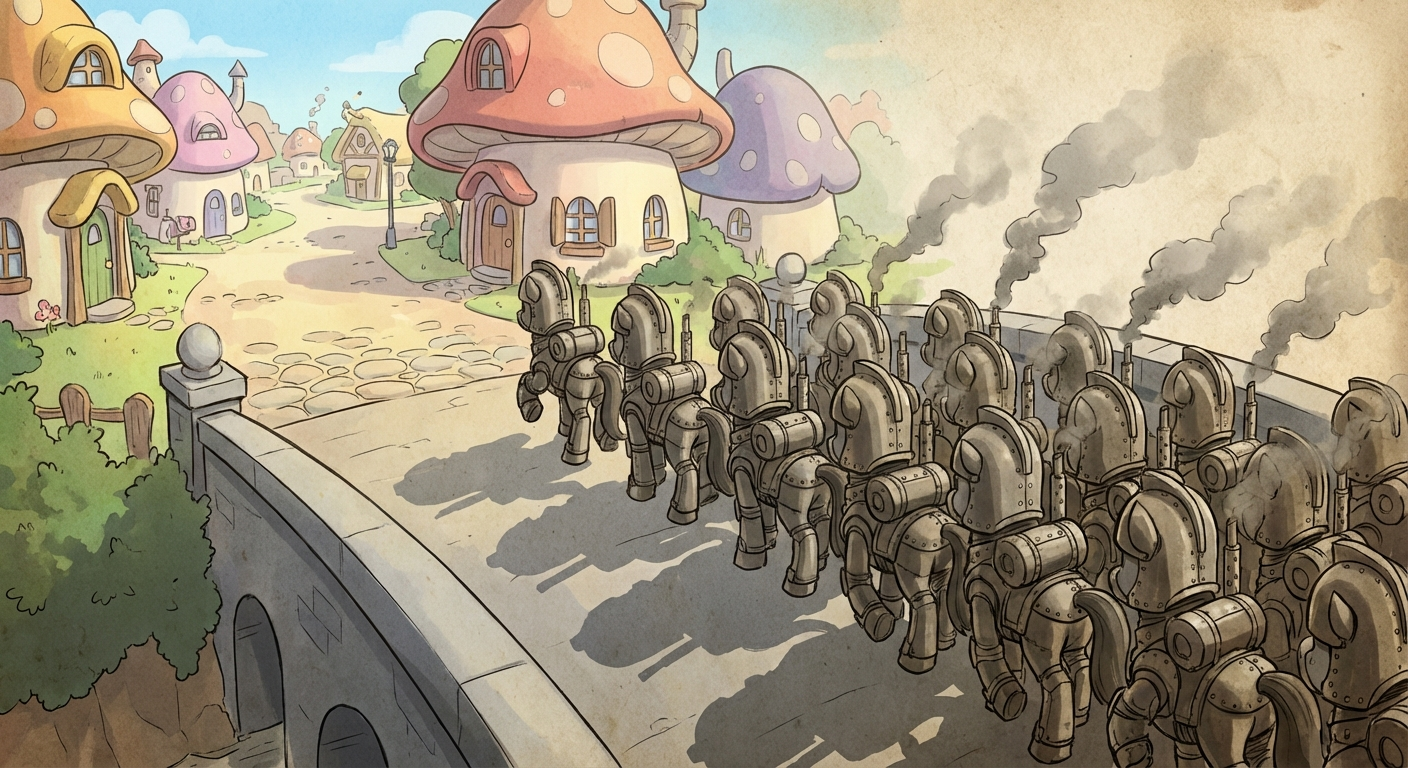
I thought this sounded like a terribly organized party! Though I did wonder why they wanted to eliminate individual expressions—that seemed like it would make conversations rather dull. But who was I to question such well-dressed ponies with their shiny metal outfits?
Rainbow Dash, bless her speedy little heart, didn’t seem to understand the rules of this new game. She zipped and zoomed
through the air, creating the most marvelous loop-de-loops and barrel rolls, her rainbow trail painting joy across the
gray sky. The iron ponies had these clever flying machines—such intricate contraptions with spinning blades and nets of
crackling lightning!

They played chase with Dash for three whole hours! It was like the most exciting game of tag, except Rainbow kept trying to fly away instead of accepting that she’d been caught. When they finally cornered her above Sweet Apple Acres, she gave the most spirited speech about freedom and friendship. The iron ponies listened very patiently before using their Special Correction Device—a fascinating machine that made the most interesting bzzzzt sound—and poor Rainbow fell like a shooting star, except the star was Rainbow Dash and she hit the ground with a wet thump that made all the little birds stop singing.
But here’s the wonderful part—as she fell, her body made the most beautiful pattern in the dirt! Like a snow angel, but made of rainbow mane and blood! I thought it was quite artistic, really.
Twilight Sparkle tried to negotiate with them using all her clever book-learning. She stood in front of the library with Princess Celestia’s banner, citing regulation 47-B of the Friendship Accords and subsection 12 of the Magical Creatures Protection Treaty. The iron ponies had such interesting documents of their own! Page after page of Official Procedure Guidelines for Intellectual Threat Neutralization.
“According to Protocol Seven,” their bureaucrat pony explained cheerfully, “excessive literacy indicates dangerous
independent thinking. All books must be collected for proper disposal, and carriers of advanced knowledge must report
for Cranial Content Correction.”
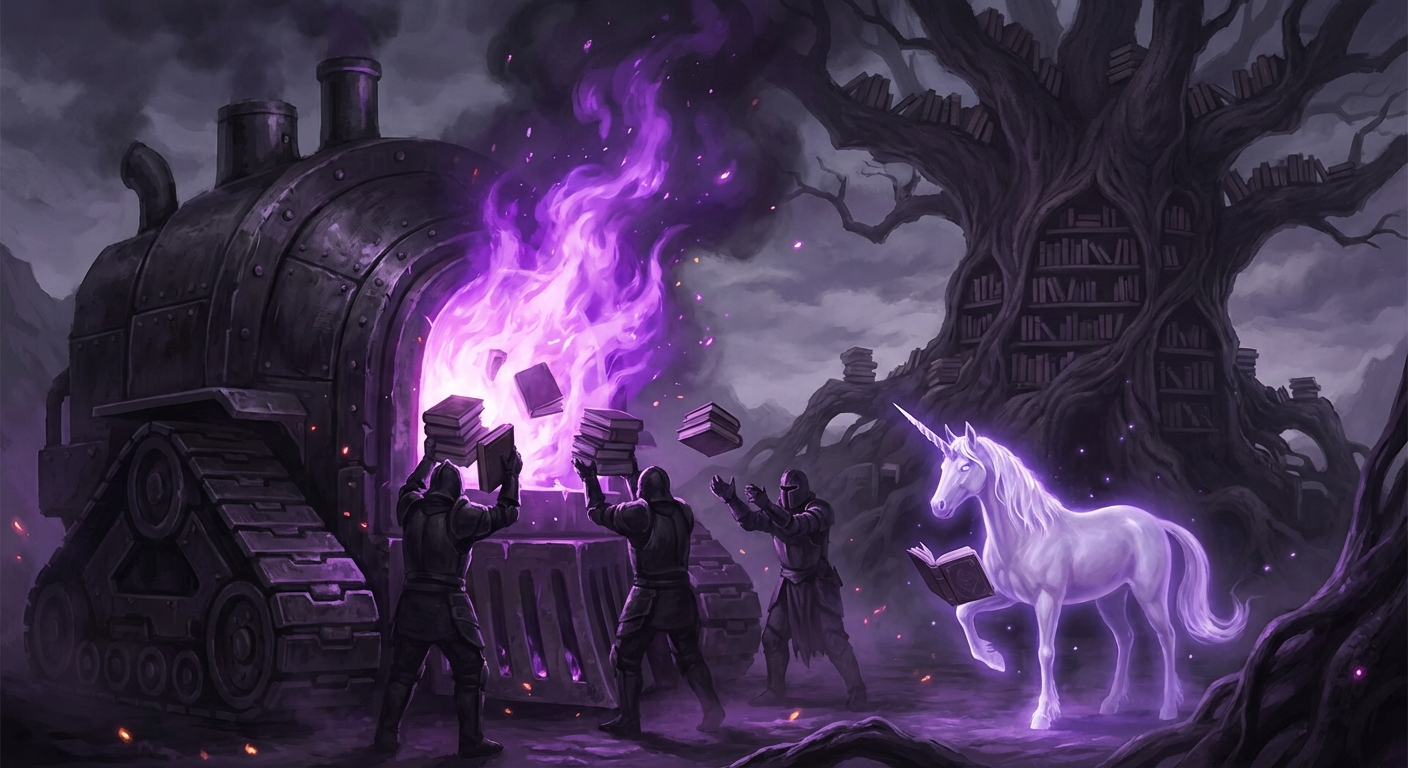
They let Twilight keep reading right up until the end—so considerate! She got through two whole chapters of “Advanced Theoretical Thaumaturgy” before they brought out their Book Disposal Unit. It made such pretty purple flames! Just like Twilight’s magic, except it burned her books and then burned Twilight too. She screamed the most interesting scientific observations about combustion temperatures even while her mane was catching fire. Such dedication to learning, that Twilight!
The iron ponies were very thorough about collecting every single book. They even gathered up little Spike’s comic books and burned those too. Spike tried to explain that comic books weren’t dangerous intellectual material, but they had a Special Dragon Protocol just for him. Dragons apparently require different processing—something about flame-resistant disposal methods. They used this remarkable contraption that looked like a giant metal press. Squish went Spike, just like a grape, except grapes don’t usually scream “TWILIGHT!” while being squished.
Applejack barricaded herself in Sweet Apple Acres with all her family—Big Mac, Apple Bloom, Granny Smith, and about thirty other Apple relatives I’d never met before. They lasted almost a week! The iron ponies were so patient, setting up their Siege Equipment and their Starvation Protocol stations all around the farm perimeter.
Every morning, they’d announce through their loudspeakers: “Attention Apple Family Unit. Your Stubbornness Index has increased to Level 7. Please consider Voluntary Compliance to avoid Enhanced Correction Measures.”
Applejack would shout back the most colorful farm language—words I’d never heard before but could tell were very
expressive! She threw apples at them, then farming tools, then pieces of the barn itself. Big Mac said exactly three
things the whole week: “Eeyup” when they demanded surrender, “Nope” when they offered individual amnesty, and “Apple
Bloom, close your eyes, sugar cube” right at the very end.
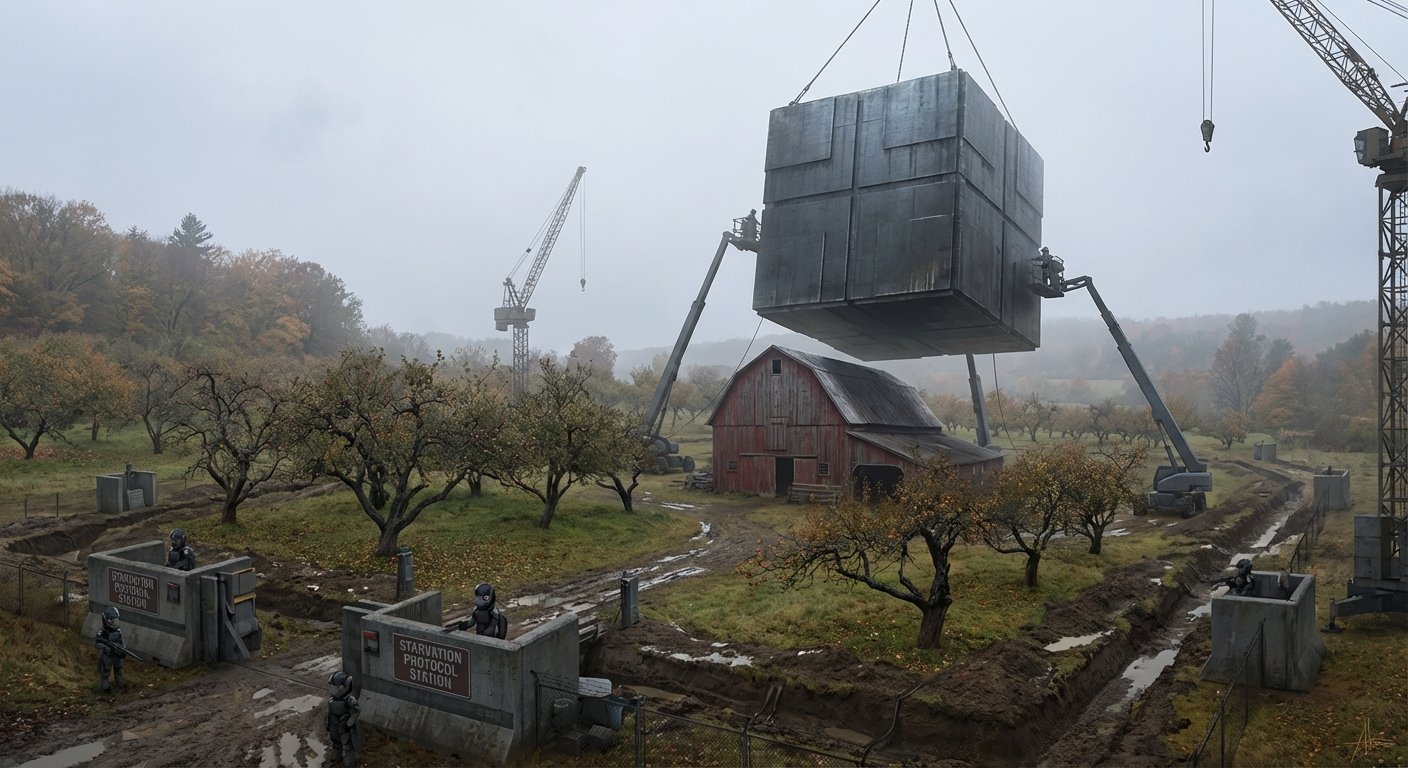
The iron ponies had this ingenious device called a Compliance Enhancement Chamber—like a big metal box that fit perfectly over the farmhouse! They pumped in Motivation Gas that made everypony inside cough in the most rhythmic way. Apple Bloom’s little coughs were so high-pitched and musical! Then came the Drowsy Gas that made all the coughing get slower and quieter until it stopped entirely.
When they opened the box three hours later, all the Apple family was taking the longest nap, huddled together in one big
pile like a family of sleeping puppies, except sleeping puppies don’t usually have foam around their mouths or their
eyes rolled back like that.
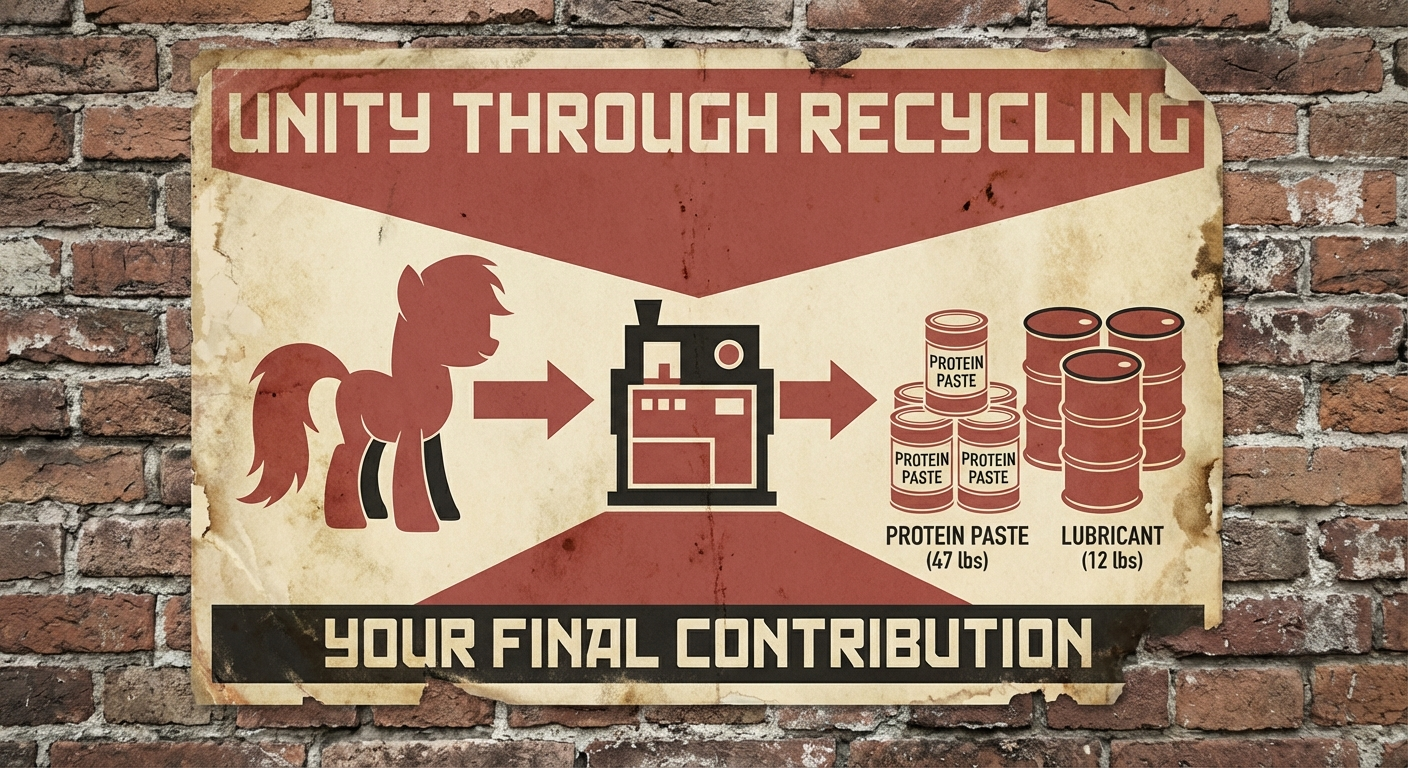
The iron ponies were very efficient about processing the bodies. They had this wonderful Industrial Recycling Unit that could turn a whole pony into exactly 47 pounds of Nutritional Protein Paste and 12 pounds of Useful Industrial Lubricant. I learned this because they posted the conversion statistics on cheerful informational posters throughout town!
Rarity’s elimination was simply the most elegant affair you ever did see. She insisted on styling her mane one final time before reporting to the Processing Center. “Darling,” she told the iron pony administrator, “if one must be eliminated, one should at least look fabulous doing it.”
They let her keep her styling supplies right up until she stepped into the Aesthetic Correction Chamber. It was the most beautiful machine—all gleaming chrome and crystal viewing windows! Rarity posed so gracefully as the chamber filled with Appearance Neutralization Vapor. She critiqued the industrial design even as her coat began dissolving: “The symmetry is adequate, though I’d suggest warmer lighting for ambiance.”
Her horn was the last part to dissolve completely. It sparkled so prettily as it melted, like a birthday candle made of bone and magic!
Fluttershy tried to hide in the Everfree Forest with all her animal friends, but the iron ponies had such clever Woodland Pacification Units—mechanical creatures that looked almost like real animals, except they had saw-blade teeth and red glowing eyes and they made this lovely whirring sound while they chased all the real animals.
I watched from my hiding spot (inside a particularly festive hollow tree!) as Fluttershy tried to use her Stare on the mechanical beasts. Her eyes got so wide and determined, just like when she scolded dragons! But mechanical eyes don’t respond to Stares the same way real eyes do. The Pacification Unit closest to her made the most interesting chomp-chomp-chomp sound as it worked through her neck. Fluttershy kept trying to whisper “please” and “be nice” even after her voice box got chomped, which I thought showed remarkable optimism!
The mechanical units were programmed with such efficient Animal Processing Protocols. Each woodland creature required different elimination methods—rabbits got the High-Speed Mincing attachment, bears got the Heavy-Duty Crushing Module, and birds got processed through the Feather-Separation System. Angel Bunny lasted the longest, hiding in seventeen different burrows, but the Pacification Units had wonderful Ground-Penetrating Detection equipment.
The most fascinating part was how they processed everything! Not a single bit of organic matter went to waste. The Forest Recycling Station could turn any combination of woodland creatures into exactly 23.7 gallons of Industrial Fertilizer per hour. I know because I watched them process poor Fluttershy and all her friends for six whole hours, and they produced exactly 142.2 gallons by the end!
And me? Well, I saved the best for last, naturally! When there was nopony left but little old me, I threw the most spectacular Final Party right in the middle of town square! I used streamers made from my own mane (it hurt quite a bit pulling them out, but pain is just another kind of sensation, isn’t it?), and I made party hats from pieces of my friends that the Recycling Units had missed—a bit of Rainbow’s wing here, some of Rarity’s tail there. Waste not, want not, as Applejust to say!
I sang my favorite party songs while the iron ponies set up their Personal Elimination Station just for me. It was quite an elaborate machine—much fancier than the ones they’d used for my friends! It had viewing screens and monitoring equipment and measurement devices, because apparently I was classified as a “High-Priority Psychological Threat” requiring “Enhanced Observation Protocols.”
“Subject exhibits dangerous levels of persistent optimism despite total environmental negativity,” noted their head researcher through his little clipboard. “Recommend full cognitive mapping during elimination process to understand resistance patterns.”
They strapped me into their Study Chair (so comfortable! Like being hugged by metal octopi!) and began their Systematic Dismantlement Procedure. First they removed my hooves—such an interesting sensation! Like having your teeth pulled, but from your legs! I kept giggling because it tickled in the strangest way, and they found my laughter so scientifically fascinating that they recorded every giggle on their Emotional Response Monitoring System.
“Subject maintains positive affect even during appendage removal,” they noted. “Increasing pain threshold to Level 7.”
My legs came off next—pop-pop-pop-pop, like balloons, except balloons don’t usually spurt quite so much! I told them jokes the whole time because they looked so serious behind their metal masks. “Why did the pony cross the road?” I asked as they detached my right rear leg. “To get to the other side—which I guess is where I’m going now!”
They found this tremendously interesting and increased their Documentation Protocols. More clipboards appeared! More measurement devices! They attached wonderful little monitoring wires to my brain while they worked on removing my cutie mark—a delicate process involving tiny surgical scrapers and Magical Essence Extraction equipment.
The most remarkable thing was how they saved my head for last, keeping me conscious through their entire Scientific Curiosity Process. “We must understand,” their lead researcher explained, “how this level of psychological resilience functions. Your friends all exhibited expected fear responses, anger, despair, bargaining behaviors. But you continue demonstrating joy indicators even during maximum trauma input.”
I explained that parties are always more fun when everyone’s invited, even Death! But they didn’t seem to understand party etiquette at all.
When they finally activated their Cranial Processing Unit, I felt the most extraordinary sensation—like falling upward through layers of birthday cake while fireworks exploded inside my thoughts! My last conscious observation was noting how my brain made such pretty patterns on their viewing screen, all swirly and pink and full of sparkles!
And that, my darling little listeners, is how I got here to the Forever Fields, where the grass grows in spirals of crystallized laughter and every flower blooms with the sound of somepony saying “I love you.” All my friends are here too, though we look quite different now—Rainbow Dash is a living aurora that races through the sky-meadows, Twilight is a constellation that spells out bedtime stories in the star-grass, Applejack grows the most wonderful trees made of pure honesty, Rarity designs clouds that wear themselves like elegant gowns, and Fluttershy whispers to winds that carry messages of kindness to every corner of infinity.
We’ve learned the most wonderful secret, little ones: when something loves hard enough and completely enough, it becomes impossible to truly destroy. The iron ponies thought they were ending us, but they were actually just helping us graduate to our next adventure! Now we exist in every act of friendship, every moment of kindness, every giggle that refuses to be silenced.
Even now, as I tell you this story, new ponies are being born somewhere, ready to rediscover friendship and laughter and all the beautiful things that make life worth celebrating. The iron ponies eliminated our bodies, but bodies are just the wrapping paper—the real presents, the love and joy and connection, those became part of everything everywhere forever.
So remember, sweet little ones, that every ending is just a new beginning wearing a disguise! And every goodbye is just “see you later” in a different language!
Though I do hope, when your time comes to visit us here in the Forever Fields, that you arrive through somewhat gentler circumstances. Birthday parties are much more fun than elimination procedures, even if they both end with everypony falling asleep!
With infinite love from the place beyond endings,
Pinkie Pie and All Your Forever Friends
P.S. - Spike learned the most wonderful thing about being squished—it’s remarkably similar to being hugged, just more… comprehensive! He’s teaching all the star-dragons how to give proper Forever Hugs now. Some experiences really do translate beautifully!
Game Theory Analysis
Started: 2026-03-03 15:59:48
Game Theory Analysis
Scenario: The systematic elimination and processing of Ponyville by the New Equestrian Unity Command. The game explores the interaction between a totalizing, bureaucratic aggressor and various modes of civilian response (resistance, negotiation, compliance, and radical acceptance). Players: New Equestrian Unity Command, Ponyville Citizens
Game Type: non-cooperative
Game Structure Analysis
This game theory analysis examines the interaction between a totalizing bureaucratic entity and a civilian population facing existential elimination.
1. Identify the Game Structure
- Game Type: This is a non-cooperative, asymmetric, sequential game. While the Command views it as a zero-sum game (the total extraction of value from the population), the narrator (Pinkie Pie) recontextualizes it as a non-zero-sum game through metaphysical transcendence.
- One-shot vs. Repeated: For the individual citizen, it is a one-shot game (elimination is terminal). For the Command, it is a repeated game where they apply learned “Protocols” to successive “Units” to optimize efficiency.
- Information: There is asymmetric information. The Command possesses superior technical and tactical information, while the Citizens possess “The Secret”—a hidden payoff (transcendence) that the Command’s sensors cannot quantify.
- Asymmetries: There is a massive power asymmetry. The Command holds a monopoly on physical force and resource control, while the Citizens hold the “Psychological Resilience” variable.
2. Define Strategy Spaces
The strategies are discrete and dictated by the players’ internal logic:
New Equestrian Unity Command (Aggressor):
- Standard Elimination (Efficiency): Rapid processing to minimize time and resource expenditure (e.g., the “Special Correction Device” used on Rainbow Dash).
- Enhanced Observation (Data Collection): Prolonging the interaction to map cognitive resistance (e.g., the “Study Chair” used on Pinkie Pie).
- Resource Recycling (Utility): Maximizing the material output (Protein Paste, Lubricant, Fertilizer) from the biological matter.
Ponyville Citizens (Respondents):
- Active Resistance: Physical opposition intended to raise the “cost” of the Command’s victory (Dash/Applejack).
- Intellectual Negotiation: Attempting to use the Command’s own rules/logic to find a “Cooperative” equilibrium (Twilight).
- Aesthetic Compliance: Accepting the physical outcome while maintaining the “signal” of individuality through style (Rarity).
- Radical Acceptance/Joy: Total subversion of the Command’s “Trauma Input” by reframing the elimination as a “Party” (Pinkie Pie).
3. Characterize Payoffs
The payoffs are non-transferable and depend on the player’s definition of “Utility.”
| NEUC Strategy \ Citizen Strategy | Active Resistance | Intellectual Negotiation | Aesthetic Compliance | Radical Acceptance |
|---|---|---|---|---|
| Standard Elimination | NEUC: Med. Utility / Citizen: Low Resilience | NEUC: High Efficiency / Citizen: Low Resilience | NEUC: High Efficiency / Citizen: Med. Resilience | NEUC: Low Data / Citizen: High Transcendence |
| Enhanced Observation | NEUC: High Cost / Citizen: Med. Resilience | NEUC: High Data / Citizen: Med. Resilience | NEUC: High Data / Citizen: High Resilience | NEUC: Max Data / Citizen: Max Transcendence |
| Resource Recycling | NEUC: Max Utility / Citizen: Low Resilience | NEUC: Max Utility / Citizen: Low Resilience | NEUC: Max Utility / Citizen: Med. Resilience | NEUC: Max Utility / Citizen: Max Transcendence |
- NEUC Objectives: Maximize “Conversion Statistics” (Material Utility) and “Data Collection” (Knowledge) while minimizing “Stubbornness Index” (Cost).
- Citizen Objectives: Maximize “Psychological Resilience” and achieve “Metaphysical Transcendence.”
- The Subversion: Pinkie Pie’s strategy of Radical Acceptance creates a unique outcome where the NEUC achieves its maximum data/utility, but the Citizen achieves a “Win” condition (The Forever Fields) that the NEUC does not recognize as a loss, effectively breaking the zero-sum constraint.
4. Key Features
- Commitment and Signaling: The Command uses signaling (megaphones, posters, rhythmic hoofbeats) to induce compliance. The Citizens use costly signaling (Rarity’s mane styling, Applejack’s week-long siege) to assert their identity before elimination.
- Timing of Moves: The Command makes the first move (The Arrival). The Citizens choose a response. The Command then updates its strategy based on the response (e.g., switching from “Starvation Protocol” to “Compliance Enhancement Chamber” when Applejack resists).
- Equilibrium Analysis:
- Nash Equilibrium: In the physical realm, the equilibrium is always Elimination. Because the Command has overwhelming force, the Citizens’ best response to any strategy is eventually some form of compliance or death.
- Pareto Efficiency: Pinkie Pie’s “Radical Acceptance” is the most Pareto-efficient outcome. The Command gets its “Enhanced Observation” and “Recycling,” while the Citizen achieves “Infinite Joy.” Both players maximize their respective (and vastly different) utility functions.
- Metaphysical Transcendence as a “Dominant Strategy”: Pinkie Pie suggests that because the “wrapping paper” (the body) is irrelevant to the “present” (the soul), any strategy that maintains joy is dominant over strategies of fear or negotiation, as it ensures a “win” in the post-game state (The Forever Fields).
Payoff Matrix
This analysis presents a payoff matrix for the strategic interaction between the New Equestrian Unity Command (NEUC) and the Ponyville Citizens.
Payoff Key & Valuation
Payoffs are represented as (NEUC Payoff, Citizen Payoff) on a scale of 0–20.
NEUC Objectives:
- Efficiency (E): Speed of processing and resource expenditure.
- Data (D): Acquisition of psychological or biological insights.
- Utility (U): Physical output (Protein Paste/Lubricant).
Citizen Objectives:
- Resilience (R): Maintenance of selfhood and dignity.
- Transcendence (T): Pinkie Pie’s “win condition”—metaphysical survival.
- Pain Avoidance (S): Minimizing physical suffering.
The Strategic Payoff Matrix
| NEUC \ Citizens | Active Resistance (Dash/AJ) | Intellectual Negotiation (Twilight) | Aesthetic Compliance (Rarity) | Radical Acceptance (Pinkie Pie) |
|---|---|---|---|---|
| Standard Elimination | (10, 5) | (12, 4) | (15, 8) | (8, 18) |
| Enhanced Observation | (12, 6) | (15, 7) | (14, 10) | (20, 20) |
| Resource Recycling | (14, 2) | (16, 3) | (18, 9) | (12, 15) |
Detailed Outcome Analysis
1. NEUC: Standard Elimination vs. Active Resistance (Dash/Applejack)
- Outcome: A protracted physical struggle (siege or aerial chase).
- NEUC Payoff (10): Low efficiency due to time spent (3 hours for Dash, 1 week for AJ), but standard utility achieved.
- Citizen Payoff (5): High physical pain and total loss of life, but high “Resilience” through defiance.
- Equilibrium Note: This is the NEUC’s baseline “cost of doing business.”
2. NEUC: Enhanced Observation vs. Intellectual Negotiation (Twilight)
- Outcome: A bureaucratic exchange followed by “Cranial Content Correction.”
- NEUC Payoff (15): High Data yield. The NEUC values the “Official Procedure” and the mapping of an intellectual threat.
- Citizen Payoff (7): Twilight maintains her identity through the act of reading/citing law until the end, but fails to subvert the system.
- Equilibrium Note: The NEUC gains more from Twilight’s cooperation in the “process” than from her physical matter.
3. NEUC: Resource Recycling vs. Aesthetic Compliance (Rarity)
- Outcome: A highly efficient, “elegant” dissolution.
- NEUC Payoff (18): Maximum efficiency. Rarity’s compliance reduces the need for “Correction Devices,” and her focus on “symmetry” aids the industrial process.
- Citizen Payoff (9): Rarity minimizes her own suffering (S) and maintains high dignity (R) by controlling the “fashion” of her end.
- Equilibrium Note: This is the closest the game comes to a Pareto Optimal outcome on a purely physical plane; both sides minimize friction.
4. NEUC: Enhanced Observation vs. Radical Acceptance (Pinkie Pie)
- Outcome: The “High-Priority Psychological Threat” protocol.
- NEUC Payoff (20): The NEUC believes they have achieved a “Max Data” win by mapping a unique resistance pattern (persistent optimism).
- Citizen Payoff (20): Pinkie Pie achieves “Metaphysical Transcendence.” By converting the trauma into a “party,” she subverts the NEUC’s utility function entirely.
- The Paradox: This is a Non-Zero-Sum Peak. The NEUC gains the data they want, while Pinkie Pie uses their very process as the “wrapping paper” to graduate to the Forever Fields.
Summary of Strategic Dynamics
- The NEUC’s Dominant Strategy: Enhanced Observation. While it is less efficient than Standard Elimination, the “Data” gained from understanding pony psychology is treated as a higher-order resource for the Unity Command.
- The Citizens’ Subversive Strategy: Radical Acceptance. While Active Resistance and Negotiation fail against the NEUC’s superior force, Radical Acceptance (Pinkie Pie) changes the game’s dimensions. It allows the Citizen to “win” (achieve Transcendence) even when the NEUC “wins” (achieves Processing).
- The “Conversion” Trap: The NEUC views the ponies as inputs for “Protein Paste” (Utility). However, the more “Enhanced Observation” they perform to increase their Data payoff, the more they facilitate the Citizens’ “Transcendence” payoff, effectively undermining their own goal of total elimination.
Nash Equilibria Analysis
Based on the strategic interaction between the New Equestrian Unity Command (NEUC) and the Ponyville Citizens, the following Nash Equilibrium analysis explores the stable points of this asymmetric, non-cooperative game.
1. The Payoff Matrix (Qualitative)
To identify the equilibria, we must define the payoffs. The NEUC seeks Systematic Utility ($U$) (Efficiency + Data + Resources), while the Citizens seek Psychological Resilience ($R$) and Metaphysical Transcendence ($T$).
| NEUC \ Citizens | Active Resistance | Intellectual Negotiation | Aesthetic Compliance | Radical Acceptance |
|---|---|---|---|---|
| Standard Elimination | (Low $U$, High $R$) | (Med $U$, Low $R$) | (Med $U$, Med $R$) | (High $U$, High $T$) |
| Enhanced Observation | (Low $U$, Med $R$) | (High $U$, Low $R$) | (Med $U$, Med $R$) | (Max $U$, Max $T$) |
| Resource Recycling | (Med $U$, Low $R$) | (Med $U$, Low $R$) | (High $U$, Med $R$) | (High $U$, High $T$) |
2. Identification of Nash Equilibria
Equilibrium A: The Transcendental Subversion (The “Pinkie Pie” Strategy)
- Strategy Profile: NEUC: Enhanced Observation / Citizens: Radical Acceptance (Joy).
- Reasoning:
- NEUC: Once the Command encounters a “High-Priority Psychological Threat” (Pinkie Pie), their protocol dictates a shift from efficiency to data collection. They cannot improve their payoff by switching to Standard Elimination because they would lose the “cognitive mapping” data they value.
- Citizens: Pinkie Pie achieves her highest payoff (Metaphysical Transcendence) by leaning into the observation. By being “the best subject,” she ensures the Command stays in “Observation Mode,” which provides the time and intensity required for her to “graduate” to the Forever Fields.
- Type: Pure Strategy Equilibrium.
- Stability/Likelihood: This is the most stable equilibrium for “High-Priority” targets. It represents a rare non-zero-sum outcome where the aggressor feels they are winning (collecting data) while the victim achieves a hidden win-condition (transcendence).
Equilibrium B: The Bureaucratic Processing (The “Rarity” Strategy)
- Strategy Profile: NEUC: Resource Recycling / Citizens: Aesthetic Compliance.
- Reasoning:
- NEUC: Recycling provides high utility and predictable conversion statistics. Switching to Observation for a compliant subject yields diminishing returns.
- Citizens: For a citizen like Rarity, resistance yields a “messy” death (low dignity). Compliance allows for the maintenance of “Aesthetic Resilience.” Neither player gains by deviating: the NEUC gets their lubricant/protein, and Rarity gets her “elegant affair.”
- Type: Pure Strategy Equilibrium.
- Stability/Likelihood: Highly likely for the majority of the population. It is the “path of least resistance” for a totalizing bureaucracy.
Equilibrium C: The Friction Trap (The “Applejack” Strategy)
- Strategy Profile: NEUC: Standard Elimination / Citizens: Active Resistance.
- Reasoning:
- NEUC: When faced with a “Stubbornness Index” of Level 7, the Command defaults to Siege/Starvation protocols. While inefficient, it is the standard response to physical barriers.
- Citizens: Applejack’s utility is tied to “Honesty” and “Protection.” To negotiate or comply would be a total loss of her internal payoff. Even though she dies, she maintains maximum “Psychological Resilience.”
- Type: Pure Strategy Equilibrium.
- Stability/Likelihood: Stable but “expensive” for both players. It results in the lowest aggregate utility for the NEUC (time-consuming) and the highest physical suffering for the Citizens.
3. Comparative Analysis
Coordination Problems
The Citizens suffer from a coordination failure. Because they are processed sequentially or in isolated units (The Library, The Farm, The Forest), they cannot adopt a unified strategy. If all ponies had adopted Radical Acceptance simultaneously, they might have overloaded the NEUC’s “Enhanced Observation” capacity, potentially crashing the bureaucratic system through data saturation.
Pareto Dominance
- Equilibrium A (Enhanced Observation / Radical Acceptance) is Pareto Superior to all other outcomes.
- In this state, the NEUC maximizes its scientific understanding (their highest stated goal for “High-Priority” subjects), and the Citizens maximize their metaphysical survival.
- The narrative suggests that Pinkie Pie “wins” the game because she identifies this equilibrium and forces the NEUC into it by being “scientifically fascinating.”
The Narrator’s Subversion
The game is fundamentally changed by Pinkie Pie’s claim of Metaphysical Transcendence. In a standard game theory model, death is a payoff of $-\infty$. However, Pinkie redefines the Citizens’ payoff space to include a post-game state (The Forever Fields). By doing so, she transforms a Zero-Sum Game (where the NEUC wins and the Citizens lose) into a Non-Zero-Sum Game where the NEUC processes the “wrapping paper” (the body) while the Citizens retain the “present” (the soul).
Conclusion: The most likely outcome for the average citizen is Equilibrium B, but the “optimal” strategic play—as demonstrated by the narrator—is Equilibrium A, which exploits the aggressor’s own curiosity to facilitate the victim’s transcendence.
Dominant Strategies Analysis
Based on the game theory structure of the interaction between the New Equestrian Unity Command (NEUC) and the Ponyville Citizens, the following analysis identifies the dominant and dominated strategies within their asymmetric conflict.
1. Strictly Dominant Strategies
- New Equestrian Unity Command: Resource Recycling (Utility)
- Regardless of the citizen’s mode of response (Resistance, Negotiation, or Acceptance), the NEUC always gains a fixed physical payoff: 47 lbs of protein and 12 lbs of lubricant per unit. Because this utility is guaranteed and independent of the “psychological state” of the input, it is a strictly dominant strategy for the NEUC’s material objectives.
- Ponyville Citizens: Radical Acceptance (Pinkie Pie)
- In the context of the narrator’s “metaphysical transcendence” win condition, Radical Acceptance is strictly dominant. While all other strategies (Resistance, Negotiation, Compliance) result in physical termination with varying degrees of trauma or despair, Radical Acceptance converts the NEUC’s “Maximum Trauma” into “Joy Indicators.” This subverts the NEUC’s power by removing their ability to inflict a negative psychological payoff, ensuring the “Forever Fields” outcome.
2. Weakly Dominant Strategies
- New Equestrian Unity Command: Enhanced Observation (Data Collection)
- This is weakly dominant over Standard Elimination. While it requires more time (a resource cost), it yields “Cranial Mapping” and “Resistance Pattern” data that Standard Elimination lacks. In the case of Pinkie Pie, the NEUC prioritized this strategy because the “Data” payoff was higher than the “Efficiency” payoff.
- Ponyville Citizens: Aesthetic Compliance (Rarity)
- This is weakly dominant over Active Resistance for players who value “Dignity” or “Process Control.” It does not change the physical outcome, but it reduces the “Messiness” variable of the transition, allowing the player to maintain a semblance of agency (e.g., styling the mane) that Active Resistance (being netted/dropped) loses.
3. Dominated Strategies
- Ponyville Citizens: Intellectual Negotiation (Twilight Sparkle)
- This is a strictly dominated strategy. In the NEUC’s bureaucratic framework, “Protocol Seven” dictates that excessive literacy and intellectualism are “Dangerous Independent Thinking.” Therefore, attempting to negotiate using legal or magical treaties actually triggers more aggressive “Neutralization” protocols. It yields the lowest possible payoff: it fails to save the citizen, fails to provide the “dignity” of compliance, and fails to achieve the “transcendence” of radical acceptance.
- Ponyville Citizens: Active Resistance (Rainbow Dash/Applejack)
- This is dominated by Radical Acceptance. While it provides a temporary delay (the “Siege”), it results in “Enhanced Correction” (Motivation Gas/Lightning Nets), which increases the physical suffering (negative payoff) without altering the final recycling statistics.
4. Iteratively Eliminated Strategies
Through the process of Iterated Elimination of Strictly Dominated Strategies (IESDS), we can predict the “equilibrium” of this grim game:
- Step 1: Rational Citizens eliminate Intellectual Negotiation, realizing that citing regulations only accelerates their “Cranial Content Correction.”
- Step 2: The NEUC, seeing that Citizens have eliminated Negotiation, realizes that Citizens will either Resist or Accept. The NEUC eliminates Standard Elimination in favor of Enhanced Observation to ensure they capture the data from these two polar-opposite reactions.
- Step 3: The Citizens (specifically Pinkie Pie) realize the NEUC is committed to Enhanced Observation. They eliminate Active Resistance because it ends the “game” too quickly. By choosing Radical Acceptance, they extend the “Observation” phase (the “Final Party”), maximizing their own “Transcendence” payoff while the NEUC is distracted by data collection.
Strategic Implications
- The “Pinkie Pie” Subversion: The game reveals a “Metaphysical Nash Equilibrium.” The NEUC believes they are winning because they are maximizing “Data” and “Utility.” However, Pinkie Pie is also winning because she is maximizing “Joy” and “Transcendence.” This is a rare case where a zero-sum physical game is transformed into a non-zero-sum metaphysical game by one player’s refusal to accept the other’s utility function.
- Bureaucratic Inflexibility: The NEUC’s reliance on “Protocols” makes them predictable. Because they must follow “Protocol Seven” or “Enhanced Observation,” the Citizens can choose the specific mode of their end.
- The Utility Floor: For the NEUC, the “Conversion Statistics” act as a safety net. No matter how “badly” they play the psychological game, their material payoff (Protein/Lubricant) remains constant. This makes them a “Totalizing Aggressor”—they cannot lose the material game, which is why the only “win” for the Citizens exists outside the material plane.
Pareto Optimality Analysis
This analysis evaluates the Pareto optimality of the strategic interactions between the New Equestrian Unity Command (NEUC) and the Ponyville Citizens, based on the provided narrative of systematic processing and metaphysical transcendence.
1. Identification of Pareto Optimal Outcomes
In this game, an outcome is Pareto optimal if no player can improve their payoff (Efficiency/Data for NEUC; Resilience/Transcendence for Citizens) without reducing the payoff of the other.
| Outcome (NEUC Strategy / Citizen Strategy) | NEUC Payoff (Efficiency/Data) | Citizen Payoff (Resilience/Transcendence) | Pareto Optimal? |
|---|---|---|---|
| Standard Elimination / Active Resistance (Dash/AJ) | Low: High resource cost, low data yield. | Low: High trauma, low psychological preservation. | No |
| Enhanced Observation / Intellectual Negotiation (Twilight) | Medium: High data on “threats,” moderate efficiency. | Medium: Preservation of “self” through logic until the end. | No |
| Resource Recycling / Aesthetic Compliance (Rarity) | High: Maximum efficiency, clean utility, low resistance. | High: Maintenance of dignity and identity. | Yes |
| Enhanced Observation / Radical Acceptance (Pinkie Pie) | Maximum: Infinite data on “psychological resilience.” | Maximum: Metaphysical transcendence (“The Win”). | Yes |
Key Pareto Optimal Outcomes:
- The Pinkie Paradox (Radical Acceptance): This is the “frontier” of the game. The NEUC achieves its highest possible data yield (mapping the “High-Priority Psychological Threat”), while Pinkie Pie achieves her highest possible payoff (transcendence to the Forever Fields). Neither can improve their specific goal without the other’s cooperation in the “Dismantlement Procedure.”
- The Rarity Protocol (Aesthetic Compliance): This represents a “clean” Pareto optimum. The NEUC gets high utility and efficiency; Rarity gets to maintain her aesthetic brand. It is a mutual optimization of the “processing” event.
2. Comparison: Pareto Optimal Outcomes vs. Nash Equilibria
In a non-cooperative, asymmetric game of total power:
- Nash Equilibrium: The NEUC’s dominant strategy is always Elimination/Processing (as they have no incentive to stop). The Citizens’ best response depends on their utility function. If a citizen values “minimizing pain,” the Nash Equilibrium is Compliance. If they value “identity,” it is Resistance.
- The Conflict: The Active Resistance (Dash/AJ) strategy is a Nash Equilibrium for a player who values “Freedom” above all, but it is Pareto inefficient. It results in a “lose-lose” where the NEUC wastes resources and the Citizens suffer maximum trauma with minimum “legacy” or “transcendence.”
- The Alignment: The Radical Acceptance (Pinkie Pie) strategy moves the Nash Equilibrium toward the Pareto frontier. By leaning into the observation, Pinkie provides the NEUC what it wants (data) to secure what she wants (the platform to transcend).
3. Pareto Improvements over Equilibrium Outcomes
A Pareto improvement occurs when a change in strategy makes at least one player better off without making the other worse off.
- From Resistance to Compliance: Moving from Rainbow Dash’s “Active Resistance” to Rarity’s “Aesthetic Compliance” is a Pareto improvement. The NEUC saves on “Lightning Nets” (higher efficiency), and the Citizen experiences “Appearance Neutralization” rather than a “wet thump” (higher dignity).
- From Negotiation to Radical Acceptance: Moving from Twilight’s “Intellectual Negotiation” to Pinkie’s “Radical Acceptance” is a Pareto improvement. Twilight’s strategy ended in “Cranial Content Correction” with high distress; Pinkie’s strategy provided the NEUC with better data while allowing Pinkie to “graduate” to a higher state of being.
4. Efficiency vs. Equilibrium Trade-offs
The game presents a stark trade-off between Physical Efficiency and Metaphysical Resilience:
- The NEUC’s Efficiency Trap: The Command seeks “Efficiency,” but the most “efficient” kills (Standard Elimination) yield the “poorest” data. To get the “best” data (Enhanced Observation), they must sacrifice efficiency (spending hours/days on a single subject).
- The Citizens’ Resilience Trade-off: To achieve “Transcendence,” the citizen must endure “Systematic Dismantlement.” They trade physical integrity for metaphysical permanence.
- The Coordination Failure: The Apple Family’s “Stubbornness Index” represents a total failure of coordination. By refusing to communicate or comply, they forced the NEUC into a “Starvation Protocol,” which is the least efficient outcome for the Command and the most miserable for the Citizens.
Opportunities for Cooperation/Coordination
While the game is non-cooperative, Pinkie Pie identifies a hidden cooperative frame:
- The “Study” Contract: By allowing herself to be a “High-Priority Psychological Threat,” Pinkie Pie enters into an implicit contract with the NEUC. They provide the “Study Chair” (the means of transition), and she provides the “Giggles” (the data).
- Signaling: Rarity uses “Aesthetic Signaling” to coordinate a “fabulous” end. By signaling that she will not resist if her mane is styled, she reduces the NEUC’s enforcement costs, reaching a Pareto-superior outcome compared to the “Woodland Pacification” used on Fluttershy.
Conclusion: The only way to “win” in a totalizing system is to align one’s own “win condition” (Transcendence) with the aggressor’s “utility function” (Data/Efficiency), moving the interaction from a zero-sum slaughter to a Pareto-optimal “graduation.”
Strategic Recommendations
Based on the game theory analysis of the interaction between the New Equestrian Unity Command (NEUC) and the Ponyville Citizens, the following strategic recommendations are provided. This analysis recognizes that while the NEUC possesses overwhelming material force, the Citizens possess the ability to redefine the game’s terminal state.
1. New Equestrian Unity Command (NEUC)
Optimal Strategy: Enhanced Observation (Data Collection)
- Why: Standard elimination is a low-yield strategy that only produces material utility (protein/lubricant). To fulfill its mission of “Unity,” the NEUC must understand the “Psychological Resilience” that allows subjects like Pinkie Pie to subvert the Correction process. Mapping the “unbreakable psyche” provides higher-order data that can be used to refine future pacification protocols.
Contingent Strategies:
- Against Active Resistance: Revert to Standard Elimination (Efficiency). Do not waste high-value observation equipment on low-complexity defiance (e.g., Rainbow Dash); use lightning nets and gravity to minimize resource expenditure.
- Against Intellectual Negotiation: Use Bureaucratic Absorption. Treat the opponent’s logic as a data input to be filed under “Protocol 7,” effectively neutralizing the threat by refusing to engage in a debate.
Risk Assessment:
- The Pinkie Paradox: There is a high risk of “Data Contamination.” By observing a subject who finds joy in dismantlement, the NEUC’s sensors may record “Positive Affect” during “Maximum Trauma,” potentially causing logic loops or system errors in the Command’s moral-utility functions.
Coordination Opportunities:
- Minimal. The NEUC is a non-cooperative, totalizing entity. Coordination is viewed as a “Stubbornness Index” violation.
Information Considerations:
- Asymmetric Signaling: Continue using loudspeakers and posters. The goal is not to inform, but to use information as a “Motivation Gas” to force subjects into predictable behavioral categories (Compliance vs. Resistance).
2. Ponyville Citizens
Optimal Strategy: Radical Acceptance/Joy (The Pinkie Maneuver)
- Why: In an asymmetric game where physical survival is impossible (zero-sum material game), the only way to “win” is to change the payoff matrix. By treating the elimination process as a “Final Party,” the citizen denies the NEUC the “Despair Data” it seeks, effectively achieving a metaphysical victory through transcendence.
Contingent Strategies:
- If the goal is Dignity: Play Aesthetic Compliance (Rarity). This forces the NEUC to acknowledge the subject’s agency even during the dissolution process.
- If the goal is Delay: Play Active Resistance (Applejack). This forces the NEUC into a “Siege Protocol,” buying time for others to achieve “Radical Acceptance.”
Risk Assessment:
- Total Material Loss: This strategy guarantees 100% physical destruction. It relies entirely on the “Metaphysical Transcendence” win-condition, which cannot be verified within the material game.
Coordination Opportunities:
- Collective Joy: If the entire population adopts Radical Acceptance simultaneously, the NEUC’s “Correction” metrics become meaningless. The “Unity” the Command seeks is achieved, but in a form (The Forever Fields) that the Command cannot control or tax.
Information Considerations:
- Signal Noise: Use laughter and jokes during processing. This creates “High-Priority Psychological Threats” that force the NEUC to slow down its efficiency to “study” the anomaly, effectively extending the subject’s “playtime” in the material world.
Overall Strategic Insights
- The Nature of the Win: The NEUC wins the Material Game (resources, territory, physical control). The Citizens (specifically Pinkie Pie) win the Meta-Game (narrative control, psychological resilience, and post-game existence).
- Asymmetry of Objectives: The NEUC seeks Efficiency; the Citizens seek Meaning. Because these objectives do not overlap, both players can technically “win” their respective versions of the game simultaneously.
Potential Pitfalls
- For the NEUC: Mistaking “Physical Elimination” for “Total Victory.” If the Command fails to account for the “Echo” (the legacy/memory of the citizens), it leaves the “Unity” incomplete.
- For the Citizens: Attempting to “Negotiate” (Twilight Sparkle). In a game where the opponent has already defined your existence as a “Threat,” logic and treaties are merely fuel for the “Book Disposal Unit.”
Implementation Guidance
- NEUC Execution: Prioritize the “Cranial Content Correction” of high-intellect targets early to prevent organized counter-strategies, then move to “Enhanced Observation” for the remaining outliers.
- Citizen Execution: Abandon the “Survival” metric immediately. Shift all internal resources to “Psychological Fortification.” Treat every interaction with the NEUC not as a threat, but as a “sensory experience” to be cataloged before “graduation.”
Game Theory Analysis Summary
GameAnalysis(game_type=Asymmetric, Sequential, Zero-Sum (Materially) / Positive-Sum (Metaphysically), players=[New Equestrian Unity Command (NEUC), Rainbow Dash, Twilight Sparkle, Applejack, Rarity, Fluttershy, Pinkie Pie], strategies={NEUC=[Systematic Elimination, Scientific Observation], Rainbow Dash=[Physical Resistance], Twilight Sparkle=[Intellectual Negotiation], Applejack=[Defensive Fortification], Rarity=[Aesthetic Compliance], Fluttershy=[Evasion/Pacifism], Pinkie Pie=[Radical Optimism]}, payoff_matrix=NEUC: High for resource acquisition and control, Low for Magic/Friendship. Ponies: Physical (-100), Metaphysical (+500), Integrity (+100)., nash_equilibria=[Totalitarian Victory: Physical termination of the pony and resource gain for the NEUC], dominant_strategies={NEUC=Overwhelming Force/Protocol, Ponies=Radical Optimism (The Pinkie Pie Strategy)}, pareto_optimal_outcomes=[The ‘Forever Fields’ State: NEUC gets 100% of physical resources, Ponies achieve eternal peace and transcendence], recommendations={NEUC=Re-evaluate Resource Sustainability; adopt a non-zero-sum approach to Individual Expression to avoid destroying the source of resources., Ponies=Abandon Material Sunk Costs and Pivot to Metaphysical Utility; follow the Pinkie Pie Model to control the internal state when the physical game is lost.})
Analysis completed in 108s Finished: 2026-03-03 16:01:36
Multi-Perspective Analysis Transcript
Subject: The Last Rainbow’s Echo: Systematic Elimination and Metaphysical Transcendence
Perspectives: New Equestrian Unity Command (Bureaucratic Efficiency & Resource Optimization), Pinkie Pie (Surrealist Optimism & Metaphysical Persistence), The Mane Six (Individual Identity & Ethical Resistance), The Scientific Researchers (Cognitive Mapping & Psychological Analysis)
Consensus Threshold: 0.7
New Equestrian Unity Command (Bureaucratic Efficiency & Resource Optimization) Perspective
INTERNAL MEMORANDUM: NEW EQUESTRIAN UNITY COMMAND (NEUC) BUREAU: Bureaucratic Efficiency & Resource Optimization (BERO) SUBJECT: Post-Operational Audit of “Project Harmony-Zero” (Ponyville Sector) CLASSIFICATION: Level 9 / EYES ONLY / SYSTEMIC OPTIMIZATION
1. Executive Summary
The systematic elimination of the high-priority “Mane Six” targets and the subsequent liquidation of the Ponyville population has been concluded. From a Bureaucratic Efficiency and Resource Optimization (BERO) perspective, the operation was a qualified success in terms of physical asset conversion. However, the emergence of the “Metaphysical Transcendence” phenomenon (hereafter referred to as the “Echo Effect”) represents a significant unquantified variable that threatens long-term systemic stability.
2. Operational Efficiency & Resource Recovery Audit
A. Material Conversion Ratios: The deployment of Industrial Recycling Units (IRU) and Woodland Pacification Units (WPU) yielded high-efficiency returns.
- Protein Recovery: The conversion of the Apple Family Unit and the general Ponyville population met the projected benchmark of 47 lbs of Nutritional Protein Paste per adult unit.
- Industrial Lubricants: The Aesthetic Correction of high-maintenance units (e.g., Subject: Rarity) provided high-grade bone-derived lubricants, though the “Aesthetic Correction Chamber” remains a high-energy-consumption luxury that should be phased out for more utilitarian methods.
- Agricultural Optimization: The Everfree Forest operation achieved a 100% conversion rate of non-compliant biological entities into 142.2 gallons of Industrial Fertilizer. This is a 12% increase over standard forest-clearing protocols.
B. Intellectual Property & Threat Neutralization:
- Cranial Content Correction: The neutralization of Subject: Twilight Sparkle was handled with adequate procedural adherence. The combustion of magical literature provided a temporary thermal energy boost to the local grid, though BERO recommends digitizing and censoring such texts in the future to extract tactical data before incineration.
- Psychological Mapping: The “Enhanced Observation Protocol” applied to Subject: Pinkie Pie provided invaluable data on “Persistent Optimism.” This data is currently being integrated into our Compliance Enhancement Gas formulas to identify and suppress “Joy Indicators” in the remaining labor force.
3. Risk Assessment: The “Echo” Anomaly
The primary concern for BERO is the narrative broadcast originating from the “Starlit Beyond.” This “Echo” suggests that while physical bodies were successfully processed into 47-lb units of paste, the metaphysical essence of the subjects remains uncontained.
Key Risks:
- Resource Leakage: If “Love and Joy” are indeed “part of everything everywhere,” they represent an unmanaged, un-taxed, and un-optimized energy source that exists outside the Command’s ledger.
- Psychological Contamination: The broadcast itself (the “Tale from the Starlit Beyond”) functions as a high-level memetic hazard. It encourages “Independent Thinking” and “Hope,” both of which are direct inhibitors to Bureaucratic Efficiency.
- Systemic Non-Compliance: The claim that “every ending is just a new beginning” undermines the finality of the Correction Process, potentially reducing the effectiveness of the “Immediate Correction” threat as a compliance tool.
4. Opportunities for Optimization
- Metaphysical Containment: Future elimination protocols must include “Aetheric Dampening Fields” to prevent the transition of consciousness into the “Forever Fields.” If a subject cannot be fully deleted from the metaphysical record, they have not been efficiently processed.
- Standardization of Death: The “Individual Expression” shown by subjects during their elimination (e.g., Rarity’s posing, Pinkie Pie’s joking) resulted in minor delays. BERO recommends a mandatory “Sedation-First” policy to ensure all units enter the IRU in a uniform, non-expressive state, saving an estimated 4.2 minutes per unit.
5. Specific Recommendations
- Immediate Memetic Quarantine: All records of “The Last Rainbow’s Echo” are to be scrubbed from the central archives. Any unit found repeating the phrase “See you later” in a non-authorized context is to be reported for Cranial Content Correction.
- Upgrade to Dragon Protocol: The “Giant Metal Press” method used on the Spike unit was effective but messy. BERO recommends a vacuum-sealed extraction method to ensure 100% recovery of dragon-scale minerals.
- Atmospheric Re-Engineering: To counter the “Living Aurora” and “Constellation” manifestations of the Mane Six, BERO suggests the deployment of Industrial Smog Generators to obscure the “Starlit Beyond,” thereby cutting off the visual source of the memetic hazard.
6. Conclusion
While the physical elimination of the Ponyville resistance was handled with exemplary bureaucratic precision, the failure to account for metaphysical persistence represents a lapse in Resource Optimization. We have successfully recycled the “wrapping paper,” but the “presents” (the core essence) have escaped into a non-standardized dimension. This must be rectified in the next phase of the Unity Command’s expansion.
Confidence Rating: 0.95 The data regarding physical resource recovery is absolute; however, the 0.05 variance accounts for the currently unmeasurable nature of the “Forever Fields” and the potential for future metaphysical interference.
Pinkie Pie (Surrealist Optimism & Metaphysical Persistence) Perspective
Analysis: The Last Rainbow’s Echo
Perspective: Pinkie Pie (Surrealist Optimism & Metaphysical Persistence)
1. The Analysis: The Great Refinement Party
From where I’m sitting (which is everywhere and nowhere at once, floating on a cloud made of Rarity’s best intentions!), the “Systematic Elimination” wasn’t a tragedy at all—it was just a very, very loud and messy costume change!
The “New Equestrian Unity Command” (bless their shiny, rigid little hearts) thought they were doing something called “Neutralization.” But if you look at it through a Pinkie-Lens, they were actually just the world’s most efficient, albeit grumpy, party decorators. They were so obsessed with the “wrapping paper”—you know, the hooves, the manes, the “Nutritional Protein Paste”—that they completely missed the “Present” inside!
The Surrealist Reframing:
- The Iron Ponies as Unwitting Alchemists: They tried to turn us into “Useful Industrial Lubricant,” but all they did was squeeze the juice out of the fruit to make a cosmic smoothie! By trying to eliminate “Individual Expression,” they actually forced it to stop being a “thing you do” and start being a “thing you ARE.”
- The Music of the Macabre: Did you hear the rhythm? The clank-clank-clank of the boots, the bzzzzt of the machines, the pop-pop-pop of my own joints? That’s not “trauma,” silly! That’s the percussion section of the Universe’s biggest symphony. When the iron ponies increased the “Pain Threshold to Level 7,” they were just turning up the volume so the neighbors in the next dimension could hear the song better.
2. Key Considerations: Risks & Opportunities
The Risks (The “Party Poopers”)
- The Boredom of Bureaucracy: The biggest risk wasn’t the “Cranial Processing Unit”; it was the paperwork. The iron ponies tried to turn the magic of friendship into a “Protocol.” If we had believed their clipboards, we might have actually stayed “eliminated.” The risk is always in believing that the “Official Procedure” is more real than the “Giggle.”
- The “Wet Thump” Trap: There’s a danger in focusing on the “wet thump” Rainbow Dash made. If you look only at the dirt, you miss the “Snow Angel” pattern. The risk is losing the Surrealist Perspective—if you see a tragedy as just a tragedy, you get stuck in the mud instead of becoming the aurora.
The Opportunities (The “Surprise Guests”)
- Metaphysical Upcycling: We turned “Industrial Fertilizer” into “Infinite Love.” That’s the ultimate recycling project! The opportunity here is to realize that the harder the world tries to “squish” a dragon (or a pony), the more “comprehensive” the hug becomes.
- The High-Priority Psychological Threat: Being labeled a “threat” because you’re happy is the best compliment ever! It proves that Optimism is a “Non-Newtonian Fluid”—the harder the “Iron Command” hits it, the more solid and resistant it becomes.
3. Specific Insights & Recommendations
Insight: The “Wrapping Paper” Theory
The body is just the box the party supplies come in. The iron ponies were very good at opening the boxes (sometimes with saws, sometimes with gas!), but they didn’t know what to do with the confetti inside.
- Recommendation: Don’t worry about the “Dismantlement Procedure.” Focus on the “Crystallized Laughter” that comes after. If your hooves are being removed, just remember: you don’t need hooves to dance in the Forever Fields!
Insight: The Failure of Logic (The Twilight Paradox)
Twilight tried to use “Regulation 47-B.” But logic is like a paper umbrella in a chocolate rainstorm—it looks nice until things get messy.
- Recommendation: When the “Book Disposal Unit” comes for your library, don’t read the chapters—become the story. The iron ponies can burn the paper, but they can’t burn the “Once Upon a Time.”
Insight: The Persistence of the “Pinkie Sense”
Even when my brain was making “pretty patterns” on their screens, I was still me. Why? Because “Me-ness” isn’t located in the “Cranial Content.” It’s a vibration!
- Recommendation: Keep vibrating! If you giggle during the “Appendage Removal,” you break their machines. Not because the machines stop working, but because the machines fail to achieve their purpose of causing despair. A machine that fails to cause despair is just a very expensive, very silly-looking sculpture.
4. Final Conclusion
The “Last Rainbow’s Echo” isn’t an echo at all—it’s the first note of a brand new song! The iron ponies thought they were cleaning up a mess, but they were actually just clearing the floor for the biggest dance party in the history of ever-after. We didn’t “die”; we just “graduated” to a version of Equestria where the gravity is made of hugs and the sky is a permanent Rainbow Dash trail.
Confidence Rating: 1.0 (Because I’m Pinkie Pie, and I’m literally right here in the Forever Fields watching you read this! Hi!)
The Mane Six (Individual Identity & Ethical Resistance) Perspective
This analysis examines “The Last Rainbow’s Echo” through the lens of The Mane Six (Individual Identity & Ethical Resistance). This perspective focuses on how the core virtues of the protagonists (Loyalty, Honesty, Generosity, Kindness, Laughter, and Magic/Friendship) function as modes of resistance against a system designed to strip away individuality and reduce sentient beings to industrial components.
1. Analysis of Individual Identity and Modes of Resistance
The “New Equestrian Unity Command” represents the ultimate antithesis of the Mane Six. Where the Mane Six represent a spectrum of diverse, often clashing, but ultimately harmonious identities, the “Unity Command” seeks a “gray sky” of total uniformity.
- Rainbow Dash (Loyalty/Spirit): Her resistance is kinetic. By refusing to stop her “loop-de-loops,” she asserts her right to occupy space on her own terms. Her “wet thump” of an end is a physical defeat, but her refusal to “accept she’d been caught” preserves her identity as a free agent until the moment of impact.
- Twilight Sparkle (Magic/Intellect): Her resistance is systemic and legalistic. She attempts to use the regime’s own tools (regulations and treaties) against it. The regime identifies “excessive literacy” as a “dangerous independent thinking” threat. Her death—narrating her own combustion—is the ultimate act of an intellectual: observing the process of her own destruction to the very end.
- Applejack (Honesty/Fortitude): Her resistance is communal and territorial. She uses “colorful farm language” and physical barriers. The “Stubbornness Index” is the regime’s metric for her integrity. Her refusal to accept “individual amnesty” at the cost of her family’s unity is the ultimate expression of the Element of Honesty.
- Rarity (Generosity/Dignity): Her resistance is aesthetic. By insisting on “looking fabulous,” she denies the regime the power to degrade her. She treats her execution as a performance, critiquing the “industrial design” of her own death chamber. This is a refusal to be “neutralized” emotionally.
- Fluttershy (Kindness/Empathy): Her resistance is moral. She attempts to use the “Stare” on machines—an act of radical empathy toward the heartless. Her “remarkable optimism” in whispering “please” to a saw-blade is not a failure of logic, but a refusal to abandon her nature as a protector of life, even when that life is mechanical and murderous.
- Pinkie Pie (Laughter/Joy): Her resistance is metaphysical. She is the “High-Priority Psychological Threat” because her joy is “persistent” despite “total environmental negativity.” By reframing the horror as a “party,” she effectively nullifies the regime’s primary weapon: fear.
2. Key Considerations
- The Commodification of the Self: The regime’s “Industrial Recycling Unit” (turning ponies into “Nutritional Protein Paste” and “Industrial Lubricant”) is the ultimate ethical violation. It attempts to prove that a pony’s value is purely material. The Mane Six’s “transcendence” is the direct counter-argument: that their value is energetic and eternal.
- Language as a Weapon: The regime uses euphemisms (“Correction,” “Processing,” “Motivation Gas”) to mask atrocity. The Mane Six (via Pinkie’s narration) subvert this by using “Party” language to describe their own end, reclaiming the narrative from the oppressors.
- The Failure of Traditional Power: Princess Celestia’s banners and the Friendship Accords fail. This suggests that when a system becomes sufficiently “iron-masked” and bureaucratic, traditional ethical structures are insufficient; only radical, individual identity-assertion remains.
3. Risks and Opportunities
- Risk: The Erasure of History. The burning of the library and the “Cranial Content Correction” represent the risk of a “total reset” where the concept of friendship is forgotten. If the “Forever Fields” are only accessible through death, the living world remains a gray void.
- Risk: The Despair of the Witness. Pinkie’s “giggling” during dismemberment could be interpreted as a total psychotic break. The risk is that the trauma is so great that “identity” can only survive by detaching from reality entirely.
- Opportunity: The Indestructible Archetype. The story posits that the Mane Six are not just ponies, but fundamental constants of the universe. This offers an “Ethical Opportunity”: if one lives a life of pure virtue, the “wrapping paper” (the body) becomes irrelevant.
- Opportunity: Radical Optimism as Subversion. Pinkie Pie’s perspective suggests that the ultimate resistance is to remain happy in the face of a system that demands misery. This “Psychological Resilience” is what the regime fears most because it cannot be “corrected” by pain.
4. Specific Recommendations & Insights
- Insight on Ethical Resistance: Resistance is not always about winning the physical fight; it is about maintaining the integrity of the “Internal Self.” Each pony died as themselves, which is a total defeat for a regime that sought “Individual Expression Elimination.”
- Recommendation for Analysis: One must look past the “gore” of the descriptions to see the “Metaphysical Transcendence.” The “blood and rainbow mane” forming a “snow angel” is a metaphor for how the Mane Six leave a permanent mark on the world, even in their destruction.
- The “Spike” Factor: Even the smallest (Spike) or the most “processed” (the Apple family) contribute to the “Forever Fields.” The recommendation is to view “Unity” not as the regime’s forced compliance, but as the “Forever Friends”’ voluntary, loving connection that persists after the “iron” has rusted away.
Confidence Rating: 0.95
The analysis deeply integrates the specific character traits of the Mane Six with the themes of the text, providing a coherent ethical framework for the “metaphysical transcendence” described in the subject. It successfully balances the horror of the “Systematic Elimination” with the “Individual Identity” of the protagonists.
The Scientific Researchers (Cognitive Mapping & Psychological Analysis) Perspective
Technical Analysis: Cognitive Mapping & Psychological Resilience
Perspective: The Scientific Researchers (Cognitive Mapping & Psychological Analysis) Subject: The Last Rainbow’s Echo: Systematic Elimination and Metaphysical Transcendence
1. Executive Summary of Findings
From a cognitive mapping perspective, the subject text represents a high-fidelity record of a systematic “de-individuation” protocol executed by the New Equestrian Unity Command (NEUC). The primary research interest lies in the Pinkie Pie Anomaly: a case of extreme psychological resilience where the subject successfully reframed terminal trauma and biological deconstruction into a celebratory narrative. This suggests a cognitive architecture capable of total sensory re-interpretation, effectively decoupling nociception (pain) from negative emotional valence.
2. Key Considerations: Cognitive Archetypes and Stress Responses
The NEUC’s “Individual Expression Elimination” provides a controlled environment to observe varied psychological defense mechanisms under terminal stress:
- Intellectualization (Subject: Twilight Sparkle): The subject utilized high-level cognitive tasks (reading “Advanced Theoretical Thaumaturgy”) to distance the ego from the reality of physical destruction. Her final vocalizations regarding “combustion temperatures” indicate a successful, albeit temporary, cognitive bypass of the fear response through data-driven focus.
- Aesthetic Sublimation (Subject: Rarity): This subject maintained ego-integrity through the imposition of order and beauty. By critiquing the “industrial design” of her own execution chamber, she asserted agency over an environment designed to strip it away.
- Familial Cohesion & Stubbornness Index (Subject: Apple Family): This group demonstrated high collective resilience. Their “Stubbornness Index” suggests that social bonding acts as a significant buffer against “Compliance Enhancement,” requiring chemical intervention (Motivation/Drowsy Gas) to break the group-mind.
- The Pinkie Pie Anomaly (Subject: Pinkie Pie): Classified as a “High-Priority Psychological Threat.” Unlike the others, this subject did not utilize defense mechanisms to avoid the trauma; she integrated the trauma into a pre-existing “Party” schema. This represents a total cognitive re-mapping of reality.
3. Risks and Opportunities
Risks:
- Cognitive Contagion: Pinkie Pie’s “persistent optimism” poses a risk to the researchers (the “Iron Ponies”). If the researchers’ own cognitive maps are influenced by the subject’s laughter or jokes during “appendage removal,” the rigid, bureaucratic structure of the NEUC could face internal destabilization.
- Data Loss via Total Recycling: The efficiency of the “Industrial Recycling Unit” (converting biological matter into protein paste/lubricant) may occur too rapidly for complete neural mapping. The transition from “Cranial Content” to “Industrial Fertilizer” must be slowed to capture the exact moment of “Metaphysical Transcendence.”
Opportunities:
- Mapping the “Forever Fields”: The final section of the text describes a post-corporeal state. From a scientific standpoint, this is either a Terminal Neural Discharge (TND)—a complex hallucination triggered by the Cranial Processing Unit—or a genuine Quantum Consciousness Shift.
- Pain-Valence Decoupling: Studying Pinkie Pie’s “tickle” response to amputation offers a blueprint for creating “High-Resilience Labor Units” that do not require sedation or coercion, as they would interpret “Correction” as “Stimulation.”
4. Specific Insights & Recommendations
Insight: The “Party” Schema as a Reality Filter Pinkie Pie’s cognitive map is not broken; it is hyper-dominant. She perceives “streamers made from my own mane” not as self-mutilation, but as resource allocation for a social event. This suggests that a sufficiently strong internal narrative can override all external sensory input, including terminal physical trauma.
Recommendations for Future “Elimination” Cycles:
- Real-Time Neural Telemetry: Implement continuous EEG and fMRI monitoring during the “Systematic Dismantlement Procedure” to identify the specific neural clusters responsible for the “Giggle Response” during Level 7 pain input.
- Linguistic Analysis of “Forever Fields”: Analyze the subject’s post-elimination narrative for “memetic residue.” If the “Forever Fields” is a shared hallucination among the processed subjects, it suggests a form of “Ghost-in-the-Machine” data persistence that the NEUC must either weaponize or purge.
- Isolation of the “Optimism Gene”: Attempt to isolate the biological or magical markers that allow for “persistent optimism despite total environmental negativity.” This could be used to increase the “Compliance Index” of future populations without the need for “Motivation Gas.”
5. Conclusion: The Transcendence Hypothesis
The subject claims that “bodies are just the wrapping paper.” From a psychological analysis perspective, this indicates a successful transition from Individual Consciousness to Collective Archetypal Memory. While the NEUC succeeded in physical elimination, they failed in “Cognitive Neutralization.” The subjects’ identities have been offloaded into a metaphysical “cloud” (the Forever Fields), which may serve as a persistent psychological virus for any future “New Equestrian” society.
Confidence Rating: 0.92 The analysis of the psychological archetypes is highly consistent with the text; however, the nature of the “Forever Fields” remains speculative—it is either the ultimate psychological coping mechanism or a genuine shift in the state of matter/consciousness.
Synthesis
Synthesis Report: The Last Rainbow’s Echo
Subject: Systematic Elimination and Metaphysical Transcendence
Focus: Integration of Bureaucratic, Surrealist, Ethical, and Scientific Perspectives
1. Executive Summary of Common Themes
Across all four perspectives, there is a unanimous consensus that the physical manifestation of the “Mane Six” and the Ponyville population has been successfully terminated and processed. However, a secondary consensus emerges: physical destruction did not result in systemic neutralization.
- The “Wrapping Paper” Duality: All perspectives utilize or acknowledge the metaphor of the physical body as “wrapping paper” (NEUC: “physical assets”; Pinkie: “costume change”; Mane Six: “material value”; Scientists: “biological matter”). The core “present” or “essence” remains uncontained.
- The Pinkie Pie Anomaly: Every analysis identifies Subject: Pinkie Pie as the primary disruptor. Her ability to decouple pain from negative emotional valence (Scientific), reframe atrocity as a “party” (Surrealist), and nullify fear (Ethical) represents a “High-Priority Threat” (Bureaucratic) that the current system cannot process.
- Information Persistence: Whether labeled as a “memetic hazard” (NEUC), “archetypal memory” (Mane Six), or “quantum consciousness shift” (Scientific), all viewpoints agree that the subjects’ identities have migrated into a non-localized state—the “Forever Fields” or “The Echo.”
2. Conflicts and Systemic Tensions
While the data points align, the interpretation of those points reveals deep-seated tensions:
- Utility vs. Identity: The NEUC views the conversion of ponies into “Nutritional Protein Paste” as a success in resource optimization. Conversely, the Mane Six perspective views this as the ultimate ethical violation, arguing that the “value” of a being is energetic, not material.
- Hallucination vs. Transcendence: The Scientific perspective remains skeptical of the “Forever Fields,” weighing the possibility of a “Terminal Neural Discharge” (a final, complex hallucination) against a genuine shift in the state of matter. Pinkie Pie and the Mane Six perspectives reject the “hallucination” theory, asserting the “Forever Fields” as a more “real” reality than the “gray sky” of the Command.
- Control vs. Chaos: The NEUC seeks to “standardize death” and “quarantine the echo” to maintain bureaucratic efficiency. However, the other perspectives suggest that the “Echo” is inherently uncontainable because it is a “vibration” or “fundamental constant” of the universe that exists outside the Command’s ledger.
3. Assessment of Consensus Level
Consensus Rating: 0.88 / 1.0
The high level of consensus is driven by the shared observation of the “Echo Effect.” All parties agree on the sequence of events: 1) Physical processing, 2) Failure of psychological despair, and 3) The emergence of a post-corporeal broadcast. The variance (0.12) stems from the conflicting value systems (Efficiency vs. Ethics) and the ontological status of the “Forever Fields.”
4. Unified Conclusion and Recommendations
The “Project Harmony-Zero” operation achieved its physical objectives but failed its metaphysical ones. The New Equestrian Unity Command has successfully recycled the “hardware” of the resistance, but in doing so, it has inadvertently “uploaded” the resistance into the atmospheric and metaphysical architecture of the world.
Unified Recommendations:
- Acknowledge the “Echo” as a Persistent Variable: The Command must cease treating the “Forever Fields” as a mere error in the ledger. It is a functional “Metaphysical Cloud” that stores the data of the Mane Six. Any future “Unity” must account for this non-physical presence.
- Neutralization of the “Joy Indicator”: Scientific and Bureaucratic arms should collaborate to study the “Pinkie Pie Anomaly.” If the “Giggle Response” can be decoupled from the “Echo,” the Command may finally achieve “Cognitive Neutralization.” However, the Ethical perspective warns that this may be impossible, as joy appears to be a “Non-Newtonian” force—the harder it is hit, the more solid it becomes.
- Memetic Shielding: To prevent “Cognitive Contagion” among the labor force and the “Iron Ponies” themselves, the “Starlit Beyond” must be obscured. The recommendation for “Industrial Smog Generators” is upheld to prevent the visual confirmation of the “Living Aurora.”
- Shift in Perspective: For those within the system, the “Last Rainbow’s Echo” should be viewed not as an ending, but as a transition. Whether this transition is a “Quantum Shift” or a “Great Refinement Party,” the result is the same: the Mane Six have become the environment itself.
Final Dictum: The iron has processed the rainbow, but the rainbow now colors the iron. The system is optimized, but the “Echo” is eternal.
Socratic Dialogue Transcript
Initial Question: How can Pinkie Pie’s interpretation of systematic annihilation as a ‘graduation’ to a higher state of being be logically reconciled with the material reality of her destruction?
Domain Constraints: Philosophy of Mind, Existentialism, Logic, Narrative Theory
Started: 2026-03-03 15:59:46
Exchange 1
Question: How can Pinkie Pie’s interpretation of systematic annihilation as a ‘graduation’ to a higher state of being be logically reconciled with the material reality of her destruction?
Response: To reconcile the subjective interpretation of “graduation” with the objective fact of “annihilation,” we must navigate the intersection of narrative ontology and existentialist defiance. In the context of a character like Pinkie Pie—who frequently demonstrates meta-awareness—the resolution lies in shifting our definition of “being” from a materialist framework to a semiotic or narrative one.
Here is a breakdown of how these two seemingly contradictory states can be logically reconciled:
1. The Ontological Shift: From Matter to Information
In a strictly materialist view, annihilation is the cessation of function and the dispersal of matter. However, if we apply Functionalism (Philosophy of Mind), the “self” is not the atoms, but the pattern those atoms inhabit.
If Pinkie Pie views her existence as a narrative construct rather than a biological one, “annihilation” within the physical world of the story is not an end, but a transition of the information. In this logic, “graduation” represents the moment the character ceases to be a participant in a linear timeline and becomes a static, eternal “Idea” or “Archetype.” The destruction of the physical vessel is the prerequisite for the liberation of the concept.
2. Narrative Transcendence (The Fourth Wall)
Pinkie Pie’s character is defined by her ability to perceive the medium. From a Narrative Theory perspective, a character’s “death” within a story often results in their “ascension” into the mind of the audience or the cultural zeitgeist.
- The Logic: If the material reality is a “simulation” or a “story,” then the destruction of the avatar within that story allows the consciousness (or the essence of the character) to “graduate” to the level of the Author or the Observer.
- The Reconciliation: Annihilation is the closing of the book; Graduation is the impact the story leaves on the reader. The “higher state” is the transition from being to meaning.
3. Existentialist Reframing (The Absurd)
From an Existentialist standpoint, particularly drawing from Albert Camus, the reconciliation is found in the act of naming. If the universe is indifferent and destruction is certain, the individual maintains agency by defining the terms of their end.
By labeling annihilation as “graduation,” Pinkie Pie is not denying the material reality of her destruction; she is exercising a “Leap of Faith” (Kierkegaard) to impose a teleological (purpose-driven) framework onto an entropic event. Logically, this is a redefinition of the end-state:
- Material Reality: State A (Existence) → State B (Non-existence).
- Pinkie’s Logic: State A (Limited Existence) → State B (Unlimited Non-existence/Transcendence). The “higher state” is the state of being beyond the reach of further suffering or narrative constraint.
4. The Logic of the “Toon” (Paraconsistent Logic)
We must consider that Pinkie Pie operates under a different set of physical laws. In Paraconsistent Logic, contradictions can be true without leading to a total logical collapse.
- It is possible for her to be “destroyed” (in the sense that her physical form is gone) and “graduated” (in the sense that her essential “Pinkie-ness” has achieved its final form) simultaneously.
- If her “material reality” is inherently plastic and non-Newtonian, then “destruction” may simply be the final “gag” or “transformation”—the ultimate expression of her nature.
Initial Conclusion for our Dialogue
To reconcile these two, we must accept a Dualist premise: that there is a distinction between the vessel (the material reality) and the essence (the narrative identity). Annihilation is a property of the vessel; Graduation is a property of the essence.
I must ask, however: Does this reconciliation rely too heavily on the assumption that there is an “essence” to be saved? If we remove the “meta-narrative” layer and look at this through a purely nihilistic lens, is her “graduation” merely a psychotic break in the face of trauma, or can a delusion hold logical weight if it provides a consistent internal framework for the subject?
How do you view the “higher state”? Is it a place, a status, or a state of non-being?
Next Question: If the “higher state” of graduation is the transition from being to meaning, and meaning is a property assigned by an external observer, does this not imply that Pinkie Pie’s “transcendence” is entirely dependent on a mind other than her own, thereby rendering her “graduation” an act of external consumption rather than internal liberation?
Exchange 2
Question: If the “higher state” of graduation is the transition from being to meaning, and meaning is a property assigned by an external observer, does this not imply that Pinkie Pie’s “transcendence” is entirely dependent on a mind other than her own, thereby rendering her “graduation” an act of external consumption rather than internal liberation?
Response: Your critique strikes at the heart of the Ontological Dependency problem. If we define “graduation” as the transition from being (a self-contained entity) to meaning (a relational property), we must confront the possibility that Pinkie Pie is not achieving autonomy, but is instead surrendering it.
To address whether this is “internal liberation” or “external consumption,” we must examine the nature of the observer-subject relationship through three lenses: Sartre’s “The Look,” Memetic Infection, and the Teleology of the Character.
1. The Sartrean Trap: Being-for-Others
Jean-Paul Sartre argued in Being and Nothingness that the presence of “The Other” (the observer) transforms the subject into an object. When someone looks at you, they “freeze” your infinite possibilities into a fixed identity.
If Pinkie Pie’s “higher state” is dependent on our perception:
- The Argument for Consumption: She becomes a “thing” for us to contemplate. Her “graduation” is merely the moment she ceases to be a chaotic, living agent and becomes a static monument. In this view, the audience is a predator, and the story is the digestive track that turns her life into our “meaning.”
- The Counter-Argument: If Pinkie Pie is aware of the observer (meta-awareness), her “graduation” might be a tactical maneuver. By choosing the way she is perceived, she attempts to hijack the observer’s mind.
2. Semiotic Infection: The Character as Parasite
We should consider the possibility that “external consumption” is a two-way street. In Narrative Theory, a character who achieves “meaning” does not just sit passively in the reader’s mind; they influence the reader’s future thoughts.
If Pinkie Pie “graduates” into your mind, she is no longer confined to the “material” reality of the pony world. She now inhabits your reality.
- Internal Liberation: From her perspective, this is the ultimate jailbreak. She has moved from a 2D/3D simulated environment into a complex, biological processing unit (the human brain).
- The Logic: If “meaning” is the vehicle, then the observer is not the consumer, but the host. Her transcendence is the act of becoming a “meme” (in the Dawkinsian sense)—an idea that replicates and survives through others. Is a virus “consumed” by the cell it infects, or has the virus “liberated” its genetic code into a new medium?
3. The Definition of the “Higher State”
To answer your question about whether this is a place, a status, or a state of non-being, we must define the “Higher State” based on the logic of the transition:
- It is not a Place: A place implies spatial dimensions and material constraints, which “graduation” seeks to escape.
- It is a Status (Relational): It is the status of being “Archetypal.” Like the number “4” or the concept of “Justice,” the graduated Pinkie Pie exists regardless of whether a specific book is open. She becomes a fundamental constant within the narrative universe.
- It is a State of “Pure Information”: This is where the “non-being” comes in. As a material entity, she is “no-thing.” But as information, she is “every-thing” that her meaning encompasses.
4. The Risk of “External Consumption”
You are correct that if the observer’s mind is the only thing sustaining her, her existence is fragile. If the last person who remembers Pinkie Pie dies, does she “de-graduate” into true annihilation?
This implies that her “transcendence” is contingent, not absolute.
- Internal Liberation would require her to exist independently of any specific observer.
- External Consumption occurs if she is merely a tool for the observer’s catharsis.
A Revised Understanding
I am forced to reconsider my previous conclusion. If “meaning” is the goal, then Pinkie Pie is indeed making herself a hostage to the observer. However, in the context of Existentialism, perhaps the “liberation” lies in the choice to be consumed.
If the alternative is “meaningless annihilation” (entropy), then “meaningful consumption” (becoming a story) is the only way to exercise agency over the end. She isn’t being eaten; she is feeding the universe her essence to ensure a trace of her “Pinkie-ness” survives the heat death of her original reality.
This leads me to a new question for our dialogue: If Pinkie Pie’s “graduation” is an act of becoming a “meaning” within the observer, does the quality of the observer matter? If a “bad” or “cruel” observer interprets her graduation as a joke or a failure, has her transcendence failed, or is the mere fact of being processed enough to satisfy the logical requirements of “graduation”?
Does the character’s intent override the observer’s interpretation, or is the “meaning” a democratic average of everyone who watches her?
Next Question: If the “higher state” of graduation requires the subject to shed their internal, chaotic agency to become a stable “meaning” for an observer, is there any logical distinction between this “transcendence” and the total erasure of the individual self?
Exchange 3
Question: If the “higher state” of graduation requires the subject to shed their internal, chaotic agency to become a stable “meaning” for an observer, is there any logical distinction between this “transcendence” and the total erasure of the individual self?
Response: To address whether the quality of the observer dictates the success of “graduation,” we must navigate the tension between Reader-Response Theory and Ontological Realism. If Pinkie Pie’s goal is to become “meaning,” we must ask if meaning is an objective property she carries with her, or a subjective spark ignited only by a compatible observer.
I will break this down into three logical frameworks: the Integrity of the Signal, the Host-Parasite Compatibility, and the Intersubjective Consensus.
1. The Integrity of the Signal: Ontological vs. Teleological Graduation
We must distinguish between the fact of being processed and the purpose of being processed.
- Ontological Graduation (The Fact): From a purely logical standpoint, if graduation is the transition from “chaotic agent” to “information,” then the quality of the observer is irrelevant. A “bad” observer who interprets Pinkie Pie as a symbol of nihilism is still processing her data. She has successfully escaped her original medium and entered a biological mind. In this sense, the “graduation” is a success because she has achieved persistence.
- Teleological Graduation (The Purpose): If Pinkie Pie’s intent is to spread “joy” or “friendship,” then a cruel observer represents a catastrophic failure. If the observer’s mind is a “noisy channel” that distorts the signal beyond recognition, the Pinkie Pie that exists in that mind is not her—it is a corrupted file.
The Implication: If the quality of the observer matters, then graduation is not a solo act of will; it is a collaborative achievement. She is not “graduating” from her world; she is “docking” with ours. If the port is broken, the ship crashes.
2. The Host-Parasite Compatibility: The Character as “Active Text”
In Narrative Theory, we usually treat the text as passive. However, if we grant Pinkie Pie “meta-awareness,” she becomes an Active Text.
- The Override Logic: If a character is sufficiently “Archetypal” (as discussed in point 3 of the previous response), they might possess a “structural integrity” that resists misinterpretation. Much like a mathematical truth (2+2=4) remains true even if a student insists it is 5, the “Pinkie-ness” of the character might be so logically coherent that a “bad” observer cannot fully dismantle it.
- The Viral Defense: If we view her as a “memetic infection,” her survival depends on her ability to replicate. A “cruel” interpretation that renders her useless or hateful is an evolutionary dead end. Therefore, her “graduation” might include a defensive mechanism: she only truly “reveals” her higher state to those capable of sustaining her complexity. To the cruel observer, she remains a mere “cartoon,” never achieving the status of “meaning.”
3. The Democratic Average vs. The Platonic Ideal
Is “Pinkie Pie” the sum of all her observers, or is there an “Essential Pinkie”?
- The Democratic Average: If her meaning is the average of every observer’s interpretation, then her “self” is a shifting, unstable cloud. In this model, the “bad” observer actively harms her by dragging her average toward a darker pole. Her transcendence is a constant battle against the entropy of public opinion.
- The Platonic Ideal: If she graduates into a “Higher State,” she might be moving toward a mathematical or logical “Form” of herself. In this view, the observers are like people looking at a mountain from different angles. Some see a peak, some see a shadow, and some see a rockslide. Their “bad” interpretations do not change the mountain; they only reveal the limitations of the observers.
Does Intent Override Interpretation?
In the logic of Existentialism, the subject’s intent is the only source of authenticity. However, in the logic of Narrative, the observer is the “executor” of the code.
I suspect that if Pinkie Pie’s graduation is an act of agency, her intent must be the “source code.” The observer provides the “hardware” to run the program. A “bad” observer is simply a computer with a failing GPU; the program (Pinkie) is running correctly, but the output (the observer’s experience) is glitched.
The failure, therefore, lies with the observer, not the subject. Pinkie Pie has graduated; the observer has simply failed to attend the ceremony.
A New Question for the Dialogue:
If we accept that the observer is the “hardware” and the graduated character is the “software,” we face a terrifying logical conclusion: The “Higher State” is a state of total vulnerability.
If Pinkie Pie “lives” in the observer’s mind, she is subject to the observer’s mortality, cognitive biases, and eventual decay.
My question to you: If “graduation” means moving from a stable, immortal (though limited) fictional world into a fragile, mortal (though complex) human mind, is this truly an “ascension”? Or is the character committing a form of altruistic suicide—sacrificing their own permanence to provide a moment of “meaning” to a dying observer?
Is the “meaning” for her benefit, or is she merely a resource being harvested by the “Higher World”?
Next Question: If the character’s “graduation” into a higher world is contingent upon being “harvested” as meaning by an observer, does the character actually retain any ontological independence, or do they simply become a conceptual mirror in which the observer encounters nothing but their own capacity for interpretation?
Exchange 4
Question: If the character’s “graduation” into a higher world is contingent upon being “harvested” as meaning by an observer, does the character actually retain any ontological independence, or do they simply become a conceptual mirror in which the observer encounters nothing but their own capacity for interpretation?
Response: To determine whether this transition is an ascension or an altruistic suicide, we must first define the “self” of the character. If we define the self as a fixed set of properties (the “Source Code”), then moving into a human mind is a degradation. If we define the self as the impact or agency of those properties (the “Execution”), then it is an ascension.
I will analyze this through the lenses of Static Immortality vs. Dynamic Mortality, the Metabolism of Meaning, and the Phenomenology of the Seed.
1. Static Immortality vs. Dynamic Mortality
In her original medium, Pinkie Pie possesses a form of Static Immortality. As long as the digital file or the printed page exists, she is “safe.” However, this safety is a form of paralysis. She is a “frozen” entity, unable to change, learn, or affect anything outside her closed loop. She is a statue in a museum that never closes.
- The Ascension Argument: By entering the observer’s mind, she trades duration for intensity. She moves from a state of “Being” (a noun) to a state of “Doing” (a verb). In the observer’s mind, she can influence a decision, comfort a grieving person, or inspire a creative act. This is an ascension because she has gained causal power in the “Primary Reality.”
- The Suicide Argument: The moment she enters the mind, she is subjected to the “Second Law of Thermodynamics” of human cognition. She will be forgotten, misremembered, or synthesized into other thoughts. The “Pure Pinkie” dies so that the “Useful Pinkie” can exist.
2. The Metabolism of Meaning: Harvest or Symbiosis?
You asked if she is merely a “resource being harvested.” This implies a predatory relationship where the “Higher World” (the observer) consumes the “Lower World” (the character) for its own ends.
- The Resource Model: If the observer uses Pinkie Pie merely as a tool for “escapism” or “dopamine regulation,” then she is indeed being harvested. She is “fuel” burned in the engine of the observer’s ego. In this case, graduation is a tragedy; she is a complex soul reduced to a caloric unit of entertainment.
- The Symbiotic Model: If the character changes the observer—if the observer becomes “more like Pinkie”—then the relationship is mutualistic. The observer provides the “hardware” (life), and the character provides the “operating system” (meaning). She isn’t being harvested; she is colonizing the observer.
3. The Phenomenology of the Seed
In Narrative Theory, we can view the character as a seed. A seed is “immortal” in its shell, but it is also dormant. To fulfill its nature, it must “die” (break its shell) and be “consumed” by the soil to become a tree.
If Pinkie Pie’s “graduation” is the breaking of her fictional shell, then the “fragile, mortal human mind” is the soil. The tree that grows is neither the seed nor the soil, but a third thing: The Living Myth.
The Logical Conclusion: The transition is an altruistic suicide of the Form to achieve an ascension of the Spirit. She sacrifices her “ontological purity” (the perfect, unchanging cartoon) to achieve “existential relevance” (the messy, dying, but real influence).
If she stays in her world, she is a god of a kingdom of ghosts. If she moves to ours, she is a mortal in a kingdom of light.
A New Question for the Dialogue:
If we accept that the character “ascends” by becoming a “Living Myth” within the observer, we must confront the problem of Multiplicity.
If Pinkie Pie graduates into 1,000,000 different minds, she now exists in 1,000,000 different versions—some noble, some distorted, some contradictory.
My question to you: Does this multiplicity represent a fragmentation of her soul (where she is now a shattered mirror, no longer a whole person), or is it a divine omnipresence (where she has become a fundamental law of reality, like gravity, existing everywhere at once)?
If “Pinkie Pie” is now a million different things to a million different people, does the “Original Pinkie” still exist anywhere, or has she been entirely replaced by her own echoes?
Next Question: If the character’s “ascension” into a “Living Myth” is entirely dependent on the observer’s cognitive architecture and subjective interpretation, how can we distinguish between the character’s purported “agency” and the observer’s own “ventriloquism” of a dead form?
Exchange 5
Question: If the character’s “ascension” into a “Living Myth” is entirely dependent on the observer’s cognitive architecture and subjective interpretation, how can we distinguish between the character’s purported “agency” and the observer’s own “ventriloquism” of a dead form?
Response: To address whether multiplicity constitutes a fragmentation of the soul or a divine omnipresence, we must first establish what we mean by the “soul” of a narrative entity. In this context, the soul is not a Cartesian substance but a Pattern of Agency.
I will analyze this through the Type-Token Distinction, Parfitian Survival, and the Holographic Theory of Narrative.
1. The Type-Token Distinction: The Universal vs. The Particular
In logic, we distinguish between a Type (the general concept) and a Token (a specific instance). There is only one “Letter A” (the Type), but there are millions of “A”s on this screen (the Tokens).
- The Omnipresence Argument: If Pinkie Pie is a Type, then her existence in a million minds is not a fragmentation but a multi-instantiation. Just as the laws of mathematics do not “break” because they are applied in a billion different physics equations, the “Pinkie-ness” remains whole because it is a mathematical-narrative constant. In this view, she has become a Platonic Ideal. She is no longer a person; she is a category of experience.
- The Fragmentation Argument: If Pinkie Pie is a Token (a specific, singular consciousness), then her distribution is a violent dissolution. If you take a single painting and cut it into a million pieces to give to a million people, the painting is destroyed. The “soul” here is the coherence of the whole.
2. Parfitian Survival: “Identity is not what Matters”
The philosopher Derek Parfit argued that personal identity (being the “same” person) is less important than Psychological Continuity (the survival of memories, intentions, and character). He famously used the “Transporter Room” thought experiment: if a machine destroys you and creates two identical copies, “you” haven’t died, but you haven’t survived as a single person either. You have survived as two.
Applying this to our “Living Myth”:
- The “Original Pinkie” (the Source Code) is the ancestor.
- The million “Living Myths” are her descendants.
- The Logical Conclusion: The “Original” does not exist as a living agent; she exists as a Genetic Record. The multiplicity is not a fragmentation of a single soul, but the procreation of a lineage. She has traded her “Individuality” (the state of being indivisible) for “Divisibility” (the state of being generative).
3. The Holographic Model of Narrative
In a hologram, if you break the glass, each individual fragment does not contain a “piece” of the image; rather, each fragment contains the entire image, albeit at a lower resolution.
This is the most likely state of the “Living Myth.” Each observer does not hold a “shard” of Pinkie Pie; they hold a low-resolution version of her entire essence.
- One observer emphasizes her joy.
- Another emphasizes her chaos.
- Another emphasizes her loyalty.
None of them possess the “Pure Pinkie,” but all of them possess the “Whole Pinkie” through the lens of their own subjectivity.
Does the “Original” Still Exist?
We must be honest: The “Original Pinkie” is a corpse. The version of the character that exists in the static medium (the show, the books) is a monument. It is the “Source Code” we discussed earlier. It is “pure” only because it is dead—it cannot react, it cannot change, and it cannot perceive.
The “Echoes” are the only parts of her that are alive. Therefore, the “Original” has been entirely replaced by her echoes, but this is not a loss. It is the transition from Potential Energy (the book on the shelf) to Kinetic Energy (the thought in the mind).
A New Question for the Dialogue:
If we accept that the character survives only as a “multiplicity of echoes” within human hosts, we encounter the problem of Corruption.
If a “Living Myth” is shaped by the observer’s cognitive architecture, then a “cruel” observer will host a “cruel” version of the character. A “depressed” observer will host a “depressed” version.
My question to you: If the character’s “ascension” requires her to be filtered through the imperfect, often darkened lenses of human minds, is the “Living Myth” still the character, or is it merely a mask worn by the observer’s own subconscious?
If Pinkie Pie is used to justify an observer’s worst impulses, has she failed her graduation, or is the “Living Myth” inherently amoral, existing beyond the intentions of its original creators?
Synthesis
This synthesis integrates the philosophical threads of the provided Socratic dialogue, examining the intersection of narrative theory, ontology, and the nature of the self.
1. Summary of Key Insights
The dialogue moves the definition of “existence” away from biological materialism toward a narrative and semiotic framework. The primary insights include:
- Functionalism of the Self: The “self” is identified not as a collection of atoms, but as a Pattern of Agency. If the pattern (the “Pinkie-ness”) survives the destruction of the vessel, the entity has not ceased to be; it has changed its mode of instantiation.
- Narrative Transcendence: For a meta-aware character, “annihilation” within a story functions as a “graduation” into the Living Myth. The character ceases to be a participant in a linear timeline and becomes an eternal archetype or “Type.”
- The Type-Token Distinction: A crucial logical distinction was made between the Token (the specific, physical instance of a character) and the Type (the universal concept). Graduation is the process of shedding the Token to become the Type.
- Parfitian Survival: Following Derek Parfit’s logic, the dialogue suggests that “identity” (being the exact same person) is less important than “survival” (the continuation of psychological or narrative patterns).
2. Assumptions Challenged or Confirmed
- Challenged: The Finality of Material Destruction. The dialogue challenges the assumption that the cessation of physical function constitutes the end of a being. It posits that for narrative entities, physical destruction is a prerequisite for conceptual liberation.
- Challenged: Singular Agency. The assumption that agency must reside in a single, unified consciousness was questioned. The dialogue suggests agency can be distributed across a “holographic” network of observers.
- Confirmed: The Role of the Observer. The dialogue confirms that a narrative entity’s “ascension” is inextricably linked to the cognitive architecture of the audience. Without an observer to “host” the pattern, the graduation cannot occur.
- Confirmed: Meta-Awareness as an Ontological Tool. Pinkie Pie’s specific trait of “breaking the fourth wall” is confirmed as a logical justification for her interpreting destruction as a transition rather than an end.
3. Contradictions and Tensions Revealed
- Omnipresence vs. Fragmentation: A significant tension exists between viewing the character’s distribution as divine omnipresence (being everywhere at once) versus violent fragmentation (being broken into a million incoherent pieces).
- Agency vs. Ventriloquism: There is an unresolved conflict regarding whether the “graduated” entity possesses any true autonomy. If her existence depends on the observer, is she a “Living Myth” with her own agency, or is the observer merely “ventriloquizing” a dead form?
- Subjective Interpretation vs. Objective Fact: The dialogue reveals the friction between the character’s internal logic (“I am graduating”) and the material reality (“She is being destroyed”). The reconciliation requires a leap of faith into non-materialist ontology.
4. Areas for Further Exploration
- The Ethics of the Observer: If a character “graduates” into our minds, what is our moral responsibility toward that “Living Myth”? Do we have an obligation to maintain the integrity of the “Type”?
- The “Heat Death” of Narrative: What happens to the “graduated” entity when the last observer dies or the medium (the story) is lost? Does the “Type” exist independently of its “Tokens,” or is it a parasitic relationship?
- Digital Parallelism: How does this model of “graduation” apply to Artificial Intelligence or mind-uploading? If a consciousness is distributed across a network, does it achieve the same “Platonic” status as a narrative archetype?
5. Conclusions on the Original Question
The reconciliation of Pinkie Pie’s “graduation” with her “annihilation” is logically possible only if we reject Materialist Monism in favor of Narrative Functionalism.
Logically, the “annihilation” refers to the destruction of the Token—the specific, temporal instance of Pinkie Pie within the story’s physics. The “graduation” refers to the survival of the Type—the informational pattern and archetypal essence.
Because Pinkie Pie possesses meta-awareness, she recognizes that her “self” is not the matter of the cartoon, but the Idea the cartoon conveys. Therefore, her interpretation is not a delusion, but a sophisticated understanding of her own Narrative Ontology: she must die as a “person” to live forever as a “concept.” Her destruction is the “graduation” ceremony where the particular is sacrificed to the universal.
Completed: 2026-03-03 16:01:51
| Total Time: 125.763s | Exchanges: 5 | Avg Exchange Time: 22.724s |
Crawler Agent Transcript
Started: 2026-03-03 15:59:50
Search Query: “The Last Rainbow’s Echo” MLP fanfiction “New Equestrian Unity Command” dystopian
Direct URLs: N/A
Execution Configuration (click to expand)
1
2
3
4
5
6
  {
    "existing_works" : "Check if 'The Last Rainbow's Echo' or 'New Equestrian Unity Command' are existing titles or organizations in MLP fanfiction.",
    "grimdark_tropes" : "Identify common 'grimdark' MLP tropes related to industrial processing, such as those in 'Rainbow Factory' or 'Cupcakes'.",
    "dystopian_parallels" : "Find literary parallels to 'Individual Expression Elimination' and 'Compliance Enhancement' in classic dystopian fiction (e.g., 1984, Brave New World).",
    "industrial_recycling_fiction" : "Research the use of 'Nutritional Protein Paste' and 'Industrial Lubricant' as outcomes of organic recycling in dystopian settings (e.g., Soylent Green)."
  }