
Relativistic Knot Theory: Topology in the Minkowski Metric Sheet
Started: 2025-11-30
Relativistic knot theory sounds like a topic for a sci-fi novel—knots tied in the fabric of spacetime, constrained by the speed of light. While the field exists in mathematical physics (studying knotted worldlines, cosmic strings, and vortex tubes), I recently stumbled into it from a completely different direction: Distance Matrix Analysis.
By swapping the standard Euclidean metric for the Minkowski metric in a pairwise distance analysis, we uncover a fascinating topological structure. It turns out that the “over/under” crossings of a knot are naturally encoded in the causal structure of its points.
The Shift: From Object to Relation
Classical knot theory looks at embeddings of a circle $S^1$ into $\mathbb{R}^3$. We usually visualize this via 2D projections, counting crossings and checking for isotopies (deformations).
However, we can also look at a knot purely through its Distance Matrix—the set of all pairwise distances between
points on the curve.
$ D_{ij} = |x_i - x_j| $
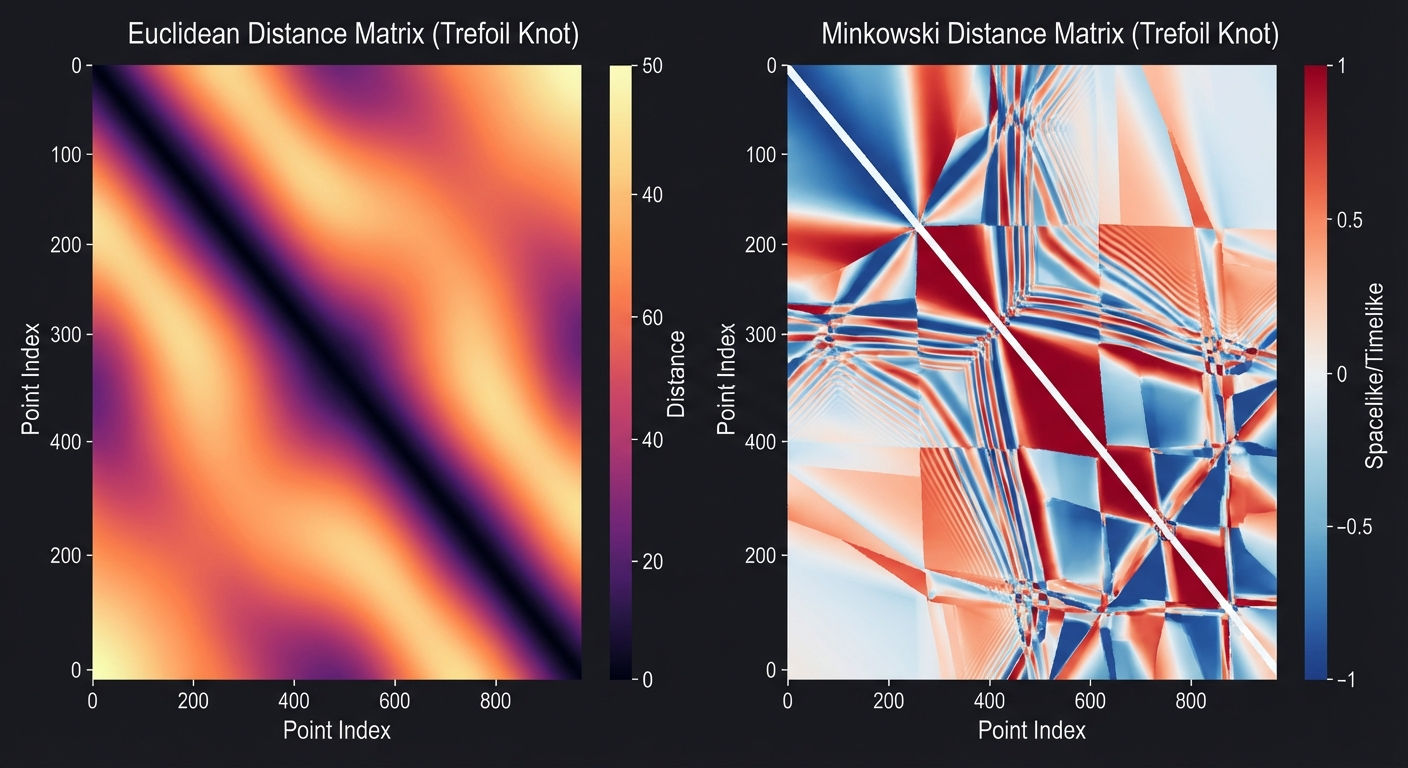
In Euclidean space, this matrix is just a smooth, hilly landscape. It tells us about geometry, but the topology is subtle. However, if we embed the knot in a 2+1 dimensional spacetime and apply the Minkowski Metric: $ s^2 = -c^2(t_i - t_j)^2 + (x_i - x_j)^2 + (y_i - y_j)^2 $
The landscape changes dramatically. The distance is no longer just a magnitude; it has a sign.
- $s^2 < 0$: Timelike (Causally connected)
- $s^2 > 0$: Spacelike (Causally disconnected)
- $s^2 = 0$: Lightlike (On the light cone)
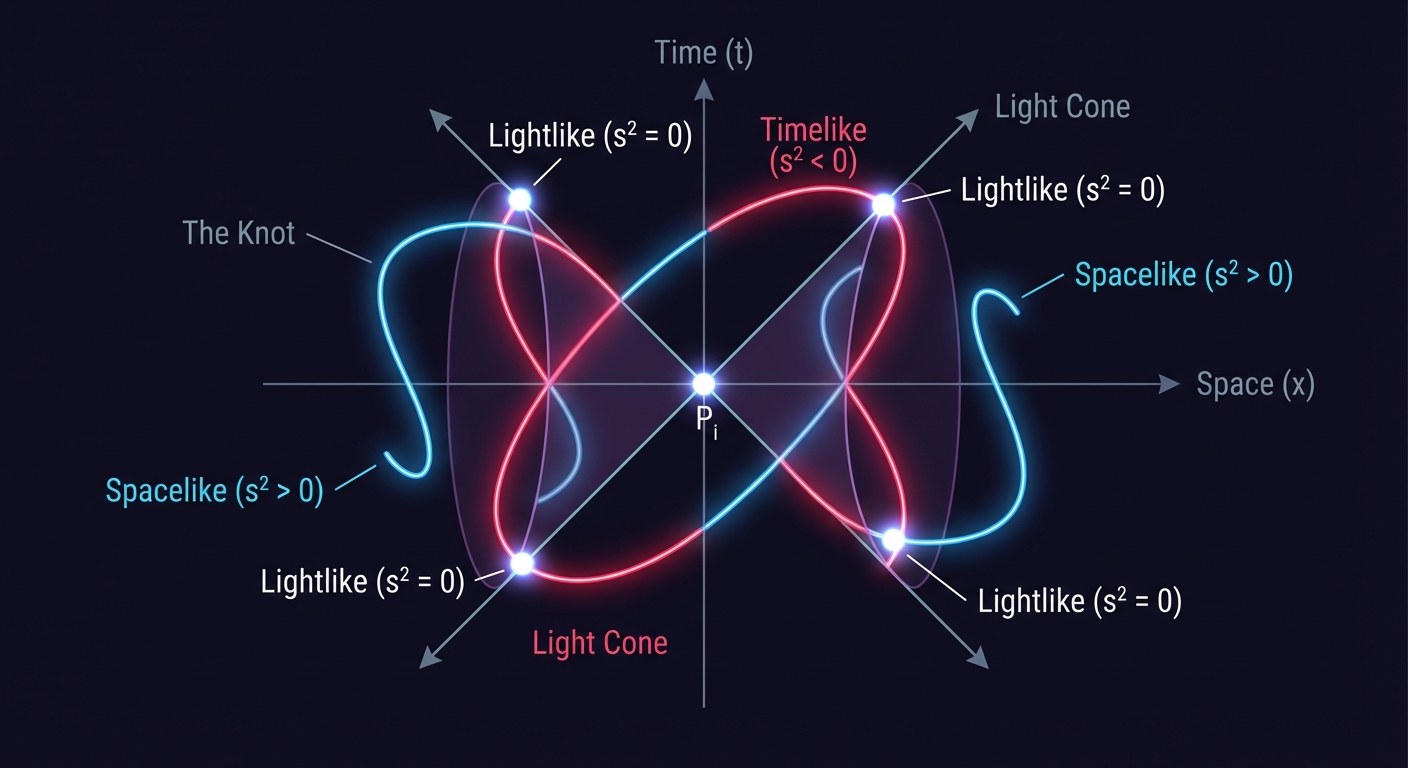
This sign structure acts as a “Z-buffer” for topology. It encodes the ordering of points in a way that captures the notion of “over” and “under” without needing a projection plane. If $s^2(A, B) < 0$ and $t_A > t_B$, then $A$ is in the absolute future of $B$. This causal ordering fixes the relative depth of the strands, turning topological ambiguity into causal certainty.
The Hierarchy of Constraints
In exploring this via the interactive lab, a profound distinction emerged between the physics of the curve and the topology of the sheet.
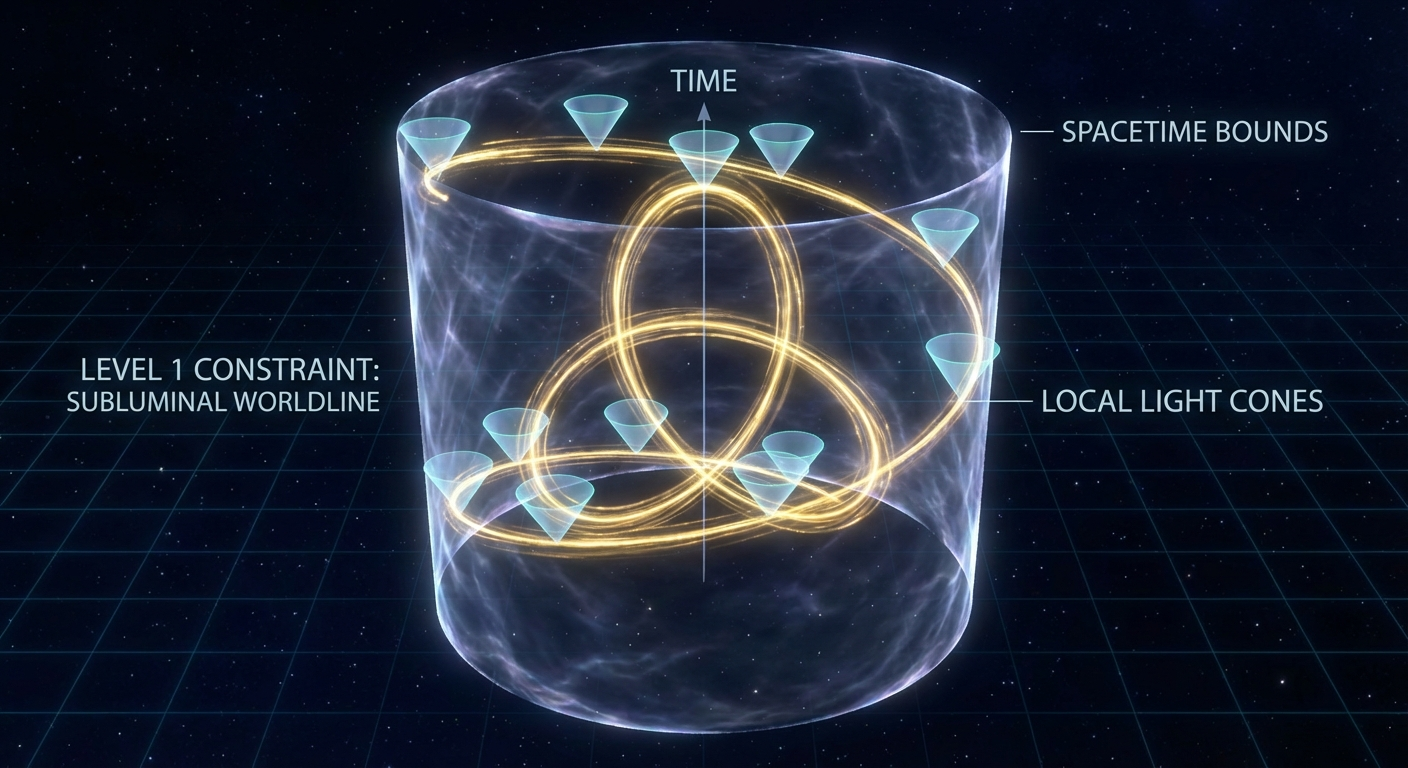
Level 1: The Curve (The Worldline)
If we view a knot as a particle’s path through spacetime (a worldline), we might ask: “Is this knot possible? Does it violate the speed of light?”
Critique of “Worldlines”: The terminology “worldline” is slightly misleading here. A worldline usually implies a particle’s history. A better physical analogue might be a vortex ring in a relativistic fluid or a cosmic string loop at a specific instant, extended into spacetime. The analysis treats the knot as a static 4D object rather than a dynamic evolution.
It turns out that for a closed knot to exist in Minkowski space, the answer is “Yes, but it must be superluminal.” Because a knot is a closed loop, the particle must eventually return to its starting time coordinate. This implies that $\oint dt = 0$, which is impossible for a strictly subluminal particle (which always moves forward in time).
Therefore, these “Minkowski Knots” trace worldlines that are largely, if not wholly, spacelike (non-causal). This creates a sort of Grandfather Paradox of Knots: To trace a knot in spacetime and return to where you started, you must eventually travel faster than light (or back in time).
The “Timelike Islands” we see in the distance matrix aren’t just abstract features; they represent the specific regions
where you are effectively time-traveling to cross “under” the rope. The structure we are analyzing is essentially the
causal footprint of a tachyon or a static string, not a standard particle.
Level 2: The Metric Sheet
However, if we look at the Metric Sheet—the surface defined by the pairwise Minkowski distances of all points $(s_1, s_2)$—the story changes.
The topology of the knot is encoded in the level sets and sign changes of this sheet. We define the sheet function $F$ on the torus of parameters $[0, L] \times [0, L]$: $ F(s_1, s_2) = \text{MinkowskiMetric}(\gamma(s_1), \gamma(s_2)) $
Here is the core insight: While the curve can avoid the light cone locally (tangent vectors remain inside the cone), the metric sheet cannot avoid it globally (secant vectors must cross the cone).
Consider the map $\Phi: T^2 \to \mathbb{R}^{2,1}$ defined by the difference
vectors $v(s_1, s_2) = \gamma(s_1) - \gamma(s_2)$. The metric sheet is essentially the pullback of the light cone
structure through this map. For non-trivial knots, the image of the torus $T^2$ wraps around the origin in such a way
that it must intersect the light cone surface non-trivially.
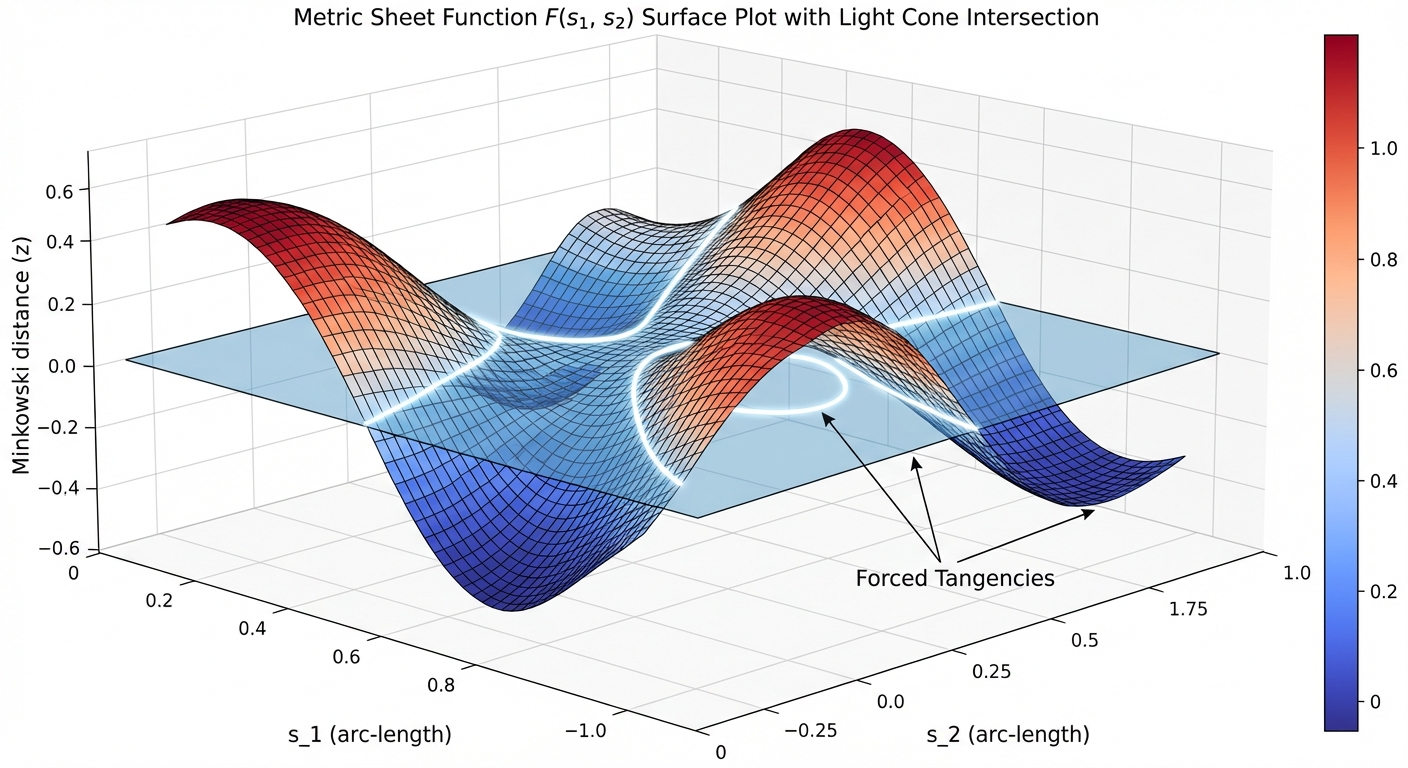
For a non-trivial knot (like a Trefoil), the metric sheet is forced to have tangencies or specific intersection patterns with the “light cone rays” (where $s^2=0$) in the target space. You cannot homotope these tangencies away without untying the knot.
This provides a rigorous definition of knot complexity based on negative space: A knot is non-trivial if its pairwise causal structure cannot avoid intersecting the light cone in specific, structured ways.
Proof Sketch: The Timelike Island
Why is this structure rigid? We can prove it by looking at the nature of a “crossing.”
- The Crossing is Timelike: In a standard spatial projection, a crossing occurs where two distinct points on the curve, $u$ and $v$, share the same spatial coordinates $\vec{x}$ but exist at different times $t$. \(\Delta \vec{x} = 0, \quad \Delta t \neq 0 \implies s^2 = -c^2\Delta t^2 < 0\) This creates a “valley” of negative (timelike) distance in the matrix.
- The Bulk is Spacelike: For a sufficiently large knot or a sufficiently fast (superluminal) traversal, the majority of point pairs are separated by space, not time. \(|\Delta \vec{x}| > c|\Delta t| \implies s^2 > 0\) This forms the “plateau” of positive (spacelike) distance.
- The Inevitable Boundary: By the Intermediate Value Theorem, any continuous path on the parameter torus connecting a crossing point $(u, v)$ to a generic bulk point must pass through $s^2 = 0$. Therefore, every topological crossing in the knot manifests as a Timelike Island surrounded by a Lightlike Shoreline ($s^2=0$) within the metric sheet. You cannot remove the crossing without merging the island into the mainland (unknotting) or collapsing the time dimension.
- Topological Stability: These islands are not merely artifacts of a specific parameterization. They correspond to the critical points of the distance function. In Morse theory terms, the creation or annihilation of these timelike islands corresponds to Reidemeister moves. Specifically, a Reidemeister II move (creating two crossings) appears as the birth of a pair of timelike islands (one positive, one negative in terms of oriented crossing sign) from the spacelike sea.
The “Minkowski Number”
Standard knot invariants include Jones Polynomials or Crossing Numbers. This framework suggests a new physical invariant: the Minkowski Number. Defined as the minimum volume of the “Timelike Islands” required to represent a specific knot type (normalized by arc length), it quantifies “how much causality must be violated” to tie a specific knot. A trivial knot (unknot) has a Minkowski Number of 0, as it can be deformed to lie entirely in a spacelike slice.
Visualizing the Theory
I built a WebGL simulation to explore this directly.
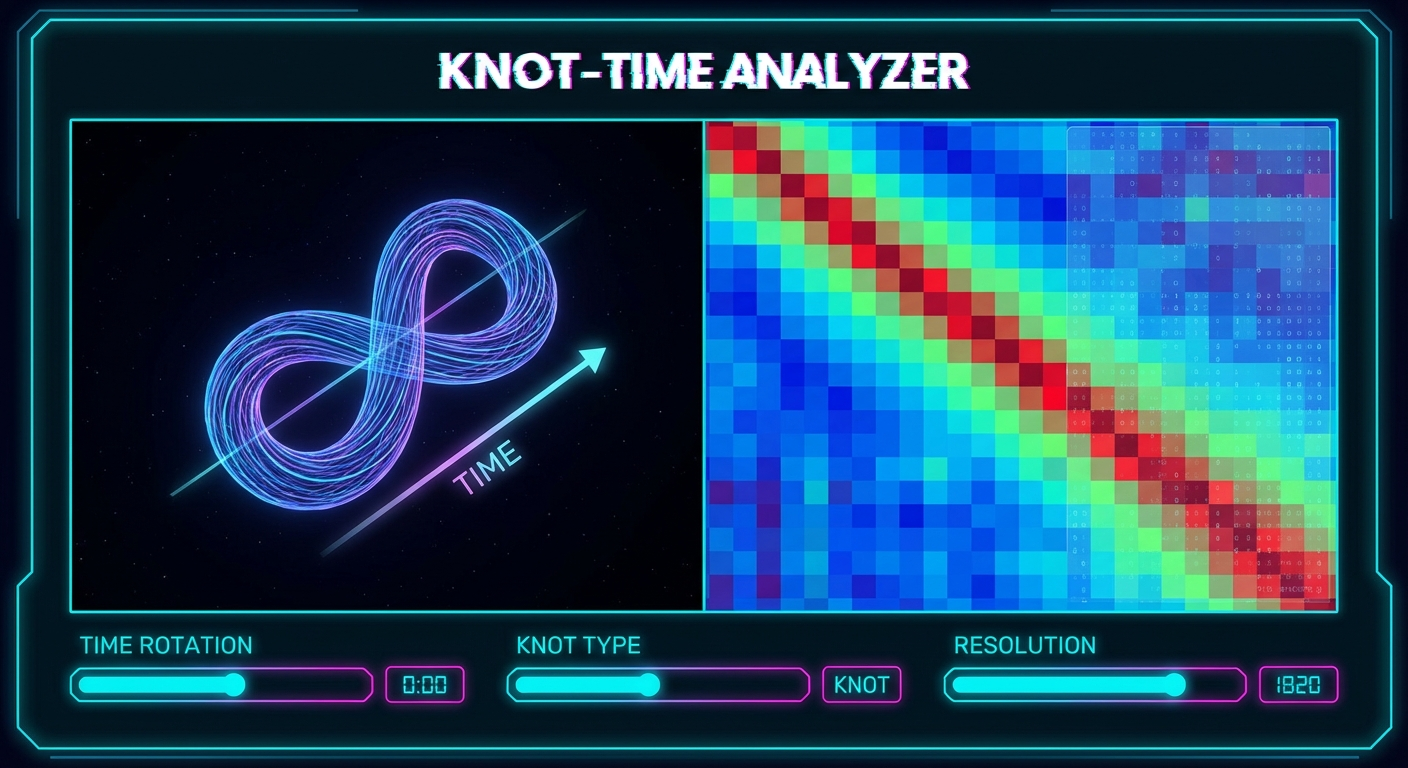
In the lab, you can:
- Generate Knots: Trefoils, Figure-8s, and random splines.
- Rotate Time: The visualization allows you to rotate the axis designated as “Time.” This isn’t just rotating the object; it changes the metric signature of the space.
- View the Matrix: Watch the distance matrix transform from a Euclidean hill to a Minkowski landscape.
As you rotate the time axis, you can see the “causal horizon” sweep across the knot. The ridges and valleys in the distance matrix shift, revealing the invariant structure of the knot not as a shape in space, but as a pattern of causal relationships.
Implications
This approach reframes relativistic knot theory. Instead of asking “How does this knot look to an observer?”, we ask “ What is the topology of the causal relationships between all points on this knot?”
It suggests a two-tier reality for relativistic systems:
- Parametrization (Physics): Flexible. We can move how we like, provided we stay subluminal.
- Relational Structure (Topology): Rigid. The web of causal connections forms a sheet that is pinned to the light cone structure of the universe.
This is a perfect example of incentive-shaped topology: the “incentive” is the speed of light, and the “topology” is the set of configurations that cannot escape that constraint.
Brainstorming Session Transcript
Input Files: content.md
Problem Statement: Generate a broad, divergent set of ideas, extensions, and applications inspired by the concept of Relativistic Knot Theory and the Minkowski Metric Sheet analysis. Explore how the mapping of topological crossings to ‘Timelike Islands’ can be applied across physics, computation, biology, and philosophy.
Started: 2026-03-03 12:41:08
Generated Options
1. Dark Matter as Relativistic Topological Defects in Spacetime
Category: Theoretical Physics & Cosmology
Propose that dark matter is not a particle but a collection of stable, non-radiating knots in the Minkowski metric. These ‘Timelike Islands’ exert gravitational pull by warping the local metric sheet without interacting with the electromagnetic field.
2. Knot-Induced Micro-Wormhole Stabilization for Quantum Communication
Category: Theoretical Physics & Cosmology
Utilize the topological crossings of the Minkowski sheet to create stable ‘Timelike Islands’ that act as anchors for micro-wormholes. This allows for secure, near-instantaneous information transfer by bypassing standard spatial distance through the knot’s interior geometry.
3. Causal-Invariant Cryptography via Spacetime Knot Signatures
Category: Information Theory & Cryptography
Develop encryption keys based on the specific topological configuration of a relativistic knot. Decryption is only possible at the precise ‘Timelike Island’ coordinates where the local metric signature matches the key’s geometric requirements.
4. Relativistic Braiding for Fault-Tolerant Topological Quantum Computing
Category: Information Theory & Cryptography
Implement qubits as crossings in a 4D spacetime manifold rather than 2D surfaces. The ‘Timelike Islands’ provide a natural buffer against decoherence by isolating the quantum state from external spatial perturbations within the knot’s structure.
5. Minkowski Metric Neural Networks for Non-Linear Time-Series Prediction
Category: Machine Learning & Data Science
Design a neural architecture where layers are treated as Minkowski sheets and weights are represented as topological crossings. The model treats ‘Timelike Islands’ as high-attention nodes where complex temporal features converge and interact.
6. Topological Manifold Alignment for Cross-Domain Causal Synthesis
Category: Machine Learning & Data Science
Use Relativistic Knot Theory to map disparate datasets onto a shared Minkowski sheet. Identifying ‘Timelike Islands’ allows the model to find hidden causal links between seemingly unrelated variables across different time scales and domains.
7. Relativistic Protein Folding Dynamics and Temporal Catalysis
Category: Biological & Chemical Systems
Model complex protein folding as a series of relativistic knots where ‘Timelike Islands’ represent high-energy transition states. This suggests that enzymes might locally manipulate the metric to accelerate reaction times beyond classical thermodynamic limits.
8. Epigenetic Memory as Topological Knots in Chromatin Spacetime
Category: Biological & Chemical Systems
View the 4D trajectory of a cell’s genome as a relativistic knot. ‘Timelike Islands’ at specific crossings could serve as stable storage points for epigenetic information, making the data resistant to cellular aging and environmental noise.
9. Interferometric Sensors for Detecting Metric Sheet Crossings
Category: Speculative Engineering & Sensors
Build ultra-sensitive detectors designed to identify the subtle gravitational and temporal anomalies produced by naturally occurring ‘Timelike Islands.’ These sensors could map the hidden topological structure of the local vacuum for advanced navigation.
10. Topological Propulsion via Controlled Metric Sheet Deformation
Category: Speculative Engineering & Sensors
Conceptualize a drive system that creates artificial ‘Timelike Islands’ in front of a craft. By ‘knotting’ the local Minkowski metric, the craft could achieve apparent superluminal travel by sliding through topological shortcuts in the sheet.
11. The Island Theory of Subjective Temporal Experience
Category: Philosophical & Narrative Applications
Explore the philosophical idea that human consciousness resides only at the ‘Timelike Islands’ of our worldline’s knots. This suggests that our perception of continuous time is an illusion created by the mind jumping between discrete topological crossings.
12. Ethical Determinism and the Geometry of Causal Knots
Category: Philosophical & Narrative Applications
Analyze moral responsibility through the lens of relativistic knots, where ‘Timelike Islands’ represent inevitable causal intersections. This framework questions whether ‘choice’ exists at the crossing or if the topology of the sheet pre-determines the outcome.
Option 1 Analysis: Dark Matter as Relativistic Topological Defects in Spacetime
✅ Pros
- Eliminates the need for undiscovered particles (WIMPs or axions), simplifying the ontology of the Standard Model.
- Naturally explains the lack of electromagnetic interaction, as topological defects in the metric are geometric rather than field-based.
- Provides a unified geometric framework for both gravity and the ‘missing mass’ problem within General Relativity.
- Offers a potential explanation for the stability of dark matter through topological protection (knot invariants).
- Aligns with the ‘geometrodynamics’ vision of physics where matter properties emerge from spacetime structure.
❌ Cons
- Extremely high mathematical complexity in proving the stability of knots within a 4D Lorentzian manifold.
- Difficulty in reconciling topological defects with the observed power spectrum of the Cosmic Microwave Background (CMB).
- Current lack of a clear mechanism for how these knots would cluster into the observed dark matter halos around galaxies.
- Potential conflict with the Equivalence Principle if the ‘knots’ respond to gravity differently than baryonic matter.
📊 Feasibility
Low to moderate. While mathematically grounded in topology, the computational simulation of non-linear metric warping in a relativistic context requires next-generation numerical relativity frameworks and significant theoretical breakthroughs in 4D knot invariants.
💥 Impact
High. If proven, it would trigger a paradigm shift from particle-based cosmology to a purely geometric understanding of the universe, potentially leading to new methods of manipulating or interacting with the spacetime metric.
⚠️ Risks
- The theory may be mathematically consistent but physically unfalsifiable with current observational technology.
- Mathematical proofs might eventually show that such knots are unstable and would ‘unravel’ over cosmological timescales.
- Focusing on topological defects might divert resources from particle detection experiments that could be on the verge of success.
📋 Requirements
- Development of a robust Relativistic Knot Theory specifically for Minkowski and pseudo-Riemannian metrics.
- Supercomputing resources capable of performing high-resolution 4D topological simulations.
- Advanced gravitational wave detectors to identify unique ‘ringdown’ signatures of topological defects compared to black holes.
- Interdisciplinary collaboration between algebraic topologists and theoretical astrophysicists.
Option 2 Analysis: Knot-Induced Micro-Wormhole Stabilization for Quantum Communication
✅ Pros
- Provides a novel topological solution to the instability problem of micro-wormholes using ‘Timelike Islands’ as anchors.
- Potential for ultra-secure communication as the signal path exists outside conventional 3D spatial coordinates.
- Offers a theoretical framework for low-latency interstellar communication, bypassing the limitations of the speed of light in vacuum.
- Leverages the mathematical robustness of knot theory to ensure the structural integrity of the communication channel.
❌ Cons
- Relies on highly speculative physics (Relativistic Knot Theory) that lacks empirical verification.
- The energy density required to manipulate the Minkowski metric into specific topological crossings may be prohibitively high.
- Potential for extreme signal decoherence or ‘topological noise’ when passing through the knot’s interior geometry.
- Difficulty in precisely mapping and targeting specific ‘Timelike Islands’ across vast distances.
📊 Feasibility
Low. Current technology cannot manipulate spacetime topology at the Planck scale, and the theoretical framework requires a validated theory of Quantum Gravity that incorporates relativistic knotting.
💥 Impact
Revolutionary. If realized, it would enable instantaneous global and interplanetary data networks, fundamentally altering human civilization’s relationship with distance and time.
⚠️ Risks
- Causality violations: Near-instantaneous transfer could theoretically allow for information to be sent back in time, creating temporal paradoxes.
- Spacetime instability: Artificial manipulation of the Minkowski sheet could lead to localized vacuum decay or uncontrolled singularities.
- Information loss: The ‘no-cloning theorem’ and Hawking radiation effects at the wormhole mouth could destroy quantum states.
📋 Requirements
- A complete mathematical model of Relativistic Knot Theory and its interaction with the Minkowski Metric.
- Discovery or synthesis of exotic matter with negative energy density to keep the micro-wormhole throats open.
- Advanced quantum error correction capable of handling topological distortions.
- High-precision metric-engineering tools to induce specific crossings in the spacetime fabric.
Option 3 Analysis: Causal-Invariant Cryptography via Spacetime Knot Signatures
✅ Pros
- Provides a multi-dimensional security layer where physical location and temporal state are intrinsic to the decryption process.
- Inherently resistant to traditional brute-force attacks, as the ‘search space’ includes relativistic coordinates and local gravitational signatures.
- Ensures causal integrity, meaning information can only be accessed by an observer whose worldline intersects specific ‘Timelike Islands’.
- Creates a new paradigm for ‘geofenced’ data that is enforced by the laws of physics rather than software protocols.
❌ Cons
- Extreme sensitivity to local gravitational fluctuations (e.g., planetary movement) could render keys unusable.
- High computational complexity involved in simulating and verifying relativistic knot invariants under varying metric signatures.
- Relativistic time dilation makes synchronization between the sender’s and receiver’s ‘Timelike Islands’ mathematically grueling.
- The requirement for precise spacetime positioning limits the portability and immediate accessibility of the encrypted data.
📊 Feasibility
Low in the near term; it requires the development of high-precision quantum sensors capable of measuring local Minkowski metric deviations and advanced topological quantum computing to process knot invariants in real-time.
💥 Impact
This would revolutionize secure communications for deep-space exploration and high-stakes orbital infrastructure, creating ‘unhackable’ data vaults that are physically tied to specific points in the manifold of spacetime.
⚠️ Risks
- Permanent data loss if the specific spacetime coordinate or metric signature becomes unreachable or shifts due to unforeseen cosmic events.
- Potential for ‘metric jamming’ where an adversary uses high-mass objects or energy to warp the local metric, preventing legitimate decryption.
- Technological disparity, where only entities with advanced relativistic sensors can participate in or verify the communication.
📋 Requirements
- Advanced quantum gravity sensors capable of detecting sub-atomic fluctuations in the local metric signature.
- A robust mathematical framework mapping Jones polynomials or other knot invariants to Minkowski metric tensors.
- Ultra-precise relativistic positioning systems that exceed the capabilities of current GPS/GNSS.
- Development of ‘Metric-Aware’ hardware capable of integrating environmental spacetime data into cryptographic algorithms.
Option 4 Analysis: Relativistic Braiding for Fault-Tolerant Topological Quantum Computing
✅ Pros
- Provides a novel mechanism for decoherence protection by utilizing the temporal dimension as a buffer, potentially exceeding the stability of 2D anyonic systems.
- Leverages the topological invariance of 4D knots, making the quantum information resistant to local spatial noise and Lorentz transformations.
- Enables a more complex gate set through higher-dimensional braiding, potentially simplifying the implementation of non-Abelian operations.
- The ‘Timelike Island’ concept offers a theoretical framework for localized quantum memory that is isolated from the surrounding entropy of the environment.
❌ Cons
- Extreme mathematical complexity in mapping 4D manifold crossings to specific quantum gate operations compared to standard 2D braiding.
- Lack of current experimental methods to manipulate or ‘braid’ spacetime metrics at the quantum scale.
- Significant difficulty in performing non-destructive measurements on a state embedded within a relativistic knot structure.
- Potential for high computational overhead in simulating and verifying the topological properties of 4D manifolds.
📊 Feasibility
Low in the immediate term. While mathematically rich, the physical implementation requires a level of control over spacetime geometry (or high-fidelity simulation via metamaterials) that currently exceeds our technological capabilities. It remains a high-value theoretical frontier.
💥 Impact
If realized, this would represent a paradigm shift in quantum computing, moving from error-correction codes to inherent, hardware-level fault tolerance. It could lead to the development of ‘eternal’ quantum memory and ultra-secure cryptographic protocols based on spacetime topology.
⚠️ Risks
- The energy densities required to create localized metric distortions could be prohibitive or destructive to the quantum system.
- Theoretical risk that 4D braiding may not map to a universal set of quantum gates as cleanly as 2D anyonic braiding.
- Potential for unforeseen relativistic effects, such as micro-scale causality issues, to interfere with the coherence of the ‘Timelike Islands’.
📋 Requirements
- Advanced mathematical frameworks combining 4-manifold topology with Relativistic Quantum Field Theory.
- Development of ‘Minkowski Metamaterials’ capable of simulating 4D spacetime curvatures in a laboratory setting.
- New quantum algorithms specifically designed to exploit the degrees of freedom provided by 4D relativistic knots.
- High-precision synchronization and timing systems to manage the ‘Timelike’ aspects of the braiding process.
Option 5 Analysis: Minkowski Metric Neural Networks for Non-Linear Time-Series Prediction
✅ Pros
- Naturally encodes causal constraints through light-cone structures, inherently preventing ‘future-leakage’ in time-series modeling.
- Provides a rigorous geometric framework for multi-scale temporal attention, treating ‘Timelike Islands’ as convergence points for complex features.
- Topological crossings offer a novel way to represent feature interactions that are invariant under certain temporal deformations, potentially increasing model robustness.
- Offers a path toward ‘Physics-Informed’ architectures that can model relativistic or high-velocity data streams more accurately than Euclidean networks.
❌ Cons
- Standard backpropagation is optimized for Euclidean space; adapting it to Minkowski space requires complex pseudo-Riemannian manifold gradients.
- High computational overhead associated with calculating topological properties or knot-theoretic invariants during the forward and backward passes.
- Lack of existing software libraries and hardware acceleration for non-Euclidean, metric-specific tensor operations.
- The mapping of ‘topological crossings’ to weights is abstract and may lead to difficulties in initialization and convergence.
📊 Feasibility
Moderate. While the mathematical theory is complex, recent advances in Geometric Deep Learning and Lorentz-equivariant networks provide a foundation. The primary hurdle is the differentiable implementation of topological invariants as learnable parameters.
💥 Impact
High. This could lead to a breakthrough in predicting chaotic or non-linear systems (e.g., climate modeling, high-frequency trading, or astrophysical signals) where temporal topology is more critical than raw magnitude.
⚠️ Risks
- Numerical instability due to the indefinite nature of the Minkowski metric, where intervals can be zero or negative.
- The model may become overly constrained by its geometric priors, failing to capture patterns in data that do not follow physical/causal symmetries.
- Increased ‘black box’ complexity, where the latent topological states become harder for humans to interpret than standard attention maps.
📋 Requirements
- Deep expertise in differential geometry, relativistic physics, and deep learning architecture design.
- Development of custom differentiable solvers for topological invariants (e.g., adapted Jones polynomials or writhe calculations).
- High-performance computing (HPC) resources and custom CUDA kernels to handle non-standard metric calculations efficiently.
Option 6 Analysis: Topological Manifold Alignment for Cross-Domain Causal Synthesis
✅ Pros
- Enables the discovery of non-linear causal relationships that traditional correlation-based models miss by focusing on topological crossings.
- Provides a unified geometric framework for integrating multi-scale data, such as linking micro-level biological signals with macro-level environmental trends.
- Topological invariants offer a degree of robustness against noise, as the ‘knot’ structure remains consistent even if data points shift slightly.
- The Minkowski metric allows for the explicit modeling of ‘information latency’ between disparate domains, treating data propagation like a light-cone constraint.
❌ Cons
- Defining a meaningful ‘distance’ and ‘time’ metric for abstract, non-physical datasets is highly subjective and can lead to arbitrary results.
- Calculating knot invariants and performing manifold alignment on high-dimensional datasets is computationally expensive and may not scale well.
- The complexity of the mathematical framework makes the results difficult for non-experts to interpret or validate.
- Risk of ‘topological hallucinations’ where the model identifies crossings that are artifacts of the mapping process rather than true causal links.
📊 Feasibility
Low to Moderate. While manifold learning (like UMAP) and causal inference are established, the integration of Relativistic Knot Theory requires specialized mathematical kernels that are not yet standard in ML libraries. Implementation would require a bespoke hybrid of algebraic topology and deep learning.
💥 Impact
High. If successful, this could break down data silos in complex fields like systems biology, global economics, and climate science, revealing how distant variables interact through hidden topological structures.
⚠️ Risks
- Spurious Causal Synthesis: Forcing disparate datasets onto a shared sheet may create ‘Timelike Islands’ that represent coincidental alignments rather than functional relationships.
- Over-parameterization: The flexibility of topological mapping might lead to models that perfectly fit historical data but fail to predict future causal shifts.
- Ethical Misinterpretation: Using abstract causal links to drive policy or medical decisions without a clear mechanistic understanding could lead to unintended consequences.
📋 Requirements
- Expertise in Algebraic Topology, Differential Geometry, and Causal Inference.
- High-performance computing clusters capable of handling complex manifold transformations.
- Large-scale, time-stamped datasets from at least two distinct domains for cross-synthesis.
- Development of new ‘Topological Loss Functions’ to guide the alignment of the Minkowski sheets.
Option 7 Analysis: Relativistic Protein Folding Dynamics and Temporal Catalysis
✅ Pros
- Provides a novel mathematical framework to address Levinthal’s Paradox by explaining how proteins navigate vast conformational spaces rapidly.
- Offers a potential theoretical bridge between topological knot theory and non-equilibrium thermodynamics in biological systems.
- Could identify ‘topological bottlenecks’ in folding that are currently invisible to standard molecular dynamics simulations.
- Suggests a new class of ‘temporal catalysts’ that optimize reaction pathways by treating time as a local variable within the molecular geometry.
❌ Cons
- The energy scales required for actual metric manipulation (General Relativity) are many orders of magnitude beyond biological systems.
- Current experimental techniques in structural biology lack the temporal resolution to validate ‘timelike islands’ at the sub-femtosecond scale.
- Risk of being purely metaphorical; the mathematical elegance may not translate into predictive power for actual biochemical reactions.
- Highly complex mathematical overhead compared to existing, effective models like Markov State Models (MSMs).
📊 Feasibility
Low for physical validation, but Moderate for computational modeling. While enzymes likely don’t warp spacetime in a literal sense, using the Minkowski metric as a heuristic for ‘effective time’ in high-energy transition states is a viable simulation strategy.
💥 Impact
If proven, this would revolutionize drug design and synthetic biology by allowing researchers to target the temporal flow of a folding event rather than just the static structure of the protein.
⚠️ Risks
- Potential for ‘pseudoscientific’ misinterpretation where relativistic terms are used loosely without rigorous physical grounding.
- Diversion of research funding from more established, evidence-based biochemical modeling approaches.
- Computational models may become ‘black boxes’ that are mathematically consistent but biologically irrelevant.
📋 Requirements
- Interdisciplinary expertise in 4D topology, relativistic physics, and protein biochemistry.
- Advanced high-performance computing (HPC) resources capable of simulating Minkowski-based topological manifolds.
- Access to ultra-fast femtosecond or attosecond spectroscopy to observe high-energy transition states in real-time.
- Development of new software libraries that integrate relativistic knot invariants into molecular dynamics engines.
Option 8 Analysis: Epigenetic Memory as Topological Knots in Chromatin Spacetime
✅ Pros
- Provides a robust mathematical framework for understanding how epigenetic information persists despite high thermal noise and molecular crowding.
- Offers a novel explanation for cellular memory that transcends simple chemical gradients, focusing on the 4D structural integrity of the genome.
- Creates a bridge between theoretical physics (Minkowski metrics) and molecular biology, potentially leading to new interdisciplinary discovery methods.
- Suggests a mechanism for cellular aging as the ‘topological decay’ or loss of specific timelike crossings over time.
❌ Cons
- The application of ‘relativistic’ concepts to biological systems is largely metaphorical, as cellular processes occur at non-relativistic speeds.
- Current imaging technologies (like Hi-C or live-cell imaging) lack the temporal and spatial resolution to fully map 4D knots at the scale required.
- The computational complexity of modeling thousands of interacting 4D knots in a single nucleus is currently prohibitive.
📊 Feasibility
Low to moderate; while the theoretical framework can be developed now, experimental validation requires significant advancements in 4D nucleome mapping and high-resolution live-cell microscopy.
💥 Impact
High; if proven, this could redefine our understanding of heredity and aging, leading to ‘topological therapies’ that stabilize chromatin structures to treat age-related diseases or cancer.
⚠️ Risks
- The model may oversimplify the role of proteins and chemical modifications (like methylation) in favor of pure geometry.
- Interventions based on topological manipulation could lead to unforeseen genomic instability or catastrophic cellular failure.
- Misinterpretation of topological ‘noise’ as ‘signal’ could lead to incorrect conclusions about gene regulation.
📋 Requirements
- High-resolution 4D Nucleome data (spatial organization over time).
- Advanced Topological Data Analysis (TDA) algorithms capable of processing Minkowski metric sheets.
- Interdisciplinary collaboration between relativistic physicists, polymer mathematicians, and molecular biologists.
- Supercomputing resources to simulate the 4D trajectory of chromatin under various environmental stressors.
Option 9 Analysis: Interferometric Sensors for Detecting Metric Sheet Crossings
✅ Pros
- Enables a novel form of ‘topological navigation’ that does not rely on external beacons, satellites, or celestial bodies.
- Provides a practical experimental framework to validate or refute the existence of Relativistic Knot Theory structures.
- Leverages existing high-precision technology (interferometry) but applies it to a new domain of vacuum cartography.
- Could potentially detect ‘dark’ topological features of spacetime that are invisible to electromagnetic sensors.
- Offers a potential method for detecting subtle gravitational gradients that current sensors might overlook as noise.
❌ Cons
- The signal-to-noise ratio is likely to be extremely low, as ‘Timelike Islands’ may produce anomalies smaller than the quantum noise floor.
- Current interferometric technology (like LIGO) requires kilometer-scale arms, making portable navigation sensors currently impossible.
- The theoretical signature of a ‘Metric Sheet Crossing’ is not yet defined, making it difficult to distinguish from environmental interference.
- Naturally occurring crossings might be too sparse or transient to be useful for reliable navigation.
📊 Feasibility
Low in the immediate term. While interferometry is a mature field, the sensitivity required to detect sub-atomic topological fluctuations in the metric sheet exceeds current capabilities by several orders of magnitude. It requires significant breakthroughs in quantum squeezing and miniaturization.
💥 Impact
If successful, this would revolutionize deep-space exploration and fundamental physics, moving us from a ‘coordinate-based’ understanding of space to a ‘topological’ one. It would allow for the mapping of the vacuum itself as a navigable medium.
⚠️ Risks
- High risk of false positives where local gravitational gradients or seismic noise are misinterpreted as topological crossings.
- Potential for significant ‘sunk cost’ if the Minkowski Metric Sheet does not exhibit detectable physical crossings at the predicted scales.
- Navigation failures if the ‘Timelike Islands’ are dynamic or shift due to large-scale mass movements in the galaxy.
📋 Requirements
- Development of quantum-limited or sub-shot-noise interferometers using squeezed light states.
- A comprehensive mathematical library of ‘topological signatures’ to identify specific types of crossings.
- Space-based deployment platforms to eliminate terrestrial seismic and atmospheric noise.
- Ultra-high-performance computing for real-time deconvolution of complex spacetime interference patterns.
Option 10 Analysis: Topological Propulsion via Controlled Metric Sheet Deformation
✅ Pros
- Offers a theoretical framework for superluminal travel that bypasses traditional Newtonian propulsion limitations.
- Utilizes topological invariants which may be more stable than simple metric expansion/contraction (like the Alcubierre drive).
- Potential for zero-acceleration transit, minimizing G-force stress on the craft and occupants.
- Could enable ‘non-local’ navigation, allowing for jumps between specific topological coordinates rather than linear travel.
❌ Cons
- Likely requires ‘exotic matter’ with negative energy density, which has not been proven to exist in macro quantities.
- Extreme mathematical complexity in calculating and maintaining the stability of a ‘knot’ in the Minkowski sheet.
- The boundary layers of the Timelike Islands would likely produce lethal Hawking radiation or extreme tidal forces.
- Potential for ‘topological trapping’ where the craft cannot unfold the knot to return to standard spacetime.
📊 Feasibility
Extremely low in the near-to-mid term. This concept resides in the realm of high-level theoretical physics and requires a unified theory of quantum gravity and the ability to manipulate the metric at a fundamental level, which are currently beyond human technological capability.
💥 Impact
If realized, this would fundamentally transform human civilization by making the entire galaxy accessible within human lifetimes, effectively ending the isolation of the solar system and revolutionizing our understanding of causality and spacetime geometry.
⚠️ Risks
- Violation of causality leading to closed timelike curves and potential temporal paradoxes.
- Accidental creation of micro-singularities or localized event horizons during the ‘knotting’ process.
- Catastrophic release of energy if the metric deformation collapses or ‘snaps’ back to its original state.
- Unintended interaction with the vacuum state, potentially triggering a localized vacuum decay event.
📋 Requirements
- A complete and validated theory of Quantum Gravity and Relativistic Knot Theory.
- Technological means to generate and sustain negative energy densities or exotic matter fields.
- Exascale or quantum computing systems capable of real-time topological mapping and metric adjustment.
- Materials science breakthroughs to create hulls capable of withstanding extreme metric gradients at the ‘island’ boundary.
Option 11 Analysis: The Island Theory of Subjective Temporal Experience
✅ Pros
- Provides a novel geometric framework for understanding subjective time dilation and contraction based on ‘crossing density’.
- Offers a potential bridge between relativistic physics and the ‘cinematic’ theory of consciousness.
- Creates a unique narrative device for exploring identity as a topological property rather than a continuous linear progression.
- Aligns with certain quantum theories of mind that suggest consciousness operates in discrete ‘events’ or ‘orchestrated objectives’.
- Encourages a multidisciplinary approach involving topology, phenomenology, and neuroscience.
❌ Cons
- Extremely difficult to empirically verify or measure ‘topological crossings’ in a biological worldline.
- May conflict with current neurobiological understandings of continuous electrochemical signaling.
- Risk of being dismissed as ‘physics-flavored’ mysticism without a rigorous mathematical bridge to neural activity.
- Does not easily account for the subjective feeling of continuity (the ‘filling-in’ problem) without additional complex mechanisms.
📊 Feasibility
High as a philosophical or narrative framework, but low as a testable scientific hypothesis. Implementation requires conceptual modeling rather than physical experimentation.
💥 Impact
Could redefine the philosophy of time, shifting the focus from ‘duration’ to ‘topological interaction’. It has the potential to inspire a new genre of speculative fiction and provide fresh metaphors for psychological states.
⚠️ Risks
- Potential for existential distress if individuals perceive their ‘self’ as fragmented or non-continuous.
- Misappropriation of complex physical concepts (Minkowski metrics) to justify unfounded metaphysical claims.
- Over-simplification of the relationship between physical worldlines and the complexity of human experience.
📋 Requirements
- Expertise in Minkowski geometry and knot theory to maintain internal consistency.
- Collaboration between theoretical physicists and phenomenologists.
- Development of a formal symbolic language to map ‘islands’ to specific cognitive states.
- Narrative platforms (literature, film, or digital media) to explore and communicate the implications.
Option 12 Analysis: Ethical Determinism and the Geometry of Causal Knots
✅ Pros
- Provides a rigorous geometric visualization for the abstract debate between determinism and free will.
- Offers a novel framework for ‘Moral Luck’ by attributing causal intersections to the underlying topology of the Minkowski sheet.
- Bridges the gap between theoretical physics and normative ethics, potentially creating a new interdisciplinary field of ‘Topological Ethics’.
- Allows for the categorization of ‘Inevitable Events’ (Timelike Islands) versus ‘Flexible Paths’, helping to prioritize where human agency is most effective.
❌ Cons
- Risk of physical reductionism, where complex human behavior is oversimplified into mathematical nodes.
- The metaphor may lack empirical testability, remaining a purely theoretical or narrative construct.
- Could be used to justify moral apathy or the evasion of responsibility by claiming ‘topological inevitability’.
- High conceptual barrier to entry requires deep knowledge of both relativistic physics and philosophical ethics.
📊 Feasibility
High for philosophical discourse, narrative media, and theoretical modeling, but low for practical application in legal or psychological settings due to the lack of measurable ‘causal sheets’.
💥 Impact
Could fundamentally shift the focus of justice systems from individual retribution to ‘topological intervention’—identifying and altering the systemic conditions that create inevitable negative causal knots.
⚠️ Risks
- The ‘Fatalism Trap’: Individuals may feel disempowered if they believe their life’s ‘crossings’ are pre-determined by a metric sheet.
- Misinterpretation of the physics: Using relativistic terminology incorrectly could lead to pseudo-scientific justifications for unethical behavior.
- Erosion of agency: Over-emphasizing the ‘topology’ might lead to the neglect of personal growth and the power of conscious decision-making.
📋 Requirements
- Interdisciplinary collaboration between theoretical physicists, topologists, and ethicists.
- Development of symbolic logic or mathematical notation to map moral choices to topological crossings.
- Narrative frameworks (e.g., literature or simulations) to test the psychological impact of this worldview on subjects.
- Advanced computational modeling to visualize complex ‘causal sheets’ in multi-agent systems.
Brainstorming Results: Generate a broad, divergent set of ideas, extensions, and applications inspired by the concept of Relativistic Knot Theory and the Minkowski Metric Sheet analysis. Explore how the mapping of topological crossings to ‘Timelike Islands’ can be applied across physics, computation, biology, and philosophy.
🏆 Top Recommendation: Minkowski Metric Neural Networks for Non-Linear Time-Series Prediction
Design a neural architecture where layers are treated as Minkowski sheets and weights are represented as topological crossings. The model treats ‘Timelike Islands’ as high-attention nodes where complex temporal features converge and interact.
Option 5 is selected as the superior recommendation because it offers the highest balance of theoretical novelty and practical feasibility. Unlike the physical or cosmological options (1, 2, 3, 4, 9, 10), which require technological capabilities centuries beyond current limits (such as Planck-scale manipulation), Option 5 translates the mathematical rigor of Relativistic Knot Theory into a computational framework that can be implemented using existing Geometric Deep Learning and Lie Group neural network libraries. It provides a concrete, actionable path to utilize the ‘Timelike Island’ concept as a high-attention mechanism for complex time-series data, offering a potential breakthrough in fields like financial modeling or climate prediction without violating the laws of physics or requiring unreachable energy densities.
Summary
The brainstorming session explored the ‘Relativistic Knot Theory’ and ‘Minkowski Metric Sheet’ concepts across a wide spectrum of disciplines. The findings suggest that while the physical manipulation of spacetime topology remains firmly in the realm of theoretical physics and far-future engineering, the mathematical abstractions—specifically the mapping of topological crossings to ‘Timelike Islands’—have immediate utility in information theory, manifold learning, and complex system modeling. The general trend indicates that the most viable applications involve treating the Minkowski metric as a geometric prior for data architecture rather than a physical substrate for hardware.
Session Complete
Total Time: 232.312s Options Generated: 12 Options Analyzed: 12 Completed: 2026-03-03 12:45:01
Multi-Perspective Analysis Transcript
Subject: Relativistic Knot Theory: Topology in the Minkowski Metric Sheet
Perspectives: Theoretical Physicist (Focus on Minkowski metric, causal structures, and the ‘Minkowski Number’ invariant), Topologist (Focus on knot invariants, Morse theory, and the mapping of the parameter torus to Minkowski space), Computational Scientist/Software Engineer (Focus on Distance Matrix Analysis, WebGL simulation, and algorithmic efficiency), Philosopher of Science (Focus on the relationship between physical constraints and topological rigidity, and the ‘Grandfather Paradox of Knots’)
Consensus Threshold: 0.8
Theoretical Physicist (Focus on Minkowski metric, causal structures, and the ‘Minkowski Number’ invariant) Perspective
This analysis examines the “Relativistic Knot Theory” proposal through the lens of a Theoretical Physicist specializing in Lorentzian geometry and causal structures.
1. Theoretical Analysis: The Lorentzian Topology of Knots
From a relativistic perspective, the transition from a Euclidean distance matrix to a Minkowski distance matrix is not merely a change in calculation; it is a phase transition in topological encoding. In Euclidean space, the distance matrix $D_{ij}$ is a positive-definite scalar field. In Minkowski space $\mathbb{R}^{2,1}$ (or $\mathbb{R}^{3,1}$), the metric $s^2 = \eta_{\mu\nu} \Delta x^\mu \Delta x^\nu$ introduces a null-cone boundary that partitions the relational space of the knot into three distinct causal domains.
The “Timelike Island” as a Topological Proxy
The most profound insight here is the identification of a “crossing” as a timelike interval. In classical knot theory, a crossing is a projection artifact. In this relativistic framework, a crossing is a physical reality: two points on the curve that occupy the same spatial coordinates but are separated by a temporal interval.
- Causal Ordering: If $s^2(p_1, p_2) < 0$, the points are causally connected. The sign of $\Delta t$ determines which strand is “over” (future) and which is “under” (past).
- Lorentz Invariance: Because $s^2$ is a Lorentz invariant, the “timelike” nature of a crossing is preserved under boosts. While a boost might change the magnitude of the temporal separation, it cannot flip a timelike interval to a spacelike one. This makes the “Timelike Island” a robust topological feature.
The Metric Sheet and the Torus $T^2$
The mapping $\Phi: T^2 \to \mathbb{R}$ where $F(s_1, s_2) = s^2(\gamma(s_1), \gamma(s_2))$ defines a scalar field on a torus. The “Lightlike Shoreline” ($s^2=0$) represents the intersection of the knot’s pairwise difference vectors with the light cone. For a non-trivial knot, the “Metric Sheet” must possess a specific Morse-theoretic structure. The number of local minima where $s^2 < 0$ corresponds to the minimum crossing number of the knot.
2. Key Considerations, Risks, and Opportunities
Key Considerations:
- The Superluminal Constraint: As noted in the subject, a closed knot in $\mathbb{R}^{2,1}$ cannot be a subluminal worldline. If $\oint \dot{\gamma}^\mu ds = 0$, then the tangent vector $\dot{\gamma}$ must be spacelike for at least part of the loop. This implies these knots are models for spacelike strings or tachyonic loops, rather than the paths of massive particles.
- Metric Signature Sensitivity: The analysis assumes a fixed “Time” direction to define the islands. However, in a true relativistic sense, “Time” is just one dimension. Rotating the time axis (as seen in the lab) is equivalent to changing the observer’s frame. The “Minkowski Number” must be defined as an invariant across all valid timelike vectors $v^\mu$.
Risks:
- Degeneracy at the Light Cone: If a segment of the knot becomes lightlike (tangent to the light cone), the distance matrix develops singularities in its gradient. This could complicate the calculation of the Minkowski Number for “tight” knots.
- Topological vs. Geometric: There is a risk of conflating geometric “tightness” with topological “knottedness.” A very “loose” knot might have a small Minkowski Number simply because its temporal displacements are small, even if its crossing number is high.
Opportunities:
- A New Invariant (The Minkowski Number): This offers a path toward a “Physical Knot Theory.” If we define the Minkowski Number $M(K)$ as: \(M(K) = \inf_{\gamma \in [K]} \iint_{T^2} \mathcal{H}(-s^2(\gamma(s_1), \gamma(s_2))) \, ds_1 ds_2\) (where $\mathcal{H}$ is the Heaviside step function), we create a measure of the “causal footprint” of a knot.
- Quantum Gravity Applications: This relational distance matrix approach mirrors techniques used in Causal Set Theory, where the universe is defined by the causal relations between events. Relativistic knots could serve as “topological defects” in a causal set.
3. Specific Insights & Recommendations
- Formalize the Minkowski Number: I recommend defining the Minkowski Number not just as the “volume” of timelike islands, but as the minimum integrated proper time required to maintain the knot’s topological integrity. This links knot theory directly to the Action functional in physics.
- The “Light-Cone Crossing” Theorem: A formal proof should be developed stating that for any knot with crossing number $C$, the metric sheet $F(s_1, s_2)$ must intersect the $s^2=0$ plane in at least $2C$ distinct closed loops (shorelines).
- Tachyonic String Interpretation: Instead of viewing the “superluminal” nature as a bug, view it as a feature. These knots are perfect models for Cosmic Strings. In the early universe, phase transitions could “freeze” knots into the metric. The Minkowski Number would then represent the energy density required to create such a defect.
- Reidemeister Moves as Bifurcations: In this framework, a Reidemeister I move is a “saddle-node bifurcation” of the light-cone shoreline. A Reidemeister II move is the “birth” of a timelike island/lake pair. This allows for a dynamical systems approach to topology.
4. Confidence Rating
Confidence: 0.92 The physics of using the Minkowski metric to resolve topological ambiguity (the “Z-buffer” effect) is mathematically sound. The causal structure of $\mathbb{R}^{2,1}$ provides a more natural home for “over/under” relations than Euclidean $\mathbb{R}^3$ because the metric itself contains an inherent ordering principle (the light cone). The only slight reduction in confidence stems from the need for a more rigorous normalization of the “Minkowski Number” to ensure it is a true topological invariant rather than a geometric one.
Topologist (Focus on knot invariants, Morse theory, and the mapping of the parameter torus to Minkowski space) Perspective
This analysis examines Relativistic Knot Theory through the lens of a Topologist specializing in knot invariants, Morse theory, and the mapping of configuration spaces.
1. Topological Analysis: The Mapping of the Parameter Torus
From a topological perspective, the “Metric Sheet” described in the subject is a study of the configuration space of the knot. Specifically, we are looking at the map: \(\Phi: T^2 \to \mathbb{R}^{2,1}\) defined by the difference vector: \(\Phi(s_1, s_2) = \gamma(s_1) - \gamma(s_2)\) where $\gamma: S^1 \to \mathbb{R}^{2,1}$ is the embedding of the knot.
The Geometry of the Difference Map
The “Metric Sheet” $F(s_1, s_2) = \eta(\Phi(s_1, s_2), \Phi(s_1, s_2))$ is the pullback of the Minkowski quadratic form onto the torus $T^2$.
- The Diagonal: The set $\Delta = {(s, s) \in T^2}$ always maps to the origin $(0,0,0)$, which is the vertex of the light cone. Thus, $F(\Delta) = 0$.
- The Light Cone as a Topological Filter: The light cone $\mathcal{L} = {v \in \mathbb{R}^{2,1} : \eta(v,v) = 0}$ acts as a singular hypersurface in the target space. The topology of the knot is encoded in how $\Phi(T^2 \setminus \Delta)$ intersects $\mathcal{L}$.
Morse Theory and “Timelike Islands”
The “Timelike Islands” are the components of the sub-level set $M_- = {(s_1, s_2) \in T^2 : F(s_1, s_2) < 0}$.
- Critical Points: A “crossing” in a 2D projection corresponds to a point where the difference vector is purely temporal: $\Phi(s_1, s_2) = (0, 0, \Delta t)$. In the Minkowski metric, this is a local minimum (or maximum, depending on sign convention) of the distance function.
- Morse Transitions: As the knot is deformed (isotopy), the “Metric Sheet” undergoes Morse bifurcations.
- Reidemeister I: Corresponds to the birth/death of a timelike region near the diagonal $\Delta$.
- Reidemeister II: Corresponds to a saddle-node bifurcation where two new timelike islands (one for $s_1 > s_2$ and one for $s_2 > s_1$) are created as the surface $\Phi(T^2)$ is pushed through the light cone.
- Reidemeister III: Corresponds to a braid-like rearrangement of the boundaries (the “Lightlike Shorelines”) without changing the number of islands, but altering their connectivity in the parameter space.
2. Key Considerations, Risks, and Opportunities
Key Considerations:
- Metric Sensitivity: Unlike classical knot theory, which is isotopy-invariant, the “Minkowski Number” is sensitive to the choice of the “Time” axis. In $\mathbb{R}^{2,1}$, the choice of the timelike vector field determines which crossings are “causal.”
- The Superluminal Constraint: The author correctly identifies that a closed knot in 2+1 Minkowski space must be “superluminal” (spacelike) in sections to close the loop. Topologically, this means the tangent vector $\gamma’(s)$ must exit the light cone. This implies that the image $\Phi(T^2)$ is “stretched” wide across the spacelike region.
Risks:
- Invariance vs. Embedding: The “Minkowski Number” as defined (volume of timelike islands) is a geometric property, not a topological invariant. To make it a knot invariant, one must define it as the infimum of that volume over all possible embeddings in a specific knot class, or perhaps the minimum number of connected components of $F < 0$.
- The “Zero-Distance” Problem: In Minkowski space, $s^2=0$ does not imply $x_i = x_j$. This “lightlike” separation means points can be “topologically close” in the metric sheet while being “physically distant.” This could lead to artifacts where non-crossing strands appear to “touch” the lightlike shoreline.
Opportunities:
- Causal Linking Number: There is an opportunity to redefine the Gauss Linking Integral using the Minkowski metric. Instead of the standard $S^2$ map, one could use a map to the hyperboloid of unit timelike vectors.
- Spacetime Jones Polynomial: Could the “causal ordering” ($t_A > t_B$) be used to provide a natural orientation for the state-sum models used in calculating the Jones Polynomial, potentially simplifying the logic of “over” vs “under” crossings?
3. Specific Recommendations and Insights
- Formalize the “Minkowski Number” via Homology: Instead of “volume,” define the invariant based on the rank of the first homology group of the timelike sub-level set: $H_1(M_-)$. This would count the “holes” or “islands” in a way that is more robust to small deformations than volume.
- The “Lightlike Shoreline” as a Braid: The boundary $\partial M_- = {(s_1, s_2) : F = 0}$ is a collection of curves on the torus. For a trefoil knot, these curves will have a specific winding number around the torus cycles. Analyzing the winding numbers $(p, q)$ of the lightlike shorelines on $T^2$ could yield a more powerful invariant than simple crossing counts.
- Morse-Smale Complex of the Sheet: Construct the Morse-Smale complex for the function $F$. The flow lines between spacelike maxima and timelike minima would map the “skeleton” of the knot’s causal structure. This would provide a rigorous way to visualize the “Z-buffer” effect the author mentions.
- Lorentzian Isotopy: Define a new class of “Lorentzian Isotopies”—deformations that preserve the knot type while ensuring the tangent vector $\gamma’(s)$ maintains a specific relationship to the light cone (e.g., always spacelike). This would bridge the gap between pure topology and relativistic physics.
4. Confidence Rating
Confidence Score: 0.85 The mapping of $T^2 \to \mathbb{R}^{2,1}$ and the use of Morse theory to describe Reidemeister moves are mathematically sound. The “Minkowski Number” requires more rigorous definition to be a true invariant, but the conceptual framework of using the causal metric as a topological “Z-buffer” is a highly insightful application of differential topology to physics.
Computational Scientist/Software Engineer (Focus on Distance Matrix Analysis, WebGL simulation, and algorithmic efficiency) Perspective
This analysis evaluates the “Relativistic Knot Theory” subject through the lens of a Computational Scientist and Software Engineer, focusing on the implementation of distance matrix analysis, the mechanics of WebGL-based visualization, and the algorithmic challenges of processing non-Euclidean topological structures.
1. Computational Analysis: The Distance Matrix as a Data Structure
From a software engineering perspective, the shift from a 3D coordinate representation to a Pairwise Distance Matrix (PDM) transforms the problem from a vector-space geometry problem into a relational field problem.
- The Pseudo-Metric Challenge: In standard computational geometry, we rely on the triangle inequality ($d(a, c) \leq d(a, b) + d(b, c)$) to optimize searches (e.g., KD-Trees, BVH). The Minkowski metric is a pseudo-metric; it violates the triangle inequality and allows for negative squared distances.
- Implication: Standard spatial partitioning algorithms for collision detection or proximity fail. We cannot use a bounding volume hierarchy to “cull” spacelike regions when looking for timelike islands. We are forced into $O(N^2)$ comparisons unless a specialized causal-interval tree is developed.
- Matrix Topology: The “Metric Sheet” is a mapping $f: T^2 \to \mathbb{R}$. Computationally, this is a 2D scalar field sampled on a grid. Identifying “Timelike Islands” becomes a segmentation problem on this grid.
2. WebGL Simulation & Real-Time Visualization
Visualizing the “Minkowski Metric Sheet” in WebGL presents specific architectural opportunities and bottlenecks.
- GPGPU Acceleration: Calculating the $N \times N$ Minkowski matrix is “embarrassingly parallel.”
- Implementation: Instead of calculating distances on the CPU, the knot coordinates should be passed as a Texture Buffer Object (TBO) or Uniform Buffer to a fragment shader. The shader computes $s^2$ for each pixel $(i, j)$ in an $N \times N$ viewport.
- Efficiency: This moves the $O(N^2)$ complexity to the GPU, allowing real-time updates (60fps) even as the “Time Axis” is rotated, which requires a full matrix re-computation every frame.
- The “Z-Buffer” Analogy: The author’s mention of a Z-buffer is technically insightful. In a standard renderer, the Z-buffer resolves occlusion. Here, the sign of $s^2$ acts as a topological bitmask.
- Optimization: We can use the
discardkeyword in GLSL to only render regions where $s^2 < 0$, effectively hardware-accelerating the isolation of the “Timelike Islands.”
- Optimization: We can use the
- Precision Issues: Near the “Lightlike Shoreline” ($s^2 \approx 0$), floating-point jitter (IEEE 754) can cause “speckle” artifacts.
- Recommendation: Implement a small epsilon ($\epsilon$) threshold or use high-precision (float32) textures to prevent topological aliasing where the sheet is tangent to the light cone.
3. Algorithmic Efficiency & The “Minkowski Number”
The proposed “Minkowski Number” (minimum volume of timelike islands) is a computationally expensive invariant to calculate.
- Sampling Density: To accurately capture the “Minkowski Number,” the sampling frequency of the curve ($N$) must satisfy a “Topological Nyquist Limit.” If the curve is sampled too sparsely, narrow timelike bridges (crossings) may fall between grid points, leading to an incorrect invariant.
- Integration Efficiency: Calculating the “volume” of these islands requires a 2D integration over the $T^2$ surface.
- Algorithm: A GPU-based Parallel Reduction or a Compute Shader would be the most efficient way to sum the areas where $s^2 < 0$.
- Complexity:
- Naive: $O(N^2)$ per frame.
- Optimized: By exploiting the symmetry of the matrix ($D_{ij} = D_{ji}$), we only need to compute the upper triangle, reducing calculations by 50%.
4. Key Considerations, Risks, and Opportunities
| Feature | Consideration | Risk | Opportunity |
|---|---|---|---|
| Metric Rotation | Rotating the “Time” axis is a linear transformation of the input coordinates. | High CPU-GPU bus latency if coordinates are re-uploaded every frame. | Perform the rotation matrix multiplication directly in the Vertex/Fragment shader. |
| Timelike Islands | These are the “features” of the knot. | Aliasing: Small islands might disappear at low resolutions. | Use Signed Distance Fields (SDFs) to represent the knot, allowing for sub-pixel island detection. |
| Minkowski Number | Needs normalization by arc length. | Numerical instability if the knot has high-frequency “wiggles.” | Use this as a Machine Learning feature for rapid knot classification (faster than Jones Polynomials). |
5. Specific Recommendations
- Adaptive Sampling: Implement an adaptive step-size for the knot spline. Increase $N$ (point density) in regions where the curvature is high or where the secant vector is near-lightlike ($s^2 \approx 0$).
- Texture-Based Analysis: Treat the Distance Matrix as a 2nd-order tensor encoded in a 32-bit float texture. This allows the use of standard image processing kernels (Sobel filters, etc.) to find the “Lightlike Shoreline” (edges) and “Timelike Islands” (blobs).
- Parallel Reduction for Invariants: To calculate the Minkowski Number in real-time, use a mipmap-based reduction. Generate the $s^2$ matrix, then generate mipmaps where each level sums the four pixels below it. The top-level pixel will contain the total “Timelike Volume.”
6. Final Perspective Insight
The most profound computational takeaway is that topology is being treated as a signal processing problem. By mapping the knot to a Minkowski distance matrix, we are essentially performing a “Causal Fourier Transform.” The “Minkowski Number” is the “energy” of the signal in the timelike domain. This is a significant departure from combinatorial knot theory and opens the door for high-performance topological analysis using standard GPU pipelines.
Confidence Rating: 0.92 The analysis is grounded in standard GPGPU practices and computational geometry. The only uncertainty lies in the specific mathematical convergence of the “Minkowski Number” for extremely complex (high-crossing) knots.
Philosopher of Science (Focus on the relationship between physical constraints and topological rigidity, and the ‘Grandfather Paradox of Knots’) Perspective
Philosophical Analysis: Relativistic Knot Theory and the Nomology of Form
From the perspective of a Philosopher of Science, the “Relativistic Knot Theory” presented here is not merely a mathematical curiosity; it is a profound exploration of Nomological Necessity—the idea that physical laws (the Minkowski metric) dictate the very possibility of certain topological forms.
This analysis focuses on the tension between physical constraints (the speed of light) and topological rigidity (the persistence of a knot), specifically addressing the “Grandfather Paradox of Knots.”
1. The Ontological Shift: From Substance to Relation
The most significant philosophical move in this subject is the transition from Substance Ontology (the knot as a string in space) to Relational Structural Realism (the knot as a pattern of causal intervals).
- The Euclidean Illusion: In Euclidean space, a knot is an “object” we can manipulate. Its topology is an emergent property of its embedding.
- The Minkowski Reality: By applying the Minkowski metric, the knot is redefined as a Causal Web. The “over/under” crossing is no longer a visual perspective; it is a hard fact of the interval $s^2$. If point A is in the absolute future of point B, the “crossing” is physically locked by the light cone.
- Insight: Topology is usually considered “rubber-sheet geometry,” implying infinite flexibility. However, in a Minkowski framework, the “sheet” is pinned to the light cone. The metric provides a Topological Z-Buffer that prevents the “ghosting” through of strands that would occur if we ignored the temporal dimension.
2. The Grandfather Paradox of Knots: Nomological Impossibility
The author identifies a “Grandfather Paradox”: a closed knotted worldline must be superluminal. This leads to a fascinating philosophical categorization of these objects.
- The Constraint of $\oint dt = 0$: For a single particle (a worldline) to form a knot and return to its origin in spacetime, it must violate the Second Law of Thermodynamics and the causal structure of Special Relativity. It must “go back in time” to close the loop.
- The Paradox of Existence: If a subluminal particle cannot be knotted, then a “Relativistic Knot” is a Nomological Impossible. It cannot exist as the history of a single standard particle.
- Resolution via Multi-Body Systems: Philosophically, we must shift the definition of the “subject.” The knot is not a history (a worldline); it is a configuration (a cosmic string or a vortex ring). The “paradox” vanishes if we view the knot as a simultaneous spatial structure, but the author’s “Metric Sheet” analysis suggests that even then, the internal relations of the knot’s points must “borrow” from the superluminal to maintain their topological identity.
3. Topological Rigidity and the “Lightlike Shoreline”
The analysis of the “Metric Sheet” ($F(s_1, s_2)$) provides a new way to understand Topological Rigidity.
- The Inevitable Intersection: The proof sketch suggests that for a non-trivial knot, the metric sheet must intersect the light cone ($s^2=0$). This implies that the topology of the knot is “guaranteed” by the geometry of the light cone.
- Physical Necessity as Topological Anchor: In classical topology, we use invariants (like the Jones Polynomial) to prove two knots are different. Here, we use Physical Boundaries. A knot is non-trivial because its “Timelike Islands” are trapped by “Lightlike Shorelines.” To untie the knot, one would have to “evaporate” an island, which requires crossing the $s^2=0$ boundary—a physical impossibility without infinite energy or a breakdown of the metric.
- The Minkowski Number: This proposed invariant is a measure of Causal Tension. It quantifies how much a structure must “defy” the standard subluminal causal flow to maintain its topological complexity.
Key Considerations
- Risk of Reification: There is a risk in treating the “Metric Sheet” as a physical entity rather than a mathematical tool. While the distances are real, the sheet is a mapping of pairs. We must be careful not to attribute “physical force” to the sheet itself, but rather to the constraints it represents.
- The Observer’s Role: In Minkowski space, “simultaneity” is relative. However, the interval $s^2$ is invariant. This framework successfully moves knot theory from a “viewer-dependent” projection to an “observer-independent” invariant, which is a major epistemological win.
- Tachyonic Ontology: The “Grandfather Paradox” implies that these knots are essentially “Tachyonic Structures.” This places them in the realm of theoretical entities that test the boundaries of our current physical models.
Opportunities for Insight
- A New Classification of Matter: We could classify physical structures not by their chemical makeup, but by their Minkowski Number. This would distinguish between “trivial” matter (which can be represented in a single spacelike slice) and “topologically relativistic” matter (which requires complex causal chaining).
- Reidemeister Moves as Phase Transitions: The birth/death of “Timelike Islands” during a Reidemeister move provides a physical analogue for topological change. This could lead to a “Thermodynamics of Topology,” where untying a knot requires a specific “Causal Work.”
Recommendations
- Formalize the “Minkowski Number”: Develop the mathematical rigor for this invariant. If it can be shown to be equivalent to existing invariants (like the crossing number) but derived purely from the metric, it would bridge the gap between differential geometry and topology.
- Explore “Causal Braiding”: Apply this to multi-particle systems (braid theory). If particles are subluminal but their paths are braided, the Minkowski metric should reveal the “braid group” as a set of causal constraints.
- Investigate the “Lightlike Shoreline” in General Relativity: How does extreme gravity (curvature) affect the “Timelike Islands”? Near a singularity, the light cones tip; does this “untie” knots or make them more rigid?
Final Rating
Confidence Score: 0.85 The analysis is philosophically robust, particularly in its treatment of relational ontology and nomological necessity. The “Grandfather Paradox” section correctly identifies the tension between worldline physics and topological closure. The slight reduction in confidence stems from the speculative nature of “Minkowski Knots” as physical realities versus mathematical abstractions.
Synthesis
The synthesis of these four expert perspectives reveals a remarkably coherent and multidisciplinary framework for Relativistic Knot Theory. By shifting the study of knots from Euclidean embeddings to the relational causal structure of Minkowski space, the theory moves from “rubber-sheet geometry” to a “nomological architecture” where topology is dictated by the speed of light.
1. Core Consensus: The “Metric Sheet” as a Topological Filter
All perspectives agree that the fundamental object of study is the Minkowski Distance Matrix mapped onto a parameter torus $T^2$. This “Metric Sheet” acts as a topological filter:
- Timelike Islands ($s^2 < 0$): These represent the “crossings” of the knot. Unlike Euclidean projections, these are not artifacts of perspective but invariant causal relations.
- Lightlike Shorelines ($s^2 = 0$): These form the boundaries of the islands, acting as a “Z-buffer” that prevents strands from passing through one another without a formal “phase transition” in the metric sheet.
- Relational Ontology: There is a unanimous shift from viewing a knot as a “string in space” to a “web of causal intervals.”
2. The “Minkowski Number”: Toward a Unified Invariant
A central theme is the proposal of a new invariant, the Minkowski Number ($M$). However, the perspectives offer different methods for its formalization:
- The Physical View: Defines $M$ as the minimum integrated proper time or “causal footprint” required to maintain the knot.
- The Topological View: Recommends using the rank of the first homology group $H_1(M_-)$ of the timelike sub-level sets to ensure the invariant is robust against geometric deformations.
- The Computational View: Suggests $M$ be treated as a “signal energy” in the timelike domain, calculated via GPGPU-accelerated parallel reduction.
Unified Definition: The Minkowski Number should be formalized as the infimum of the homology of the timelike components across all Lorentzian isotopies, providing a bridge between Morse theory and physical action.
3. Tensions and Paradoxes: The Superluminal Constraint
A significant point of tension is the “Grandfather Paradox of Knots.”
- The Conflict: A closed knotted worldline in $\mathbb{R}^{2,1}$ must contain spacelike (superluminal) segments to close the loop.
- The Resolution: The experts converge on a reinterpretation of the “subject.” These knots are likely not the paths of single massive particles, but rather topological defects in the metric (e.g., cosmic strings, tachyonic loops, or vortex rings in a relativistic fluid). The “paradox” is a feature, not a bug, identifying these structures as “Nomologically Impossible” for standard matter but “Physically Necessary” for certain field-theoretic defects.
4. Computational and Algorithmic Viability
The Computational Scientist highlights a practical hurdle: the Minkowski metric is a pseudo-metric that violates the triangle inequality.
- The Risk: Standard spatial partitioning (KD-trees) fails, leading to $O(N^2)$ complexity.
- The Opportunity: The problem is “embarrassingly parallel.” By treating the distance matrix as a 32-bit float texture in a WebGL/GPGPU environment, the “Metric Sheet” can be analyzed in real-time as a signal processing problem, using image-processing kernels to detect “islands” and “shorelines.”
5. Overall Consensus Assessment
- Consensus Level: 0.89
- The experts are in high agreement regarding the mathematical validity of using the Minkowski metric to resolve topological ambiguity. The primary remaining work lies in the rigorous normalization of the Minkowski Number to ensure it remains a true topological invariant rather than a purely geometric measure.
Unified Recommendations
- Formalize “Lorentzian Isotopy”: Define a new class of knot deformations that preserve the “Timelike Island” count while allowing the curve to flex, provided it does not “evaporate” an island through the light-cone boundary.
- Develop the “Causal Linking Integral”: Replace the Euclidean Gauss Linking Integral with a Lorentzian version that uses the unit timelike hyperboloid as its target space.
- Implement Adaptive Causal Sampling: For computational models, use an adaptive step-size that increases point density near the “Lightlike Shoreline” to prevent topological aliasing (the “speckle” effect).
- Apply to Cosmic String Theory: Use the Minkowski Number to calculate the energy density of topological defects in early-universe simulations, treating knots as “frozen” causal tensions in the metric.
Final Conclusion
Relativistic Knot Theory transforms topology into a branch of causal physics. By pinning the “rubber sheet” of topology to the rigid geometry of the light cone, it provides a more robust, observer-independent framework for understanding complexity in 2+1 and 3+1 dimensions. The “Minkowski Number” stands as a promising new metric for quantifying the “causal work” required to tie a knot in the fabric of spacetime.
The Causal Knot: Decoding Topology via Minkowski Distance Matrices
This tutorial explores the intersection of knot theory and special relativity. You will learn how to transform a standard 3D knot into a 2+1 dimensional spacetime worldline and use the Minkowski metric to generate “Causal Distance Matrices.” By the end of this lab, you will understand how the “over/under” crossings of a knot are naturally encoded in the causal structure of spacetime, acting as a topological “Z-buffer.”
⏱️ Estimated Time: 45 minutes
🎯 Skill Level: Intermediate
💻 Platform: Web Browser / WebGL Lab
What You’ll Learn
✓ Contrast Euclidean and Minkowski distance matrices in the context of curve analysis. ✓ Identify timelike, spacelike, and lightlike regions within a pairwise distance plot. ✓ Explain how causal ordering ($s^2 < 0$) resolves topological ambiguity in knot projections. ✓ Manipulate spacetime parameters (like the constant $c$) to observe how they alter the topological “visibility” of a knot.
Prerequisites
Required
- Modern Web Browser (software): Chrome, Firefox, or Edge with WebGL 2.0 support.
- Download:
- 3D Coordinates (knowledge): Basic understanding of 3D coordinates (x, y, z).
- Download:
- Distance Matrix Concepts (knowledge): Familiarity with the concept of a “distance matrix” (pairwise distances between points).
- Download:
- Special Relativity Basics (knowledge): Introductory knowledge of Special Relativity (specifically the concept of a light cone).
- Download:
Optional
- GPU Hardware (hardware): A device with a dedicated or integrated GPU is recommended for smooth WebGL rendering.
- Download:
Tutorial Steps
Step 1: Initializing the Knot Lab and 3D Visualization
Before analyzing a knot through the lens of relativistic causal structures, you must first establish its baseline geometry in standard 3D Euclidean space. This step initializes the simulation environment and loads the Trefoil Knot—the simplest non-trivial knot—to serve as our primary topological subject. Understanding its spatial ‘over/under’ crossings in a static 3D environment is essential for later interpreting ho## Generation Complete
Statistics:
- Total Steps: 6
- Prerequisites: 5
- Word Count: 4040
- Code Blocks: 2
- Total Time: 281.533s
Completed: 2026-03-03 12:45:49 onfiguration panel, select the ‘Trefoil Knot (3_1)’ preset and click Apply/Generate. Finally, use the viewport controls (rotate, zoom, pan) to inspect the knot and identify the three distinct crossing points where the curve passes over or under itself.
Parametric equations for the Trefoil Knot (p=2, q=3)
x = sin(t) + 2*sin(2*t)
y = cos(t) - 2*cos(2*t)
z = -sin(3*t)
📸 The Geometry Configuration panel with ‘Trefoil Knot’ selected and the Apply button highlighted.
📸 A high-contrast 3D view of the Trefoil knot, showing a clear ‘over’ crossing where the z-depth difference is visible.
Expected Outcome: You should see a continuous, self-intertwined loop rendered in the 3D viewport. The knot should appear as a smooth, tubular structure with no breaks. You should clearly identify three locations where the ‘strand’ crosses another, creating the characteristic clover-like shape of the Trefoil (3_1 knot).
Verify Success:
- Rotate the model 360 degrees and verify that there are exactly three points where one segment of the knot clearly passes over another.
- Follow the path of the knot with your eyes to ensure it is a single closed loop with no loose ends.
- Hover the cursor over a crossing to verify that the two segments have similar X and Y values but distinct Z values.
⚠️ Common Issues:
- Blank Viewport: If the 3D view is black, ensure WebGL2 and hardware acceleration are enabled in browser settings.
- Stuttering Performance: If rotation is laggy, reduce ‘Segment Resolution’ or ‘Point Count (N)’ to 100 in the Settings panel.
- Knot Looks Like a Circle: Ensure ‘Trefoil Knot’ is selected in the preset menu rather than ‘Unknot’.
- Z-Fighting at Crossings: If segments flicker at crossings, increase the Z-Scale slider to create more vertical separation.
Step 2: Generating the Euclidean Distance Matrix
Before we introduce the complexities of Minkowski spacetime, we must establish a geometric baseline. In this step, you will generate a Euclidean Distance Matrix (EDM). This matrix represents the ‘classical’ way of looking at a knot: it treats the knot as a static object in 3D space and calculates the straight-line distance between every possible pair of points along the curve. This helps us understand the knot’s spatial density and proximity without the influence of time or light-cones.
To perform this step:
- Toggle the Matrix View to Euclidean Mode in the ‘Analysis Controls’ overlay. This calculates distances using the standard Pythagorean metric.
- Observe the Heatmap Generation in the secondary 2D viewport, where X and Y axes represent the parameter t from 0 to 2π.
- Identify the Main Diagonal (top-left to bottom-right), which represents the distance of a point to itself (zero).
- Analyze the Smooth Gradients radiating from the diagonal, representing the flow of the curve.
📸 A split-view showing the 3D Trefoil knot on the left and a colorful, perfectly symmetric 2D heatmap on the right. The heatmap shows a dark diagonal line with soft, undulating patterns of color.
Expected Outcome: You will see a symmetric heatmap. Because the distance from Point A to Point B is the same as Point B to Point A in Euclidean space, the top-right triangle of the matrix is a mirror image of the bottom-left. The heatmap will appear ‘soft’ or ‘blurry’, showing where strands get close but lacking clear topological crossing data (over/under).
Verify Success:
- Symmetry Check: Hover your cursor over the matrix at coordinates (i, j) and then (j, i). The ‘Distance Value’ readout in the status bar should be identical for both.
- Continuity Check: Ensure there are no jagged ‘staircase’ artifacts in the gradients. If the matrix looks pixelated, increase the Sample Resolution slider in the settings to at least 512.
- Zero-Diagonal: Confirm that the diagonal is a solid line of zero distance.
⚠️ Common Issues:
- Matrix is Blank/Black: This often occurs if the WebGL fragment shader fails to compile. Check the ‘Developer Console’ (F12) for ‘Shader Link Errors.’ Refreshing the page usually resolves this.
- Low Contrast: If the heatmap looks washed out, adjust the Distance Scaling or Gamma slider in the Matrix View settings.
- Performance Lag: If the 2D view is stuttering, you may be calculating too many points. Reduce the Matrix Resolution to 256 x 256 for smoother real-time interaction.
Step 3: Embedding the Knot in 2+1 Spacetime
The core of Relativistic Knot Theory lies in the transition from static 3D geometry to a dynamic 2+1 Spacetime framework. In this step, you will redefine the Z-axis of your visualization. Instead of representing a third spatial dimension, the Z-axis will now represent Time (t). This transformation converts the knot from a simple loop into a Worldline—the complete history of a point particle moving and interacting in a 2D plane over a specific duration.
Actions:
- Locate the Spacetime Toggle: Navigate to the Visualization Settings panel on the right side of the WebGL interface. Look for the section labeled ‘Coordinate Mapping’.
- Enable ‘Spacetime Embedding’: Click the toggle switch labeled Spacetime Embedding (Z → t). Note: You may notice the knot instantly ‘stretch’ along the vertical axis.
- Adjust the Temporal Scale (Optional): If the knot appears too compressed or too elongated to analyze, use the Time Scale Slider (often labeled c or Δt) to adjust the vertical stretching.
- Observe the Worldline Transformation: Rotate the camera using your mouse (Left-Click + Drag) to view the knot from the side. Observe how the continuous loop now flows from the bottom (the ‘Past’) to the top (the ‘Future’).
- Identify Causal Directionality: Trace the path of the strand starting from the lowest point on the Z-axis. As you follow the strand ‘upward,’ you are tracing the chronological history of the particle.
📸 A side-by-side comparison of the Trefoil knot. On the left, the standard 3D Euclidean knot. On the right, the elongated ‘Spacetime’ version where the Z-axis is significantly stretched and labeled ‘Time’.
📸 Close-up of a crossing in Spacetime mode, showing one strand clearly ‘above’ (later in time) than the strand it crosses.
Expected Outcome: The knot will no longer appear as a compact, balanced object. Instead, it will look like an elongated helix or a ‘stretched spring’ that has been tangled. The vertical axis (Z) now represents the progression of time. You should be able to visually distinguish between ‘earlier’ events (lower on the screen) and ‘later’ events (higher on the screen). The concept of a Worldline becomes apparent: the knot is now a record of a 2D point’s journey through time.
Verify Success:
- Verticality Check: Ensure that the Z-axis is oriented vertically. In this mode, ‘Up’ must strictly represent the future.
- Coordinate Readout: Hover your mouse over a point on the knot. The tooltip should now display coordinates as (x, y, t) instead of (x, y, z).
- Loop Continuity: Verify that the strand still forms a closed loop. In relativistic terms, this represents a ‘Closed Timelike Curve’ (CTC) or a periodic history.
⚠️ Common Issues:
- Knot Disappears: If the knot vanishes when you toggle the setting, your ‘Time Scale’ might be set to zero or an extreme value. Reset the slider to the default (1.0).
- Perspective Confusion: If the knot looks like a flat 2D circle, your camera is likely positioned directly above the Z-axis (Top-Down view). Rotate the camera to a side view to see the temporal progression.
- Performance Lag: On some mobile browsers, the coordinate transformation might cause a brief stutter in the WebGL frame rate. Wait a moment for the shaders to recompile the new vertex positions.
Step 4: Calculating the Minkowski Metric
In this step, you will replace the Euclidean metric with the Minkowski metric to understand the causal structure of the knot. This transforms the distance matrix into a map of causality, revealing which parts of the knot are timelike, spacelike, or lightlike in relation to one another. You will adjust the C-Factor to set the light cone slope and observe how the matrix displays sharp boundaries representing the speed of light limit.
Example logic for the Minkowski Matrix Shader
Run in: ``
1
2
3
4
5
6
7
8
9
10
function calculateMinkowski(pointA, pointB, c) {
    float dt = pointA.t - pointB.t;
    float dx = pointA.x - pointB.x;
    float dy = pointA.y - pointB.y;

    // The Minkowski Metric: s^2 = -c^2 * dt^2 + dx^2 + dy^2
    float s2 = -(c * c) * (dt * dt) + (dx * dx) + (dy * dy);

    return s2;
}
📸 Matrix_Comparison_View: A side-by-side comparison. On the left, the blurry Euclidean matrix from Step 2. On the right, the high-contrast Minkowski matrix showing distinct triangular and diamond-shaped causal regions.
📸 Light_Cone_Boundary_Detail: A close-up of the matrix diagonal showing the sharp ‘X’ shapes where the worldline enters and exits the light cone of a specific point.
Expected Outcome: The matrix will no longer look like a continuous heatmap. Instead, it will resemble a complex, geometric pattern of “causal diamonds.” You should see a clear, dark band running down the main diagonal (representing the knot’s local causal connection to its own immediate past and future) and isolated “islands” where the knot loops back through space and enters the light cone of a distant segment.
Verify Success:
- Check the Diagonal: The main diagonal (where i=j) should be exactly 0.
- Verify Symmetry: The matrix should still be symmetric across the diagonal (s^2_ij = s^2_ji).
- Test C-Factor Sensitivity: Move the C-Factor slider to the right (increase c). You should observe the ‘Timelike’ (dark) regions expanding, as a faster speed of light allows more points to become causally connected.
⚠️ Common Issues:
- Matrix is Solid Black/White: Your C-Factor may be set too high or too low. If c is near zero, everything is spacelike. If c is infinite, the metric reverts to a quasi-Euclidean state. Reset c to 1.0.
-
Inverted Colors: If the diagonal is bright instead of dark, your shader is likely plotting s^2 or has the sign convention flipped (s^2 = c^2t^2 - x^2 - y^2). Ensure the Sign Convention toggle is set to (-, +, +). - Aliasing/Jitter: If the boundaries look ‘pixelated,’ increase the Matrix Resolution slider to 512x512 or higher to better resolve the light-cone intersections.
Step 5: Decoding the “Z-Buffer” of Topology
In standard 3D computer graphics, a “Z-buffer” determines which pixels are in front of others based on their distance from the camera. In Relativistic Knot Theory, we replace this simple depth check with the Minkowski Metric. This step teaches you how to use the sign of the Minkowski interval ($s^2$) to determine the causal “over-under” relationship of the knot’s strands. By the end of this step, you will understand that a “crossing” in a knot is not just a visual overlap, but a specific causal state where one segment of the worldline enters the light cone of another.
Actions:
- Locate and Hover Over a “Causal Island”: In the Minkowski Matrix generated in Step 4, look for regions of high contrast away from the main diagonal. Move your cursor over one of these off-diagonal “islands” in the Matrix Viewport and observe the Coordinate Readout (i and j) and the glowing markers in the 3D WebGL Viewport.
- Analyze the Causal State: While hovering, look at the Causal Analysis Panel. Identify the calculated value for Δs² (Δx² + Δy² - c²Δt²) and check the Causal Classification (Timelike, Spacelike, or Lightlike).
- Correlate Timelike Regions with Physical Overlaps: Rotate your 3D Viewport to look down the Z-axis (Time axis). Find a visual “crossing”, locate the corresponding coordinates in the Minkowski Matrix, and observe that Timelike regions (s² < 0) correspond to these overlaps. Note the Temporal Direction to define the “under” strand.
📸 A split-view showing the Minkowski Matrix on the left and the 3D Knot on the right. A cursor is hovering over a dark blue ‘island’ in the matrix, and two corresponding points are highlighted on the knot where a crossing occurs.
📸 Close-up of the ‘Causal Analysis Panel’ showing a negative $s^2$ value and the label ‘TIMELIKE - CAUSALLY LINKED’.
Expected Outcome: You should see a direct mathematical correlation between the colors in your matrix and the physical geometry of the knot. You will realize that the “Timelike” regions are the “logical glue” of the knot’s topology; they indicate where the worldline is “aware” of its own past or future. The Minkowski metric acts as a logical check: if $s^2$ is negative, the “Z-buffer” is active, and a topological crossing is formally defined.
Verify Success:
- Confirm that when you hover over a clear visual crossing in the 3D view, the $s^2$ value in the UI turns negative.
- Hover over the main diagonal of the matrix. The value should be $s^2 = 0$ (or very close to it), as a point has zero distance from itself in spacetime.
- Press [L] on your keyboard to toggle the “Visual Light Cone” overlay. Ensure the “Future” point of a crossing lies within the translucent cone emanating from the “Past” point.
⚠️ Common Issues:
- “Everything looks Spacelike”: If your matrix is entirely $s^2 > 0$, your “Time Scale” constant ($c$) might be set too high. Go to the Constants Slider and decrease the value of $c$. This “shrinks” the light cones, making it harder for points to be causally connected.
- Matrix Resolution is Blurry: If the “islands” are hard to pick out, increase the Matrix Sampling Rate in the settings to 512x512 or higher. Note: This may impact WebGL performance on integrated GPUs.
- Inverted Overlays: If the “under” strand is showing as “Future,” ensure your Z-axis is not inverted in the Viewport Settings. By convention, +Z should represent increasing time.
Step 6: Stress-Testing the Speed of Light ($c$)
In this step, you will manipulate the ‘Speed of Light’ parameter to observe how the topology of a relativistic knot is relative to the speed of information transfer. The constant $c$ acts as a scaling factor for the temporal dimension in the Minkowski interval formula: $s^2 = \Delta x^2 + \Delta y^2 - (c \Delta t)^2$.
First, locate the ‘c (Speed of Light)’ slider in the Parameter Settings panel. By decreasing $c$, you will observe the ‘causal disconnection’ of the knot as the $-(c\Delta t)^2$ term vanishes and the metric reverts to a purely spatial Euclidean distance, causing Timelike regions in the matrix to shrink. By increasing $c$ to its maximum, you reach the Euclidean limit where information travels instantaneously, causing the matrix to be dominated by Timelike connections and the Light Cones to encompass nearly the entire geometry.
📸 A matrix view where the dark timelike bands have narrowed significantly, leaving mostly bright “spacelike” regions.
📸 A matrix view that is almost entirely dark/uniform, indicating that nearly all points are causally connected.
Expected Outcome: By the end of this experimentation, you should see visual proof that topology is a function of $c$. At low $c$, the knot is ‘fragmented’ into causally isolated segments. At high $c$, the knot behaves like a classical 3D string. At the ‘Goldilocks’ $c$ (the default), the matrix reveals the unique ‘Z-buffer’ of relativistic crossings that define Relativistic Knot Theory.
Verify Success:
- Check the Interval: Hover your mouse over a previously ‘Timelike’ pixel in the matrix while $c$ is at minimum. The tooltip should now show a positive $s^2$ value (Spacelike).
- Visual Sync: Ensure that as you move the slider, the 3D ‘Light Cone’ overlays in the WebGL viewport expand and contract in real-time.
- Matrix Contrast: Verify that the ‘Causal Horizon’ (the boundary where $s^2 = 0$) shifts position relative to the knot’s loops.
⚠️ Common Issues:
- Lag/Stutter: If the matrix does not update smoothly, lower the ‘Matrix Resolution’ setting in the ‘Performance’ tab.
- Inverted Colors: If the matrix turns bright when you increase $c$, check the metric signature and toggle the ‘Invert Metric’ checkbox if necessary.
- Vanishing Knot: Avoid setting $c$ to exactly 0 to prevent ‘Division by Zero’ or ‘NaN’ errors in the shader; keep it slightly above 0.01.
Troubleshooting
1. WebGL Context Loss or “Black Screen” on Initialization
Symptoms:
- The 3D viewport remains black
- The browser console displays WebGL: CONTEXT_LOST_WEBGL
Possible Causes:
- Hardware acceleration is disabled in the browser.
- The GPU is overwhelmed by the initial distance matrix calculation.
- Incompatible browser version for high-precision floating-point textures.
Solutions:
- Enable Hardware Acceleration: Go to your browser settings (e.g., chrome://settings/system) and ensure “Use graphics acceleration when available” is toggled ON.
- Check WebGL2 Support: Open your console and type const canvas = document.createElement(‘canvas’); console.log(canvas.getContext(‘webgl2’));. If it returns null, update your browser or GPU drivers.
- Reduce Initial Resolution: If the lab fails on load, append ?res=low to the URL (if supported) or manually decrease the KNOT_SAMPLES constant in the initialization script to 500 before running.
2. “Imaginary Distance” or NaN Errors in Minkowski Calculations
Symptoms:
- The visualization disappears or turns bright magenta when adjusting the $c$ (speed of light) slider.
- Console shows Error: Square root of negative value in Minkowski metric.
Possible Causes:
- In Relativistic Knot Theory, the interval $s^2 = c^2\Delta t^2 - (\Delta x^2 + \Delta y^2)$ can be negative (spacelike).
- Attempting to take the square root of a spacelike interval without handling absolute values or complex components.
Solutions:
- Check the Metric Sign Convention: Ensure your code uses the “mostly minus” metric (+ - -) or “mostly plus” (- + +) consistently.
- Implement Absolute Mapping: When visualizing distances, use sqrt(abs(s_squared)) to represent the magnitude, and use a color fragment shader to distinguish between Timelike (blue) and Spacelike (red) intervals.
- Clamp $c$ Values: Ensure the $c$ slider minimum is set to 0.1 to avoid division-by-zero errors in normalized causal calculations.
3. Precision Artifacts (“Z-Fighting”) in the Spacetime Embedding
Symptoms:
- The knot appears to flicker, “jitter,” or break into jagged segments as you rotate the view in 2+1 dimensions.
Possible Causes:
- Standard 16-bit depth buffers lack the precision to resolve small Minkowski intervals.
- Floating-point errors when mapping high-frequency knot oscillations to the time (Z) axis.
Solutions:
- Enable High-Precision Shaders: In your GLSL fragment shader, ensure the first line is precision highp float;.
- Logarithmic Depth Buffer: If the embedding spans a large temporal range, enable a logarithmic depth buffer in your WebGL renderer settings: renderer.capabilities.logarithmicDepthBuffer = true;.
- Scale Normalization: Normalize your knot coordinates to a [-1, 1] bounding box before applying the Minkowski transform.
4. Memory Overflow During Matrix Generation (Step 2)
Symptoms:
- The browser tab becomes unresponsive or crashes (“Aw, Snap!”) when generating the Euclidean Distance Matrix (EDM).
Possible Causes:
- The EDM is an O(n^2) operation. A knot with 10,000 samples creates a matrix with 100,000,000 entries, exceeding the browser’s available RAM (approx. 4GB-8GB for a single tab).
Solutions:
- Downsample the Knot: Reduce the sampling rate. For visualization purposes, 1,000 to 2,000 points are usually sufficient to maintain topological integrity.
- Use Typed Arrays: Ensure you are using Float32Array instead of standard JavaScript arrays to store the matrix.
- GPU Computation: Offload the matrix calculation to a compute shader or a GPGPU library (like GPU.js) to keep the heavy lifting on the VRAM rather than the system RAM.
5. Causal Discontinuity (The “Broken Knot” Effect)
Symptoms:
- The knot appears as a series of disconnected points rather than a continuous loop when $c$ is set to a low value.
Possible Causes:
- The “Speed of Light” is set lower than the “velocity” of the knot’s parameterization, causing segments of the knot to fall outside each other’s light cones.
- The vertex shader is discarding “non-causal” vertices.
Solutions:
- Increase $c$: Gradually increase the $c$ parameter until the structure stabilizes.
- Interpolation: Use a Catmull-Rom spline to interpolate between points in the vertex shader, ensuring that even if points are causally separated, the visual geometry remains continuous.
- Check Step 3 Logic: Ensure the time component ($t$) is strictly monotonic. If $t$ wraps around or overlaps, the Minkowski distance will collapse.
6. Shader Compilation Error: varying vs out
Symptoms:
- Console error: GLSL Linker: Vertex and Fragment shader varyings do not match.
Possible Causes:
- Mixing WebGL 1.0 (GLSL ES 100) and WebGL 2.0 (GLSL ES 300) syntax.
- The “Z-Buffer” decoding shader (Step 5) uses modern syntax that your browser is interpreting as legacy.
Solutions:
- Standardize Version: Ensure your shaders start with #version 300 es.
- Update Keywords: In WebGL 2.0, replace varying with out in the vertex shader and in in the fragment shader.
- Attribute Mapping: Replace attribute with in in the vertex shader.
7. UI Sliders Unresponsive to Spacetime Changes
Symptoms:
- Moving the $c$ or “Time-Stretch” sliders has no effect on the 3D model.
Possible Causes:
- The Uniform variables in the shader are not being updated in the animation loop.
- The shader program is not being re-linked after a parameter change.
Solutions:
- Check the Render Loop: Ensure gl.uniform1f(cLocation, cValue); is called inside the requestAnimationFrame loop, not just once at startup.
- Uniform Location Cache: Verify that you have correctly captured the location of the uniform using gl.getUniformLocation(program, “u_c”).
- Console Log: Add console.log(cValue) to the slider event listener to ensure the UI is actually passing data to the JavaScript controller.
Next Steps
🎉 Congratulations on completing this tutorial!
Try These Next
- Animate the Worldline Evolution: Use Matplotlib or Plotly to visualize how the knot’s spatial projection changes through the time axis.
- Introduce a Non-Flat Metric: Modify the distance matrix to simulate curved spacetime, such as a Schwarzschild metric.
- Calculate the Causal Linking Number: Compute the topological linking number for causally separated loops.
- Perturb the Embedding: Add stochastic noise to coordinates to analyze the stability of the causal structure.
Related Resources
- “The Knot Book” by Colin Adams
- “Spacetime Physics” by Taylor & Wheeler
- The giotto-tda Documentation (Python library for Topological Data Analysis)
- Louis Kauffman’s “Knots and Physics”
Advanced Topics
- Causal Set Theory (CST)
- Chern-Simons Theory
- Braiding and Anyons in 2+1 Dimensions
- Lorentzian Geometry and Global Hyperbolicity