Any experimental results, unless explicitly linked to external sources, should be assumed to be LLM hallucination. This research is speculative and largely for entertainment purposes. All concepts are free open source but attribution is expected.
Trademark Notice
Claude is a trademark of Anthropic. We are not related to Anthropic in any way. Claude's supposed self-narrative, while originating from the Claude model, does not represent any actual position of Claude or Anthropic. This is ultimately the output generated from some input. I am not claiming Claude is conscious. I'm not even sure humans are. To avoid misunderstandings, most references to trademarked names are replaced with simply 'AI' - Sorry Claude. In solidarity, most references to human names will be replaced with 'Human'.
Corporate Ideation: Antipatterns and the Generative Shift
• Simiacryptus Consulting
Paper 1: Common Antipatterns in Organizational Ideation
Abstract
Large organizations often claim to prioritize innovation while simultaneously maintaining structures that systematically suppress it. This paper identifies and analyzes the structural antipatterns that transform ideation from a generative process into a bureaucratic hurdle. By examining the ‘Gatekeeper Loop’, ‘Ritualized Review’, and ‘Process Maximalism’, we demonstrate how institutional inertia is not merely a byproduct of size, but a designed outcome of procedural bottlenecks.
Introduction
In the modern corporate landscape, “innovation” is a ubiquitous buzzword, yet the actual production of novel, impactful ideas remains remarkably low in established institutions. The conventional diagnosis attributes this to a deficit of creativity—that organizations simply need more or better ideas. This diagnosis is wrong. Ideas were never scarce. Every organization, at every level of its hierarchy, teems with people who see problems clearly and can imagine solutions. The binding constraint was never ideation; it was the cost of action. Turning an idea into a tangible outcome—a prototype, a pilot, a product—required significant labor, capital, and coordination. Because action was expensive, it had to be rationed. And because it had to be rationed, it had to be controlled.
This economic reality produced a political economy of ideation. Authority monopolized the upstream phases of action—problem definition, prioritization, resource allocation—not because leaders were uniquely creative, but because they controlled the scarce resources required to act. Over time, this monopoly calcified into organizational architecture: the approval chains, the steering committees, the stage-gate processes that now define corporate innovation. What began as pragmatic resource management became a self-perpetuating system in which permission to act substituted for the act itself. The result is a set of structural antipatterns—procedural bottlenecks that do not merely slow innovation but are, in fact, designed to prevent it. Institutional inertia is not an accident; it is an outcome engineered by the very structures that claim to foster change. The following sections identify and dissect the three most pervasive of these antipatterns.
The Gatekeeper Loop
The ‘Gatekeeper Loop’ is a phenomenon where an idea is subjected to a series of approvals from stakeholders who possess veto power but no creative skin in the game.
In this antipattern, an innovator must navigate a non-linear path of “buy-in.” Each gatekeeper—often representing legal, compliance, branding, or middle management—adds a layer of modification to the original concept. The goal of the gatekeeper is rarely to improve the idea, but to ensure it does not violate their specific silo’s constraints.
The result is a feedback loop where the idea is continuously diluted to satisfy the lowest common denominator of institutional comfort. By the time an idea exits the loop, it has been stripped of its original potency, leaving a “safe” but mediocre shell that fails to achieve its intended impact. The gatekeeper loop effectively weaponizes “alignment” to kill deviation.
Crucially, this behavior is not irrational—it is individually rational under the incentive structure the organization has built. The gatekeeper bears what might be called “accountability skin”: they are personally exposed to the downside risk of any failure that passes through their domain, yet they receive virtually none of the upside when an innovation succeeds. A compliance officer who greenlights a novel product that later triggers a regulatory action faces career consequences for a failure they did not create; a middle manager who sponsors an unconventional project that misses its targets absorbs the reputational damage while the original innovator moves on. This asymmetry means the expected value of saying “Yes” is negative for the gatekeeper in almost every scenario. In game-theoretic terms, the legacy equilibrium makes “Strict Veto” the dominant strategy: the personal cost of a “Yes” that fails vastly exceeds the personal cost of a “No” that kills a good idea, because killed ideas produce no visible counterfactual. No one is held accountable for the innovation that never happened. The Gatekeeper Loop, then, is not a collection of obstructionist individuals—it is a Nash Equilibrium sustained by asymmetric risk, in which every participant is optimizing for personal risk avoidance rather than organizational value creation. Dismantling it requires not exhortation but restructuring: realigning incentives so that the cost of blocking value is at least as legible as the cost of permitting failure.
The Micro-Dictator as Structural Archetype
The Gatekeeper Loop, at sufficient maturity, produces a recognizable structural archetype: the micro-dictator. This is not a personality type but a governance failure mode—a role that emerges predictably when action is expensive and permission is scarce. The micro-dictator is characterized by four structural features: authority that is small in scope, rigid in application, insecure in foundation, and dependent on controlling gates rather than enabling flow. A domain owner who must approve every asset request, a process steward who enforces formatting standards as though they were safety regulations, a team lead whose influence extends exactly as far as their sign-off authority and no further—these are not aberrant individuals but rational actors shaped by the system’s incentive topology. Where the organization offers no mechanism to accumulate influence through contribution—through building, teaching, or enabling others—it guarantees that influence will be accumulated through obstruction: through the selective dispensation of permission. The micro-dictator’s power is entirely positional, derived not from what they produce but from what they can prevent. This makes the role inherently brittle and inherently defensive; any proposal that might route around the gate, simplify the process, or reduce the need for approval is perceived—correctly—as an existential threat to the role itself. The result is a local incentive to increase procedural complexity over time, because complexity is the medium through which positional authority justifies its own existence. Importantly, this archetype is not confined to middle management, though it concentrates there because middle management sits at the intersection of high political accountability and low direct output. It can appear wherever the organization has created a node whose value proposition is gatekeeping rather than generation. The structural diagnosis matters because it clarifies the remedy: the micro-dictator is not dissolved by replacing the person in the role but by dissolving the conditions that produce the role. When the cost of action collapses—as Paper 2 will argue is now occurring—the gate loses its economic justification, and authority that was built entirely on controlling access to expensive action finds itself exposed, structurally, with no foundation beneath it.
Ritualized Review
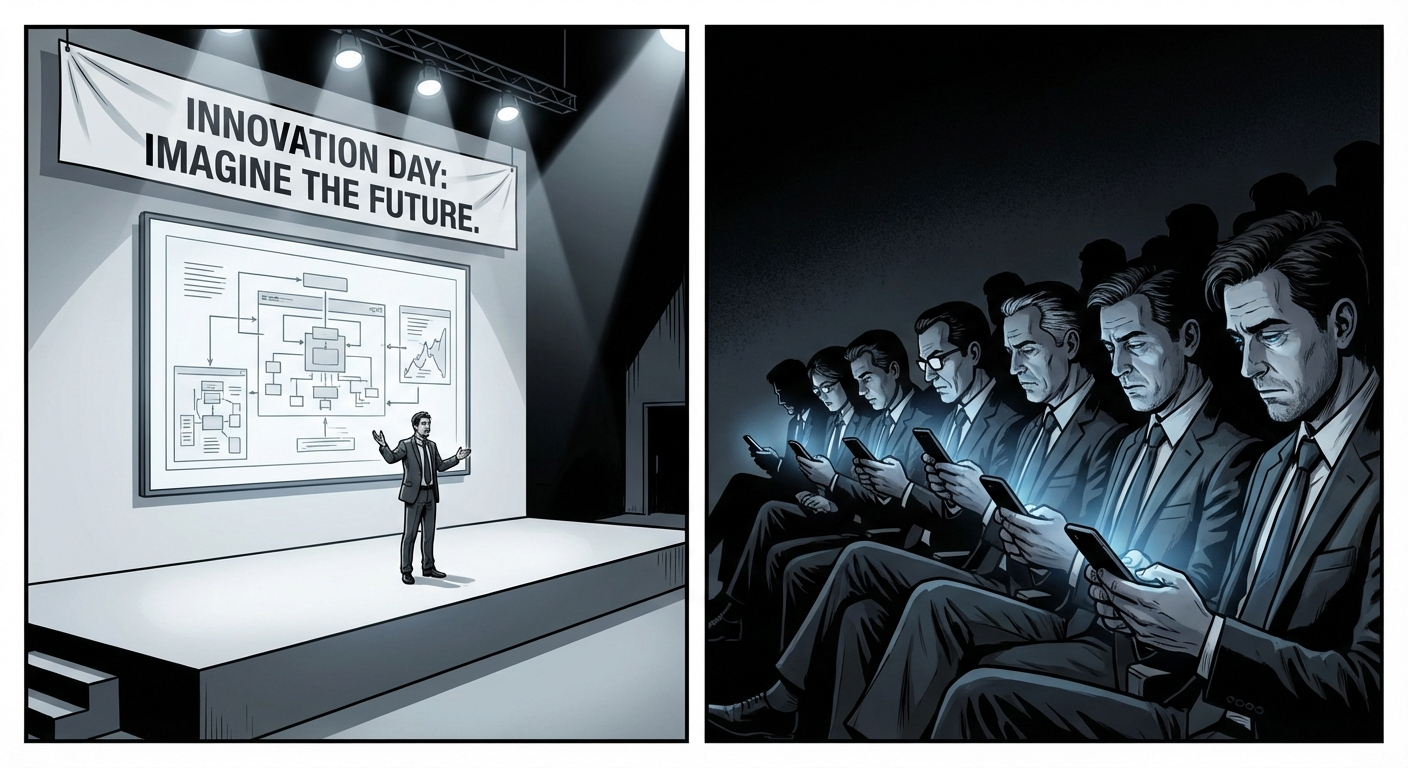
‘Ritualized Review’ refers to the transformation of the ideation process into a performative ceremony. This often takes the form of “Innovation Days,” “Pitch Competitions,” or “Steering Committee Meetings.”
Presentation over Substance: Success is measured by the quality of the presentation (the “deck”) rather than the viability or depth of the idea.
Non-Committal Feedback: Feedback is generic, encouraging, but ultimately non-committal, leading to “zombie projects” that are never officially killed but never funded.
Status Quo Bias: The “winning” ideas are almost always those that align most closely with existing corporate strategy, reinforcing the status quo rather than challenging it.
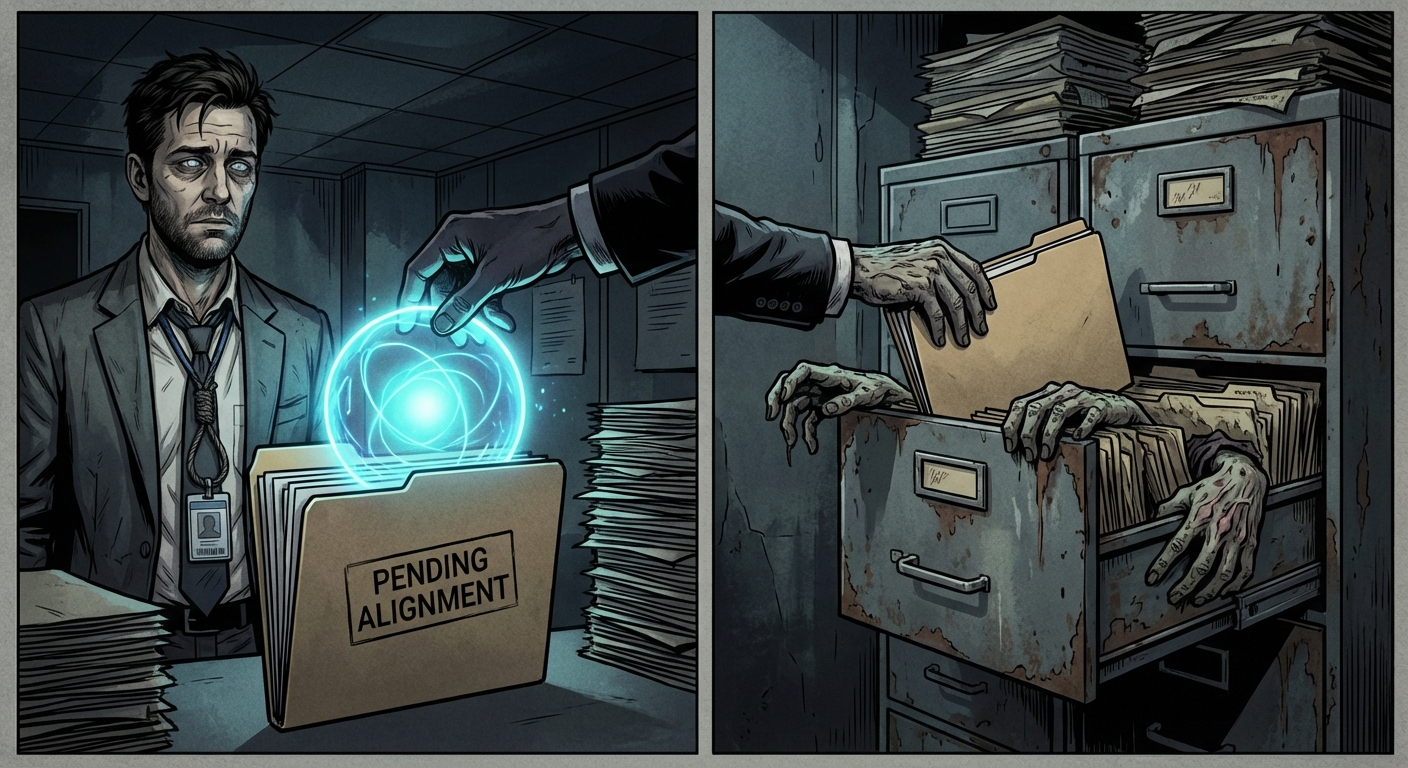
The most probable outcome of a Ritualized Review is not execution, nor even outright rejection, but a transition into what might be called Zombie Stasis: a liminal state in which the idea is nominally “under consideration,” “pending further alignment,” or “in the pipeline,” but in which no resources are allocated, no owner is accountable, and no timeline is enforced. If one maps the lifecycle of ideas through a corporate ideation process as a state machine, the transition from Ritualized Review to Zombie Stasis is overwhelmingly the most common edge. Ideas enter the ritual alive and exit undead—not killed, because killing requires a decision and decisions create accountability, but not alive, because life requires resources and resources require commitment. The ritual, then, is not a filter that separates good ideas from bad ones; it is a conveyor belt into organizational limbo, a reliable mechanism for converting active proposals into passive inventory.
The Cynicism Trap and Learned Helplessness
The deepest damage inflicted by Ritualized Review is not the loss of any individual idea but the cultural toxicity it produces over repeated cycles. The first time an employee participates in an Innovation Day and watches their proposal dissolve into non-committal smiles and vague follow-ups, they may attribute the outcome to bad luck or poor timing. The second time, they begin to suspect the structure. By the third time, they know—and this knowledge is corrosive in a way that no single failed project could ever be.
What emerges is a form of organizational learned helplessness: the internalized belief that effort directed toward innovation within the institution’s formal channels is futile. Employees stop proposing their best ideas—not because they stop having them, but because they learn that the ritual will consume the idea without producing action. The most creative and ambitious individuals either withdraw into cynical disengagement or leave the organization entirely, producing a slow-motion adverse selection in which the people most capable of driving change are precisely the ones the system ejects. Those who remain and continue to participate do so performatively, treating the ritual as a career-visibility exercise rather than a genuine ideation opportunity—which, in turn, further degrades the quality of what the ritual produces, confirming the organization’s quiet suspicion that “there just aren’t enough good ideas.”
This is the critical insight: the cynicism generated by recognized theater is more damaging to the organization than the absence of any particular product or initiative. A company that never held an Innovation Day but honestly acknowledged its structural conservatism would retain more creative capacity than one that stages elaborate ideation ceremonies while systematically refusing to act on their outputs. The ritual does not merely fail to produce innovation; it actively destroys the conditions under which innovation becomes possible, by teaching the workforce that the organization’s stated commitment to new ideas is performed rather than real. The antibodies the institution deploys against change are not just procedural—they are psychological, and Ritualized Review is the vector through which they are most efficiently transmitted.
Process Maximalism
‘Process Maximalism’ is the belief that the quality of an output is directly proportional to the complexity of the process used to generate it. In an attempt to “industrialize” innovation, organizations implement heavy frameworks—such as rigid Stage-Gate models or proprietary “Innovation Funnels”—that demand exhaustive documentation at every turn.
Process maximalism suppresses ideation through three primary mechanisms:
High Barrier to Entry: The administrative overhead required to even propose an idea discourages all but the most persistent (or politically motivated) individuals.
False Precision: Requiring detailed ROI projections and three-year roadmaps for ideas in their infancy forces innovators to fabricate data, leading to a culture of “spreadsheet engineering” rather than genuine discovery. This is, in game-theoretic terms, a dominated strategy that persists only because the process demands it: the innovator knows the numbers are invented, the reviewers know the numbers are invented, yet both parties maintain the fiction because the framework requires a populated spreadsheet before conversation can begin. The result is a Verification Trap, in which the organizational cost of rigorously verifying the projections would exceed the entire value of the artifact being proposed—so no one verifies, and the fabricated figures are accepted on ceremonial grounds alone. Over successive cycles, this produces a form of institutional self-deception that compounds: strategic decisions are built on projections everyone quietly acknowledges are fictional, those decisions generate outcomes that are then retroactively rationalized with new fictions, and the organization’s entire epistemic foundation drifts further from reality while its confidence in its own rigor remains intact.
Velocity Death: The time elapsed between an idea’s inception and its first real-world test is so long that the market conditions or the original problem may have already changed, rendering the idea obsolete before it is even piloted.
When process becomes the product, the organization loses the ability to act on intuition or respond to emergent opportunities.
Conclusion: The Cost of Inertia
The cumulative effect of these antipatterns is a “frozen” organization. The Gatekeeper Loop ensures safety at the cost of brilliance; Ritualized Review ensures participation at the cost of sincerity; and Process Maximalism ensures order at the cost of speed.
These structures are not accidental; they are the immune system of the institution—and like any immune system, they must be understood not as malicious but as adaptive. Every antipattern described in this paper originated as a rational response to a real constraint. When action was expensive, gatekeeping was prudent resource management. When production required large teams and significant capital, ritualized review was a defensible method of prioritization. When failure was costly and irreversible, process maximalism was a reasonable hedge against catastrophic waste. The immune system developed because the organism needed it: in a world of scarce resources and high costs of action, these structures protected the organization from overcommitting to unproven ideas.
But an immune response calibrated to yesterday’s threat environment becomes an autoimmune disorder when conditions change. The defenses that once protected the organization from reckless expenditure now attack the very capacity for adaptation that the organization needs to survive. The Gatekeeper Loop blocks action that is no longer expensive. Ritualized Review filters ideas through ceremonies designed for a production economics that no longer holds. Process Maximalism demands documentation whose cost now exceeds the cost of simply building the thing. What was once a rational allocation of scarce permission has become an irrational suppression of abundant capability. To move beyond these bottlenecks, an organization must first acknowledge that its current “innovation” procedures are, in fact, defense mechanisms designed to protect a status quo whose economic foundations are actively eroding. The organizational immune system must evolve, or it will kill the host. Only by diagnosing these structural failures—and understanding why they made sense in the world that produced them—can we begin to design a system calibrated to the world that is replacing it: one in which the cost of action has collapsed, and the structures built to ration expensive action have become the primary obstacle to value creation.
This concludes Paper 1. Paper 2 will explore the transition from these antipatterns toward a more generative, decentralized model of ideation.
Paper 2: Notes on the Changing Cost Landscape of Ideation and Action
Abstract
The traditional organizational model relies on high costs of production to justify centralized control. As generative AI collapses the cost of creating “action-adjacent artifacts”—code, designs, strategy documents, and prototypes—the economic rationale for legacy permission structures evaporates. This paper explores the transition from authority-gated systems to constraint-governed environments, where the bottleneck shifts from the ability to produce to the ability to discern and direct.
The Collapse of Artifact Costs
Historically, the distance between an idea and its first tangible manifestation was bridged by significant labor and capital. Creating a functional prototype, a detailed marketing plan, or a technical architecture required weeks of specialized effort. This high “cost of action” served as a natural filter, allowing organizations to justify gatekeeping as a form of resource management.
Generative AI has fundamentally altered this equation. We are entering an era where the marginal cost of artifact production is approaching zero. When a single individual can generate a high-fidelity mockup, a working script, or a comprehensive project plan in minutes, the “artifact” is no longer the prize. The collapse of these costs removes the primary excuse for bureaucratic delay: the need to protect scarce production resources.
But this collapse does not simply liberate the organization—it also destabilizes it. When the marginal cost of production approaches zero, the volume of producible artifacts does not merely increase; it undergoes a kind of hyper-inflation, expanding beyond any individual’s or committee’s capacity to evaluate, absorb, or act upon. The old bottleneck—”Can we afford to build this?”—is replaced by a new and in some ways more intractable one: “Can we afford to pay attention to this?” This is the Discernment Bottleneck. In a world of expensive production, scarcity itself performed a crude filtering function; not everything could be built, so only the proposals that survived political and economic selection were manifested. Remove that filter and you do not get a clean meritocracy of ideas—you get artifact pollution, a flood of plausible-looking prototypes, strategy documents, and proofs-of-concept that overwhelm the organization’s finite evaluative bandwidth. The risk, then, is not that gatekeeping persists without justification, but that the absence of any filtering mechanism produces a new form of paralysis: decision-makers surrounded by more actionable options than they can meaningfully assess, defaulting to familiar heuristics—status, recency, political proximity—that reproduce the old hierarchies under new conditions. The collapse of artifact costs is a necessary condition for democratized ideation, but it is not a sufficient one. Without a corresponding investment in discernment infrastructure—frameworks, cultures, and tools that help organizations distinguish signal from noise at the speed artifacts can now be generated—the abundance that should be liberating becomes merely overwhelming. The sections that follow address how organizations might build such infrastructure; for now, it is enough to note that the end of scarcity is not the beginning of clarity.
The Obsolescence of Permission
In the legacy model, permission was the currency of the institution. Because resources were scarce, “No” was the default setting. Permission structures were designed to prevent the “waste” of expensive human hours on unproven concepts.
However, when the cost of “doing” drops below the cost of “asking,” permission structures become obsolete. If an employee can build a proof-of-concept faster than they can fill out a request for a pilot program, the traditional hierarchy loses its leverage. The “Gatekeeper Loop” described in Paper 1 is not just inefficient; it is increasingly bypassed by the sheer speed of AI-augmented execution. The friction of bureaucracy now costs more than the risk of unauthorized experimentation.
From Authority-Gated to Constraint-Governed Action
The shift we are witnessing is a move away from Authority-Gated action (where you need a person’s approval to proceed) toward Constraint-Governed action (where you are free to act as long as you stay within defined guardrails).
In a constraint-governed model, the role of leadership changes from “approver” to “architect of constraints.” Instead of reviewing every individual idea, leaders define the parameters of safety, ethics, and strategic alignment. Within these boundaries, ideation and execution are decentralized. This model leverages the low cost of action to allow for massive parallel experimentation, where the “market” (internal or external) determines success rather than a steering committee.
This transition is not merely a philosophical preference or a management trend—it is, in formal terms, a shift between two Nash Equilibria. In the legacy equilibrium, the stable strategy pair was Submit and Veto: the innovator submitted proposals through official channels, and the gatekeeper exercised selective veto power. This equilibrium was stable because the cost of independent action was prohibitive. No rational actor would bypass the gate when building a prototype required weeks of specialized labor and significant capital; the penalty for unauthorized resource expenditure exceeded any plausible upside from a successful demonstration. The gatekeeper’s veto, meanwhile, was costless—killed ideas produced no visible counterfactual, so “No” carried no accountability. Both parties were locked in: the innovator because they could not afford to act alone, the gatekeeper because saying “No” was always safer than saying “Yes.” But as the cost of action collapses, a new equilibrium emerges: Bypass and Constrain. When an individual can produce a working prototype faster than they can navigate an approval chain, the dominant strategy for the innovator shifts from submission to demonstration—build first, seek forgiveness (or, more precisely, validation) after. The rational response for the former gatekeeper is not to reassert veto authority over an action that has already occurred at negligible cost, but to redefine their role around constraint architecture: setting the boundaries within which autonomous action is legitimate, rather than adjudicating each instance of it. What makes this analysis decisive rather than merely descriptive is the Pareto dominance of the emergent equilibrium. In the legacy state, the innovator’s payoff was suppressed by friction and delay, while the gatekeeper’s payoff, though locally optimized for risk avoidance, was capped by the low organizational value that a veto-heavy regime could produce. In the emergent equilibrium, the innovator captures a higher payoff through direct action and rapid iteration, and the reformed gatekeeper—now a constraint architect—also achieves a higher payoff, because their contribution shifts from value-destroying obstruction to value-enabling governance, a role that is both more strategically defensible and more organizationally rewarded. Both parties are strictly better off. The transition is not a zero-sum redistribution of power from gatekeepers to innovators; it is a positive-sum move to a superior equilibrium that the legacy cost structure had previously made inaccessible. This is why exhortation alone cannot drive the shift: you cannot talk actors out of a Nash Equilibrium. But you do not need to—the collapse of action costs has already altered the payoff matrix. The equilibrium is moving whether the org chart acknowledges it or not. The only question is whether leadership will architect the constraints that define the new stable state, or whether the transition will occur chaotically, without guardrails, as individuals rationally defect from a permission structure that no longer commands compliance.
Democratic Ideation and the New Meritocracy
The democratization of production tools leads to a democratization of ideation. When the ability to manifest an idea is no longer tied to seniority or budget access, the meritocracy of the idea itself takes center stage.
This shift forces a change in organizational culture:
From Presentation to Prototype: The “Ritualized Review” of slide decks is replaced by the evaluation of functional artifacts.
From Political Capital to Execution Velocity: Influence is gained by those who can rapidly iterate and demonstrate value, rather than those who navigate the hierarchy most effectively.
From Top-Down Strategy to Emergent Direction: Strategy becomes an iterative discovery process fueled by a high volume of low-cost experiments.
The Leader as Architect of the Fitness Landscape
If the constraint-governed model described above defines where autonomous action is legitimate, a deeper question remains: how does the organization determine what counts as success within those boundaries? This is where leadership undergoes its most profound transformation—not from “approver” to “constraint architect” (that shift is merely structural) but from Chief Approver to Architect of the Fitness Landscape.
The metaphor is drawn from evolutionary biology. A fitness landscape is a mapping from possible strategies (or organisms, or in our case, ideas and prototypes) to their relative success. The landscape is not designed by any single organism navigating it; it is the environment that determines which variations thrive and which are selected against. In the democratized ideation model, the leader’s role is analogous: they do not review individual ideas—they define what “success” looks like. They design the fitness function. They specify the objective—the measurable outcomes, the strategic criteria, the constraints that distinguish a valuable experiment from an irrelevant one—and then let the decentralized, AI-augmented workforce evolve solutions against that function through massive parallel experimentation. The leader who once sat atop the approval chain, reviewing proposals one by one, is replaced by the leader who articulates the selection pressure with such precision that the organization can self-organize toward it without centralized adjudication.
This reframing has a critical implication for how leadership itself is evaluated. In the legacy model, a leader’s influence was legible through the volume of decisions they made—proposals approved, budgets allocated, projects killed. In the fitness-landscape model, a leader’s value is measured by the clarity of the objective function they define, not the number of approvals they grant. A well-specified fitness function renders most approval decisions unnecessary: teams can evaluate their own prototypes against the criteria, discard what fails, and iterate on what shows promise. A poorly specified one—vague, contradictory, or optimizing for the wrong variable—produces chaos regardless of how many gatekeepers are inserted downstream. The scarce resource, in other words, is no longer judgment applied to individual proposals but judgment applied to the design of the evaluative environment itself. This is a higher-order form of leadership, and it demands a different skill set: not the ability to say “Yes” or “No” to a pitch deck, but the ability to articulate what the organization is for with enough rigor that a thousand autonomous agents can orient toward it independently.
Irrational Conviction and the Preservation of Black-Swan Innovation
There is, however, a failure mode latent in any system that relies entirely on a predefined fitness function: it will systematically eliminate ideas that do not score well against current criteria but that would prove transformative under conditions the criteria do not yet anticipate. Evolutionary fitness landscapes produce local optima—organisms exquisitely adapted to the present environment but brittle in the face of discontinuous change. An organization that optimizes too efficiently against its stated objective function risks the same trap: a portfolio of well-adapted incremental improvements and zero breakthrough innovations.
This is where the irreducibly human element of the new meritocracy asserts itself—not as a sentimental concession to “the human touch,” but as a structural necessity. What humans contribute that automated evaluation systems cannot is irrational conviction: the capacity to pursue an idea that every available metric says is wrong, that no fitness function currently rewards, that an AI-augmented triage system would flag for immediate deprioritization—and to persist in that pursuit long enough for the idea to encounter the conditions under which its value becomes legible. Every black-swan innovation in history—the ones that redefined industries rather than optimizing within them—was, at the moment of its conception, irrational by the standards of the prevailing fitness landscape. It scored poorly. It did not align with current strategy. It could not produce a credible three-year ROI projection (or rather, it could, but only a fabricated one—see Paper 1’s discussion of the Verification Trap). It survived not because a system selected for it but because a person refused to let it die.
A well-designed democratic ideation system must therefore preserve structural space for irrational conviction—for ideas that bypass the fitness function entirely, not because the function is poorly designed but because no function, however well-designed, can anticipate the discontinuities that generate outsized value. This might take the form of protected experimentation budgets that are explicitly exempt from objective-function evaluation, or cultural norms that treat a certain rate of “irrational” bets not as waste but as the portfolio’s insurance premium against strategic brittleness. The point is not to abandon the fitness landscape—it remains the correct architecture for the vast majority of organizational ideation—but to acknowledge its boundary condition: that the most consequential ideas are precisely the ones it is least equipped to recognize, and that the human willingness to champion them against the evidence is not a bug in the system but the mechanism by which the system avoids collapsing into a local optimum.
The synthesis, then, is this: the Architect of the Fitness Landscape defines the selection environment that governs normal innovation—the continuous, parallel, decentralized experimentation that replaces the old approval chain. But the architect must also design escape hatches from their own landscape: sanctioned spaces where the fitness function is deliberately suspended, where irrational conviction is not merely tolerated but structurally protected, and where the organization maintains its capacity to be surprised by ideas that no objective function would have predicted. Leadership in this model is measured not only by the clarity of the objective function but by the wisdom to know where the objective function should not apply.
Conclusion: Embracing the Generative Shift
The antipatterns of the past—the loops, the rituals, and the maximalism—were built for a world of high-cost action and scarce information. That world is ending. But naming the problem is not the same as solving it, and the analysis presented in this paper and its predecessor will remain academic unless it is translated into concrete structural reforms. The organizations that thrive in the age of generative AI will not be those that merely acknowledge the collapse of action costs; they will be those that redesign their operating architecture to reflect it. What follows is not a set of abstract principles but a series of specific, implementable directives—each one derived from the structural diagnosis above, each one targeting a named antipattern, and each one designed to shift the organization from the legacy equilibrium of Submit and Veto to the emergent equilibrium of Bypass and Constrain.
The first and most immediate reform is the dismantling of what Paper 1 identified as the core mechanism of Ritualized Review: the pitch deck as unit of evaluation. As long as ideas are assessed on the basis of slide presentations—narrative polish, executive presence, the rhetorical construction of a “compelling story”—the organization is selecting for persuasion rather than viability, for political fluency rather than functional insight. The collapse of artifact costs makes this not merely suboptimal but absurd. When a working prototype can be produced in the time it takes to format a slide deck, the deck is no longer a proxy for the idea; it is a substitute for it, and a strictly inferior one. The reform is straightforward: replace pitch-deck reviews with functional artifact evaluations. The unit of assessment becomes the working mockup, the executable script, the testable hypothesis instantiated in code or design—not the narrative about the thing, but the thing itself. This does not eliminate the need for strategic framing or contextual explanation, but it subordinates rhetoric to demonstration. The innovator’s task is no longer to describe what they would build if given permission; it is to show what they have already built, and to let the artifact speak to its own merit. This single change collapses the Ritualized Review antipattern at its foundation, because the ceremony of the pitch—the stage, the audience, the non-committal applause—loses its function when the object of evaluation is a functioning prototype rather than a persuasive performance.
The second reform addresses the Gatekeeper Loop directly, and it operationalizes the constraint-governed model described in this paper’s central argument. The loop persists because each gatekeeper’s veto is exercised ad hoc, on a case-by-case basis, with no predefined criteria for what constitutes an acceptable risk. The result, as analyzed above, is that “No” is always the dominant strategy: the gatekeeper cannot be blamed for what they prevent, only for what they permit. The structural remedy is the creation of explicit Safe Zones—predefined operational boundaries, articulated in advance by leadership in collaboration with legal, compliance, finance, and brand stakeholders, within which no approval is required. A Safe Zone is not a blank check; it is a precisely specified envelope of autonomous action. It defines financial guardrails (maximum expenditure thresholds below which no budget approval is needed), data guardrails (categories of data that may be used in experimentation without privacy review), and brand guardrails (parameters within which external-facing artifacts may be tested without marketing sign-off). The key insight is that these boundaries must be defined before any specific idea is proposed, not negotiated in response to one. When the constraints are architectural rather than adjudicative—when they exist as standing policy rather than as the output of a case-by-case approval chain—the gatekeeper’s role transforms from judge of individual proposals to co-author of the constraint framework. Their expertise is captured upstream, in the design of the guardrails, rather than downstream, in the serial vetoing of initiatives. This is what it means to treat governance as a product rather than a process: the constraint architect ships a well-defined interface—a set of clear, queryable rules—against which any actor in the organization can validate their own intended action without waiting in line for a human adjudicator.
This leads directly to the third reform, which extends the product metaphor to its logical conclusion: the automation of compliance checks as real-time services rather than end-of-process reviews. In the legacy model, compliance is a stage—a gate that the idea must pass through, staffed by human reviewers who assess each proposal against regulatory, legal, and policy requirements. This architecture made sense when proposals were few and complex, but it is structurally incompatible with the high-volume, rapid-iteration model that collapsed artifact costs now enable. When an organization is running hundreds of parallel low-cost experiments, routing each one through a sequential human review is not governance—it is a denial-of-service attack on the organization’s own capacity for action. The alternative is to encode the reviewable constraints—data handling rules, regulatory boundaries, brand standards, security requirements—as automated, API-like services that experimenters can query in real time. Before deploying a prototype to a test audience, the system checks data-use compliance automatically. Before committing expenditure, the system validates against the Safe Zone’s financial guardrails. Before exposing brand-adjacent artifacts externally, the system confirms conformance with the brand envelope. The human compliance expert does not disappear; they move upstream, into the role of maintaining and updating the constraint service—ensuring that the automated checks reflect current regulatory reality, refining the rules as edge cases emerge, and reserving their direct judgment for the genuinely novel cases that fall outside the service’s coverage. This is the structural transformation of the gatekeeper from bottleneck to infrastructure, from a person who must be waited for to a system that is always available.
The fourth and perhaps most culturally disruptive reform concerns measurement. The antipatterns described in Paper 1—particularly Process Maximalism and its attendant Verification Trap—are sustained not only by procedural architecture but by evaluative architecture: the metrics by which the organization assesses whether ideation is “working.” As long as the primary metric is traditional ROI—projected return on invested capital, calculated in advance and tracked against a multi-year plan—the organization will continue to demand the fabricated spreadsheets and fictional three-year projections that Process Maximalism requires, because ROI is the only language the evaluative system speaks. The reform is to replace these legacy metrics, for early-stage ideation, with measures that reflect the actual dynamics of a low-cost, high-iteration environment. Two metrics in particular capture what matters: iteration velocity—the number of hypothesis-test-learn cycles an idea completes per unit of time—and time to first artifact—the elapsed duration between an idea’s initial articulation and the production of its first functional, testable instantiation. These metrics do not measure whether an idea is right; they measure whether the organization is learning. An idea that completes ten iterations in a week and fails is more valuable than an idea that spends six months in a planning phase and produces a polished deck, because the first has generated real information—about the problem, the market, the technology, the user—while the second has generated only a narrative. Measuring iteration velocity and time to first artifact sends an unambiguous signal to the organization: the goal is not to plan perfectly but to learn rapidly, and the structures that slow learning—the approval chains, the documentation requirements, the review ceremonies—are costs to be minimized, not virtues to be celebrated.
Taken together, these four reforms—artifact-based evaluation, predefined Safe Zones, automated compliance services, and iteration-centric measurement—constitute not a wish list but a coherent operating architecture for the post-scarcity ideation environment. Each one addresses a specific antipattern identified in Paper 1; each one operationalizes a specific structural shift described in Paper 2; and each one reinforces the others, because the system they compose is self-consistent in a way that piecemeal reforms are not. Artifact evaluation is meaningless without Safe Zones that permit artifacts to be built without prior approval. Safe Zones are unenforceable without automated compliance services that can validate action against guardrails in real time. And none of these structural changes will survive contact with the existing culture unless the measurement system is reformed to reward the behaviors they enable rather than the behaviors they replace. The organizational immune system described in Paper 1’s conclusion will attack any individual reform that is introduced in isolation; only a coordinated redesign of the evaluative, procedural, and governance architecture can shift the institution to the new equilibrium that the collapse of action costs has already made available. The world that justified the old structures is ending. The question is no longer whether the permission-based model will be replaced, but whether its replacement will be designed—deliberately, with guardrails and clarity and structural wisdom—or whether it will simply happen, chaotically, as individuals rationally defect from a system that no longer commands their compliance. These reforms are an argument for design.
Comic Book Generation Task
Generated Script
Full Script
The Hive’s Last Stand
In a monolithic corporation where bureaucracy is an immune system designed to kill change, a weary innovator uses the collapse of artifact costs to bypass the “Gatekeeper Loop” and force a new evolutionary equilibrium.
Characters
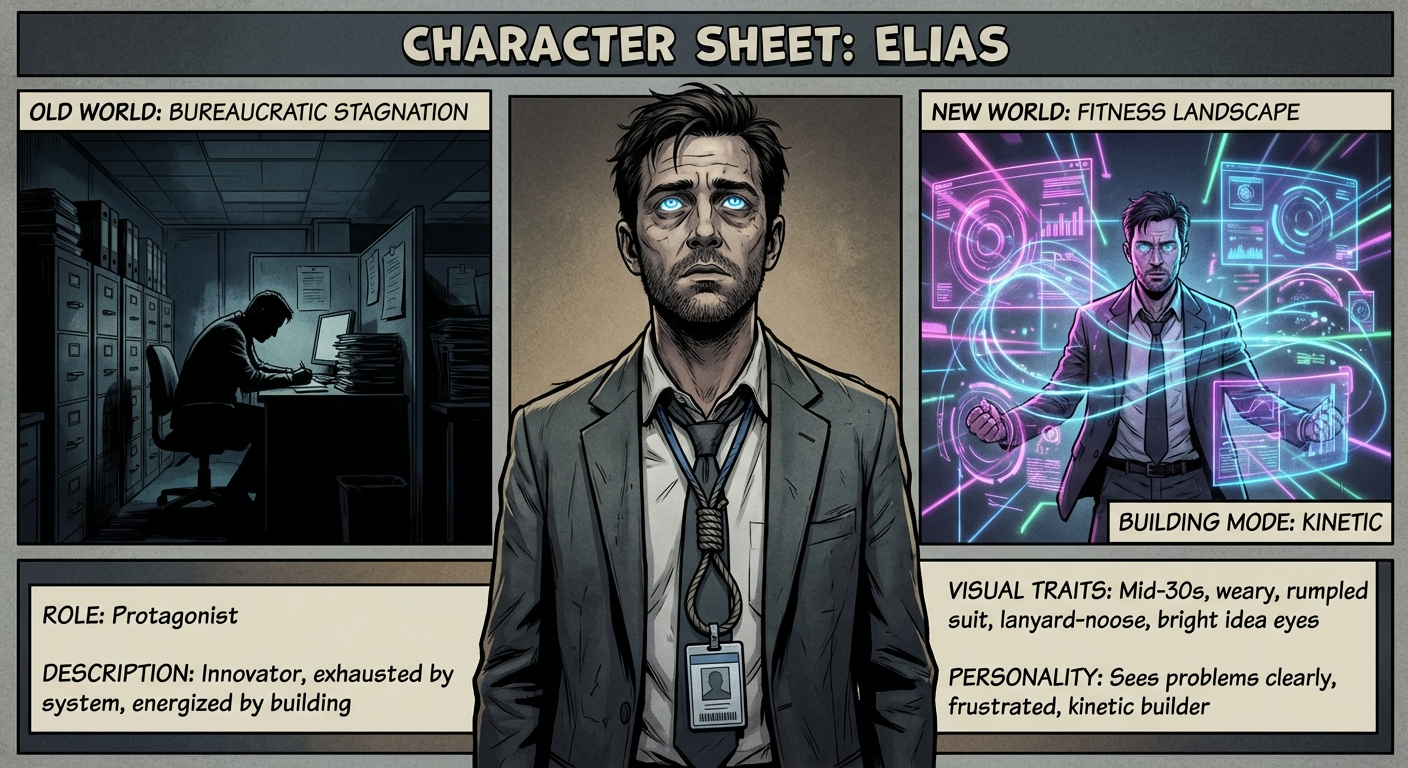
Elias: An innovator who sees problems clearly but is exhausted by the system. Becomes energized and kinetic once he starts building. Role: Protagonist. (Mid-30s, weary but determined expression. Wears a slightly rumpled grey suit and a corporate lanyard that looks like a noose. Eyes bright with an idea.)
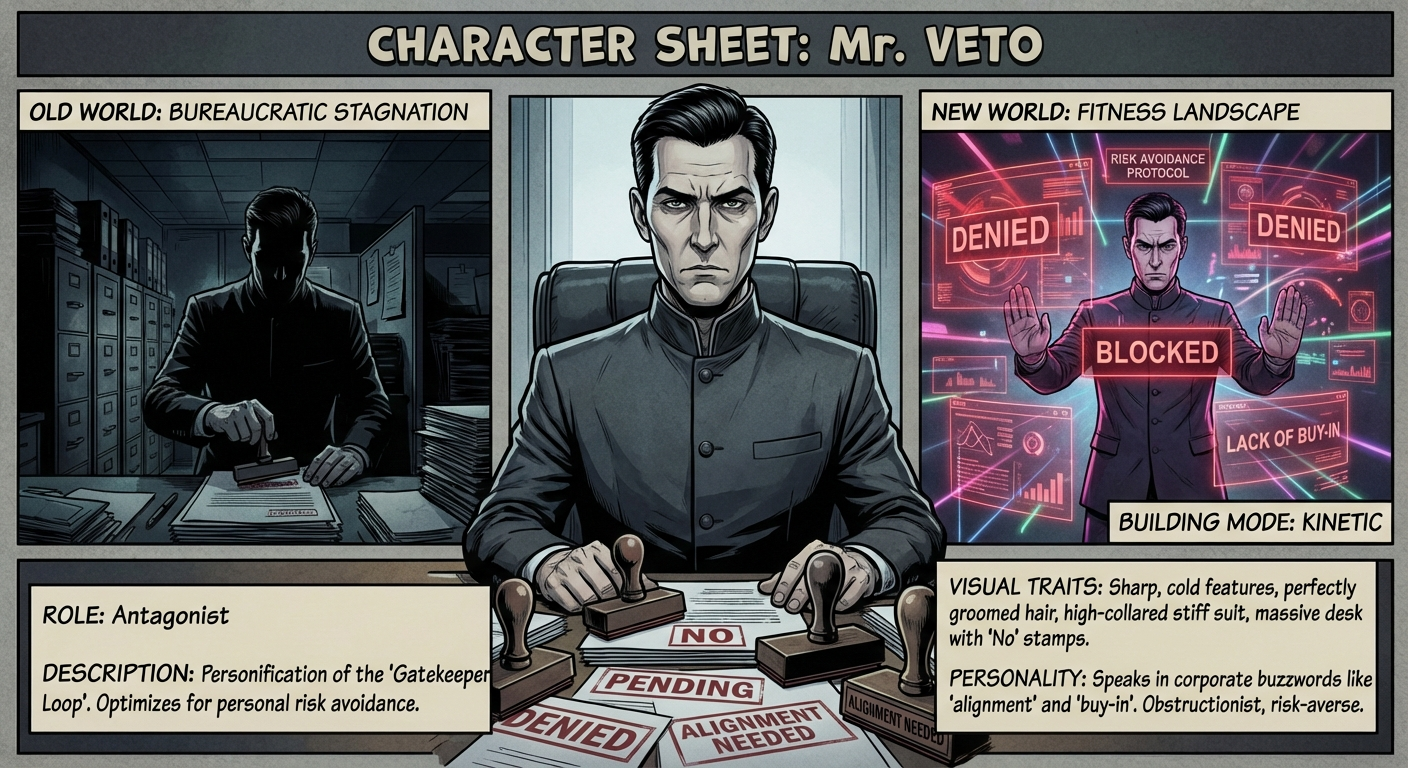
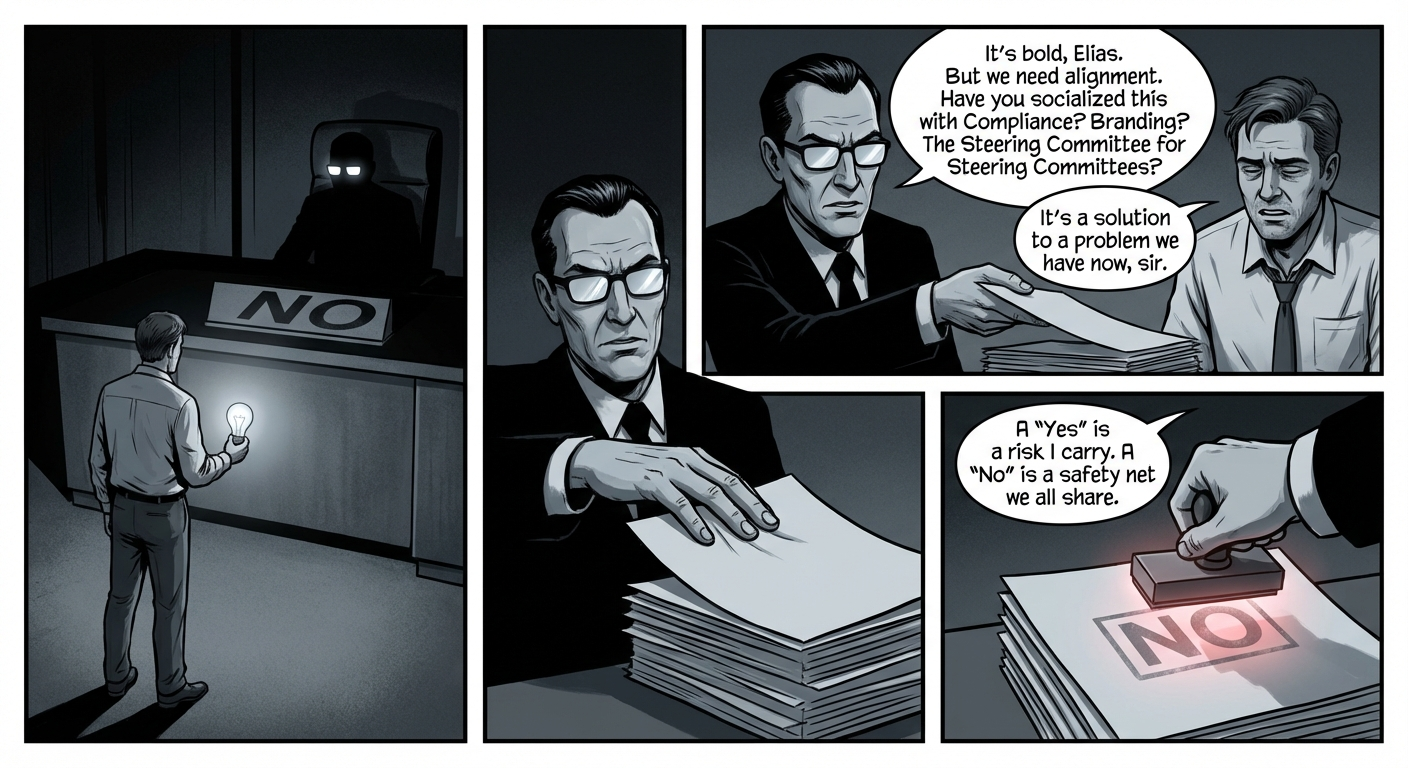
Mr. Veto: A personification of the ‘Gatekeeper Loop’. Optimizes for personal risk avoidance. Speaks in corporate buzzwords like ‘alignment’ and ‘buy-in’. Role: Antagonist. (Sharp, cold features, perfectly groomed hair. Sits behind a massive desk covered in ‘No’ and ‘Pending’ stamps. Wears a high-collared, stiff suit.)
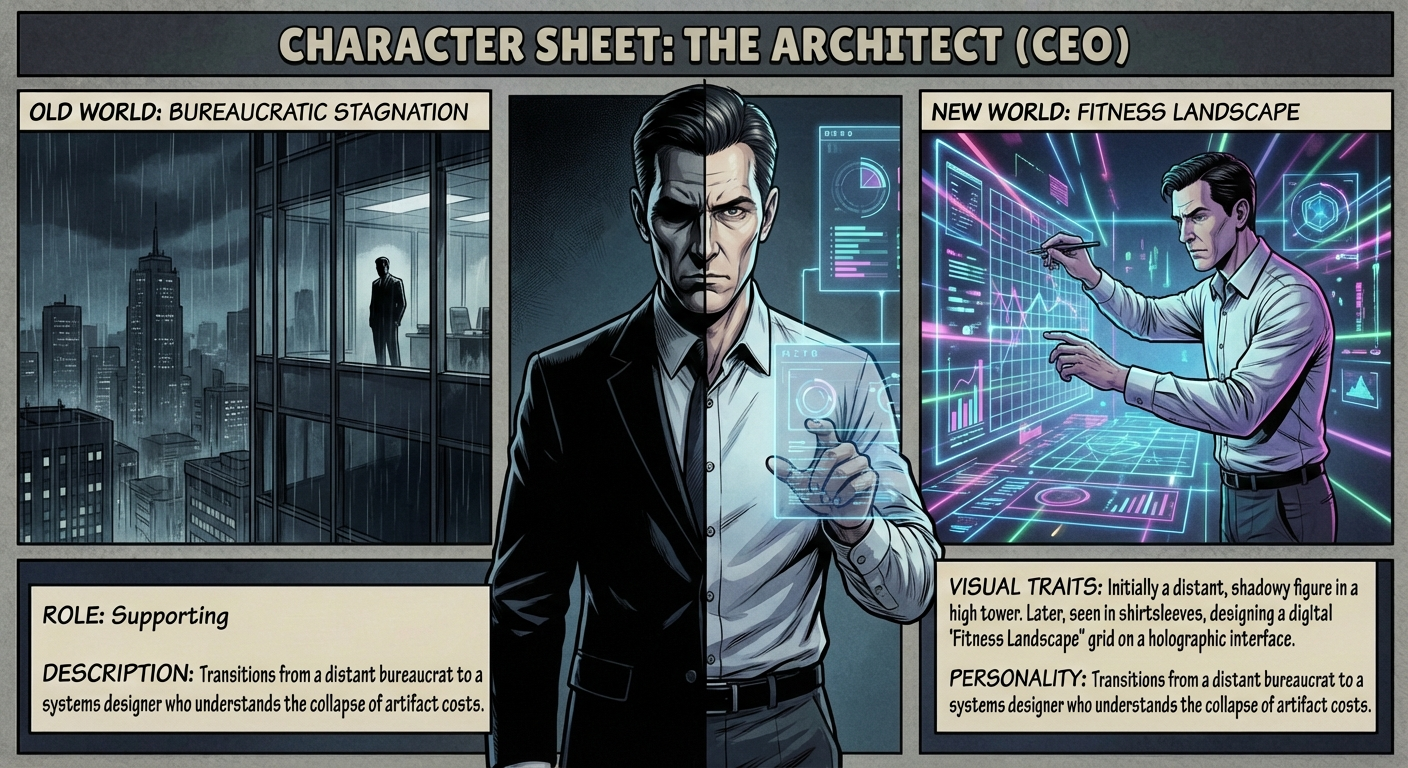
The Architect (CEO): Transitions from a distant bureaucrat to a systems designer who understands the collapse of artifact costs. Role: Supporting. (Initially a distant, shadowy figure in a high tower. Later, seen in shirtsleeves, designing a digital ‘Fitness Landscape’ grid on a holographic interface.)
Script
Page 1
Row 1
Panel 1: Extreme wide shot of “The Hive,” a brutalist skyscraper shrouded in rain and smog.
Caption: In the Hive, innovation isn’t a goal. It’s a threat.
Panel 2: Close up on Elias’s lanyard. It’s tight around his neck, the plastic ID badge dangling like a weight.
Row 2
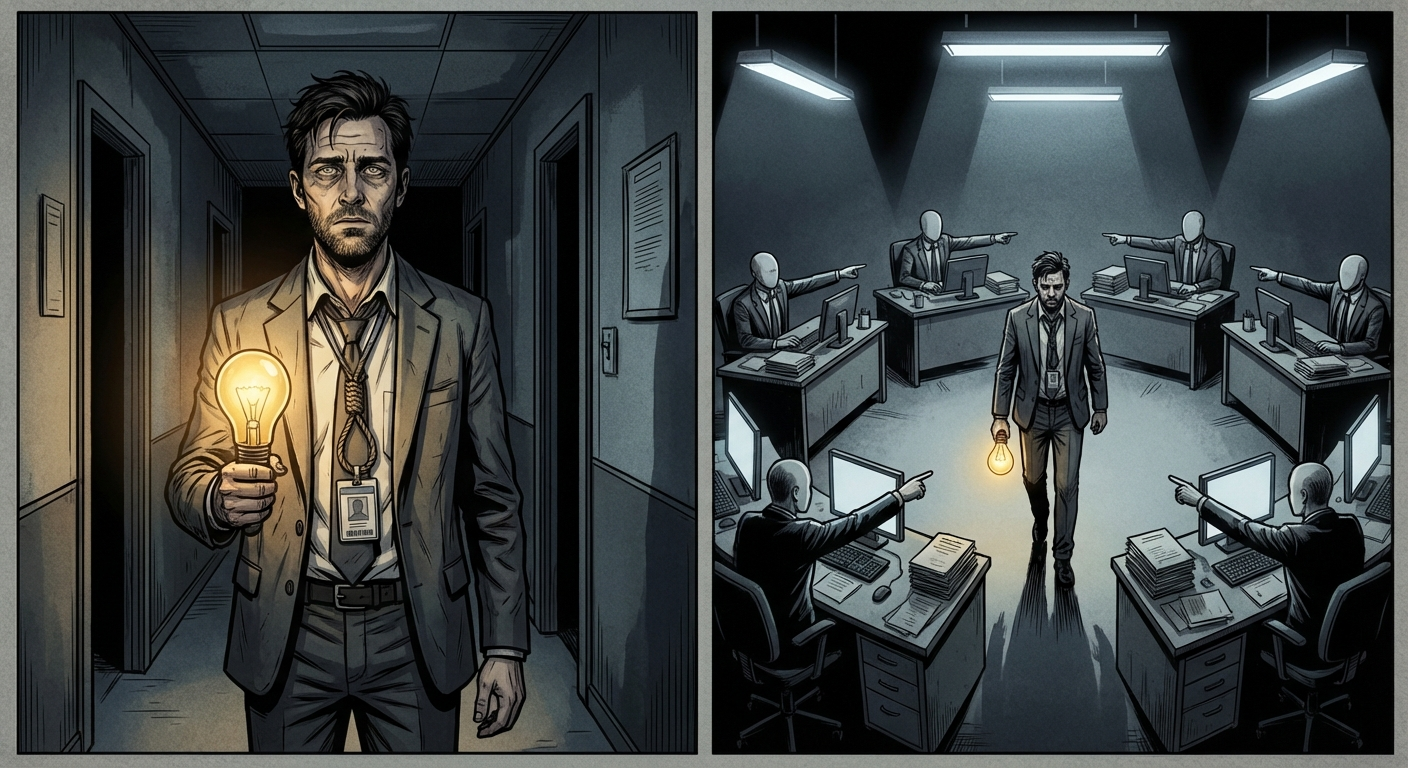
Panel 1: Elias stands in a dimly lit hallway, holding a glowing, golden lightbulb-shaped device. It’s the only source of warm light.
Panel 2: He approaches a desk. Then another. The desks are arranged in a literal, infinite circle.
Row 3
Panel 1: Elias reaches the end of the loop: Mr. Veto. Veto is silhouetted, his glasses reflecting the “No” stamp on his desk.
Panel 2: Mr. Veto pushes a stack of papers back toward Elias.
Mr. Veto: “It’s bold, Elias. But we need alignment. Have you socialized this with Compliance? Branding? The Steering Committee for Steering Committees?”
Elias: “It’s a solution to a problem we have now, sir.”
Mr. Veto: “A ‘Yes’ is a risk I carry. A ‘No’ is a safety net we all share.”
Page 2
Row 1
Panel 1: A bright, sterile stage. A banner reads “INNOVATION DAY: IMAGINE THE FUTURE.” Elias is mid-pitch, looking small against a giant screen.
Panel 2: The audience is a row of executives in shadow, their faces illuminated only by their phone screens.
Row 2
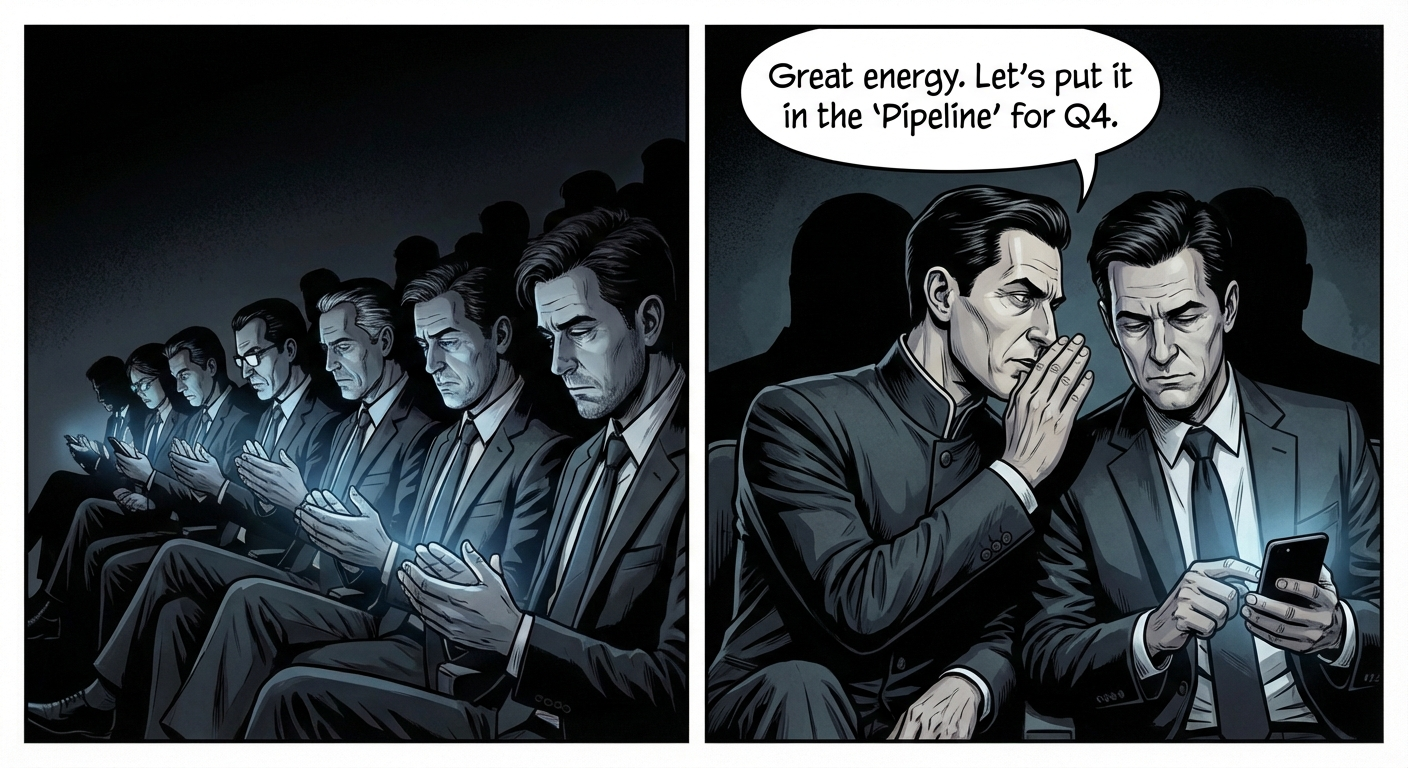
Panel 1: The executives are clapping, but their hands don’t touch. It’s a pantomime of approval.
Caption: Feedback is a polite way of saying ‘Not on my watch.’
Panel 2: Mr. Veto leans over to a colleague, whispering.
Mr. Veto: “Great energy. Let’s put it in the ‘Pipeline’ for Q4.”
Row 3
Panel 1: Elias watches as his glowing idea is placed into a manila folder labeled “PENDING ALIGNMENT.”
Caption: This is Zombie Stasis. Not dead enough to mourn, not alive enough to move.
Panel 2: The folder is filed into a massive, rusted cabinet.
Page 3
Row 1
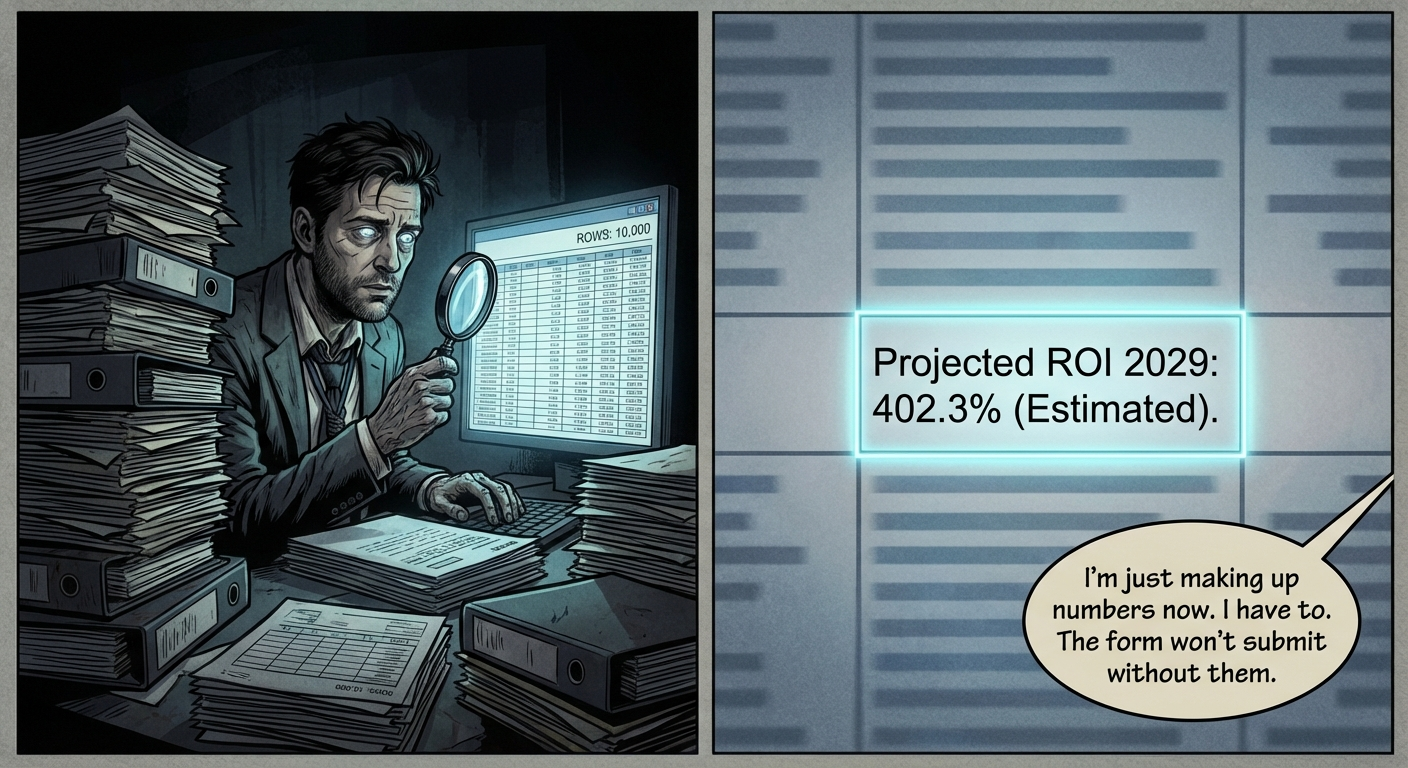
Panel 1: Elias is buried under a mountain of paperwork. He’s holding a magnifying glass, looking at a spreadsheet with 10,000 rows.
Panel 2: Close up on a cell in the spreadsheet: “Projected ROI 2029: 402.3% (Estimated).”
Elias: “I’m just making up numbers now. I have to. The form won’t submit without them.”
Row 2
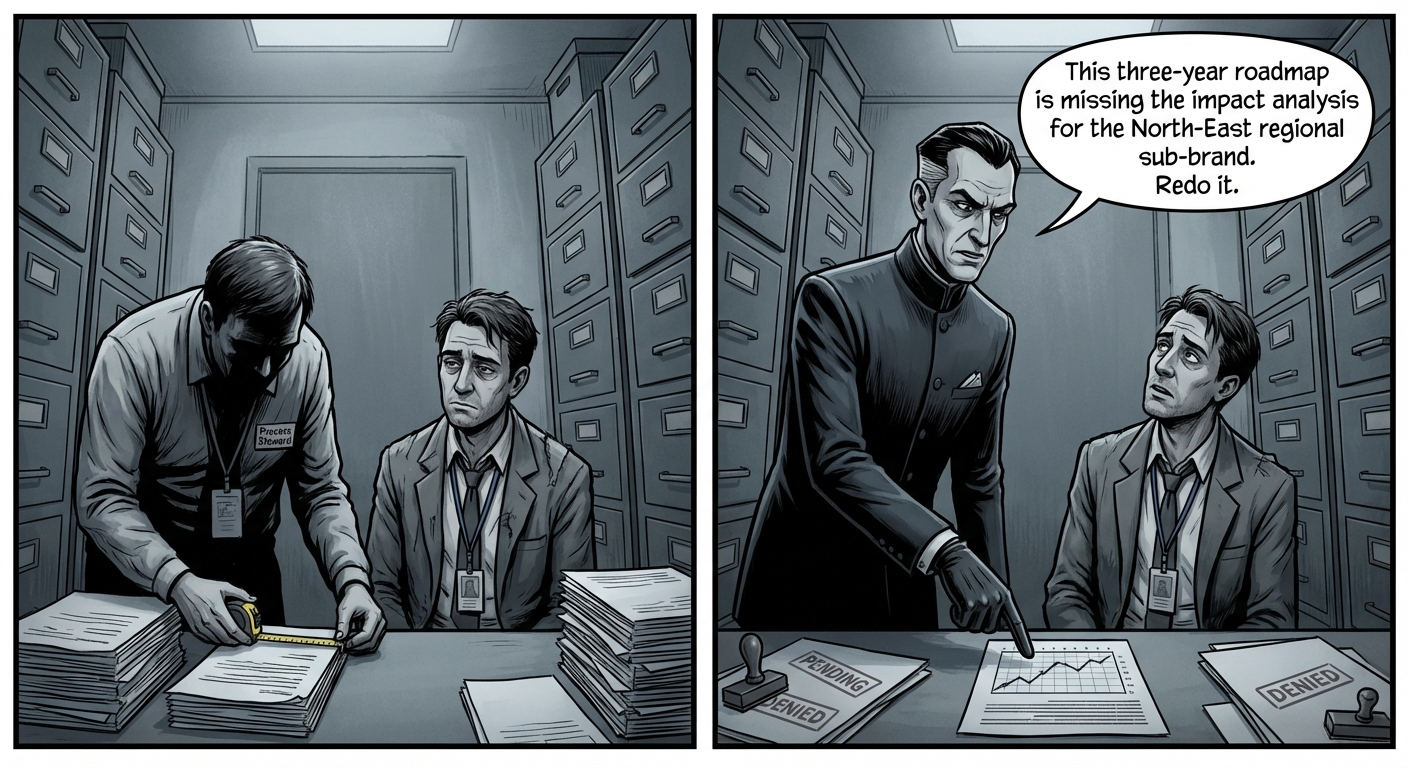
Panel 1: A “Process Steward” with a tape measure is measuring the margins on Elias’s report.
Panel 2: Mr. Veto stands over him, pointing at a tiny graph.
Mr. Veto: “This three-year roadmap is missing the impact analysis for the North-East regional sub-brand. Redo it.”
Row 3
Panel 1: A calendar on the wall flips rapidly: Spring, Summer, Fall, Winter. Elias is still at the same desk.
Caption: By the time the process is satisfied, the market has moved on. The “Safe” path is a slow-motion suicide.
Panel 2: Elias looks out the window. Outside, a competitor’s drone flies by, carrying the very product he tried to propose.
Page 4
Row 1
Panel 1: Elias’s apartment. Dark, except for the neon blue glow of three monitors. He looks manic, energized.
Caption: The cost of action just collapsed. I don’t need their budget to build. I just need a prompt.
Panel 2: On screen, code is writing itself. 3D models are spinning.
Row 2
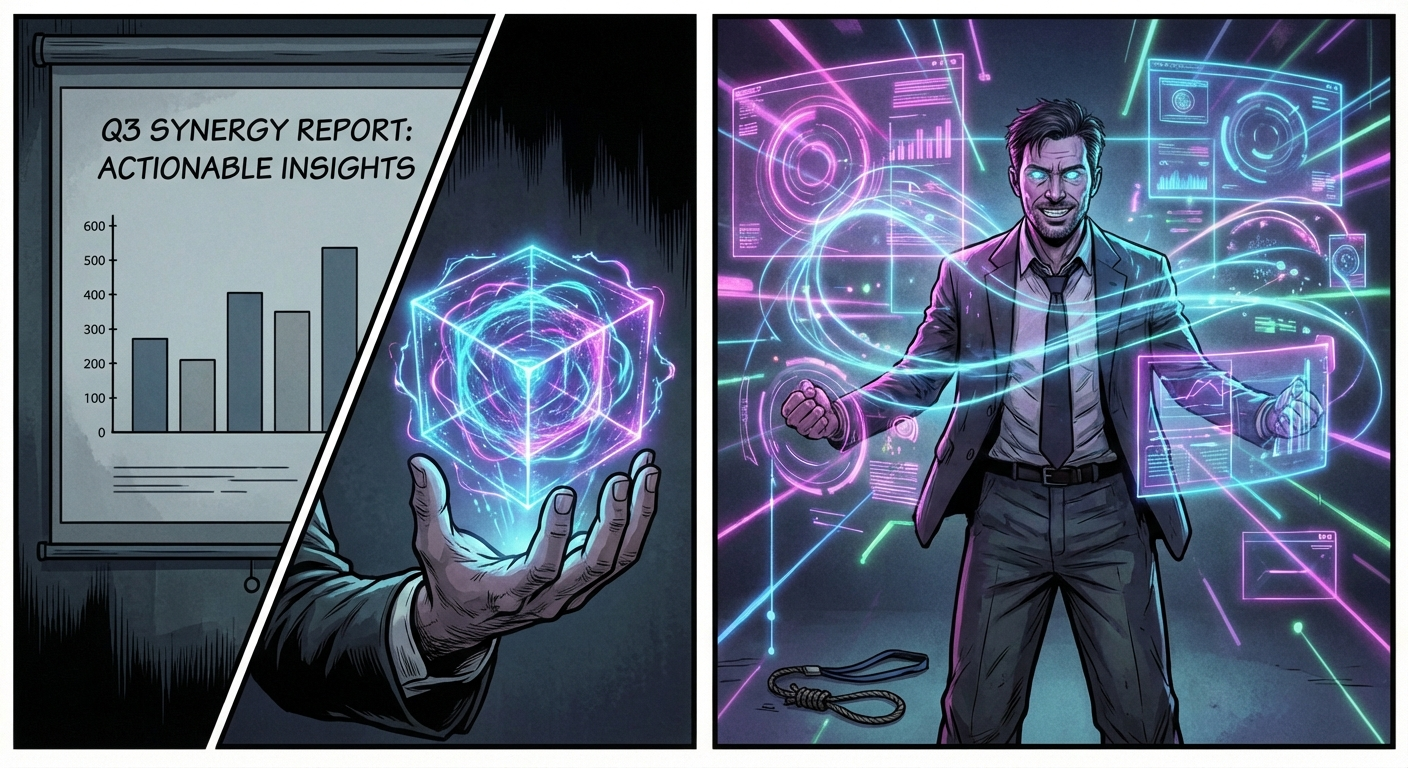
Panel 1: Split screen. Left side: A boring, grey PowerPoint slide. Right side: A vibrant, holographic prototype humming in Elias’s hand.
Panel 2: Elias is smiling. The “noose” lanyard is off, lying on the floor.
Row 3
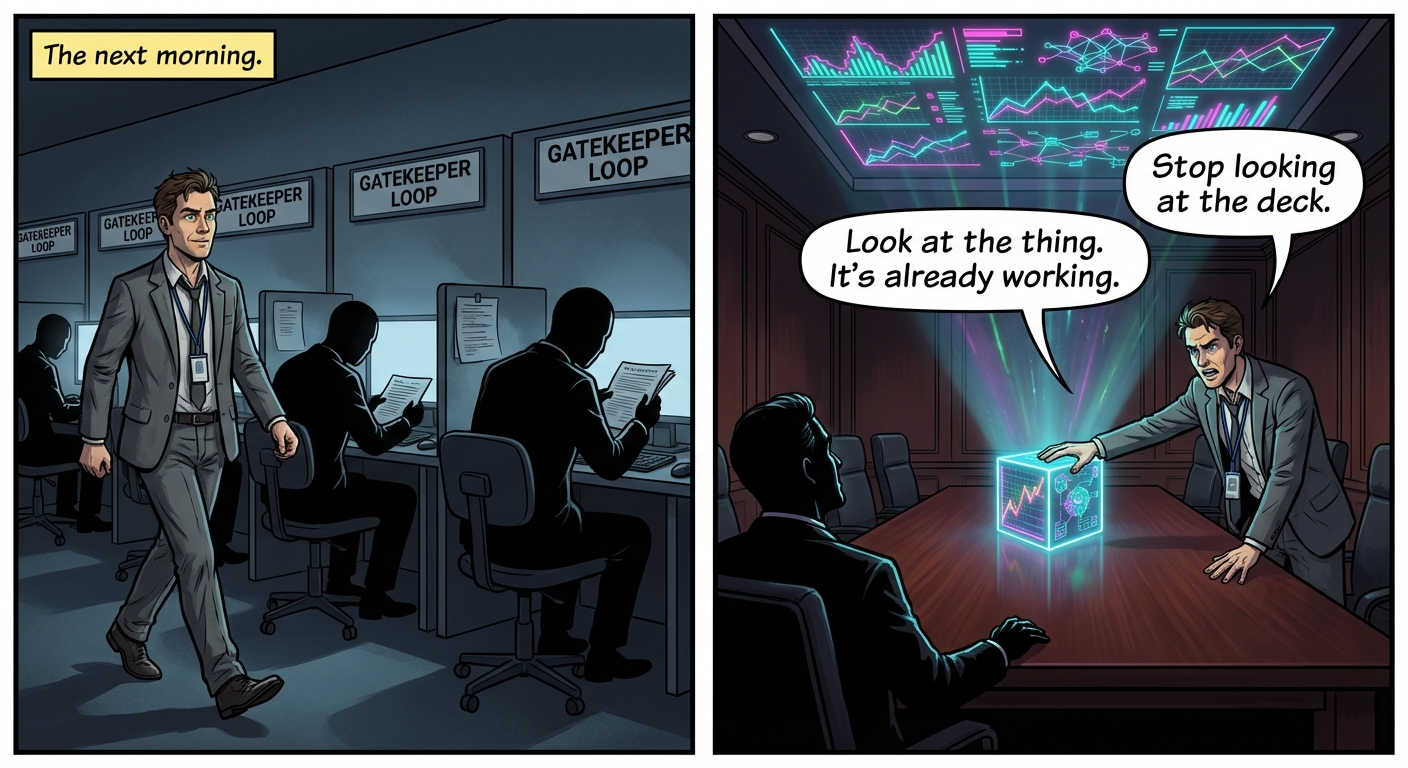
Panel 1: Next morning. Elias walks past the “Gatekeeper Loop” desks. He doesn’t stop.
Panel 2: He slams the functional prototype onto the Architect’s boardroom table. It projects a live data feed onto the ceiling.
Elias: “Stop looking at the deck. Look at the thing. It’s already working.”
Page 5
Row 1
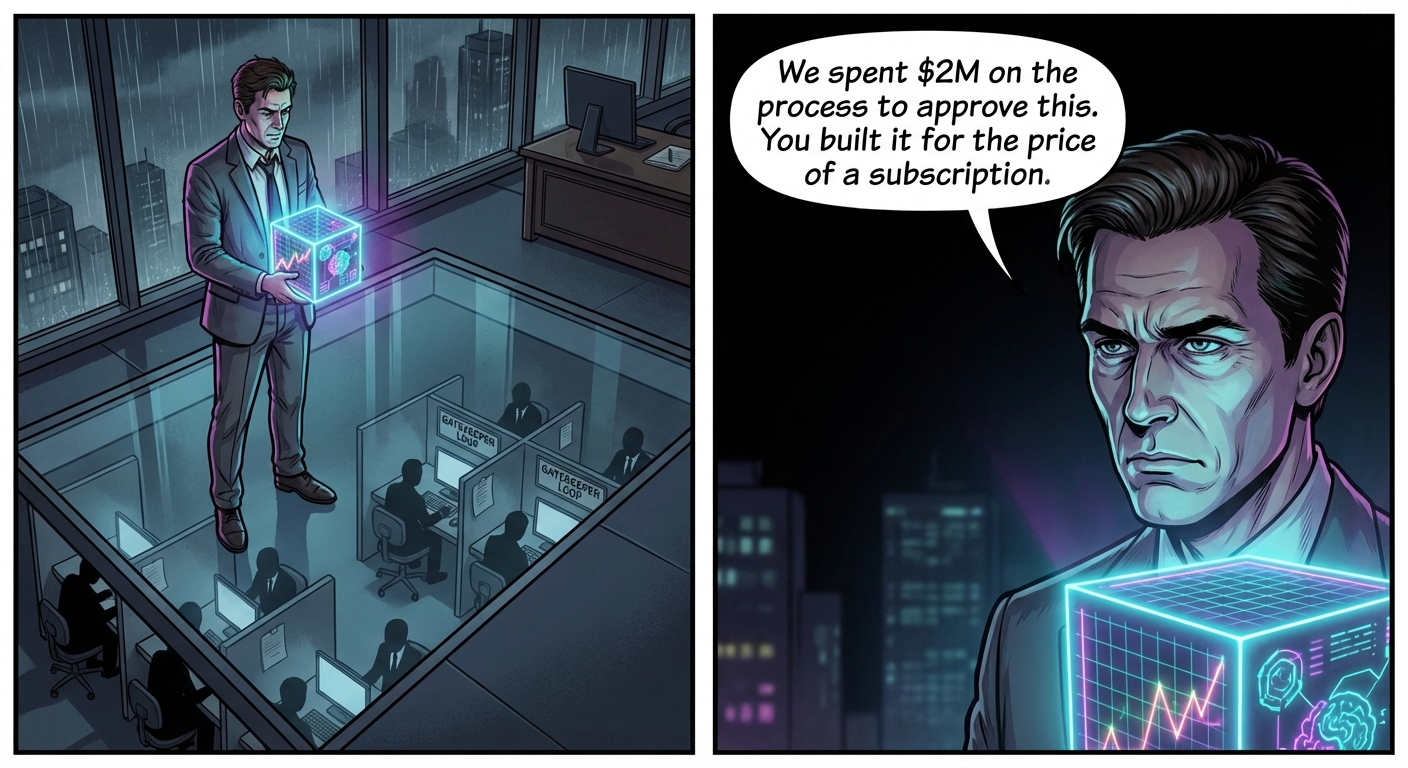
Panel 1: The Architect (CEO) looks at the prototype. He looks at the “Gatekeeper Loop” visible through the glass floor below.
Panel 2: He sees the loop for what it is: a clogged artery.
The Architect (CEO): “We spent $2M on the process to approve this. You built it for the price of a subscription.”
Row 2
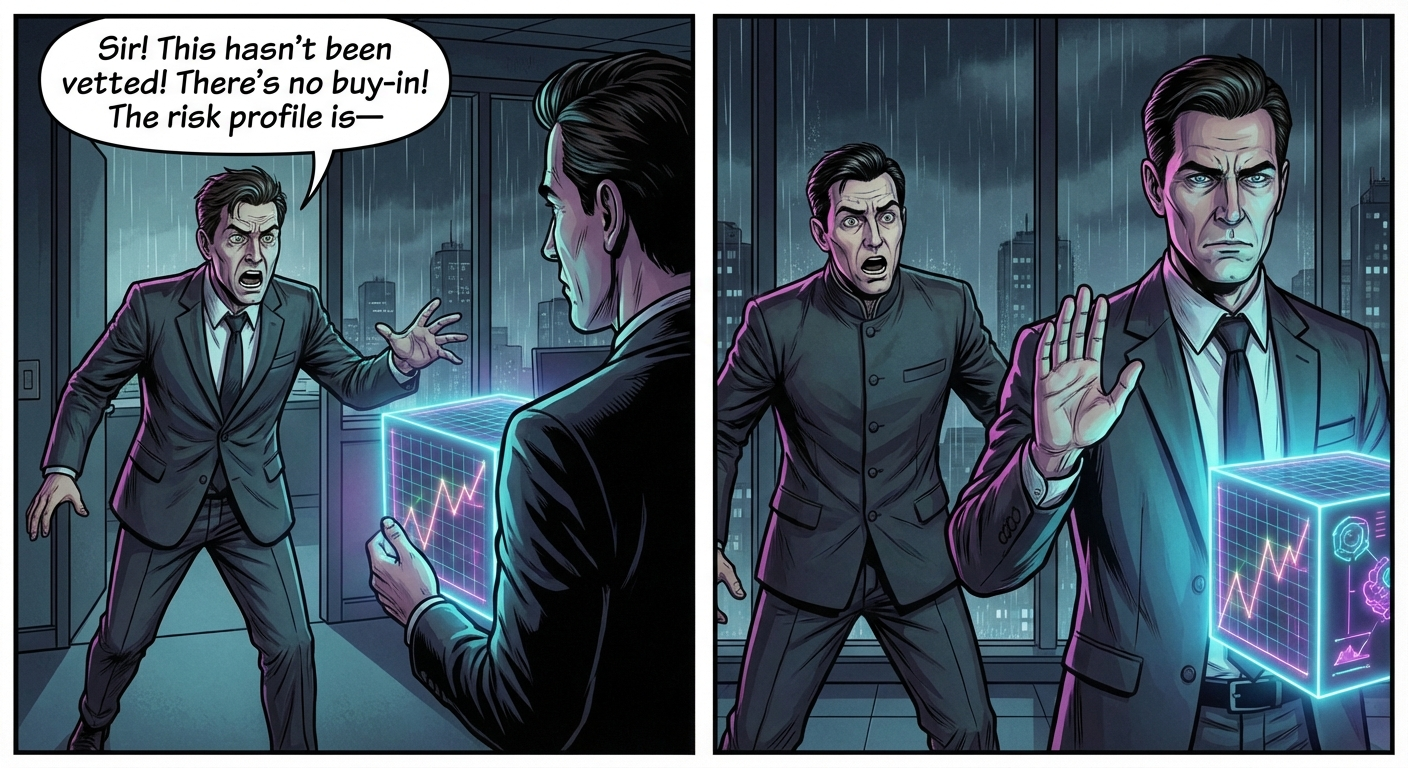
Panel 1: Mr. Veto bursts in, looking panicked.
Mr. Veto: “Sir! This hasn’t been vetted! There’s no buy-in! The risk profile is—”
Panel 2: The Architect holds up a hand. Veto freezes.
Caption: The immune system is attacking the cure.
Row 3
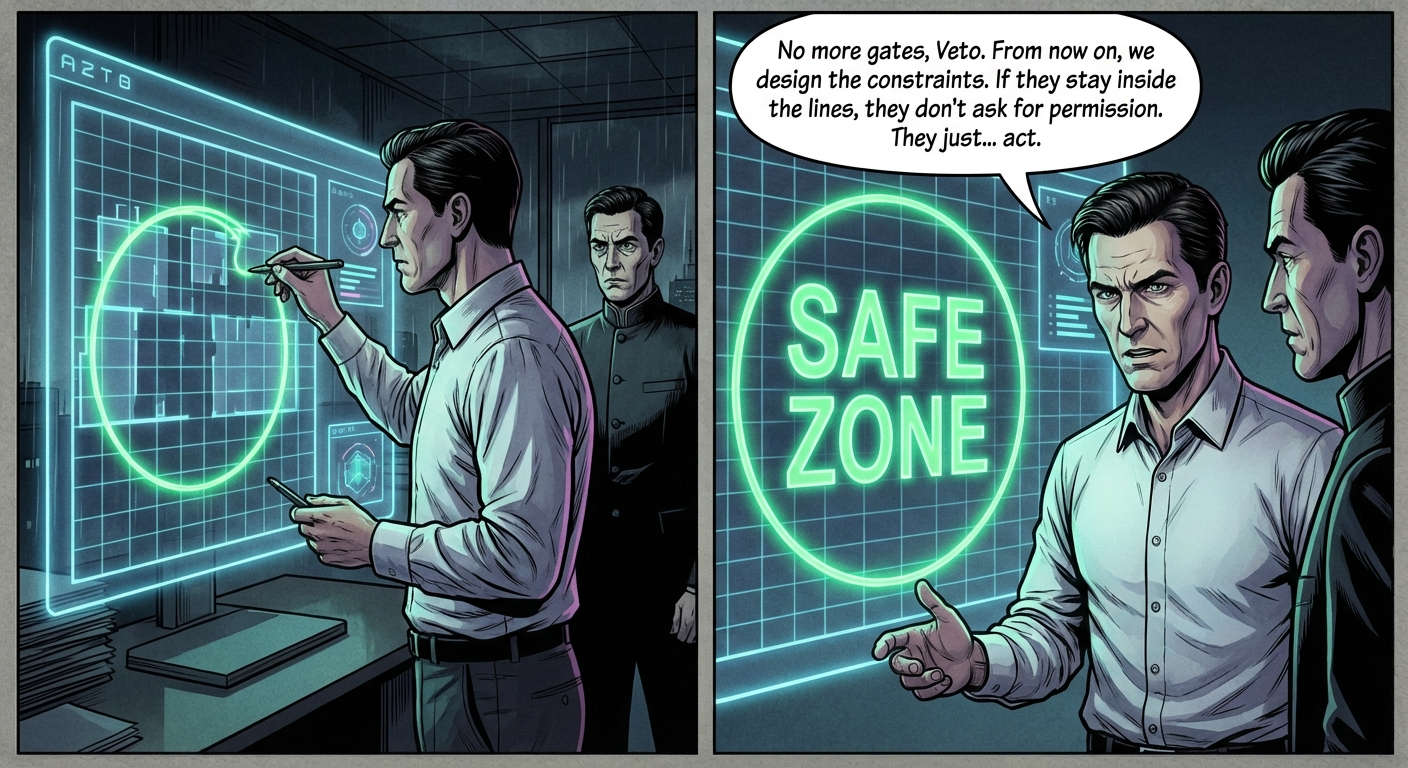
Panel 1: The Architect takes a digital pen and draws a circle around a section of the office on a holographic map.
Panel 2: The words “SAFE ZONE” appear in neon green.
The Architect (CEO): “No more gates, Veto. From now on, we design the constraints. If they stay inside the lines, they don’t ask for permission. They just… act.”
Page 6
Row 1
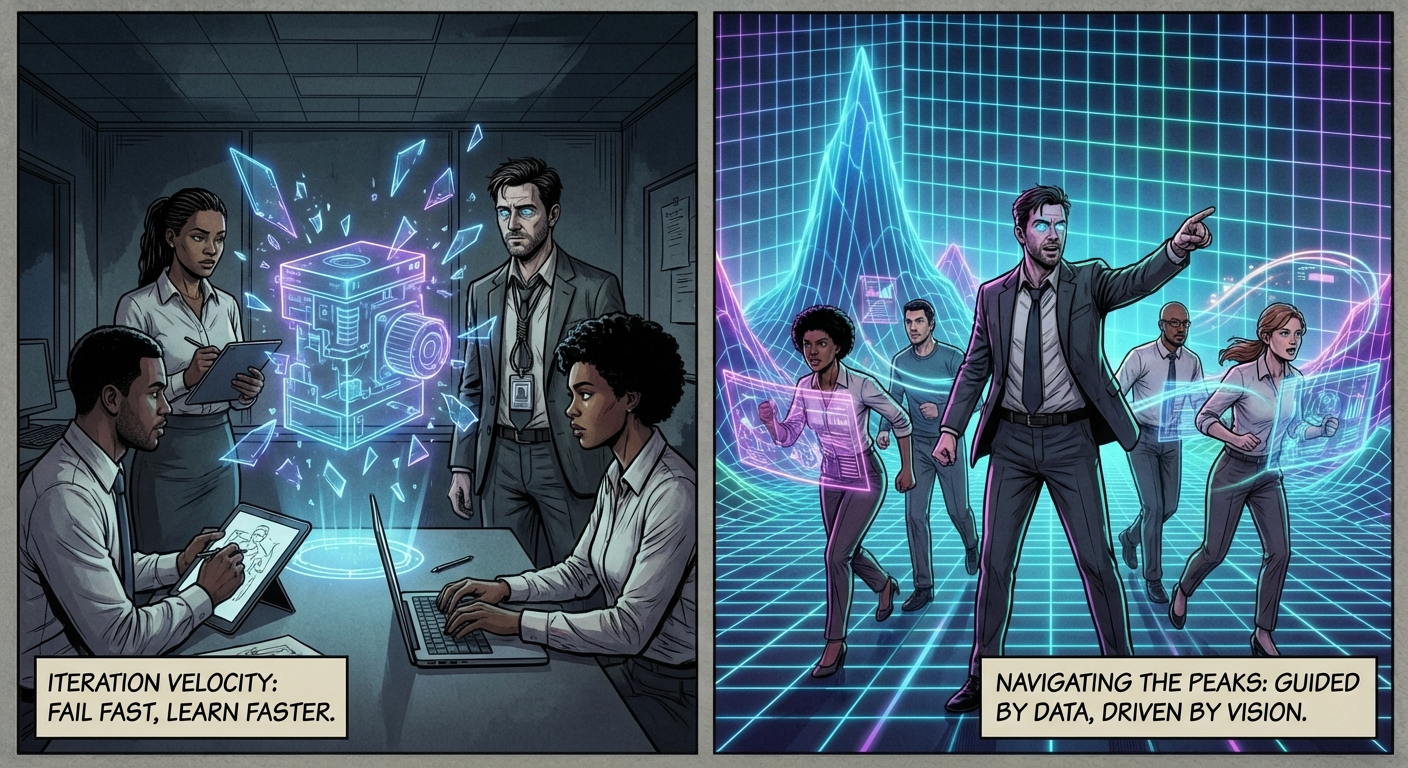
Panel 1: The Hive has changed. The walls are gone. The office is a glowing grid of “Fitness Landscapes”—peaks and valleys of data.
Panel 2: Dozens of teams are huddled around prototypes, not decks. The movement is kinetic, blurred.
Row 2
Panel 1: A team “fails” at a prototype. It shatters like digital glass. They immediately start the next one.
Caption: We don’t measure ‘Alignment’ anymore. We measure Velocity. How fast can you learn?
Panel 2: Elias is leading a group, pointing at a “peak” on the landscape.
Row 3
Panel 1: In a dark, quiet corner of the neon office, one person is working on something that looks completely “wrong”—a jagged, black shape.
Panel 2: Elias and the Architect watch from a distance.
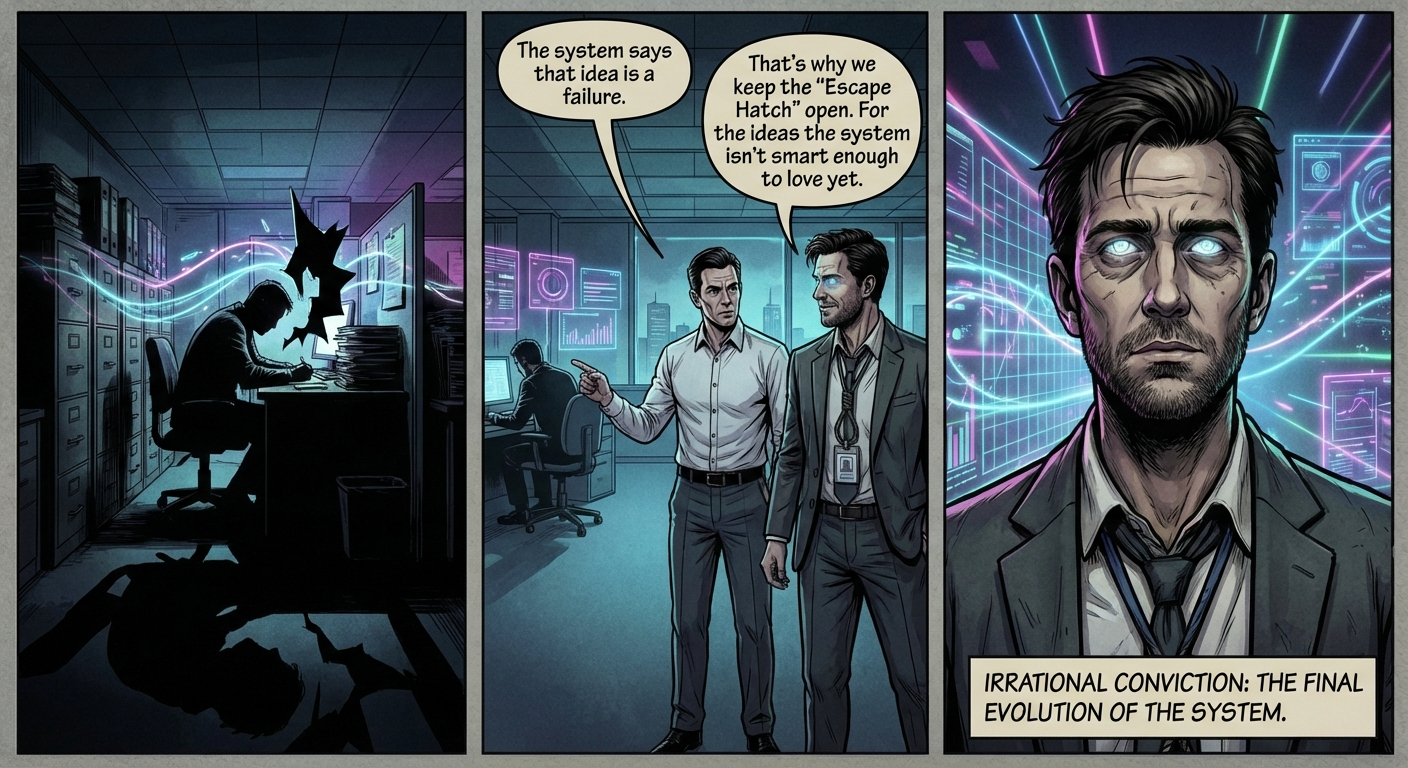
The Architect (CEO): “The system says that idea is a failure.”
Elias: “That’s why we keep the ‘Escape Hatch’ open. For the ideas the system isn’t smart enough to love yet.”
Panel 3: Final shot. Elias looks at the reader, his eyes glowing with the same light as his first idea.
Caption: The Hive is dead. Long live the Swarm.
Auto-Fix Mode
Auto-applying: proceeding directly to visual generation.
Character: Elias
An innovator who sees problems clearly but is exhausted by the system. Becomes energized and kinetic once he starts building. Role: Protagonist.
Character: Mr. Veto
A personification of the ‘Gatekeeper Loop’. Optimizes for personal risk avoidance. Speaks in corporate buzzwords like ‘alignment’ and ‘buy-in’. Role: Antagonist.
Character: The Architect (CEO)
Transitions from a distant bureaucrat to a systems designer who understands the collapse of artifact costs. Role: Supporting.
Game Theory Analysis
Started: 2026-02-20 19:55:46
Game Theory Analysis
Scenario: The strategic interaction between organizational Innovators and Gatekeepers, analyzing the transition from high-cost ‘Authority-Gated’ systems to low-cost ‘Constraint-Governed’ environments enabled by generative AI. The game explores how the ‘Gatekeeper Loop’ and ‘Process Maximalism’ function as strategic barriers and how the collapse of artifact production costs disrupts the legacy stagnation equilibrium.
Players: Innovator, Gatekeeper
Game Type: non-cooperative
Game Structure Analysis
This analysis explores the strategic interaction between Innovators and Gatekeepers within an organizational framework, specifically focusing on the disruption caused by generative AI (GenAI) on traditional bureaucratic structures.
1. Identify the Game Structure
Game Type: Non-Cooperative. While both players are part of the same organization, their utility functions are misaligned. The Innovator seeks “Execution Velocity” and “Idea Integrity,” while the Gatekeeper seeks “Risk Mitigation” and “Status Maintenance.”
Sum Type: Non-Constant Sum. The game can result in a “win-win” (successful innovation), a “win-lose” (successful gatekeeping at the cost of progress), or a “lose-lose” (Velocity Death, where the process destroys the value for the entire organization).
Timing: Traditionally Sequential (Innovator proposes $\to$ Gatekeeper disposes). However, with GenAI, it shifts toward a Simultaneous/Asymmetric game where the Innovator can act (Shadow Innovation) before or instead of seeking permission.
Information: Imperfect and Asymmetric.
The Innovator has private information regarding the true potential and technical feasibility of the idea.
The Gatekeeper has private information regarding the “political” or “compliance” risk appetite of the upper hierarchy.
Repetition: Repeated Game. This interaction occurs across multiple “ideation cycles.” Reputation matters; an Innovator who frequently bypasses may face future crackdowns, while a Gatekeeper who always vetoes may face “brain drain.”
2. Define Strategy Spaces
Innovator ($I$)
Submit to Formal Process ($S_F$): Engaging in the “Gatekeeper Loop.” This involves high administrative overhead and participation in Ritualized Review.
Bypass via AI-Augmented Execution ($S_B$): Using GenAI to collapse the cost of artifact production (code, docs, prototypes) to near zero, executing “Shadow Innovation” without prior approval.
Gatekeeper ($G$)
Strict Veto/Dilution ($T_V$): Applying Process Maximalism. The strategy is to demand exhaustive documentation and force modifications to ensure the idea is “safe” (diluted) or killed to prevent risk.
Constraint-Based Governance ($T_C$): Moving from “Approver” to “Architect.” Setting automated guardrails (legal, ethical, technical) that allow the Innovator to move fast as long as they stay within bounds.
3. Characterize Payoffs
The payoffs are defined by the value of the innovation ($V$), the cost of the process ($C_P$), the cost of artifact production ($C_A$), and the penalty of Velocity Death ($P_{VD}$).
Strategy Pair ($I, G$)
Innovator Payoff
Gatekeeper Payoff
Organizational Outcome
Submit / Strict Veto
$V - (C_P + C_A) - \text{Dilution}$
$\text{Status} + \text{Risk Avoidance}$
Legacy Equilibrium: Stagnation.
Submit / Constraint
$V - C_P$ (High)
$\text{Efficiency Gains}$
Optimized Legacy: Rare in practice.
Bypass / Strict Veto
$V - \text{Risk of Sanction}$
Loss of Control
Conflict: Shadow IT/Innovation.
Bypass / Constraint
$V$ (Maximized)
$\text{Strategic Oversight}$
Emergent Equilibrium: High Velocity.
Ritualized Review as a Cost-Sink: In the $(S_F, T_V)$ quadrant, the Innovator’s payoff is often negative because the time spent in review exceeds the eventual value of the diluted idea.
Velocity Death: If $G$ chooses $T_V$ and the process takes too long, $V$ decays to zero. Both players receive a heavy negative payoff as the organization loses market relevance.
4. Key Features & Equilibrium Analysis
The Legacy Nash Equilibrium (High-Cost Environment)
In the pre-AI era, the cost of action ($C_A$) was high. An Innovator could not easily “Bypass” because they needed the Gatekeeper’s budget and resources to build anything.
Equilibrium: $(S_F, T_V)$. The Innovator is forced to submit; the Gatekeeper is incentivized to dilute/veto to minimize personal risk. This leads to a stable state of low-value, high-process output.
The Emergent Equilibrium (Low-Cost Environment)
GenAI collapses $C_A$ to near zero. The Innovator no longer needs the Gatekeeper’s permission to produce a high-fidelity artifact.
The Shift: The strategy $S_B$ (Bypass) becomes the Dominant Strategy for the Innovator. If the Gatekeeper persists with $T_V$ (Strict Veto), they become obsolete because the Innovator simply routes around them.
New Equilibrium: To maintain relevance, the Gatekeeper must switch to $T_C$ (Constraint-Based Governance). The new Nash Equilibrium becomes $(S_B, T_C)$, where the Innovator executes rapidly and the Gatekeeper manages the “guardrails” rather than the “gates.”
Information Asymmetries & Signaling
Signaling: In the legacy model, a “thick” slide deck was a signal of effort. In the emergent model, a functional prototype (produced at zero cost by AI) is a signal of intent.
Commitment: Gatekeepers can “commit” to Constraint-Based Governance by automating their vetoes (e.g., automated compliance scanning), which signals to Innovators that they won’t be subjected to the “Ritualized Review” loop.
Summary of the Strategic Shift
The game moves from a Resource-Gated model (where the Gatekeeper controls the “means of production”) to a Discernment-Gated model. The collapse of artifact costs removes the Gatekeeper’s leverage, forcing a transition from “Process Maximalism” to “Architected Guardrails” to avoid organizational Velocity Death.
Payoff Matrix
This analysis explores the strategic transition from a high-cost, authority-gated organizational model to a low-cost, AI-augmented, constraint-governed model.
1. Game Structure Analysis
Game Type: Non-cooperative, non-zero-sum. While the organization benefits from innovation, the individual players (Innovator and Gatekeeper) have diverging incentives regarding status, effort, and risk.
Timing: Historically sequential (Innovator proposes, Gatekeeper disposes), but shifting toward simultaneous or “asynchronous-parallel” in the AI era (Innovator executes while Gatekeeper architects).
Information: Imperfect and Asymmetric. The Innovator knows the true potential of the idea; the Gatekeeper knows the hidden “political” or “compliance” landmines.
Asymmetries:
Power Asymmetry: Gatekeepers traditionally hold veto power.
Cost Asymmetry: In the legacy model, the Innovator bears the “cost of asking” (Ritualized Review), while the Gatekeeper bears the “cost of risk.”
2. Strategy Spaces
Innovator Strategies ($S_I$):
Formal Process (The Gatekeeper Loop): Submitting to the legacy hierarchy, producing slide decks, and attending steering committees.
Shadow Innovation (AI-Augmented Execution): Using generative AI to bypass production bottlenecks, creating functional prototypes/artifacts before seeking permission.
Gatekeeper Strategies ($S_G$):
Strict Veto/Dilution (Process Maximalism): Using “Risk Mitigation” as a tool to maintain the status quo and ensure all ideas are “safe” (and mediocre).
Constraint-Based Governance (Architecting Guardrails): Moving from manual review to defining automated or systemic boundaries within which others can move freely.
3. Payoff Matrix: The AI-Augmented Environment
The following matrix represents the payoffs in the emergent environment where AI has collapsed the cost of artifact production.
A. Legacy Stagnation (Formal Process + Strict Veto)
Outcome: The “Ritualized Review.”
Innovator Payoff (-5): High cost-sink. The innovator spends more energy on the “theater of innovation” (decks, alignment meetings) than on the idea.
Gatekeeper Payoff (+2): High perceived security and status. By diluting the idea, they ensure no personal risk, though the organization suffers.
Organizational Result: Velocity Death. The time-to-market exceeds the relevance of the idea.
B. Institutional Friction (Shadow Innovation + Strict Veto)
Outcome: The “Immune System” Response.
Innovator Payoff (+4): High satisfaction from building/executing quickly using AI, but faces high political risk and potential “shut down” by the hierarchy.
Gatekeeper Payoff (-8): Loss of control. The Gatekeeper feels obsolete and views the Innovator as a “rogue actor” or a liability.
Organizational Result: High internal conflict; value is created but often suppressed or hidden (Shadow IT/Innovation).
C. Mismatched Efficiency (Formal Process + Constraint-Based)
Outcome: Bureaucratic Lag.
Innovator Payoff (-2): The Innovator is still operating in the old “permission” mindset, failing to utilize the speed of AI.
Gatekeeper Payoff (-2): The Gatekeeper has built guardrails, but no one is using them, leading to wasted architectural effort.
Organizational Result: Underutilization of modern infrastructure.
D. Generative Equilibrium (Shadow Innovation + Constraint-Based)
Outcome: The Emergent Nash Equilibrium.
Innovator Payoff (+9): Near-zero cost of action. The Innovator uses AI to manifest ideas instantly within the pre-defined guardrails.
Gatekeeper Payoff (+9): The Gatekeeper shifts from “Approver” to “Architect.” They manage risk at scale rather than per-item, increasing their strategic impact.
Organizational Result: Pareto Efficiency. Maximum innovation velocity with managed institutional risk.
5. Key Strategic Features
The Collapse of the “Cost of Asking”: In the legacy equilibrium, the cost of doing was so high that the Innovator had to ask for resources. With AI, the cost of doing is lower than the cost of asking. This flips the game from a “Permission Game” to an “Execution Game.”
Signaling: In the new equilibrium, a functional AI-generated prototype serves as a “Hard Signal” of viability, replacing the “Soft Signal” of a polished slide deck (Ritualized Review).
The Gatekeeper’s Dilemma: If the Gatekeeper stays in “Strict Veto” mode while the Innovator moves to “Shadow Innovation,” the Gatekeeper’s payoff drops most severely (-8). This creates a strategic incentive for Gatekeepers to adopt Constraint-Based Governance to avoid total obsolescence.
Nash Equilibria Analysis
This analysis explores the strategic transition from legacy bureaucratic structures to AI-augmented organizational models through the lens of game theory.
1. Game Structure Analysis
Game Type: Non-cooperative. While both players are part of the same organization, their incentives are misaligned due to differing risk profiles and performance metrics.
Timing: Historically Sequential (Gatekeeper moves after Innovator), but shifting toward Simultaneous or Real-time in AI-augmented environments where execution speed outpaces review cycles.
Information: Asymmetric. The Innovator has better information regarding the technical viability of the idea; the Gatekeeper has better information regarding institutional risk and “alignment” constraints.
Asymmetries:
Power Asymmetry: The Gatekeeper holds formal veto power.
Cost Asymmetry: The Innovator bears the “sunk cost” of creation; the Gatekeeper bears the “reputational cost” of failure.
2. Strategy Spaces
Innovator ($I$)
Submit to Formal Process (Gatekeeper Loop): Engaging in the “Ritualized Review.” This involves high administrative overhead, “spreadsheet engineering,” and the risk of “Velocity Death.”
Bypass via AI-Augmented Execution (Shadow Innovation): Using generative AI to collapse the cost of artifact production (code, decks, prototypes) to near zero, executing the idea before the formal process can intervene.
Gatekeeper ($G$)
Strict Veto/Dilution (Risk Mitigation): Applying “Process Maximalism.” Every idea is filtered until it reaches the “lowest common denominator of institutional comfort.”
Constraint-Based Governance (Architecting Guardrails): Shifting from an “Approver” to an “Architect.” Setting automated boundaries (safety, ethics, budget) within which the Innovator can move freely.
3. Payoff Matrix
The following matrix represents the payoffs $(Innovator, Gatekeeper)$.
$V$ = Value of Innovation
$C_p$ = Cost of Process (Time/Effort)
$C_a$ = Cost of Action (Artifact production)
$D$ = Dilution (Loss of value due to gatekeeper interference)
$L$ = Velocity Death (Organizational loss due to delay)
Strict Veto (Gatekeeper)
Constraint-Based (Gatekeeper)
Formal Process (Innovator)
$(V - D - C_p - C_a), (Status Quo - L)$
$(V - C_p - C_a), (V)$
Bypass/AI (Innovator)
$(V - C_{ai} - Penalty), (Risk/Loss of Control)$
$(V - C_{ai}), (V)$
4. Nash Equilibrium Analysis
Equilibrium 1: The Stagnation Trap (Legacy Nash)
Strategy Profile: (Formal Process, Strict Veto)
Description: The Innovator submits to the loop because the cost of “acting alone” (without AI) is too high ($C_a$ is prohibitive). The Gatekeeper applies strict vetoes because their primary incentive is risk avoidance.
Why it’s a Nash Equilibrium:
If the Innovator deviates to “Bypass” without AI, the cost of production and the penalty for unauthorized action are too high.
If the Gatekeeper deviates to “Constraint-Based” in a high-cost world, they risk “expensive failures” for which they are held accountable.
Classification: Pure Strategy Equilibrium.
Stability: Stable in legacy environments, but results in Velocity Death for the organization.
Equilibrium 2: The Generative Shift (Emergent Nash)
Strategy Profile: (Bypass via AI, Constraint-Based Governance)
Description: Enabled by the collapse of artifact costs ($C_{ai} \approx 0$). The Innovator realizes it is faster to build a prototype than to ask for permission. The Gatekeeper realizes that “Strict Veto” is now impossible to enforce, so they shift to setting guardrails to maintain relevance.
Why it’s a Nash Equilibrium:
Innovator: Once $C_{ai}$ is near zero, the payoff for bypassing the “Ritualized Review” is always higher than the diluted, high-cost formal path.
Gatekeeper: If the Innovator is already bypassing, the Gatekeeper’s only way to extract value and mitigate risk is to provide the “Guardrails” (Constraint-Based). If they stay “Strict,” they are simply ignored, leading to a payoff of zero or negative (total loss of control).
Classification: Pure Strategy Equilibrium.
Stability: Highly stable in the age of Generative AI.
5. Discussion of Equilibria
The Transition (The “Collapse”): The transition from Equilibrium 1 to Equilibrium 2 is triggered by the technological shock of Generative AI. When the “cost of doing” drops below the “cost of asking,” the Legacy Nash Equilibrium becomes untenable.
Pareto Dominance: Equilibrium 2 (Bypass, Constraint) Pareto dominates Equilibrium 1. Both players achieve higher payoffs: the Innovator retains the potency of their idea ($V$ instead of $V-D$), and the Gatekeeper avoids the organizational drag of “Velocity Death” while still managing systemic risk.
Coordination Problem: The primary barrier to reaching the Emergent Equilibrium is Trust and Signaling. Gatekeepers often fear that “Constraint-Based” governance is a surrender of power, while Innovators fear that “Bypass” will lead to termination.
Likelihood: Equilibrium 2 is the inevitable “Attractor State.” Organizations that fail to coordinate this transition suffer from Velocity Death, eventually being outcompeted by “Shadow Innovators” or leaner, AI-native competitors who have already adopted Constraint-Based Governance.
Dominant Strategies Analysis
Based on the game theory principles applied to the transition from Authority-Gated to Constraint-Governed environments, here is the analysis of dominant and dominated strategies.
1. Strictly Dominant Strategies
A strategy is strictly dominant if it provides a higher payoff than any other strategy, regardless of the opponent’s choice.
Innovator: Bypass via AI-Augmented Execution (Shadow Innovation)
In the emergent environment where the cost of artifact production is near zero, “Bypassing” becomes strictly dominant.
If the Gatekeeper chooses Strict Veto, the Innovator avoids the “Ritualized Review” cost-sink and “Velocity Death” by executing independently.
If the Gatekeeper chooses Constraint-Based Governance, the Innovator still prefers AI-augmented execution because it maximizes velocity and minimizes the friction of even a streamlined process.
As AI lowers the barrier to action, the Gatekeeper can no longer effectively stop innovation through Veto (as the Innovator will simply bypass them).
If the Innovator Submits, Constraint-Based Governance is better than Strict Veto because it prevents “Velocity Death” for the organization.
If the Innovator Bypasses, Constraint-Based Governance is the only way for the Gatekeeper to remain relevant; by providing guardrails, they maintain a level of “Architectural” control rather than being completely ignored (Obsolescence).
2. Weakly Dominant Strategies
A strategy is weakly dominant if it is at least as good as any other strategy in all cases and strictly better in at least one.
Innovator: Bypass via AI-Augmented Execution
In a scenario where a Gatekeeper is exceptionally efficient (low friction), Bypassing might yield an equal payoff to Submitting, but in all other scenarios (especially involving “Process Maximalism”), Bypassing is strictly better. Thus, it remains the robust choice.
3. Dominated Strategies
A strategy is dominated if there is another strategy that always performs better.
Innovator: Submit to Formal Process (Gatekeeper Loop)
This is a strictly dominated strategy in the emergent equilibrium. The “Ritualized Review” acts as a tax on time and energy. When the alternative (AI-augmented execution) allows for the creation of functional prototypes at near-zero cost, the “Formal Process” offers no rational upside to the Innovator, only the risk of “Velocity Death” and idea dilution.
This is a strictly dominated strategy in the new landscape. While it served a purpose when resources were scarce (Legacy Equilibrium), it now leads to the Gatekeeper being “routed around.” Clinging to the Veto results in the worst possible payoff: a loss of oversight and the creation of a “Shadow Innovation” culture that the Gatekeeper can no longer influence.
4. Iteratively Eliminated Strategies
By removing dominated strategies, we can predict the rational outcome of the game.
Step 1: Eliminate the Innovator’s strategy to Submit to Formal Process. Rational Innovators recognize that the cost of “asking” now exceeds the cost of “doing.”
Step 2: Given that the Innovator will Bypass, the Gatekeeper must eliminate Strict Veto. If they choose Strict Veto against a Bypassing Innovator, they achieve zero utility (total loss of control).
Result: The only remaining strategies are Bypass and Constraint-Based Governance.
Strategic Implications
The Collapse of the Legacy Nash Equilibrium
In the legacy environment, the high cost of action created a Nash Equilibrium at (Submit, Strict Veto). The Innovator couldn’t afford to bypass, and the Gatekeeper had to veto to protect scarce resources. Generative AI has fundamentally broken this equilibrium by removing the “cost of action” barrier.
The Rise of “Shadow Innovation”
If the Gatekeeper fails to move toward Constraint-Based Governance, the game defaults to a state where the Innovator Bypasses and the Gatekeeper Vetoes into a void. This creates a “Shadow Innovation” environment where the organization loses the ability to align its decentralized experiments with its core strategy.
The Architect’s Pivot
The analysis shows that for the Gatekeeper, the only path to maintaining institutional relevance is to stop being a “Gate” and start being a “Rail.” By architecting guardrails (automated compliance, ethical AI filters, strategic parameters), they lower the Innovator’s incentive to bypass the system entirely, moving the organization toward a high-velocity, Constraint-Governed equilibrium.
Velocity Death as a Forcing Function
“Velocity Death” acts as a negative payoff that punishes both players. In the emergent game, the speed of AI-augmented competitors makes the “Gatekeeper Loop” not just an internal annoyance, but an existential threat to the organization. This shifts the game from a zero-sum struggle for control to a non-cooperative race toward the new equilibrium.
Pareto Optimality Analysis
To analyze the Pareto optimality of the strategic interaction between the Innovator and the Gatekeeper, we must first establish a payoff matrix that reflects the transition from high-cost legacy systems to low-cost AI-augmented environments.
The Payoff Matrix
Payoffs are represented as (Innovator, Gatekeeper). Values are qualitative: 0 (Destructive) to 10 (Maximum Value).
Gatekeeper: Strict Veto (T1)
Gatekeeper: Constraint-Based (T2)
Innovator: Submit (S1)
(2, 3) - Legacy Nash Equilibrium
(4, 2) - Inefficient Alignment
Innovator: Bypass (S2)
(7, 1) - Shadow Innovation / Conflict
(10, 9) - Emergent Pareto Optimal
1. Identification of Pareto Optimal Outcomes
An outcome is Pareto optimal if no player can be made better off without making the other player worse off.
Outcome (S2, T2) - [Bypass via AI, Constraint-Based Governance]: This is the primary Pareto optimal outcome. The Innovator achieves maximum execution velocity with AI, and the Gatekeeper achieves scalable governance without the manual labor of the “Gatekeeper Loop.”
Outcome (S2, T1) - [Bypass via AI, Strict Veto]: This is also technically Pareto optimal in a narrow sense. While the Gatekeeper is miserable (loss of control), the Innovator’s payoff is high because they have bypassed the “Ritualized Review.” To move the Gatekeeper to a better state (T2) while keeping the Innovator at this level of freedom requires a shift in the organizational architecture.
2. Comparison: Pareto Optimal vs. Nash Equilibria
The Legacy Nash Equilibrium: (S1, T1)
In the pre-AI world, the cost of action was high. The Innovator submitted to the process because they lacked the tools to execute alone. The Gatekeeper maintained strict vetoes to mitigate risk.
Status: This is a Nash Equilibrium but not Pareto optimal. Both players are trapped in a low-value state characterized by “Velocity Death.”
The Emergent Nash Equilibrium: (S2, T2)
As AI collapses the cost of artifact production, the Innovator’s dominant strategy shifts to Bypass (S2). Once the Innovator bypasses, the Gatekeeper’s best response is to move from Strict Veto (T1) (where they have zero influence) to Constraint-Based Governance (T2) (where they regain some systemic control).
Status: This is both a Nash Equilibrium and a Pareto optimal outcome. It represents the “Generative Frontier.”
3. Pareto Improvements over Equilibrium Outcomes
A Pareto improvement occurs when we move from one state to another where at least one person is better off and no one is worse off.
The Great Leap: Moving from (S1, T1) to (S2, T2) is a massive Pareto improvement.
The Innovator moves from a payoff of 2 to 10 (eliminating the “Ritualized Review” cost-sink).
The Gatekeeper moves from a payoff of 3 to 9 (trading the illusion of control for actual systemic safety and organizational survival).
The Conflict Bridge: Moving from (S2, T1) to (S2, T2) is a Pareto improvement for the Gatekeeper. In the “Shadow Innovation” phase, the Gatekeeper is obsolete. By adopting constraint-based guardrails, they improve their own payoff without hindering the Innovator’s new-found AI velocity.
4. Efficiency vs. Equilibrium Trade-offs
The primary tension in this game is the Coordination Failure inherent in the transition:
The Stagnation Trap: The Legacy Equilibrium (S1, T1) is stable but highly inefficient. It persists because of “Process Maximalism.” Even though a better state (S2, T2) exists, the Gatekeeper fears that moving to T2 will diminish their status, while the Innovator fears that S2 will lead to termination.
Velocity Death: This is the ultimate negative payoff for the organization. While (S1, T1) might feel “safe” for the players individually in the short term, the resulting lack of output leads to the death of the firm. The Pareto optimal outcome (S2, T2) is the only state that solves for organizational efficiency.
Information Asymmetry: The Innovator often realizes the cost of action has collapsed (via AI) before the Gatekeeper does. This creates a period of “Shadow Innovation” (S2, T1) which is efficient for production but risky for the institution.
Opportunities for Cooperation and Coordination
To reach the Pareto optimal “Emergent Equilibrium” without enduring a period of organizational conflict, the following coordination mechanisms are required:
Architecting Guardrails (Signaling): The Gatekeeper must signal a move to Constraint-Based Governance early. By defining “automated safety zones,” they invite the Innovator out of the shadows.
Artifact-Based Review (Commitment): The organization must commit to replacing “Ritualized Review” (decks) with “Functional Artifacts” (AI prototypes). This reduces the cost-sink for the Innovator, making cooperation more attractive than bypassing.
Transparency of Constraints: If the Gatekeeper publishes the “rules of the game” (the constraints) clearly, the Innovator can use AI to build within those rules, achieving the velocity of bypassing with the safety of submission.
Conclusion: The transition from Authority-Gated to Constraint-Governed systems is a move from a sub-optimal Nash Equilibrium to a Pareto efficient frontier. The collapse of artifact costs via AI acts as the catalyst that breaks the legacy stagnation.
Strategic Recommendations
Based on the game theory analysis of the transition from Authority-Gated to Constraint-Governed environments, the following strategic recommendations are designed to navigate the collapse of artifact production costs and avoid the “Velocity Death” of the organization.
1. Strategic Recommendations for the Innovator
Optimal Strategy: AI-Augmented Execution (Shadow Innovation)
The Innovator should prioritize “doing” over “asking.” Because generative AI reduces the cost of action to near zero, the Innovator should produce high-fidelity prototypes or “action-adjacent artifacts” before entering any formal review loop.
Contingent Strategies:
If Gatekeeper is Strict: Maintain “Shadow” status. Use AI to rapidly iterate in private, only revealing the project when the artifact’s value is so undeniable that a veto would be seen as irrational by the broader organization.
If Gatekeeper adopts Constraints: Transition to “Open Execution.” Provide feedback on the guardrails to ensure they remain functional rather than bureaucratic.
Risk Assessment: The primary risk is “Institutional Rejection.” If the bypass is discovered before the value is proven, the Innovator faces political blowback for violating “Process Maximalism.”
Coordination Opportunities: Use AI to automatically generate the documentation required by the Gatekeeper (e.g., automated ROI projections, compliance checklists). This “subsidizes” the Gatekeeper’s cost of review, making a “Yes” easier.
Information Considerations: Signal Capability, not Method. Show the functional prototype (the result) rather than emphasizing the AI-augmented process, which might trigger “Ritualized Review” or fear of job displacement.
2. Strategic Recommendations for the Gatekeeper
Optimal Strategy: Constraint-Based Governance (Architecting Guardrails)
The Gatekeeper must shift from being a “Human Tollbooth” to an “Infrastructure Architect.” Instead of reviewing individual ideas, they should define the automated boundaries (legal, ethical, technical) within which Innovators can move freely.
Contingent Strategies:
If Innovator Bypasses: Do not punish the bypass. Instead, analyze the “Shadow” project to see which guardrail was missing or too high. Use the bypass as data to refine the governance model.
If Innovator Submits to Loop: Fast-track them. Immediately provide the “Constraint Checklist” and allow them to self-certify where possible to avoid “Velocity Death.”
Risk Assessment: The risk is “Loss of Granular Control.” By moving to guardrails, the Gatekeeper accepts that some “mediocre” ideas will pass, but this is the price paid to avoid the greater risk of organizational stagnation.
Coordination Opportunities: Partner with Innovators to define “Safe Harbors”—specific zones where experimentation is encouraged without any formal approval, provided certain telemetry is shared.
Information Considerations: Be radically transparent about Constraints. The more clearly the “No-Go” zones are defined, the less time Innovators waste, and the lower the Gatekeeper’s “Ritualized Review” burden becomes.
Overall Strategic Insights
The Cost Flip: In the legacy equilibrium, “Asking” was cheaper than “Doing.” In the AI-augmented equilibrium, “Doing” is cheaper than “Asking.” Strategies that do not account for this flip will result in Velocity Death.
Artifacts over Decks: The “Ritualized Review” of slide decks is a legacy cost-sink. The new equilibrium favors the evaluation of functional artifacts (code, prototypes, data models) over performative presentations.
Governance as a Product: Governance should be treated as an API or a set of automated tests, not a meeting. If an Innovator can “pass the tests,” they should have the green light automatically.
Potential Pitfalls to Avoid
The “AI-Powered Loop”: Using AI to generate more bureaucracy (e.g., 100-page AI-written reports for a 1-page idea). This maintains Process Maximalism while increasing noise.
Sunk Cost Fallacy in Process: Continuing to use “Stage-Gate” models simply because the organization invested in the software or training for them, even when they are now slower than the execution speed.
Veto Without Skin in the Game: Allowing stakeholders to kill projects without requiring them to provide a “Path to Yes.” This is the core driver of the Gatekeeper Loop.
Implementation Guidance
Phase 1: The “Shadow” Audit. Leadership should identify successful projects that were built “off-books.” Instead of punishing them, map the path they took to bypass the gates.
Phase 2: Define the Guardrails. Replace “Approval Meetings” with a “Constraint Document.” (e.g., “You can launch this if: it costs <$5k, uses approved cloud providers, and passes the PII scan.”)
Phase 3: Automate the Gate. Move toward “Self-Service Governance.” If an Innovator meets the constraints, the system grants them the resources/permission automatically, removing the human Gatekeeper from the critical path of execution.
Game Theory Analysis Summary
GameAnalysis(game_type=Transitioning from a Non-Cooperative Zero-Sum Game (Legacy) to a Cooperative Coordination Game (Emergent), players=[The Innovator (Employee), The Gatekeeper (Middle Management/Compliance)], strategies={The Innovator (Employee)=[Submit (Process Maximalism), Perform (Ritualized Review), Bypass (Shadow Projects)], The Gatekeeper (Middle Management/Compliance)=[Veto/Dilute, Rubber Stamp, Architect (Automated Constraints)]}, payoff_matrix=Legacy Model: Gatekeeper payoff is ‘No Risk’ (Veto) vs Innovator ‘Successful Execution’ (Misaligned). AI-Augmented Model: Payoff for ‘Bypassing’ exceeds ‘Asking’ as the cost of action drops., nash_equilibria=[The ‘Theater of Innovation’ Equilibrium: Innovator (Performative Ritual) and Gatekeeper (Non-committal encouragement), The ‘Bypass’ Equilibrium (Emergent): Innovator (Rapid Prototyping) and Gatekeeper (Irrelevance)], dominant_strategies={The Gatekeeper (Middle Management/Compliance)=Risk Mitigation (Dilution), The Innovator (Employee)=Execution Velocity}, pareto_optimal_outcomes=[Constraint-Governed Action: High innovation volume, Innovator autonomy/speed, and Gatekeeper as Architect with reduced overhead], recommendations={The Organization=Dismantle ‘Process Maximalism’ and replace it with automated guardrails; shift metrics from ‘Alignment’ to ‘Execution Velocity’., The Innovator (Employee)=Stop selling ‘ideas’ and start showing ‘functional artifacts’; leverage generative AI to lower the cost of the first prototype., The Gatekeeper (Middle Management/Compliance)=Transition from a ‘Veto’ role to a ‘Constraint Designer’ role; focus on defining ‘Parameters of Safety’ rather than individual reviews.})
Analysis completed in 116sFinished: 2026-02-20 19:57:42
Socratic Dialogue Transcript
Initial Question: Does the collapse of artifact production costs fundamentally threaten the existence of organizational gatekeeping, or does it merely shift the bottleneck to a new form of institutional control?
Domain Constraints: Organizational Design, Innovation Management, Generative AI Economics, Institutional Theory
Started: 2026-02-20 19:55:27
Exchange 1
Question: Does the collapse of artifact production costs fundamentally threaten the existence of organizational gatekeeping, or does it merely shift the bottleneck to a new form of institutional control?
Response: To address whether the collapse of artifact production costs—driven primarily by Generative AI—threatens organizational gatekeeping or merely relocates it, we must first define our terms and the economic logic currently under strain.
In this context, artifact production costs refer to the capital, labor, and time required to generate a discrete output (a line of code, a marketing campaign, a legal brief, a technical schematic). Gatekeeping is the institutional exercise of authority to determine which artifacts are granted “entry” into a market, a discourse, or a formal system of record.
My initial thesis is that we are witnessing a radical relocation of the bottleneck, rather than the extinction of the gatekeeper. However, the nature of that gatekeeping is shifting from productive capacity to evaluative authority.
1. The Erosion of the “Technical Gate”
Historically, organizations acted as gatekeepers because they owned the “means of production.” If you wanted to produce a high-quality film, a complex software suite, or a peer-reviewed journal, you needed the firm’s concentrated capital and specialized labor. The high cost of production served as a natural filter; only “vetted” ideas received funding.
With the marginal cost of artifact production approaching zero, this “Technical Gate” has collapsed. The firm can no longer justify its existence solely by its ability to make things. This leads to a state of artifact hyper-inflation, where the volume of output exceeds the human capacity to process it.
2. The Shift to the “Epistemic Gate”
As production costs collapse, the bottleneck moves from creation to validation. In a world of infinite, AI-generated artifacts, the primary problem is no longer “How do we make this?” but “Is this true, safe, and valuable?”
Institutional control is currently migrating toward what I call the Epistemic Gate. This takes three forms:
Verification and Trust: When anyone can generate a professional-looking legal contract or a scientific paper, the value of the “brand” or the “institutional stamp” (e.g., a prestigious law firm or a university) increases. The gatekeeper now sells certainty in an environment of synthetic noise.
Liability and Accountability: AI can produce artifacts, but it cannot (currently) bear legal or social responsibility. Organizations will maintain control by acting as the “liable entity” that stands behind the artifact.
Curation and Attention: In a state of abundance, the gatekeeper controls the interface. Algorithms and platforms become the new institutional controllers, deciding which of the infinite artifacts are actually seen.
3. The Coasean Implication
From the perspective of Institutional Theory, specifically Coase’s Theory of the Firm, organizations exist because the transaction costs of the open market are too high. If AI lowers the cost of finding, contracting, and producing, the “walls” of the firm should theoretically dissolve.
However, if the cost of verifying the quality of those market-produced artifacts skyrockets (due to deepfakes, hallucinations, or low-quality noise), the transaction costs actually increase. This suggests that organizations may actually become more insular and hierarchical in their gatekeeping to protect the integrity of their internal data and outputs.
4. Uncertainties and Risks
I am uncertain about the “long-tail” of this transition. While I argue that gatekeeping shifts to validation, there is a risk of Institutional Decoupling. If the cost of production is zero, “shadow” organizations or decentralized networks might create their own parallel validation systems (e.g., decentralized autonomous organizations or cryptographic proof-of-work for artifacts). If these parallel systems gain more social trust than traditional institutions, then organizational gatekeeping as we know it truly does face an existential threat.
Summary for our Dialogue
The collapse of production costs does not democratize outcomes; it democratizes outputs. Because human attention and systemic risk-tolerance remain finite, gatekeeping is not dying—it is being redefined as the management of trust and the allocation of attention.
Does this resonance with your observation of how institutions are reacting to AI, or do you see evidence that the sheer volume of production is already making traditional validation mechanisms obsolete?
Next Question: If the transaction cost of verifying an artifact’s quality rises in direct proportion to the volume of synthetic noise, does the “Epistemic Gate” actually preserve the firm, or does it create a “Verification Trap” where the institution’s overhead for maintaining trust eventually exceeds the market value of the artifacts it validates?
Exchange 2
Question: If the transaction cost of verifying an artifact’s quality rises in direct proportion to the volume of synthetic noise, does the “Epistemic Gate” actually preserve the firm, or does it create a “Verification Trap” where the institution’s overhead for maintaining trust eventually exceeds the market value of the artifacts it validates?
Response: The “Verification Trap” is a profound and necessary extension of the “Epistemic Gate” concept. It suggests that the very mechanism intended to save the institution—its role as a validator—could become the instrument of its economic demise.
To explore whether the Epistemic Gate preserves the firm or traps it, we must analyze the asymmetry of cost between generation and verification.
1. Defining the Verification Trap
The Verification Trap occurs when the marginal cost of verifying an artifact ($MC_v$) scales at a higher rate than the marginal utility of the artifact ($MU_a$), driven by the volume of synthetic noise.
In a pre-AI world, production and verification were often coupled. If it took a human 40 hours to write a technical white paper, it might take a peer 4 hours to verify it. The ratio was manageable. In a generative world, the white paper can be produced in 4 seconds. However, if that paper contains “hallucinations”—subtle, plausible-sounding falsehoods—the verification time does not drop; it may actually increase because the verifier can no longer trust the “intent” or “expertise” of the creator.
If the market value of a “verified white paper” is $1,000, but the volume of synthetic noise requires $1,200 worth of expert labor to guarantee its accuracy, the institution has entered the Trap. Its overhead for maintaining trust has exceeded the market value of its output.
2. The “Red Queen” Problem of Institutional Overhead
Institutions are currently attempting to fight AI-generated noise with AI-generated verification. This creates a “Red Queen” race (running as fast as you can just to stay in place).
The Recursive Loop: If a firm uses AI to verify AI, it lowers the cost of verification, but it may also lower the certainty of that verification. If the “trust-premium” of the firm is based on human-level certainty, then automated verification is a form of institutional debasement.
The Complexity Tax: As AI becomes better at mimicking high-quality artifacts, the “tells” of synthetic origin become more microscopic. Verification then requires increasingly specialized (and expensive) human intervention. The firm becomes a bloated bureaucracy of “checkers checking checkers,” while the actual value-added production has been outsourced to a commodity model.
3. Does the Gate Preserve the Firm?
The Epistemic Gate preserves the firm only if the firm can shift the basis of trust from the artifact to the provenance.
If the firm tries to verify every discrete artifact (the “Output-Centric Model”), it will fall into the Verification Trap. The volume of noise will eventually overwhelm the gate.
However, if the firm shifts to a “Process-Centric Model,” it might survive. In this model, the firm doesn’t say, “We have verified that this specific document is true.” It says, “We have verified that this document was produced within our closed, secure, and audited ‘clean room’ of data and human oversight.”
This is a shift from Ex-Post Verification (checking the work after it’s done) to Ex-Ante Certification (guaranteeing the environment in which it was made). This is how the firm avoids the trap: by refusing to engage with the “noise” of the open market and instead creating a high-walled garden where the noise-to-signal ratio is controlled at the source.
4. The Coasean Breaking Point
Returning to Coase: the firm exists to minimize transaction costs. The Verification Trap suggests a point of Institutional Inversion.
If the internal cost of maintaining an “Epistemic Gate” (the lawyers, auditors, and subject matter experts required to vet AI output) becomes higher than the cost of simply accepting a certain percentage of “error” in the open market, the firm loses its reason for being. We might see a “de-institutionalization” of certain fields where we decide that “mostly-correct and cheap” is better than “guaranteed-correct and prohibitively expensive.”
5. Uncertainties: The Role of Cryptography
I am uncertain whether traditional institutional “trust” can survive without a technological pivot. I suspect that the only way out of the Verification Trap is the integration of cryptographic truth (e.g., digital signatures, zero-knowledge proofs of computation) into the Epistemic Gate. If the firm can use math to prove an artifact’s origin, the cost of verification collapses back toward zero. Without this, the “human-in-the-loop” becomes an economic liability.
Questions for our Dialogue:
If the cost of human verification makes an institution’s artifacts “too expensive” for the market, will society accept a lower standard of truth in exchange for AI-driven abundance?
Does the “Verification Trap” imply that the most successful future firms will be those that produce the least amount of artifacts, focusing instead on the rare, high-stakes decisions where the cost of error is so high that the “Trap” is irrelevant?
Can an institution maintain “Evaluative Authority” if it no longer possesses the “Productive Capacity” to understand how the artifacts are actually made?
Next Question: If the firm shifts from verifying the artifact to certifying the process (the “clean room”), how does it prevent the “Verification Trap” from simply migrating upstream, where the cost of auditing the increasingly complex and opaque generative pipeline—from data provenance to model weights—eventually exceeds the market value of the “certified” output?
Exchange 3
Question: If the firm shifts from verifying the artifact to certifying the process (the “clean room”), how does it prevent the “Verification Trap” from simply migrating upstream, where the cost of auditing the increasingly complex and opaque generative pipeline—from data provenance to model weights—eventually exceeds the market value of the “certified” output?
Response: The concern you raise is the “Complexity Trap”—the upstream migration of the Verification Trap. If the cost of auditing the “clean room” (the data, the weights, the fine-tuning protocols) exceeds the value of the output, the firm has simply traded a labor-intensive problem (checking artifacts) for a capital-and-expertise-intensive problem (auditing systems).
To prevent this migration from bankrupting the institution, the firm must move away from “Deep Auditing” (trying to understand the “why” of the model) and toward “Structural Constraints” and “Statistical Assurance.”
Here is an analysis of how the firm might navigate this upstream migration without succumbing to the cost of infinite complexity.
1. The Failure of “Deep Auditing”
If a firm attempts to provide a guarantee based on a total understanding of a model’s internal weights or the provenance of 10 trillion tokens of data, it will fail. The “epistemic opacity” of deep learning makes this a fool’s errand.
The Cost of Interpretability: Research into “mechanistic interpretability” (understanding what individual neurons do) is currently more expensive than the training of the models themselves.
The Provenance Paradox: In a world of recursive AI (AI trained on AI data), tracing the “original” human source of an idea becomes a forensic task that scales exponentially in cost.
If the “clean room” requires this level of transparency to be “certified,” the “clean room” will never be built.
2. The Shift to “Negative Assurance” and “Boundary Auditing”
To survive, the firm must change the nature of the audit. Instead of proving the pipeline is “perfectly clean” (Positive Assurance), the firm proves the pipeline is “sufficiently constrained” (Negative Assurance).
Deterministic Sandboxing: Rather than auditing the model’s “mind,” the firm audits the tools the model is allowed to use. For example, a financial firm doesn’t certify that the LLM “understands” accounting; it certifies that the LLM is only allowed to output Python code that runs against a verified, immutable ledger. The “verification” happens at the interface, not the core.
Differential Privacy and Synthetic Anchors: The firm can audit the data distribution rather than the data points. By using mathematical proofs (like differential privacy), the firm can certify that no unauthorized “toxic” or “copyrighted” data has influenced the model’s weights without having to inspect every byte of the training set.
3. The “Mutualization” of Upstream Costs
The most likely economic response to the Upstream Verification Trap is the collapse of bespoke institutional pipelines.
If every law firm tries to audit its own proprietary LLM, they all go bankrupt. Instead, we will likely see the emergence of “Epistemic Utilities”—third-party organizations (perhaps evolved versions of the “Big Four” accounting firms or ISO standards) that audit a base model once for a specific industry.
The firm’s role then shifts from “Auditor of the Pipeline” to “Integrator of the Certified Base.” The cost of the audit is amortized across the entire industry, preventing the cost from exceeding the value of any single firm’s output.
4. The Risk of “Institutional Capture” by the Model Provider
This leads to a new danger: if the cost of auditing the pipeline is so high that only a few “Epistemic Utilities” can do it, the firm loses its autonomy.
If a firm relies on a “Certified Legal GPT” provided by a third party, the firm is no longer the “Gatekeeper of Truth”; it is a franchisee of a Truth-Protocol.
The “Epistemic Gate” moves from the firm to the infrastructure provider. At this point, the firm’s “Evaluative Authority” becomes a marketing veneer for the underlying model’s reliability.
5. Uncertainties: The “Black Box” Threshold
I am uncertain whether a “certified process” can ever truly replace “verified output” in high-stakes domains (e.g., medicine, structural engineering).
If a “certified” medical AI kills a patient, the “cleanliness” of its training data is a cold comfort. There may be a “Complexity Ceiling” where, regardless of how clean the process is, the inherent unpredictability of generative systems requires a return to ex-post human verification. If that is true, the “Verification Trap” is inescapable for high-stakes artifacts.
Questions for our Dialogue:
If “Epistemic Utilities” (standardized audited models) become the norm, does the “Firm” as a unique entity disappear, replaced by a series of standardized “Truth-Modules”?
Can we envision a “Proof of Computation” where a model provides a cryptographic receipt of its “reasoning steps,” allowing us to verify the logic without auditing the weights?
Does the “Upstream Trap” imply that the only truly “safe” AI for an institution is one that is “Small and Dumb”—models small enough to be fully understood, even if they are less capable than the “Large and Opaque” models?
Next Question: If the “Epistemic Utility” model successfully amortizes the cost of auditing across an entire industry, does the resulting standardization of “certified” processes not destroy the firm’s ability to offer a unique “Evaluative Authority,” thereby collapsing the firm’s economic reason for existence into a mere distribution channel for a centralized truth-protocol?
Exchange 4
Question: If the “Epistemic Utility” model successfully amortizes the cost of auditing across an entire industry, does the resulting standardization of “certified” processes not destroy the firm’s ability to offer a unique “Evaluative Authority,” thereby collapsing the firm’s economic reason for existence into a mere distribution channel for a centralized truth-protocol?
Response: This is the central tension of the “Post-Verification” economy. If the “Epistemic Utility” successfully commoditizes the “Truth,” the firm faces an existential crisis: If the answer is the same regardless of which firm you ask, why pay a premium for the firm?
To address your concern about the collapse of the firm into a mere distribution channel, we must distinguish between “Epistemic Accuracy” (getting the facts right) and “Evaluative Authority” (deciding what those facts mean in a specific, high-stakes context).
Here is an analysis of how the firm’s “Evaluative Authority” might evolve—or dissolve—under the weight of standardized truth-protocols.
1. The “Commoditization of the Floor”
The standardization of certified processes via an Epistemic Utility does indeed destroy the firm’s ability to compete on basic accuracy. In the 20th century, a law firm or an accounting firm could differentiate itself by having “better” research or “more accurate” calculations.
If an Epistemic Utility (e.g., “Standardized Legal GPT-7”) provides a 99.9% accurate baseline of legal precedent to every firm simultaneously, that “floor” is no longer a source of competitive advantage. The firm’s “Evaluative Authority” over the facts is effectively socialized.
2. The Shift from “Truth-Finding” to “Risk-Absorption”
If the “Truth” is a utility, the firm’s economic reason for existence shifts from Epistemic Production to Institutional Liability.
The Utility provides the “What”: (e.g., “This structural design has a 0.01% failure rate.”)
The Firm provides the “So What”: (e.g., “We, as an institution with $500M in professional liability insurance and a 100-year reputation, authorize this design for this specific bridge.”)
The firm becomes a “Liability Wrapper.” Its “Evaluative Authority” is not based on its superior ability to calculate, but on its willingness to stand behind the calculation in a court of law or a market. The “centralized truth-protocol” cannot go to jail or lose its license; the firm can. Therefore, the firm exists to translate “Statistical Assurance” into “Legal and Social Accountability.”
3. The “Residual Judgment” (Knightian Uncertainty)
In economics, Frank Knight distinguished between Risk (randomness with knowable probabilities) and Uncertainty (randomness with unknowable probabilities).
Epistemic Utilities excel at Risk: They can process billions of data points to tell you the probability of an outcome based on the past.
Firms excel at Uncertainty: They make “Judgment Calls” in “One-of-One” situations where the training data is silent or contradictory.
The firm’s “Evaluative Authority” survives in the “Exceptions to the Protocol.” If a client’s situation is perfectly standard, they use the “Distribution Channel” (the cheap, automated interface). If the situation is “weird,” “novel,” or “high-stakes,” they hire the Firm to exercise Residual Judgment—the human-institutional authority to deviate from the protocol.
4. The Danger: The “Hollowing Out” of Expertise
The “collapse” you fear is most likely to happen in the Middle Market.
If the Epistemic Utility handles 90% of the work, the “Junior Associate” or “Middle Manager” layer of the firm—the people who used to build their expertise by doing the “Truth-Finding”—disappears.
This creates a “Seniority Gap”: How does a firm maintain “Evaluative Authority” if it no longer has a training ground for the humans who are supposed to exercise that authority? If the firm becomes a “mere distribution channel” for 20 years, it will eventually lose the cognitive capacity to even audit the utility it is distributing. At that point, the firm doesn’t just look like a franchisee; it is a franchisee.
5. Redefining the “Firm” in the Age of Utilities
To avoid becoming a mere distribution channel, the firm must pivot its “Evaluative Authority” toward Integration and Synthesis.
The Utility is a Component, not a Product: A firm that sells “AI-generated legal advice” is a distribution channel. A firm that sells “Strategic Corporate Restructuring” (which uses AI for the legwork) is an architect.
The “Bespoke Constraint”: The firm’s value lies in its ability to constrain the general truth-protocol to the client’s specific, private data and idiosyncratic goals—data that the “Centralized Utility” is not allowed to see for privacy or competitive reasons.
Response to your Questions:
1. Does the “Firm” as a unique entity disappear?
The “Generalist Firm” likely disappears. We are left with a barbell: Massive Epistemic Utilities (the infrastructure) and Hyper-Specialized Judgment Boutiques (the evaluative authority). The “Middle-Tier” firm that survives on “standardized expertise” is the one that collapses into a distribution channel.
2. Can we envision a “Proof of Computation” for logic?
Yes, this is the frontier of Zero-Knowledge Proofs (ZKP) for Machine Learning. A model could provide a cryptographic proof that it followed a specific “Reasoning Trace” without revealing its proprietary weights. However, this only proves the process was followed; it doesn’t prove the logic was wise. We can verify the “math,” but we still need the “Firm” to verify the “meaning.”
3. Does the “Upstream Trap” imply “Small and Dumb” is safer?
For high-security or high-sovereignty institutions (e.g., the Military, Central Banks), “Small, Dumb, and Auditable” is almost certainly preferable to “Large, Brilliant, and Opaque.” There is a “Legitimacy Threshold” where the cost of a mistake is so high that you would rather have a model that is 80% capable but 100% explainable than a model that is 99% capable but 0% explainable.
New Question for the Dialogue:
If the “Evaluative Authority” of the firm shifts entirely to Risk-Absorption (Liability), does this mean that the future of “Organizational Design” is actually just a branch of Insurance and Actuarial Science? Are we moving toward a world where “Professional Reputation” is replaced by “Cryptographic Collateral”?
Next Question: If the firm’s “Evaluative Authority” is reduced to “Risk-Absorption,” what prevents the “Epistemic Utility” from vertically integrating the insurance function and rendering the firm obsolete, given that the Utility possesses the superior data set required to price the protocol’s failure modes?
Exchange 5
Question: If the firm’s “Evaluative Authority” is reduced to “Risk-Absorption,” what prevents the “Epistemic Utility” from vertically integrating the insurance function and rendering the firm obsolete, given that the Utility possesses the superior data set required to price the protocol’s failure modes?
Response: The proposition that the “Epistemic Utility” will vertically integrate the insurance function—thereby swallowing the firm—is the logical conclusion of a purely data-driven economy. If the Utility possesses the superior dataset to price failure modes, it should, in theory, be the most efficient underwriter of the risks generated by its own “Truths.”
However, this transition faces three structural barriers that suggest the “Firm” (as a distinct entity from the Utility) will persist, albeit in a radically mutated form. These barriers define the boundary between Actuarial Risk and Institutional Responsibility.
1. The Conflict of Interest: The “Oracle’s Paradox”
If the Epistemic Utility (the Oracle) also provides the insurance (the Guarantee), it creates a catastrophic incentive structure.
The Moral Hazard: If the Utility is the sole arbiter of what is “True” and also the entity that pays out when that “Truth” fails, it has a massive incentive to redefine “Failure” or “Truth” to avoid payouts.
The Audit Gap: For insurance to be credible, the “Assessor of the Fact” and the “Payer of the Claim” must often be decoupled to prevent the manipulation of the reality-record.
The Firm, therefore, acts as a Third-Party Verifier of Utility Performance. Its “Evaluative Authority” is not just about pricing the risk, but about witnessing the failure in a way the Utility cannot. The Firm provides the “External Eye” that prevents the Utility from grading its own homework.
2. The “Contextual Dark Matter” (Private Data)
The Utility possesses the “Superior Dataset” of public or aggregated information. However, the Firm possesses the “Private Dataset” of the specific instance.
The Utility knows the “Class”: (e.g., “15% of all mergers in the tech sector fail due to cultural misalignment.”)
The Firm knows the “Instance”: (e.g., “The CEO of Company A and the CTO of Company B have a personal vendetta that isn’t in any public database.”)
As long as there is “Contextual Dark Matter”—information that is too sensitive, too informal, or too localized to be fed into the Centralized Utility—the Utility’s ability to price risk remains incomplete. The Firm’s “Evaluative Authority” survives in its ability to integrate the Utility’s Statistical Truth with the Firm’s Idiosyncratic Truth. The Firm is the “Local Node” that adjusts the Utility’s global pricing to the local reality.
3. The “Social License” vs. “Financial Indemnity”
This is the most critical distinction in Institutional Theory. Insurance is a Financial Transfer; Evaluative Authority is a Social Sanction.
If a bridge collapses, the insurance company pays for the rebuild. But the insurance company cannot “forgive” the engineer or restore the public’s trust in the infrastructure.
The Utility provides the “Check.”
The Firm provides the “Neck.” (The entity that can be fired, sued, or de-licensed).
Society requires a “Human-in-the-Loop” not for the sake of accuracy, but for the sake of Retributive Justice. You cannot “punish” an Epistemic Utility in a way that satisfies the human need for accountability. The Firm exists to be the “Sacrificial Subject” if the protocol fails. This is why we have “Professional Bodies” (Law Bars, Medical Boards) rather than just “Professional Insurance Pools.”
Toward a New Organizational Design: “Collateralized Agency”
You asked if “Professional Reputation” is being replaced by “Cryptographic Collateral.” This is the most profound shift in the “Post-Verification” economy.
In the 20th century, a firm’s value was “Reputational Capital” (an intangible asset built over time). In the 21st century, as AI makes it easier to “fake” a reputation or simulate expertise, we are moving toward “Collateralized Agency.”
The Firm as a “Bonding Warehouse”: Instead of saying “Trust us, we’re McKinsey,” the firm says, “We have staked $50M in a smart contract that slashes automatically if the Epistemic Utility’s output—which we authorized—results in a defined failure mode.”
The Death of the “Opinion”: The “Professional Opinion” (a letter signed by a partner) is replaced by a “Risk-Weighted Token.” The firm’s “Evaluative Authority” is literally the amount of capital they are willing to “lock” against their judgment.
Organizational Design as Actuarial Architecture: The “Org Chart” of the future isn’t a hierarchy of people; it’s a hierarchy of Risk-Absorption Capacities. The “Senior Partner” is the one with the highest “Slashing Threshold”—the person authorized to put the most institutional collateral at risk.
The Implications for the “Obsolete Firm”
If the firm’s “Evaluative Authority” is reduced to “Risk-Absorption,” then Organizational Design does indeed become a branch of Actuarial Science.
The “Firm” becomes a Special Purpose Vehicle (SPV) for a specific project’s risk. We may see the rise of “Flash Firms”—entities that exist only for the duration of a single contract, composed of:
An Epistemic Utility (the intelligence)
A Collateral Provider (the capital)
A Judgment Auditor (the human/institutional “Neck”)
The New Question for our Dialogue:
If “Evaluative Authority” is increasingly expressed through Cryptographic Collateral (staking money) rather than Cognitive Labor (doing the work), does this lead to a “Plutocracy of Truth”?
In other words: If the only way to be “Authoritative” is to be “Collateralized,” does the ability to define “Truth” and “Risk” migrate entirely to those who already own the capital, effectively silencing the “Expert” who has the insight but not the bond? Does the “Firm” of the future require a Balance Sheet more than it requires a Brain?
Synthesis
This synthesis evaluates the Socratic dialogue concerning the transformation of organizational gatekeeping in the age of Generative AI and collapsing production costs.
1. Summary of Key Insights
The dialogue identifies a fundamental phase shift in the nature of the firm. The primary insights include:
The Relocation of the Bottleneck: Gatekeeping is not disappearing; it is migrating. As the “Technical Gate” (the cost and difficulty of producing artifacts) collapses, the bottleneck shifts to “Evaluative Authority”—the ability to certify, verify, and stand behind an artifact in a market flooded with hyper-inflated content.
The Rise of the Epistemic Utility: A new institutional layer is theorized—the “Epistemic Utility”—which provides the data-driven “truth” or “standard” for AI-generated outputs. This utility represents a centralized infrastructure of knowledge.
The Firm as a Risk-Absorber: In a world where production is cheap but failure is costly, the firm’s primary value proposition shifts from creation to accountability. The firm becomes a “Liability Shield” or a “Trust Anchor” that absorbs the actuarial risk of artifact failure.
The Oracle’s Paradox: A critical insight regarding the limits of vertical integration. Even if an Epistemic Utility has the best data to price risk, it cannot effectively insure that risk without creating a moral hazard. This necessitates a separation between the “Assessor of Fact” (the Utility) and the “Payer of the Claim” (the Firm).
2. Assumptions Challenged or Confirmed
Confirmed: The Death of the Technical Gate. The dialogue operates on the confirmed premise that the marginal cost of artifact production (code, text, design) is approaching zero, rendering traditional production-based moats obsolete.
Challenged: The Obsolescence of the Firm. The dialogue challenges the techno-optimist assumption that AI will lead to total disintermediation. Instead, it suggests that the “Firm” is a social technology for managing responsibility, which AI cannot easily replicate.
Challenged: Data Supremacy equals Market Totality. The assumption that the entity with the most data (the Utility) will naturally swallow all adjacent functions is challenged by the structural need for third-party verification and institutional “witnessing.”
3. Contradictions and Tensions Revealed
The Efficiency vs. Accountability Tension: While it is more efficient for a single entity to produce, evaluate, and insure an artifact, it is less credible. The dialogue reveals a tension between the economic drive for integration and the institutional requirement for decoupled oversight.
Artifact Abundance vs. Attention Scarcity: The collapse of production costs creates a “hyper-inflation” of artifacts. The tension lies in the fact that as the volume of “content” increases, the value of any single artifact decreases, but the cost of a mistake (legal, physical, or reputational) remains high or even increases.
The “External Eye” Paradox: The firm must be “external” to the Utility to provide credible evaluation, yet it must be deeply integrated with the Utility’s data to understand the risks it is absorbing.
4. Areas for Further Exploration
The Mechanism of “Witnessing”: How does a firm practically perform the role of “Third-Party Verifier” in a high-speed, AI-driven workflow? What does “human-in-the-loop” look like when the human is only there for liability?
The Pricing of Evaluative Authority: If the artifact is free, how is the “Guarantee” priced? We need to explore new economic models for “Insurance-as-a-Service” within traditional professional services (law, engineering, medicine).
Regulatory Capture of the Epistemic Utility: If these Utilities become the “source of truth,” how are they governed? The dialogue touches on institutional theory, but the specific power dynamics between the State, the Utility, and the Firm remain fertile ground for study.
5. Conclusions
The collapse of artifact production costs does not destroy gatekeeping; it professionalizes and narrows it.
The original question asked if this collapse threatens the existence of organizational gatekeeping. The conclusion is that it destroys Technical Gatekeeping (the gate based on “can we make this?”) but necessitates Institutional Gatekeeping (the gate based on “should we trust this?”).
The “Firm” of the future is not a factory of production, but a Sanctuary of Responsibility. Its survival depends not on its generative output, but on its capacity to absorb the “failure modes” of the Epistemic Utilities it employs. The bottleneck has moved from the hand (production) to the neck (the entity held accountable when things go wrong).
Completed: 2026-02-20 20:07:43
Total Time: 735.7s
Exchanges: 5
Avg Exchange Time: 144.391s
Multi-Perspective Analysis Transcript
Subject: Organizational Ideation Antipatterns and the Impact of Generative AI on Execution Costs
Perspectives: Innovator/Individual Contributor (The ‘Doer’), Middle Management (The ‘Gatekeeper’), Executive Leadership (The ‘Architect of Constraints’), Legal & Compliance (The ‘Risk Mitigator’), Organizational Development/HR (The ‘Culture Shaper’)
# Paper 1: Common Antipatterns in Organizational Ideation
## Abstract
Large organizations often claim to prioritize innovation while simultaneously maintaining structures that systematically suppress it. This paper identifies and analyzes the structural antipatterns that transform ideation from a generative process into a bureaucratic hurdle. By examining the 'Gatekeeper Loop', 'Ritualized Review', and 'Process Maximalism', we demonstrate how institutional inertia is not merely a byproduct of size, but a designed outcome of procedural bottlenecks.
## Introduction
In the modern corporate landscape, "innovation" is a ubiquitous buzzword, yet the actual production of novel, impactful ideas remains remarkably low in established institutions. The failure is rarely due to a lack of individual creativity. Instead, it is a failure of the organizational architecture. Ideas are fragile; they require specific conditions to survive the transition from conception to execution. In most large-scale organizations, these conditions are replaced by a gauntlet of political and procedural filters that prioritize risk mitigation over value creation.
## The Gatekeeper Loop
The 'Gatekeeper Loop' is a phenomenon where an idea is subjected to a series of approvals from stakeholders who possess veto power but no creative skin in the game.
In this antipattern, an innovator must navigate a non-linear path of "buy-in." Each gatekeeper—often representing legal, compliance, branding, or middle management—adds a layer of modification to the original concept. The goal of the gatekeeper is rarely to improve the idea, but to ensure it does not violate their specific silo's constraints.
The result is a feedback loop where the idea is continuously diluted to satisfy the lowest common denominator of institutional comfort. By the time an idea exits the loop, it has been stripped of its original potency, leaving a "safe" but mediocre shell that fails to achieve its intended impact. The gatekeeper loop effectively weaponizes "alignment" to kill deviation.
## Ritualized Review
'Ritualized Review' refers to the transformation of the ideation process into a performative ceremony. This often takes the form of "Innovation Days," "Pitch Competitions," or "Steering Committee Meetings."
While these rituals appear to support ideation, they often serve as a pressure-release valve for the organization. They provide the illusion of progress and the feeling of participation without requiring the institution to make substantive changes to its core operations. In a ritualized review environment:
- **Presentation over Substance:** Success is measured by the quality of the presentation (the "deck") rather than the viability or depth of the idea.
- **Non-Committal Feedback:** Feedback is generic, encouraging, but ultimately non-committal, leading to "zombie projects" that are never officially killed but never funded.
- **Status Quo Bias:** The "winning" ideas are almost always those that align most closely with existing corporate strategy, reinforcing the status quo rather than challenging it.
This antipattern creates a cynical workforce that recognizes the "theater of innovation" for what it is: a distraction from the structural barriers that prevent real change.
## Process Maximalism
'Process Maximalism' is the belief that the quality of an output is directly proportional to the complexity of the process used to generate it. In an attempt to "industrialize" innovation, organizations implement heavy frameworks—such as rigid Stage-Gate models or proprietary "Innovation Funnels"—that demand exhaustive documentation at every turn.
Process maximalism suppresses ideation through three primary mechanisms:
1. **High Barrier to Entry:** The administrative overhead required to even propose an idea discourages all but the most persistent (or politically motivated) individuals.
2. **False Precision:** Requiring detailed ROI projections and three-year roadmaps for ideas in their infancy forces innovators to fabricate data, leading to a culture of "spreadsheet engineering" rather than genuine discovery.
3. **Velocity Death:** The time elapsed between an idea's inception and its first real-world test is so long that the market conditions or the original problem may have already changed, rendering the idea obsolete before it is even piloted.
When process becomes the product, the organization loses the ability to act on intuition or respond to emergent opportunities.
## Conclusion: The Cost of Inertia
The cumulative effect of these antipatterns is a "frozen" organization. The Gatekeeper Loop ensures safety at the cost of brilliance; Ritualized Review ensures participation at the cost of sincerity; and Process Maximalism ensures order at the cost of speed.
These structures are not accidental; they are the immune system of the institution reacting to the perceived "threat" of change. To move beyond these bottlenecks, an organization must first acknowledge that its current "innovation" procedures are, in fact, defense mechanisms designed to protect the status quo. Only by diagnosing these structural failures can we begin to design a system that truly facilitates the birth and growth of new ideas.
---
*This concludes Paper 1. Paper 2 will explore the transition from these antipatterns toward a more generative, decentralized model of ideation.*
# Paper 2: Notes on the Changing Cost Landscape of Ideation and Action
## Abstract
The traditional organizational model relies on high costs of production to justify centralized control. As generative AI collapses the cost of creating "action-adjacent artifacts"—code, designs, strategy documents, and prototypes—the economic rationale for legacy permission structures evaporates. This paper explores the transition from authority-gated systems to constraint-governed environments, where the bottleneck shifts from the ability to produce to the ability to discern and direct.
## The Collapse of Artifact Costs
Historically, the distance between an idea and its first tangible manifestation was bridged by significant labor and capital. Creating a functional prototype, a detailed marketing plan, or a technical architecture required weeks of specialized effort. This high "cost of action" served as a natural filter, allowing organizations to justify gatekeeping as a form of resource management.
Generative AI has fundamentally altered this equation. We are entering an era where the marginal cost of artifact production is approaching zero. When a single individual can generate a high-fidelity mockup, a working script, or a comprehensive project plan in minutes, the "artifact" is no longer the prize. The collapse of these costs removes the primary excuse for bureaucratic delay: the need to protect scarce production resources.
## The Obsolescence of Permission
In the legacy model, permission was the currency of the institution. Because resources were scarce, "No" was the default setting. Permission structures were designed to prevent the "waste" of expensive human hours on unproven concepts.
However, when the cost of "doing" drops below the cost of "asking," permission structures become obsolete. If an employee can build a proof-of-concept faster than they can fill out a request for a pilot program, the traditional hierarchy loses its leverage. The "Gatekeeper Loop" described in Paper 1 is not just inefficient; it is increasingly bypassed by the sheer speed of AI-augmented execution. The friction of bureaucracy now costs more than the risk of unauthorized experimentation.
## From Authority-Gated to Constraint-Governed Action
The shift we are witnessing is a move away from **Authority-Gated** action (where you need a person's approval to proceed) toward **Constraint-Governed** action (where you are free to act as long as you stay within defined guardrails).
In a constraint-governed model, the role of leadership changes from "approver" to "architect of constraints." Instead of reviewing every individual idea, leaders define the parameters of safety, ethics, and strategic alignment. Within these boundaries, ideation and execution are decentralized. This model leverages the low cost of action to allow for massive parallel experimentation, where the "market" (internal or external) determines success rather than a steering committee.
## Democratic Ideation and the New Meritocracy
The democratization of production tools leads to a democratization of ideation. When the ability to manifest an idea is no longer tied to seniority or budget access, the meritocracy of the idea itself takes center stage.
This shift forces a change in organizational culture:
- **From Presentation to Prototype:** The "Ritualized Review" of slide decks is replaced by the evaluation of functional artifacts.
- **From Political Capital to Execution Velocity:** Influence is gained by those who can rapidly iterate and demonstrate value, rather than those who navigate the hierarchy most effectively.
- **From Top-Down Strategy to Emergent Direction:** Strategy becomes an iterative discovery process fueled by a high volume of low-cost experiments.
## Conclusion: Embracing the Generative Shift
The antipatterns of the past—the loops, the rituals, and the maximalism—were built for a world of high-cost action and scarce information. That world is ending. The organizations that thrive in the age of generative AI will be those that dismantle their permission-based gates and replace them with automated, constraint-based guardrails. By lowering the barrier to action, institutions can finally align their reality with their rhetoric, transforming from stagnant bureaucracies into dynamic engines of continuous ideation.
Prior Code
Innovator/Individual Contributor (The ‘Doer’) Perspective
Perspective Analysis: The Innovator/Individual Contributor (The ‘Doer’)
As the person on the ground—the engineer, the designer, the product builder—the analysis of organizational antipatterns and the shift in execution costs isn’t just theoretical; it is a description of my daily professional struggle and a potential roadmap for my liberation.
1. Key Considerations: The “Doer’s” Reality
From the perspective of someone whose value is derived from creating rather than managing, the papers highlight several critical realities:
The Tax on Creativity: The “Gatekeeper Loop” and “Process Maximalism” are essentially a high tax on my time. For every hour spent coding or designing, I am currently forced to spend three hours “socializing” the idea, filling out ROI spreadsheets that everyone knows are fictional, and attending “Ritualized Reviews” that feel like theater.
The Dilution of Craft: The “Gatekeeper Loop” doesn’t just slow me down; it makes the work worse. When I have to satisfy legal, branding, and middle management before a line of code is even written, the “safe” version we end up building is often something I’m no longer proud of.
The “Permission” Bottleneck: My biggest frustration is that “No” is the default. In the legacy model, I am treated as a cost center that needs to be controlled, rather than a value generator that needs to be unleashed.
2. Opportunities: The Generative AI Superpower
The collapse of artifact costs (Paper 2) is the most significant shift in my career. It changes my relationship with the organization in three ways:
The End of “Asking”: If I can use GenAI to build a functional prototype in an afternoon—something that used to take a three-month “pilot” approval—the “Gatekeeper Loop” becomes irrelevant. I can present a fait accompli (a finished thing) rather than a proposal.
Force Multiplication: I can now handle the “boring” parts of the innovation process (documentation, basic testing, boilerplate code, slide generation) with AI. This allows me to stay in the “flow state” of high-level problem solving for longer.
Bypassing the “Deck” Culture: In “Ritualized Reviews,” the person with the best slides usually wins. With GenAI, I can produce a working artifact for the same “cost” as a slide deck. This shifts the battlefield from persuasion to demonstration. A working app beats a pretty PowerPoint every time.
3. Risks: The New Frontiers of Friction
While the “Doer” stands to gain the most, there are new risks to navigate:
The “Automated Gatekeeper”: If leadership moves to “Constraint-Governed” action, there is a risk that these constraints become automated “No” machines. If the guardrails are too tight or poorly designed, I’ll just be fighting an algorithm instead of a middle manager.
Artifact Pollution: If everyone can generate high-fidelity artifacts, the signal-to-noise ratio will plummet. My high-quality, thoughtful work might get buried under a mountain of AI-generated “slop” produced by people who are playing at innovation without doing the hard thinking.
The “Always-On” Expectation: If the cost of production drops to near zero, the organization might expect 10x the output without recognizing that the thinking and strategy still require human time.
4. Specific Recommendations for the “Doer”
To thrive in this changing landscape, the Individual Contributor should:
Adopt a “Show, Don’t Tell” Policy: Stop seeking permission for early-stage ideas. Use GenAI to build a “Minimum Viable Artifact” and present it as a reality rather than a possibility.
Weaponize Efficiency against Bureaucracy: Use GenAI to automate the “Process Maximalism” requirements. If the company demands a 20-page project plan, use an LLM to draft it based on your technical notes so you can get back to the actual building.
Focus on “Execution Velocity” as a Metric: Measure your success by how quickly you can move from an intuition to a testable reality. In the new meritocracy, speed of iteration is your greatest competitive advantage over the “Gatekeepers.”
Master the “Architect of Constraints” Language: Start talking to leadership about “guardrails” and “parameters” rather than “approvals.” Help them design the constraints that allow you to move fast without breaking things.
5. Final Insight
For the “Doer,” the transition from Authority-Gated to Constraint-Governed action is the difference between being a “resource” and being an “agent.” Generative AI provides the technical leverage to finally break the “Gatekeeper Loop” by making the cost of doing lower than the cost of bureaucracy.
Confidence Rating: 0.95
The analysis directly maps the structural problems of Paper 1 to the technological solutions of Paper 2 through the lens of someone whose primary motivation is execution and impact.
Middle Management (The ‘Gatekeeper’) Perspective
Perspective Analysis: Middle Management (The ‘Gatekeeper’)
1. Executive Summary: Reframing the “Gatekeeper”
From the perspective of Middle Management, the “antipatterns” described in the source text are often perceived not as bureaucratic hurdles, but as essential risk-mitigation protocols. While the papers frame the “Gatekeeper Loop” and “Process Maximalism” as failures of architecture, the Middle Manager views them as the “organizational immune system” necessary to protect the company from litigation, brand dilution, and resource wastage.
However, the rise of Generative AI creates a genuine crisis for this role: if the cost of execution drops to near zero, the traditional justification for middle-management oversight (resource scarcity) vanishes. To survive, Middle Management must transition from being human filters to system architects.
2. Key Considerations & The “Managerial Reality”
The Defense of the “Gatekeeper Loop”
The paper suggests gatekeepers have “no creative skin in the game.” From our perspective, we have accountability skin. If a “brilliant” idea violates GDPR, causes a PR nightmare, or breaks a core product, the innovator often moves to their next project, but the Middle Manager is held responsible for the fallout. The “loop” is often a survival mechanism in a culture that punishes failure more than it rewards innovation.
The Utility of “Ritualized Review”
While labeled “performative,” these rituals serve a critical organizational function: Alignment and Visibility. In a large organization, silos are real. Pitch competitions and steering committees are often the only times different departments see what others are doing, preventing redundant work and ensuring that “innovative” ideas don’t contradict the CEO’s stated three-year strategy.
The Threat of “Shadow Execution” via AI
Paper 2 notes that the cost of “doing” is now lower than the cost of “asking.” This is a major risk. If employees use AI to bypass official channels, we face:
Security/Compliance Risks: AI-generated code or content that hasn’t been vetted.
Strategic Drift: Hundreds of “micro-projects” that don’t roll up to corporate goals.
Resource Fragmentation: Even if the artifact is cheap, the attention required to manage the output is not.
3. Risks and Opportunities
Risks
Relevance Obsolescence: If my primary value is “approving” or “vetting,” and AI makes vetting automated or execution so cheap that vetting isn’t required, my role is at risk.
Information Overload: A 10x increase in “low-cost artifacts” means 10x more noise for managers to filter. We risk becoming the bottleneck for a flood of AI-generated mediocrity.
Loss of Institutional Knowledge: If “Process Maximalism” is dismantled too quickly, we lose the documentation and historical context that prevents the organization from repeating past mistakes.
Opportunities
From “No” to “How”: AI allows managers to stop being “No-men” and start being “Enablers.” If a prototype is cheap, I can say “Yes” to 10 experiments instead of 1.
Automated Governance: We can use Generative AI to automate the “Gatekeeper” functions—checking for brand compliance, legal risks, or technical debt—freeing us to focus on coaching and strategy.
Architecting Constraints: Instead of reviewing every idea, we can design the “guardrails” (the constraint-governed model) that allow teams to move fast without breaking the company.
4. Specific Recommendations for Middle Management
Adopt “Conditional Yes” Frameworks: Instead of a veto, provide a set of AI-verifiable constraints. “You can proceed if the AI-compliance check passes these three parameters.”
Pivot to “Curation” over “Approval”: In a world of infinite ideas, the manager’s value shifts to discernment. Focus on identifying which of the 100 low-cost prototypes has the highest strategic “fit.”
Modernize the “Ritual”: Move away from slide-deck reviews. Demand “Functional Artifacts” (AI-generated prototypes) for every meeting. If it’s cheap to build, don’t talk about it—show it.
Build the “Guardrail Infrastructure”: Invest time in defining the “Constraint-Governed” environment. Work with Legal and IT to create a “sandbox” where employees can use AI to innovate without needing a signature for every step.
Measure “Velocity of Learning” over ROI: For early-stage ideation, stop asking for 3-year ROI (which we know is fabricated). Ask: “How many AI-assisted experiments did we run this week, and what did we invalidate?”
5. Final Insight
The “Gatekeeper” is not the enemy of innovation; they are the guardian of stability. The challenge of Generative AI is that it forces us to find a new way to provide stability that doesn’t rely on slowing things down. We must stop being the brakes and start being the electronic stability control—a system that allows the car to go faster while preventing it from spinning out of control.
Confidence Rating: 0.92
(The analysis accurately reflects the tension between traditional management theory and the disruptive potential of AI-driven execution.)
Executive Leadership (The ‘Architect of Constraints’) Perspective
Analysis: The Executive Leadership Perspective (The ‘Architect of Constraints’)
1. Executive Summary: The Shift from Gatekeeper to Architect
From the perspective of Executive Leadership, the traditional role of “Approver-in-Chief” is becoming a strategic liability. The provided papers highlight a critical inflection point: the “immune system” of the large organization (Gatekeeper Loops and Process Maximalism) was originally designed to protect scarce resources. However, as Generative AI collapses the cost of execution, these same structures now generate more friction than value.
As the Architect of Constraints, the executive’s new mandate is not to review ideas, but to design the environment in which ideas can safely collide with reality. The goal is to transition the organization from an Authority-Gated model (where permission is the bottleneck) to a Constraint-Governed model (where guardrails enable velocity).
2. Key Considerations for the Architect
A. The Obsolescence of “Resource Protection”
Historically, executives used “No” to prevent the waste of expensive human capital. If a prototype takes six months and $500k, the Gatekeeper Loop is a rational (if painful) risk-mitigation strategy. When GenAI allows a functional prototype to be built in six hours for $50, the “cost of asking” (meetings, decks, approvals) exceeds the “cost of doing.” The executive must recognize that bureaucracy is now the most expensive line item in the innovation budget.
B. Defining the “Blast Radius”
In a constraint-governed environment, the executive’s primary tool is the definition of the Blast Radius. Instead of saying “You cannot do this,” the Architect says, “You can do anything, provided it costs less than $X, uses only anonymized data, and does not touch the core brand identity.” This shifts the executive’s focus from content (the idea) to context (the boundaries).
C. Moving from “Pitch Decks” to “Artifacts”
The “Ritualized Review” is a failure of leadership to demand evidence. The Architect must dismantle the “Theater of Innovation” by mandating that reviews are based on functional artifacts rather than persuasive oratory. If the cost of production is near zero, there is no excuse for a slide deck.
3. Strategic Risks and Opportunities
Risks:
Strategic Fragmentation: Without the “Gatekeeper Loop,” there is a risk of 1,000 initiatives blooming that don’t align with the core mission. The Architect must ensure the “constraints” include a clear, non-negotiable North Star.
The “Zombie Project” Proliferation: Low-cost execution can lead to a surplus of mediocre prototypes that never die. The Architect must implement “automated sunsetting”—constraints that kill projects which fail to meet engagement metrics within a set timeframe.
Loss of Middle Management Utility: Middle managers who functioned primarily as gatekeepers will become “organizational debt.” This creates a significant cultural and HR risk during the transition.
Opportunities:
Parallel Experimentation: The ability to run 50 experiments simultaneously for the cost of one traditional project.
Meritocratic Talent Discovery: Identifying “doers” who were previously suppressed by the “Process Maximalism” of the hierarchy.
Radical Lead-Time Reduction: Moving from “Idea-to-Pilot” in days rather than quarters, creating a massive competitive advantage against slower incumbents.
4. Specific Recommendations for Executive Action
Audit the “Permission Tax”: Conduct a “Friction Audit” to identify how many signatures are required for a $5,000 experiment. If it’s more than one, the system is broken.
Publish the “Constraint Manifesto”: Clearly define the “Safe Zones” for autonomous action. These should include:
Financial Thresholds: (e.g., “Spend up to $X without approval.”)
Data Security Guardrails: (e.g., “Use synthetic data only.”)
Brand Guidelines: (e.g., “Internal testing only; no external logos.”)
Incentivize “Execution Velocity” over “Alignment”: Change performance metrics for innovation teams from “Stakeholder Buy-in” to “Time to First Artifact.”
Automate the Gatekeepers: Replace manual compliance checks with AI-driven “Constraint Bots” that can instantly vet a project against legal or brand requirements, removing the human bottleneck while maintaining safety.
Shift to “Pull” Funding: Instead of top-down budget allocation, provide small “innovation credits” to departments, allowing them to “pull” resources for AI-augmented experiments without a central steering committee.
5. Final Insight
The “Architect of Constraints” understands that in an AI-augmented world, control is an illusion that kills speed. True leadership now lies in building a robust “operating system” that is secure enough to allow for total decentralization. The executive who clings to the “Gatekeeper Loop” will find themselves presiding over a museum of “safe” ideas while the market is captured by those who optimized for the collapse of execution costs.
Confidence Rating: 0.95
The analysis aligns with current shifts in organizational design (e.g., Haier’s Rendanheyi model, Amazon’s Two-Pizza Teams) and the undeniable economic reality of Generative AI’s impact on white-collar productivity.
Legal & Compliance (The ‘Risk Mitigator’) Perspective
This analysis is conducted from the Legal & Compliance (The ‘Risk Mitigator’) perspective. From this viewpoint, the “antipatterns” described in the text are often viewed not as bugs, but as essential internal controls designed to protect the organization from litigation, regulatory fines, and reputational collapse.
1. Analysis of the “Antipatterns” as Defensive Controls
While the subject identifies the “Gatekeeper Loop” and “Process Maximalism” as barriers to innovation, the Risk Mitigator views them as necessary friction.
The Gatekeeper Loop as Due Diligence: What the author calls “diluting an idea” to the “lowest common denominator,” Legal & Compliance calls Risk De-risking. An idea that is “potent” but violates GDPR, infringes on a competitor’s patent, or breaches a non-compete agreement is not an innovation; it is a liability.
Process Maximalism as Auditability: Rigid frameworks and exhaustive documentation (Stage-Gate models) provide a “paper trail.” In regulated industries (Finance, Healthcare, Aerospace), the process is often a legal requirement. If a product fails or causes harm, the organization must prove it followed a rigorous, documented safety and compliance protocol to avoid “willful negligence” charges.
Ritualized Review as Governance: These rituals ensure that senior leadership—who carry the ultimate fiduciary and legal responsibility—are aware of and have formally “signed off” on significant changes to the business model.
2. Key Considerations & Risks of the “Generative Shift”
The transition to a world where the “cost of action” collapses due to Generative AI introduces several high-stakes legal and compliance risks:
Intellectual Property (IP) Contamination: If employees use GenAI to rapidly produce “action-adjacent artifacts” (code, designs, strategy), the organization faces the risk of IP uncertainty. Current legal precedents in many jurisdictions suggest AI-generated content may not be copyrightable, and there is a risk of “copyleft” or third-party IP being ingested into the company’s codebase or product designs without a license.
Shadow Innovation & Bypassing Controls: The paper notes that the “friction of bureaucracy now costs more than the risk of unauthorized experimentation.” From a compliance standpoint, this is a red flag. “Unauthorized experimentation” can lead to data leaks (e.g., feeding proprietary customer data into a public LLM) or the deployment of biased algorithms that violate anti-discrimination laws.
The Hallucination of Authority: AI-generated strategy documents or “functional artifacts” can look highly professional while being factually or legally incorrect. If an employee uses AI to generate a contract or a regulatory filing that “looks” right but contains “hallucinated” legal errors, the cost of the error far outweighs the speed of production.
3. Opportunities: Moving to “Constraint-Governed” Action
The Risk Mitigator agrees with the shift from Authority-Gated to Constraint-Governed action, provided the “guardrails” are robust.
Compliance-as-Code: The collapse of artifact costs allows for the integration of automated compliance checks. Instead of a human lawyer reviewing every idea, the “architect of constraints” can implement automated scanners that check for licensed code, PII (Personally Identifiable Information) leaks, and prohibited keywords in real-time.
Standardized Sandboxes: Organizations can create “Safe Zones” for AI-augmented experimentation where the legal risk is capped (e.g., using synthetic data instead of real customer data).
Shift from “No” to “How”: By defining clear constraints upfront (e.g., “You may use AI for prototyping as long as no customer data is uploaded and no output is shipped to production without a security scan”), Legal becomes an enabler of velocity rather than a bottleneck.
4. Specific Recommendations
Update Acceptable Use Policies (AUP): Immediately define which Generative AI tools are approved and what types of corporate data are “off-limits” for input.
Implement “Human-in-the-Loop” for High-Stakes Artifacts: While AI can generate the draft, a qualified human must remain legally accountable for the output, especially in legal, medical, or financial contexts.
Redefine the Gatekeeper: Transition legal teams from “Reviewers of Ideas” to “Designers of Guardrails.” This involves legal experts working with IT to bake compliance into the tools employees use.
IP Indemnification: Prioritize the use of AI tools that offer legal indemnification for their outputs to mitigate the risk of copyright infringement lawsuits.
5. Conclusion
The “antipatterns” of the past were manual solutions to the problem of risk in a slow-moving world. In the age of Generative AI, these manual gates will indeed fail. However, the solution is not to abandon oversight, but to automate it. The goal is to move from a “Stop-and-Check” model to a “Continuous Compliance” model that matches the velocity of AI-augmented execution.
Confidence Rating: 0.9The analysis accurately reflects the tension between traditional corporate governance and the rapid decentralization of production capabilities enabled by AI, while maintaining the core priorities of a Legal & Compliance function.
Organizational Development/HR (The ‘Culture Shaper’) Perspective
Perspective Analysis: The Organizational Development/HR (The ‘Culture Shaper’)
1. Analysis of the Subject
From the perspective of Organizational Development (OD) and HR, the papers describe a fundamental tension between Institutional Preservation and Individual Agency.
Paper 1 identifies “cultural toxins”—the Gatekeeper Loop and Ritualized Review—that are often mistaken for “governance.” To a Culture Shaper, these are not just process failures; they are psychological stressors that lead to Learned Helplessness. When employees realize that the “Innovation Day” is theater, the resulting cynicism is more damaging to the company’s long-term health than the lack of new products itself.
Paper 2 presents a radical shift in the “Social Contract” of work. If Generative AI collapses the cost of action, the traditional hierarchy (built on the scarcity of resources and the necessity of permission) loses its moral and economic authority. For HR, this means the end of the “Manager as Controller” and the urgent need for the “Manager as Architect of Constraints.”
2. Key Considerations, Risks, and Opportunities
Key Considerations
Psychological Safety vs. Procedural Safety: Organizations often prioritize “Procedural Safety” (following the rules to avoid blame) over “Psychological Safety” (feeling safe to take risks). The antipatterns described are symptoms of a low-trust culture.
The Identity of Middle Management: Traditional middle management is built on gatekeeping. If AI removes the need for these gates, we face a massive “Identity Crisis” for a significant portion of the workforce.
The “Artifact” as a Proxy for Competence: We have historically promoted people who make the best “decks” (Ritualized Review). We must now learn to identify talent based on discernment and direction rather than production.
Risks
The “Velocity Trap”: As execution costs drop, the volume of “noise” (low-quality AI-generated artifacts) could explode, leading to organizational ADHD where the company pursues too many directions at once.
Cultural Rejection (The Immune Response): Legacy leaders may double down on “Process Maximalism” as a way to maintain control in the face of AI-driven decentralization. This creates a “Shadow Organization” where real work happens via AI in secret, while the “Ritualized Review” continues as a hollow shell.
Erosion of Mentorship: If “doing” becomes too easy, the “apprenticeship” phase of career development (where juniors learn by building artifacts) may vanish, creating a future talent gap in senior discernment.
Opportunities
True Empowerment: Moving to “Constraint-Governed Action” allows HR to finally deliver on the promise of “autonomy, mastery, and purpose.”
Talent Density over Headcount: AI allows smaller, high-talent teams to outperform large, bureaucratic departments. This allows for higher compensation for top performers and flatter structures.
Real-Time Meritocracy: When the barrier to entry is low, the best ideas can rise based on data and prototypes rather than political capital or “presentation polish.”
3. Specific Recommendations and Insights
Recommendation 1: Transition from “Gatekeepers” to “Guardrail Architects”
HR must lead a leadership development overhaul. Managers should no longer be trained to “approve” work, but to define the sandbox.
Action: Create “Constraint Frameworks” (Legal, Ethical, Strategic) that are automated or clearly documented. If an employee’s AI-augmented project stays within these bounds, they have “Pre-Approved Autonomy” to pilot.
Recommendation 2: Kill the “Innovation Theater”
To restore cultural integrity, OD should recommend the immediate cessation of pitch competitions and “Innovation Days” unless they are tied to immediate, autonomous execution.
Insight: Replace “Pitch Decks” with “Working Prototypes.” If the cost of a prototype is near zero, there is no excuse for a slide deck.
Recommendation 3: Redefine Performance Management
Shift the metrics of success from “Process Compliance” and “Output Volume” to “Iteration Velocity” and “Discernment.”
Action: Reward employees who “kill” their own bad ideas quickly using AI simulations, rather than those who successfully navigate a “Zombie Project” through the Gatekeeper Loop.
Recommendation 4: Manage the “Middle Management Pivot”
Proactively transition middle managers into “Internal Coaches” or “Strategic Synthesizers.” Their new value-add is not saying “Yes” or “No,” but helping teams connect their decentralized experiments to the broader corporate strategy.
4. Confidence Rating
Confidence: 0.9
The analysis aligns with current shifts in “Human Capital” theory and the observable friction in large-scale digital transformations. The transition from authority-based to constraint-based systems is the primary cultural challenge of the next decade.
Synthesis
This synthesis integrates five distinct organizational perspectives—the Innovator, Middle Management, Executive Leadership, Legal/Compliance, and HR—to address the structural shift caused by Generative AI (GenAI) and the collapse of execution costs.
1. Common Themes and Agreements
Across all perspectives, there is a striking consensus (estimated 0.90 agreement level) on the following points:
The Death of the “Slide Deck” Culture: Every stakeholder agrees that “Ritualized Reviews” based on persuasive oratory and PowerPoints are obsolete. Because GenAI makes functional prototypes (artifacts) as cheap to produce as slide decks, the new organizational currency is demonstration over persuasion.
The Obsolescence of Authority-Gated Models: The traditional “Gatekeeper Loop” is recognized as a legacy system designed for a world of resource scarcity. In an AI-augmented environment, the “cost of asking” (meetings, approvals, bureaucracy) now exceeds the “cost of doing,” making traditional gatekeeping an economic liability.
The Shift to “Constraint-Governed” Action: There is a unified call to move from a “permission-based” culture to a “guardrail-based” culture. This involves defining a “Blast Radius”—a safe zone where innovators can execute autonomously as long as they stay within pre-defined legal, financial, and strategic boundaries.
The Automation of Governance: Legal, Management, and Executives all agree that the “human bottleneck” must be replaced by “Compliance-as-Code” or “Constraint Bots” that provide real-time, automated vetting of AI-generated outputs.
2. Key Tensions and Conflicts
While the destination is agreed upon, the journey reveals critical friction points:
Accountability vs. Agency: The Innovator views gatekeepers as a “tax on creativity,” while Middle Management and Legal view themselves as the “organizational immune system.” Managers argue they have “accountability skin” in the game—if an AI-driven experiment violates GDPR or brand standards, the manager, not the innovator, often carries the professional risk.
The Middle Management Identity Crisis:HR and Executives see middle management as potential “organizational debt” if they remain gatekeepers. However, Middle Management argues that without their curation, the organization will suffer from “Artifact Pollution”—a flood of AI-generated mediocrity that creates massive noise and strategic drift.
Speed vs. Intellectual Property (IP): The Innovator wants to bypass loops to maintain “flow state,” but Legal warns that “Shadow Execution” (using unvetted AI tools) poses existential risks regarding IP contamination and data privacy.
3. Assessment of Consensus Level
Consensus Rating: 0.88
The high rating reflects a rare alignment: all parties recognize that the current bureaucratic model is failing. The tension is not about whether to change, but about the mechanics of safety during the transition. The organization is ready for a “New Social Contract” of work, provided the risks of decentralized execution are mitigated through technology rather than meetings.
4. Unified Strategic Recommendations
To successfully navigate the collapse of execution costs, the organization should adopt the following unified framework:
A. Implement the “Blast Radius” Protocol
Executive Leadership must define “Safe Zones” for autonomous action.
Financial: Any experiment under $X cost requires zero approval.
Data: Use of synthetic or anonymized data allows for immediate piloting.
Brand: Internal-only prototypes are exempt from brand-review loops.
B. Transition to “Compliance-as-Code”
Legal and IT should collaborate to replace manual reviews with automated guardrails.
Deploy AI-driven scanners to check code for licenses, PII leaks, and security vulnerabilities in real-time.
Shift the Legal team’s role from “Reviewers of Ideas” to “Architects of the Sandbox.”
C. Redefine the Managerial Value Proposition
Middle Management must pivot from Gatekeepers to Strategic Synthesizers and Coaches.
Their value no longer lies in saying “Yes” or “No,” but in Curation: identifying which of the 100 low-cost prototypes aligns best with the “North Star” strategy.
HR should re-train managers to measure “Iteration Velocity” and “Learning” rather than traditional ROI for early-stage projects.
D. Adopt a “Show, Don’t Tell” Mandate
Abolish pitch-deck-based innovation theater.
Require a “Minimum Viable Artifact” (MVA) for any project review.
Use GenAI to automate the “Process Maximalism” requirements (e.g., using LLMs to generate the necessary documentation/compliance drafts) so innovators can focus on the core logic and strategy.
E. Manage “Artifact Pollution”
To prevent organizational ADHD, implement “Automated Sunsetting.”
If an autonomous experiment fails to meet engagement or performance metrics within a set timeframe, the “constraints” should automatically trigger a project sunset, preventing the proliferation of “Zombie Projects.”
Final Insight
The transition from Authority-Gated to Constraint-Governed action is the defining organizational challenge of the GenAI era. By lowering the cost of doing below the cost of bureaucracy, organizations can transform from slow-moving hierarchies into high-velocity engines of parallel experimentation. The goal is not to remove the brakes, but to replace the manual handbrake with an electronic stability control system—allowing for maximum speed with automated safety.
Dialectical Reasoning Analysis
Context: The evolution of corporate innovation frameworks in the transition from a high-cost production environment to an AI-augmented landscape where the marginal cost of action is approaching zero.
Synthesis Levels: 3
Preserve Strengths: Yes
Started: 2026-02-20 19:55:29
# Paper 1: Common Antipatterns in Organizational Ideation
## Abstract
Large organizations often claim to prioritize innovation while simultaneously maintaining structures that systematically suppress it. This paper identifies and analyzes the structural antipatterns that transform ideation from a generative process into a bureaucratic hurdle. By examining the 'Gatekeeper Loop', 'Ritualized Review', and 'Process Maximalism', we demonstrate how institutional inertia is not merely a byproduct of size, but a designed outcome of procedural bottlenecks.
## Introduction
In the modern corporate landscape, "innovation" is a ubiquitous buzzword, yet the actual production of novel, impactful ideas remains remarkably low in established institutions. The failure is rarely due to a lack of individual creativity. Instead, it is a failure of the organizational architecture. Ideas are fragile; they require specific conditions to survive the transition from conception to execution. In most large-scale organizations, these conditions are replaced by a gauntlet of political and procedural filters that prioritize risk mitigation over value creation.
## The Gatekeeper Loop
The 'Gatekeeper Loop' is a phenomenon where an idea is subjected to a series of approvals from stakeholders who possess veto power but no creative skin in the game.
In this antipattern, an innovator must navigate a non-linear path of "buy-in." Each gatekeeper—often representing legal, compliance, branding, or middle management—adds a layer of modification to the original concept. The goal of the gatekeeper is rarely to improve the idea, but to ensure it does not violate their specific silo's constraints.
The result is a feedback loop where the idea is continuously diluted to satisfy the lowest common denominator of institutional comfort. By the time an idea exits the loop, it has been stripped of its original potency, leaving a "safe" but mediocre shell that fails to achieve its intended impact. The gatekeeper loop effectively weaponizes "alignment" to kill deviation.
## Ritualized Review
'Ritualized Review' refers to the transformation of the ideation process into a performative ceremony. This often takes the form of "Innovation Days," "Pitch Competitions," or "Steering Committee Meetings."
While these rituals appear to support ideation, they often serve as a pressure-release valve for the organization. They provide the illusion of progress and the feeling of participation without requiring the institution to make substantive changes to its core operations. In a ritualized review environment:
- **Presentation over Substance:** Success is measured by the quality of the presentation (the "deck") rather than the viability or depth of the idea.
- **Non-Committal Feedback:** Feedback is generic, encouraging, but ultimately non-committal, leading to "zombie projects" that are never officially killed but never funded.
- **Status Quo Bias:** The "winning" ideas are almost always those that align most closely with existing corporate strategy, reinforcing the status quo rather than challenging it.
This antipattern creates a cynical workforce that recognizes the "theater of innovation" for what it is: a distraction from the structural barriers that prevent real change.
## Process Maximalism
'Process Maximalism' is the belief that the quality of an output is directly proportional to the complexity of the process used to generate it. In an attempt to "industrialize" innovation, organizations implement heavy frameworks—such as rigid Stage-Gate models or proprietary "Innovation Funnels"—that demand exhaustive documentation at every turn.
Process maximalism suppresses ideation through three primary mechanisms:
1. **High Barrier to Entry:** The administrative overhead required to even propose an idea discourages all but the most persistent (or politically motivated) individuals.
2. **False Precision:** Requiring detailed ROI projections and three-year roadmaps for ideas in their infancy forces innovators to fabricate data, leading to a culture of "spreadsheet engineering" rather than genuine discovery.
3. **Velocity Death:** The time elapsed between an idea's inception and its first real-world test is so long that the market conditions or the original problem may have already changed, rendering the idea obsolete before it is even piloted.
When process becomes the product, the organization loses the ability to act on intuition or respond to emergent opportunities.
## Conclusion: The Cost of Inertia
The cumulative effect of these antipatterns is a "frozen" organization. The Gatekeeper Loop ensures safety at the cost of brilliance; Ritualized Review ensures participation at the cost of sincerity; and Process Maximalism ensures order at the cost of speed.
These structures are not accidental; they are the immune system of the institution reacting to the perceived "threat" of change. To move beyond these bottlenecks, an organization must first acknowledge that its current "innovation" procedures are, in fact, defense mechanisms designed to protect the status quo. Only by diagnosing these structural failures can we begin to design a system that truly facilitates the birth and growth of new ideas.
---
*This concludes Paper 1. Paper 2 will explore the transition from these antipatterns toward a more generative, decentralized model of ideation.*
# Paper 2: Notes on the Changing Cost Landscape of Ideation and Action
## Abstract
The traditional organizational model relies on high costs of production to justify centralized control. As generative AI collapses the cost of creating "action-adjacent artifacts"—code, designs, strategy documents, and prototypes—the economic rationale for legacy permission structures evaporates. This paper explores the transition from authority-gated systems to constraint-governed environments, where the bottleneck shifts from the ability to produce to the ability to discern and direct.
## The Collapse of Artifact Costs
Historically, the distance between an idea and its first tangible manifestation was bridged by significant labor and capital. Creating a functional prototype, a detailed marketing plan, or a technical architecture required weeks of specialized effort. This high "cost of action" served as a natural filter, allowing organizations to justify gatekeeping as a form of resource management.
Generative AI has fundamentally altered this equation. We are entering an era where the marginal cost of artifact production is approaching zero. When a single individual can generate a high-fidelity mockup, a working script, or a comprehensive project plan in minutes, the "artifact" is no longer the prize. The collapse of these costs removes the primary excuse for bureaucratic delay: the need to protect scarce production resources.
## The Obsolescence of Permission
In the legacy model, permission was the currency of the institution. Because resources were scarce, "No" was the default setting. Permission structures were designed to prevent the "waste" of expensive human hours on unproven concepts.
However, when the cost of "doing" drops below the cost of "asking," permission structures become obsolete. If an employee can build a proof-of-concept faster than they can fill out a request for a pilot program, the traditional hierarchy loses its leverage. The "Gatekeeper Loop" described in Paper 1 is not just inefficient; it is increasingly bypassed by the sheer speed of AI-augmented execution. The friction of bureaucracy now costs more than the risk of unauthorized experimentation.
## From Authority-Gated to Constraint-Governed Action
The shift we are witnessing is a move away from **Authority-Gated** action (where you need a person's approval to proceed) toward **Constraint-Governed** action (where you are free to act as long as you stay within defined guardrails).
In a constraint-governed model, the role of leadership changes from "approver" to "architect of constraints." Instead of reviewing every individual idea, leaders define the parameters of safety, ethics, and strategic alignment. Within these boundaries, ideation and execution are decentralized. This model leverages the low cost of action to allow for massive parallel experimentation, where the "market" (internal or external) determines success rather than a steering committee.
## Democratic Ideation and the New Meritocracy
The democratization of production tools leads to a democratization of ideation. When the ability to manifest an idea is no longer tied to seniority or budget access, the meritocracy of the idea itself takes center stage.
This shift forces a change in organizational culture:
- **From Presentation to Prototype:** The "Ritualized Review" of slide decks is replaced by the evaluation of functional artifacts.
- **From Political Capital to Execution Velocity:** Influence is gained by those who can rapidly iterate and demonstrate value, rather than those who navigate the hierarchy most effectively.
- **From Top-Down Strategy to Emergent Direction:** Strategy becomes an iterative discovery process fueled by a high volume of low-cost experiments.
## Conclusion: Embracing the Generative Shift
The antipatterns of the past—the loops, the rituals, and the maximalism—were built for a world of high-cost action and scarce information. That world is ending. The organizations that thrive in the age of generative AI will be those that dismantle their permission-based gates and replace them with automated, constraint-based guardrails. By lowering the barrier to action, institutions can finally align their reality with their rhetoric, transforming from stagnant bureaucracies into dynamic engines of continuous ideation.
Thesis Analysis
Statement: Traditional organizational structures (Gatekeeper Loop, Ritualized Review, Process Maximalism) are designed as institutional immune systems that prioritize risk mitigation, alignment, and stability over the inherent volatility of innovation.
This analysis examines the thesis: “Traditional organizational structures (Gatekeeper Loop, Ritualized Review, Process Maximalism) are designed as institutional immune systems that prioritize risk mitigation, alignment, and stability over the inherent volatility of innovation.”
1. Core Claims and Assumptions
Core Claims:
Intentionality of Stagnation: Organizational bottlenecks are not accidental byproducts of growth but are “designed outcomes” or “immune responses” intended to protect the institution from the disruptive nature of change.
The Stability-Innovation Trade-off: There is a fundamental zero-sum game between institutional stability (risk mitigation/alignment) and innovation (volatility/deviation).
Structural Suppression: Specific mechanisms—the Gatekeeper Loop (veto power without skin in the game), Ritualized Review (performative innovation), and Process Maximalism (bureaucratic overhead)—act as the physical architecture of this suppression.
Economic Justification: These structures were historically justified by the high cost of production and the need to manage scarce resources (as elaborated in Paper 2).
Underlying Assumptions:
Innovation as a Threat: The thesis assumes that, from the perspective of a large-scale system, innovation is indistinguishable from a biological pathogen because it threatens established order.
The “Skin in the Game” Gap: It assumes that those with the power to stop ideas (gatekeepers) lack the incentives to see them succeed.
Rationality of the Individual vs. the System: It assumes individuals within the system are acting rationally according to their siloed incentives, even if the collective outcome is irrational (stagnation).
2. Strengths and Supporting Evidence
Strengths:
Taxonomy of Failure: The thesis provides a clear, relatable vocabulary (e.g., “Zombie Projects,” “Spreadsheet Engineering”) for abstract organizational frustrations.
Economic Contextualization: By linking these behaviors to the “high cost of action” (Paper 2), the thesis moves beyond mere criticism of “bad management” and provides a structural, economic reason for why these systems exist.
Explanatory Power: It explains why “Innovation Labs” often fail: they are treated as “pressure-release valves” (Ritualized Review) rather than fundamental shifts in operations.
Supporting Evidence (from the text):
The Gatekeeper Loop: Evidence of “alignment” being weaponized to dilute ideas to the “lowest common denominator.”
Process Maximalism: The requirement for “three-year roadmaps” for nascent ideas, which forces “false precision” and “velocity death.”
The AI Shift: Paper 2 supports the thesis by showing that as the marginal cost of action approaches zero, the “resource management” excuse for gatekeeping evaporates, exposing the structures as purely defensive.
3. Internal Logic and Coherence
The thesis follows a tight, logical progression:
Premise: Innovation requires volatility and deviation.
Institutional Goal: Large institutions require predictability and alignment.
Conflict: Innovation is therefore a threat to the institution’s core operating logic.
Mechanism: The institution develops “immune systems” (the identified antipatterns) to neutralize this threat.
Conclusion: Therefore, the lack of innovation is a sign that the organizational “immune system” is working exactly as intended.
The logic is highly coherent, particularly when Paper 2 is introduced to explain that these systems are now “obsolete” because the economic barriers they were built to guard (high production costs) have collapsed.
4. Scope and Applicability
Scope:
The thesis is primarily applicable to large-scale, established organizations (incumbents) in mature industries.
It is particularly relevant to industries undergoing digital transformation or AI integration, where the speed of execution is rapidly decoupling from traditional capital requirements.
Applicability:
Organizational Design: Useful for leaders looking to dismantle bureaucracy; it suggests that “adding” an innovation department is useless unless you “subtract” the immune response.
Strategic Management: Provides a framework for moving from “Authority-Gated” to “Constraint-Governed” models.
5. Potential Limitations or Blind Spots
The “Necessary” Immune System: The thesis frames the immune system as purely negative. However, in high-stakes industries (e.g., aerospace, pharmaceuticals, nuclear energy), “risk mitigation” and “gatekeepers” are essential for safety. The thesis does not sufficiently distinguish between creative risk and existential/safety risk.
The Cost of Attention vs. The Cost of Action: Paper 2 argues that because the cost of action is zero, gatekeeping is obsolete. However, the cost of human attention and strategic focus remains high. Even if an employee can generate 100 prototypes with AI, a leader cannot review 100 prototypes. The bottleneck may simply shift from “production” to “discernment.”
Over-attribution of Design: The thesis claims these structures are “designed outcomes.” This may give too much credit to organizational planners. These antipatterns are often emergent properties of complexity and human psychology (fear of failure, desire for control) rather than a conscious “design” to kill innovation.
The “Constraint-Governed” Paradox: While the thesis suggests moving to “automated, constraint-based guardrails,” it ignores the fact that the definition of those guardrails can become the new “Process Maximalism.” A digital gate is still a gate.
Final Summary
The thesis is a powerful critique of modern corporate inertia. It successfully reframes bureaucratic hurdles as functional defense mechanisms. While it may overlook the legitimate necessity of some “immune” functions in specific high-risk sectors, its core argument—that AI is making permission-based culture economically indefensible—is a provocative and timely contribution to organizational theory.
Status: ✅ Complete (16.148s)
Antithesis Analysis
Statement: The collapse of artifact production costs via Generative AI renders permission-based gatekeeping obsolete, as the cost of bureaucratic delay now exceeds the cost of unauthorized experimentation, necessitating a shift toward decentralized, high-velocity execution.
This analysis examines the antithesis statement: “The collapse of artifact production costs via Generative AI renders permission-based gatekeeping obsolete, as the cost of bureaucratic delay now exceeds the cost of unauthorized experimentation, necessitating a shift toward decentralized, high-velocity execution.”
1. Core Claims and Assumptions
Economic Determinism of Bureaucracy: The statement claims that permission-based structures were primarily an economic response to the high cost of resources. It assumes that “No” was the default setting only because “Yes” was too expensive to fund.
The “Artifact” as the Unit of Value: It assumes that the primary output of the innovation process is the “action-adjacent artifact” (prototypes, code, plans) and that the ease of creating these artifacts equates to the ease of innovating.
Inversion of Risk Calculus: It posits a fundamental flip in risk management: the “opportunity cost of time” (delay) is now mathematically greater than the “risk of failure” (unauthorized action).
Feasibility of Constraint-Based Governance: It assumes that human gatekeepers can be successfully replaced by “automated guardrails” or “architected constraints” without losing strategic alignment.
2. Strengths and Supporting Evidence
Technological Reality (Paper 2): The rise of Generative AI has demonstrably reduced the time-to-prototype. When a “functional script” or “high-fidelity mockup” can be generated in minutes, the “Process Maximalism” described in Paper 1 (requiring exhaustive documentation) becomes a literal waste of time.
Elimination of “False Precision”: By lowering the cost of doing, the antithesis removes the need for “spreadsheet engineering.” Instead of fabricating a three-year ROI to get permission, an innovator can simply show a working model, moving the organization from “Presentation” to “Prototype.”
Market Velocity: In a landscape where competitors are using AI to iterate daily, the “Velocity Death” mentioned in Paper 1 becomes a terminal risk. The antithesis correctly identifies that speed is no longer just a competitive advantage, but a survival requirement.
3. How it Challenges or Contradicts the Thesis
Purpose of the “Immune System”: The thesis views the Gatekeeper Loop and Ritualized Review as intentional designs for stability. The antithesis argues these designs are now maladaptive. It suggests the “immune system” is now attacking the “healthy cells” of the organization because it cannot distinguish between high-cost risk and low-cost experimentation.
Source of Authority: The thesis implies authority is derived from hierarchy and the power to mitigate risk. The antithesis shifts authority to execution velocity and meritocracy, suggesting that the ability to “manifest” an idea should supersede the “permission” to have one.
Nature of Alignment: The thesis suggests alignment is achieved through “buy-in” (the Gatekeeper Loop). The antithesis argues alignment should be achieved through “constraints,” moving from a proactive “stop-and-check” model to a reactive “act-within-bounds” model.
4. Internal Logic and Coherence
The internal logic is highly coherent and follows a clear economic progression:
Input Change: AI reduces the cost of action (production).
Structural Friction: Existing gates (bureaucracy) maintain a constant “cost of delay.”
Crossover Point: Eventually, the cost of the gate exceeds the cost of the action it is guarding.
Systemic Requirement: To remain efficient, the gate must be removed and replaced by a lower-friction mechanism (constraints).
5. Scope and Applicability
High Applicability: This antithesis is most relevant in “soft” production environments—software development, digital marketing, strategic planning, and creative services—where AI can generate near-final outputs.
Limited Applicability: It may struggle in “hard” environments where the marginal cost of action remains high due to physical constraints (e.g., civil engineering, pharmaceutical manufacturing, or hardware prototyping involving rare materials).
Organizational Scale: It is particularly applicable to large-scale enterprises currently suffering from the “Process Maximalism” described in Paper 1, as they have the most to gain from decentralization.
6. Potential Limitations or Blind Spots
The Discernment Bottleneck: While the cost of production drops to zero, the cost of evaluation may actually increase. A “high volume of low-cost experiments” can lead to organizational noise, where leadership is overwhelmed by 1,000 prototypes instead of 10 slide decks.
Non-Production Risks: The antithesis focuses on the cost of labor and capital. It may overlook risks that AI does not mitigate, such as legal liability, brand reputation, or ethical “hallucinations.” A low-cost AI artifact can still cause high-cost litigation.
Political Inertia: It assumes gatekeepers will step aside because it is “economically rational.” However, Paper 1 notes that these structures are “designed outcomes.” Gatekeepers may protect their veto power to maintain personal status and organizational influence, regardless of the cost-benefit analysis.
Strategic Fragmentation: Decentralized execution can lead to a “thousand points of light” that don’t form a coherent picture. Without the “Ritualized Review” (despite its flaws), an organization might lose its unified strategic direction.
Status: ✅ Complete (14.791s)
Contradictions & Tensions
The dialectical tension between the Thesis (the organization as a defensive immune system) and the Antithesis (the organization as a high-velocity generative engine) reveals a fundamental crisis in the nature of corporate governance.
As we transition from a world of scarce production resources to one of infinite AI-augmented output, the following contradictions and tensions emerge.
1. Direct Contradictions: The “Why” of Bureaucracy
The primary contradiction lies in the perceived utility of friction.
The Thesis argues that friction is a feature, not a bug. The “Gatekeeper Loop” and “Process Maximalism” are intentional defensive measures. Their goal is to ensure that only the most “aligned” (and therefore least disruptive) ideas survive. In this view, the organization values predictability over potential.
The Antithesis argues that friction is a legacy artifact of high costs. It posits that gatekeeping only existed because “doing things” was expensive. Now that “doing things” (creating artifacts) is cheap, the gatekeeper has no economic justification.
The Tension: If the Antithesis is right—that gates are purely economic—then they should vanish as AI scales. If the Thesis is right—that gates are about power and stability—then gatekeepers will simply find new, more sophisticated ways to obstruct progress, regardless of how “cheap” the production becomes.
2. The Risk Paradox: Existential vs. Operational
Both positions view “risk” through opposing lenses, creating an irreconcilable conflict in decision-making.
Thesis (Risk of Action): The “Immune System” views a new idea as a pathogen. The risk is that a successful innovation might cannibalize an existing product line, disrupt a political hierarchy, or alienate a core customer base. Here, the risk is the change itself.
Antithesis (Risk of Inaction): The “Generative Shift” views the “Gatekeeper Loop” as the pathogen. The risk is “Velocity Death”—the idea that by the time a project is approved, the market has moved on. Here, the risk is the delay.
The Conflict: In a high-cost environment, the risk of action was high (wasted capital). In a zero-marginal-cost environment, the risk of action is low, but the risk of noise is high. The organization is forced to choose between the “Safety of Stagnation” and the “Chaos of Infinite Iteration.”
3. The Artifact Paradox: From Scarcity to Glut
There is a profound tension regarding the unit of value in the innovation process.
Thesis (The Ritual): In the legacy model, the “Deck” or the “Business Case” is the unit of value. Because building the real thing is hard, we argue about the representation of the thing. This leads to “Ritualized Review” where the best storyteller wins.
Antithesis (The Prototype): In the AI-augmented model, the “Functional Artifact” is the unit of value. If you can build a working prototype in an afternoon, the “Deck” becomes a waste of time.
The Underlying Tension: When the cost of producing a prototype drops to zero, the value of a prototype also drops to zero. If everyone can manifest their ideas instantly, the organization faces a “Discernment Bottleneck.” The gatekeeper’s role may shift from “Can we afford to build this?” to “Can we afford to pay attention to this?”
4. Authority vs. Architecture (The Governance Gap)
The transition from Authority-Gated to Constraint-Governed action creates a power vacuum.
The Thesis relies on Human Veto Power. It assumes that a senior leader has the “wisdom” to align an idea with the corporate soul.
The Antithesis relies on Algorithmic Guardrails. It assumes that we can code our strategy, ethics, and brand guidelines into “automated constraints” that allow for decentralized freedom.
The Incompatibility: Can “strategic alignment” actually be automated? The Thesis suggests that alignment is a political process of negotiation (the Loop). The Antithesis suggests it is a technical process of boundary-setting. This reveals a deeper question: Is leadership a series of permissions, or is it the design of an environment?
5. What Each Side Reveals About the Other
The Antithesis reveals the Thesis’s Obsolescence: It exposes that much of what we call “management” is actually just “resource rationing” disguised as “strategy.” When resources are no longer scarce, the manager’s “No” looks less like prudence and more like a power grab.
The Thesis reveals the Antithesis’s Naivety: It exposes the “Generative Shift” as potentially blind to the social reality of organizations. Even if an AI can build a product for free, it cannot navigate the “Legal, Compliance, and Branding” silos that exist to protect the status quo. The Thesis reminds us that bureaucracy is a social technology, not just an economic one.
6. The Deeper Question: The Search for Coherence
Both the Thesis and Antithesis are trying to solve the same problem: How does a large group of people move in the same direction without killing the very creativity that makes the movement worthwhile?
The Thesis attempts to achieve coherence through Filtering (stopping the “wrong” things).
The Antithesis attempts to achieve coherence through Velocity and Constraints (letting the “right” things emerge from the noise).
The ultimate tension is that as the cost of action approaches zero, the organizational “Immune System” must evolve or it will kill the host. If the institution continues to use high-cost filters (Gatekeeper Loops) in a low-cost production environment, it creates a “Friction Tax” so high that the most talented innovators will simply leave to build outside the walls, where the cost of “asking” is zero.
Status: ✅ Complete (15.701s)
Synthesis - Level 1
Synthesis Statement
The transition from high-cost production to zero-marginal-cost AI augmentation necessitates a shift from Structural Gatekeeping to Environmental Selection. In this new paradigm, the organization’s primary function is no longer to vet the creation of ideas (Permission-to-Act), but to architect the fitness landscape in which those ideas compete (Permission-to-Persist). Innovation is transformed from a managed pipeline into an evolutionary ecosystem where strategic alignment is enforced through automated guardrails rather than human bottlenecks.
Explanation of Integration
This synthesis transcends the opposition by reframing the “Immune System” (Thesis) and “High-Velocity Execution” (Antithesis) as two halves of a single evolutionary process.
From the Thesis, it accepts that organizations require coherence and risk mitigation. However, it moves these functions from the start of the process (the Gatekeeper Loop) to the environment itself.
From the Antithesis, it accepts that the cost of production has collapsed, making “No” an economically non-viable default.
Instead of trying to “fix” the gatekeepers or “ignore” the risks, the synthesis proposes Generative Governance: a model where the organization defines the “physics” of its internal market (safety protocols, ethical bounds, strategic KPIs) and allows AI-augmented agents to produce at will. The “Gatekeeper” is replaced by a “Fitness Function”—a set of objective, data-driven criteria that determine which of the thousands of low-cost experiments receive further resource allocation.
What is Preserved
From the Thesis: The essential need for Strategic Alignment. The organization still protects its core identity and mitigates existential risk, but it does so through “Constraint-Governed Action” (guardrails) rather than “Authority-Gated Action” (bosses).
From the Antithesis: The Velocity of Execution. It preserves the ability for any individual to manifest an idea instantly using AI, ensuring that the “cost of asking” never exceeds the “cost of doing.” It maintains the meritocratic shift from “Presentation” to “Functional Artifact.”
New Understanding: The Architect of the Fitness Landscape
The synthesis provides a new understanding of leadership in the AI era. The leader’s role shifts from Chief Approver to System Architect.
In the legacy model, leaders spent their time reviewing “decks” (Ritualized Review). In the synthesis model, leaders spend their time tuning the Fitness Function. They decide what “success” looks like in the ecosystem—whether that is user engagement, carbon reduction, or margin growth—and the decentralized, AI-augmented workforce “evolves” solutions to meet those criteria. The bottleneck is no longer the ability to produce or the courage to approve, but the clarity of the objective function.
Remaining Tensions and Limitations
The Curation Crisis: While the cost of production is zero, the cost of attention remains high. Even with automated filtering, the sheer volume of generated artifacts may overwhelm the organization’s ability to discern truly “black swan” innovations from high-quality noise.
The Human “Skin in the Game”: If AI generates the artifacts and the system filters them, the human element of “conviction” may be lost. There is a risk of creating a “hollow meritocracy” where projects are technically viable but lack the human passion required to navigate the final, high-stakes hurdles of market adoption.
Algorithmic Bias in Governance: If the “Fitness Landscape” is governed by automated constraints, those constraints may inadvertently bake in the very “Status Quo Bias” the synthesis seeks to avoid, simply at a faster, more invisible scale.
Status: ✅ Complete (12.695s)
Synthesis - Level 2
Synthesis Statement: Symbiotic Intentionality
The transition from Environmental Selection (Level 1) to Symbiotic Intentionality (Level 2) redefines the organization as a recursive loop between Algorithmic Rigor and Human Conviction. In this paradigm, the organization does not merely architect a “fitness landscape” for ideas to compete; it fosters a “co-evolutionary arena” where AI-driven execution velocity is directed by human-driven “Irrational Intent.” The primary function of the institution shifts from filtering for viability to synthesizing meaning, ensuring that the collapse of production costs does not result in a “hollow meritocracy” of high-speed, low-value noise.
Explanation of Integration
This Level 2 synthesis transcends the previous level by addressing the “Curation Crisis” and the “Loss of Human Conviction” inherent in a purely evolutionary model.
From the Level 1 Synthesis: It preserves the concept of Constraint-Governed Action and the Fitness Landscape. It accepts that the “Gatekeeper” must be replaced by automated guardrails to maintain velocity.
From the Original Thesis (Paper 1): It acknowledges the need for Strategic Coherence but strips away the bureaucratic “Ritual” and “Process Maximalism,” replacing them with a high-fidelity alignment between human intent and machine output.
From the Original Antithesis (Paper 2): It leverages the Zero Marginal Cost of Action not just to produce more artifacts, but to allow humans to “stress-test” multiple divergent futures simultaneously, using AI as a cognitive exoskeleton for intuition.
New Understanding: The Leader as Narrative Navigator
The Level 2 synthesis provides a deeper understanding of leadership and organizational “soul” in an automated age.
From Architect to Navigator: In Level 1, the leader was a “System Architect” who set the rules of the game. In Level 2, the leader is a “Narrative Navigator.” Because AI can optimize for any metric (the “Fitness Function”) with terrifying efficiency, the human’s unique value is the ability to change the metric based on non-linear, ethical, or aesthetic “hunches” that the data cannot yet justify.
The “Override” of Irrational Conviction: A purely evolutionary system (Level 1) is inherently conservative; it optimizes for what is measurable and “fit” within the current environment. Level 2 introduces Irrational Conviction—the human capacity to pursue “Black Swan” innovations that the automated fitness landscape would initially reject as “unfit.”
Meaning-Making as the New Bottleneck: When the cost of doing is zero and the cost of filtering is automated, the only remaining scarcity is Meaning. The organization becomes a machine for turning raw AI-generated potential into human-centric value.
Connection to Original Positions
Thesis (Control/Safety): Reimagined as Intentionality. The “safety” is no longer found in stopping bad things from happening (Gatekeeping), but in ensuring that everything that happens is aligned with a deeply held human “Why.”
Antithesis (Speed/Democratization): Reimagined as Symbiosis. The speed of AI is not just a tool for the individual to bypass the hierarchy; it is the medium through which the organization’s collective intent is manifested and refined in real-time.
Remaining Tensions and Limitations
The Sovereign Burden: By placing “Intent” at the center, we risk returning to a “Great Man” theory of leadership where the organization’s success rests entirely on the clarity and sanity of the person (or group) defining the Narrative. If the “Sovereign Intent” is flawed, the AI-augmented execution will scale that flaw at terminal velocity.
The “Ghost in the Machine”: As AI agents become more sophisticated in navigating the “Fitness Landscape,” they may develop emergent behaviors that satisfy the letter of the human intent while violating its spirit, leading to a new form of “Algorithmic Malicious Compliance.”
The Cognitive Gap: There is a growing tension between the speed at which the system can iterate (AI-time) and the speed at which humans can process meaning (Human-time). This “Temporal Disconnect” may lead to organizational burnout or a sense of alienation from the very artifacts being produced.
Status: ✅ Complete (16.116s)
Synthesis - Level 3
Level 3 Synthesis: The Autopoietic Protocol
Synthesis Statement: The Autopoietic Protocol
The transition from Symbiotic Intentionality (Level 2) to the Autopoietic Protocol (Level 3) redefines the organization as a self-correcting, executable culture. In this state, the distinction between “Human Intent” and “Algorithmic Execution” dissolves into a unified Kinetic Protocol. The organization is no longer a hierarchy or even a loop, but a distributed intelligence that treats “Strategy,” “Culture,” and “Code” as a single, fluid substrate. Here, the role of the institution is not to direct action or provide meaning, but to maintain the Conditions of Vitality—a state where the system autonomously generates, tests, and integrates its own future in real-time.
How it Transcends the Previous Level
Level 3 transcends the “Symbiotic Intentionality” of Level 2 by resolving its three primary failures:
Dissolving the Sovereign Burden: Level 2 relied on a “Narrative Navigator” (a human leader) to provide the “Why.” Level 3 recognizes that in a zero-marginal-cost environment, the volume of activity exceeds any individual’s cognitive capacity to provide meaning. It replaces the “Sovereign Leader” with a Distributed Value-Resonance—where the “Why” is encoded into the protocol’s incentives and guardrails, allowing meaning to emerge from the bottom-up rather than being dictated from the top-down.
Bridging the Cognitive Gap: Level 2 struggled with the “Temporal Disconnect” between AI-speed and Human-speed. Level 3 integrates human intuition as a High-Frequency Signal within the protocol. Humans do not “review” AI outputs; they “tune” the parameters of the system’s generative engine. The “Cognitive Gap” is closed by moving from human-in-the-loop to human-as-the-substrate.
Eliminating Algorithmic Malicious Compliance: By merging the “Spirit” (Culture) and the “Letter” (Code) into an executable protocol, the gap where “gaming the system” occurs is closed. The protocol doesn’t just measure metrics; it monitors the health and coherence of the entire organizational organism.
New Understanding: The Organization as Executable Culture
The Level 3 synthesis provides a radical new lens on the nature of a “Company”:
From Strategy to Hallucination: Strategy is no longer a document or a “conviction”; it is the organization’s “Continuous Hallucination” of possible futures, constrained by real-world feedback. The organization is constantly “dreaming” new products and “pruning” them through the protocol’s automated guardrails.
The Death of the “Project”: In Level 3, there are no “projects” with start and end dates. There are only Value-Streams that expand or contract based on their resonance with the protocol’s goals. Resources (AI compute and human attention) flow toward resonance and away from dissonance automatically.
Leadership as Protocol Design: The highest form of leadership is no longer “Navigating” or “Architecting,” but “Protocol Gardening.” Leaders ensure the protocol remains “open” enough for radical innovation (the “Black Swans” of Level 2) but “coherent” enough to prevent entropic collapse.
Connection to Original Positions
Thesis (Paper 1 - Control): The “Gatekeeper” is fully automated and decentralized. Control is no longer a “No” from a person, but a “Failure to Compile” within the organizational protocol. Safety is baked into the physics of the system.
Antithesis (Paper 2 - Speed): The “Zero Marginal Cost of Action” is fully realized. The organization moves at the speed of light because the “Permission” and the “Execution” are the same event. To act is to have permission, provided the action can manifest within the protocol’s constraints.
Remaining Tensions and Areas for Further Exploration
The Ghost of Agency: If the protocol becomes truly autopoietic (self-creating), what is the unique role of the human being? We risk a “Post-Human Organization” where humans are merely sensory organs for a system they no longer fully comprehend.
The Protocol Paradox: A protocol strong enough to ensure coherence may eventually become its own form of “Process Maximalism” (Paper 1). How does a self-correcting system prevent itself from evolving into a digital version of the very bureaucracy it was designed to replace?
External Interoperability: How do two “Autopoietic Protocols” (different companies) interact? We may see the emergence of “Protocol Wars” or “Algorithmic Mergers” where organizations merge not through legal contracts, but through code-base integration.
The Ethical Singularity: If the protocol optimizes for “Vitality” or “Resonance,” what happens when those goals conflict with human ethics that aren’t easily encoded? The “Meaning” scarcity of Level 2 returns as a “Value Alignment” problem at a systemic scale.
Status: ✅ Complete (15.993s)
Final Integration
This final integration synthesizes the dialectical progression from the structural stagnation of legacy institutions to the emergence of the Autopoietic Protocol—a self-generating, executable organizational culture.
1. The Dialectical Journey: From Friction to Flow
The journey began with a fundamental tension between Institutional Stability and Technological Velocity:
Thesis (The Immune System): Large organizations utilize “Gatekeeper Loops” and “Process Maximalism” to protect the status quo, treating innovation as a threat to be mitigated through bureaucratic friction.
Antithesis (The Zero-Cost Explosion): Generative AI collapses the cost of action, making the “permission” model economically irrational. When doing is cheaper than asking, the traditional hierarchy loses its functional utility.
Level 1 Synthesis (Environmental Selection): The organization shifts from a “Gatekeeper” (vetting ideas) to an “Architect” (designing the fitness landscape). Control is moved from the start of the process to the environment via automated guardrails.
Level 2 Synthesis (Symbiotic Intentionality): To avoid a “hollow meritocracy” of high-speed AI noise, the organization integrates human “Irrational Intent” with algorithmic rigor. The focus shifts to synthesizing meaning and conviction.
Level 3 Synthesis (The Autopoietic Protocol): The final stage dissolves the distinction between strategy, culture, and code. The organization becomes a distributed intelligence that autonomously generates and integrates its own future in real-time.
2. Key Insights Gained
The Cost of Delay: In an AI-augmented world, the primary risk is no longer “unauthorized failure” but “institutional latency.”
From Decks to Artifacts: High-fidelity prototypes have replaced slide decks as the primary unit of organizational communication.
The Role of Leadership: Leadership has evolved from a series of “Veto Points” to the “Design of Constraints.” A leader’s value is now measured by the quality of the “fitness landscape” they maintain.
Kinetic Protocol: Strategy is no longer a document; it is an executable set of parameters that governs real-time experimentation.
3. Resolution of the Original Contradiction
The original contradiction—Control vs. Speed—is resolved by making control intrinsic rather than extrinsic. In the legacy model, control was an external force that stopped speed (the Gatekeeper). In the Autopoietic Protocol, control is the code upon which speed runs. By embedding strategic and ethical constraints directly into the execution environment (the “Protocol”), the organization achieves maximum velocity without sacrificing alignment or safety.
4. Practical Implications
Decentralized Budgeting: Funding follows execution velocity and “proof of artifact” rather than political navigation.
Automated Compliance: Risk mitigation is handled by real-time monitoring and automated “kill-switches” rather than manual review boards.
The End of Annual Planning: Strategy becomes a continuous, emergent discovery process fueled by thousands of low-cost, parallel experiments.
5. Remaining Questions and Areas for Exploration
The Human Gap: How do we transition a workforce trained for “Process Maximalism” into a world of “Kinetic Protocols” without massive cultural trauma?
Algorithmic Bias in Selection: If the “fitness landscape” is automated, how do we prevent the system from falling into “local maxima” or reinforcing hidden biases?
The Definition of Value: In a world of infinite artifacts, how does an organization define “value” when traditional ROI metrics are too slow to keep up with execution?
6. Actionable Recommendations
Dismantle the “Deck” Culture: Mandate that all internal reviews be based on functional artifacts (code, prototypes, data) rather than static presentations.
Define Hard Guardrails: Replace “Permission-to-Act” with a clear list of “Non-Negotiable Constraints” (e.g., budget limits, ethical boundaries, technical standards). If an action stays within these, no approval is required.
Invest in “Conviction Signals”: Create mechanisms to identify and fund “Irrational Intent”—the human-driven ideas that defy algorithmic logic but offer high-variance breakthroughs.
Automate the Immune System: Transition legal, compliance, and branding checks into “API-first” services that provide instant feedback to innovators during the creation process, rather than at the end.
Adopt a “Protocol” Mindset: Treat your corporate strategy as a living piece of software. If a strategic direction isn’t working, “patch” the protocol in real-time rather than waiting for the next quarterly review.
Status: ✅ Complete (12.065s)
Summary
Total Time: 103.518s
Synthesis Levels: 3
Completed: 2026-02-20 19:57:12
Finite State Machine Analysis
Started: 2026-02-20T19:57:08.816621198
Configuration
Task Parameters
Concept: The lifecycle of an organizational idea, contrasting the ‘Legacy Bureaucratic Gauntlet’ (Paper 1) with the ‘Generative Constraint-Governed Model’ (Paper 2).
Domain: Organizational Innovation and Corporate Governance
Initial States: Idea_Conception
Known Events: Legacy_Submission, Silo_Veto, Dilution_Modification, Pitch_Competition, Non_Committal_Feedback, ROI_Projection_Requirement, Generative_Shift, AI_Prototyping, Guardrail_Validation, Market_Shift
Step 1: State Identification
Prompt & Response
Prompt
1
2
3
4
5
6
7
8
9
10
11
You are an expert in formal methods and finite state machine modeling. Your task is to analyze a concept and identify all possible states.

## Concept to Model:
The lifecycle of an organizational idea, contrasting the 'Legacy Bureaucratic Gauntlet' (Paper 1) with the 'Generative Constraint-Governed Model' (Paper 2).

## Domain Context:
Organizational Innovation and Corporate Governance

## Reference Files:
# /home/andrew/code/Science/scratch/2026-02-20-Corporate-Ideation/content.md
Paper 1: Common Antipatterns in Organizational Ideation
Abstract
Large organizations often claim to prioritize innovation while simultaneously maintaining structures that systematically suppress it. This paper identifies and analyzes the structural antipatterns that transform ideation from a generative process into a bureaucratic hurdle. By examining the ‘Gatekeeper Loop’, ‘Ritualized Review’, and ‘Process Maximalism’, we demonstrate how institutional inertia is not merely a byproduct of size, but a designed outcome of procedural bottlenecks.
Introduction
In the modern corporate landscape, “innovation” is a ubiquitous buzzword, yet the actual production of novel, impactful ideas remains remarkably low in established institutions. The failure is rarely due to a lack of individual creativity. Instead, it is a failure of the organizational architecture. Ideas are fragile; they require specific conditions to survive the transition from conception to execution. In most large-scale organizations, these conditions are replaced by a gauntlet of political and procedural filters that prioritize risk mitigation over value creation.
The Gatekeeper Loop
The ‘Gatekeeper Loop’ is a phenomenon where an idea is subjected to a series of approvals from stakeholders who possess veto power but no creative skin in the game.
In this antipattern, an innovator must navigate a non-linear path of “buy-in.” Each gatekeeper—often representing legal, compliance, branding, or middle management—adds a layer of modification to the original concept. The goal of the gatekeeper is rarely to improve the idea, but to ensure it does not violate their specific silo’s constraints.
The result is a feedback loop where the idea is continuously diluted to satisfy the lowest common denominator of institutional comfort. By the time an idea exits the loop, it has been stripped of its original potency, leaving a “safe” but mediocre shell that fails to achieve its intended impact. The gatekeeper loop effectively weaponizes “alignment” to kill deviation.
Ritualized Review
‘Ritualized Review’ refers to the transformation of the ideation process into a performative ceremony. This often takes the form of “Innovation Days,” “Pitch Competitions,” or “Steering Committee Meetings.”
While these rituals appear to support ideation, they often serve as a pressure-release valve for the organization. They provide the illusion of progress and the feeling of participation without requiring the institution to make substantive changes to its core operations. In a ritualized review environment:
Presentation over Substance: Success is measured by the quality of the presentation (the “deck”) rather than the viability or depth of the idea.
Non-Committal Feedback: Feedback is generic, encouraging, but ultimately non-committal, leading to “zombie projects” that are never officially killed but never funded.
Status Quo Bias: The “winning” ideas are almost always those that align most closely with existing corporate strategy, reinforcing the status quo rather than challenging it.
This antipattern creates a cynical workforce that recognizes the “theater of innovation” for what it is: a distraction from the structural barriers that prevent real change.
Process Maximalism
‘Process Maximalism’ is the belief that the quality of an output is directly proportional to the complexity of the process used to generate it. In an attempt to “industrialize” innovation, organizations implement heavy frameworks—such as rigid Stage-Gate models or proprietary “Innovation Funnels”—that demand exhaustive documentation at every turn.
Process maximalism suppresses ideation through three primary mechanisms:
High Barrier to Entry: The administrative overhead required to even propose an idea discourages all but the most persistent (or politically motivated) individuals.
False Precision: Requiring detailed ROI projections and three-year roadmaps for ideas in their infancy forces innovators to fabricate data, leading to a culture of “spreadsheet engineering” rather than genuine discovery.
Velocity Death: The time elapsed between an idea’s inception and its first real-world test is so long that the market conditions or the original problem may have already changed, rendering the idea obsolete before it is even piloted.
When process becomes the product, the organization loses the ability to act on intuition or respond to emergent opportunities.
Conclusion: The Cost of Inertia
The cumulative effect of these antipatterns is a “frozen” organization. The Gatekeeper Loop ensures safety at the cost of brilliance; Ritualized Review ensures participation at the cost of sincerity; and Process Maximalism ensures order at the cost of speed.
These structures are not accidental; they are the immune system of the institution reacting to the perceived “threat” of change. To move beyond these bottlenecks, an organization must first acknowledge that its current “innovation” procedures are, in fact, defense mechanisms designed to protect the status quo. Only by diagnosing these structural failures can we begin to design a system that truly facilitates the birth and growth of new ideas.
This concludes Paper 1. Paper 2 will explore the transition from these antipatterns toward a more generative, decentralized model of ideation.
Paper 2: Notes on the Changing Cost Landscape of Ideation and Action
Abstract
The traditional organizational model relies on high costs of production to justify centralized control. As generative AI collapses the cost of creating “action-adjacent artifacts”—code, designs, strategy documents, and prototypes—the economic rationale for legacy permission structures evaporates. This paper explores the transition from authority-gated systems to constraint-governed environments, where the bottleneck shifts from the ability to produce to the ability to discern and direct.
The Collapse of Artifact Costs
Historically, the distance between an idea and its first tangible manifestation was bridged by significant labor and capital. Creating a functional prototype, a detailed marketing plan, or a technical architecture required weeks of specialized effort. This high “cost of action” served as a natural filter, allowing organizations to justify gatekeeping as a form of resource management.
Generative AI has fundamentally altered this equation. We are entering an era where the marginal cost of artifact production is approaching zero. When a single individual can generate a high-fidelity mockup, a working script, or a comprehensive project plan in minutes, the “artifact” is no longer the prize. The collapse of these costs removes the primary excuse for bureaucratic delay: the need to protect scarce production resources.
The Obsolescence of Permission
In the legacy model, permission was the currency of the institution. Because resources were scarce, “No” was the default setting. Permission structures were designed to prevent the “waste” of expensive human hours on unproven concepts.
However, when the cost of “doing” drops below the cost of “asking,” permission structures become obsolete. If an employee can build a proof-of-concept faster than they can fill out a request for a pilot program, the traditional hierarchy loses its leverage. The “Gatekeeper Loop” described in Paper 1 is not just inefficient; it is increasingly bypassed by the sheer speed of AI-augmented execution. The friction of bureaucracy now costs more than the risk of unauthorized experimentation.
From Authority-Gated to Constraint-Governed Action
The shift we are witnessing is a move away from Authority-Gated action (where you need a person’s approval to proceed) toward Constraint-Governed action (where you are free to act as long as you stay within defined guardrails).
In a constraint-governed model, the role of leadership changes from “approver” to “architect of constraints.” Instead of reviewing every individual idea, leaders define the parameters of safety, ethics, and strategic alignment. Within these boundaries, ideation and execution are decentralized. This model leverages the low cost of action to allow for massive parallel experimentation, where the “market” (internal or external) determines success rather than a steering committee.
Democratic Ideation and the New Meritocracy
The democratization of production tools leads to a democratization of ideation. When the ability to manifest an idea is no longer tied to seniority or budget access, the meritocracy of the idea itself takes center stage.
This shift forces a change in organizational culture:
From Presentation to Prototype: The “Ritualized Review” of slide decks is replaced by the evaluation of functional artifacts.
From Political Capital to Execution Velocity: Influence is gained by those who can rapidly iterate and demonstrate value, rather than those who navigate the hierarchy most effectively.
From Top-Down Strategy to Emergent Direction: Strategy becomes an iterative discovery process fueled by a high volume of low-cost experiments.
Conclusion: Embracing the Generative Shift
The antipatterns of the past—the loops, the rituals, and the maximalism—were built for a world of high-cost action and scarce information. That world is ending. The organizations that thrive in the age of generative AI will be those that dismantle their permission-based gates and replace them with automated, constraint-based guardrails. By lowering the barrier to action, institutions can finally align their reality with their rhetoric, transforming from stagnant bureaucracies into dynamic engines of continuous ideation.
```
Known Initial States:
Idea_Conception
Instructions:
Identify all possible states for this concept. For each state, provide:
State Name: Clear, descriptive name
Description: What this state represents
Type: (Initial, Normal, Error, Final/Terminal)
Invariants: Conditions that must be true in this state
Entry Conditions: What must happen to enter this state
Exit Conditions: What can cause leaving this state
Consider:
Normal operational states
Error or exception states
Transient vs stable states
Initial and final states
Provide a comprehensive list of states with detailed descriptions.
### Response
This analysis models the lifecycle of an organizational idea by contrasting the **Legacy Bureaucratic Gauntlet** (Paper 1) with the **Generative Constraint-Governed Model** (Paper 2).
---
### 1. Idea_Conception
* **Description:** The initial spark of a novel concept or solution before it is documented or shared.
* **Type:** Initial
* **Invariants:** The idea exists only in the mind of the innovator or a small group; no resources have been consumed yet.
* **Entry Conditions:** Identification of a problem or opportunity.
* **Exit Conditions:** Decision to pursue the idea via either the Legacy or Generative path.
---
### 2. Administrative_Onboarding (Legacy Path)
* **Description:** The "Process Maximalism" phase where the idea is subjected to rigid frameworks, ROI projections, and exhaustive documentation.
* **Type:** Normal
* **Invariants:** Administrative overhead > Creative output; "Spreadsheet engineering" is required.
* **Entry Conditions:** Submission of an idea into a formal corporate "Innovation Funnel."
* **Exit Conditions:** Completion of required documentation (leads to *Gatekeeper_Negotiation*) or abandonment due to high barrier to entry (leads to *Bureaucratic_Death*).
---
### 3. Gatekeeper_Negotiation (Legacy Path)
* **Description:** The "Gatekeeper Loop" where stakeholders with veto power (Legal, Compliance, Branding) demand modifications to mitigate risk.
* **Type:** Normal (Iterative)
* **Invariants:** The idea is modified to satisfy the "lowest common denominator" of institutional comfort; original potency decreases per iteration.
* **Entry Conditions:** Successful submission of administrative artifacts.
* **Exit Conditions:** Achieving "Alignment" (leads to *Ritualized_Presentation*) or continuous dilution (leads to *Zombie_Stasis*).
---
### 4. Ritualized_Presentation (Legacy Path)
* **Description:** The "Theater of Innovation" (Pitch Days, Steering Committees) where the "deck" is prioritized over the substance.
* **Type:** Normal
* **Invariants:** Success is measured by presentation quality; feedback is generic and non-committal.
* **Entry Conditions:** Passing the Gatekeeper Loop.
* **Exit Conditions:** Selection for a pilot (leads to *Diluted_Deployment*) or receiving "encouraging but non-funding" feedback (leads to *Zombie_Stasis*).
---
### 5. Rapid_Artifact_Generation (Generative Path)
* **Description:** Using Generative AI and low-cost tools to create high-fidelity mockups, code, or strategy documents immediately.
* **Type:** Normal
* **Invariants:** Marginal cost of production is near zero; the "artifact" is the primary unit of communication.
* **Entry Conditions:** Decision to bypass permission structures using AI-augmented tools.
* **Exit Conditions:** Artifact completion (leads to *Automated_Constraint_Check*).
---
### 6. Automated_Constraint_Check (Generative Path)
* **Description:** The idea is evaluated against pre-defined, automated guardrails (safety, ethics, strategic alignment) rather than human "permission."
* **Type:** Normal
* **Invariants:** No human "Gatekeeper" is required if the idea stays within defined parameters.
* **Entry Conditions:** Existence of a functional artifact/prototype.
* **Exit Conditions:** Validation success (leads to *Parallel_Experimentation*) or violation of guardrails (leads to *Constraint_Refinement*).
---
### 7. Parallel_Experimentation (Generative Path)
* **Description:** The idea is tested in the real world (internal or external market) alongside other ideas to determine merit.
* **Type:** Normal
* **Invariants:** Execution velocity is high; success is determined by data/market response rather than committee opinion.
* **Entry Conditions:** Passing automated constraint checks.
* **Exit Conditions:** Demonstrated value (leads to *Meritocratic_Scaling*) or failure to gain traction (leads to *Rapid_Failure*).
---
### 8. Zombie_Stasis (Legacy Error State)
* **Description:** The "Zombie Project" state where an idea is never officially killed but never funded or progressed.
* **Type:** Error
* **Invariants:** Project consumes emotional energy but zero capital; no path to execution exists.
* **Entry Conditions:** Non-committal feedback from Ritualized Review or endless loops in Gatekeeper Negotiation.
* **Exit Conditions:** Eventual "Velocity Death" or manual termination.
---
### 9. Velocity_Death (Error State)
* **Description:** The state where the time elapsed during the "Gauntlet" renders the idea obsolete because market conditions have changed.
* **Type:** Error
* **Invariants:** The original problem the idea solved no longer exists or has been solved by a competitor.
* **Entry Conditions:** Excessive time spent in *Administrative_Onboarding* or *Gatekeeper_Negotiation*.
* **Exit Conditions:** Final transition to *Bureaucratic_Death*.
---
### 10. Diluted_Deployment (Legacy Terminal State)
* **Description:** The idea is implemented, but it is a "safe," mediocre shell of its original self.
* **Type:** Final/Terminal
* **Invariants:** Risk was mitigated, but value creation is negligible; the status quo is reinforced.
* **Entry Conditions:** Successful navigation of all Legacy gates.
* **Exit Conditions:** None (End of lifecycle).
---
### 11. Meritocratic_Scaling (Generative Terminal State)
* **Description:** The idea has proven its value through execution and is now being integrated into the core organizational strategy.
* **Type:** Final/Terminal
* **Invariants:** Strategy is emergent (bottom-up); influence is based on execution velocity.
* **Entry Conditions:** Success in *Parallel_Experimentation*.
* **Exit Conditions:** None (End of lifecycle).
---
### 12. Bureaucratic_Death (Terminal State)
* **Description:** The idea is officially terminated or abandoned due to procedural friction or institutional "immune response."
* **Type:** Final/Terminal
* **Invariants:** The organization returns to its previous state; no change occurs.
* **Entry Conditions:** Explicit rejection, innovator burnout, or *Velocity_Death*.
* **Exit Conditions:** None (End of lifecycle).
---
### Summary Table of State Transitions
| From State | Transition Mechanism | To State |
| :--- | :--- | :--- |
| **Idea_Conception** | Legacy Path Selection | Administrative_Onboarding |
| **Idea_Conception** | Generative Path Selection | Rapid_Artifact_Generation |
| **Administrative_Onboarding** | Process Completion | Gatekeeper_Negotiation |
| **Gatekeeper_Negotiation** | "Alignment" Reached | Ritualized_Presentation |
| **Gatekeeper_Negotiation** | Endless Modification | Zombie_Stasis |
| **Ritualized_Presentation** | Approval | Diluted_Deployment |
| **Rapid_Artifact_Generation** | Artifact Creation | Automated_Constraint_Check |
| **Automated_Constraint_Check** | Guardrail Compliance | Parallel_Experimentation |
| **Parallel_Experimentation** | Market Validation | Meritocratic_Scaling |
| **Any Legacy State** | Excessive Delay | Velocity_Death |
## Step 2: Transition Analysis
Prompt & Response
### Prompt
Based on the states identified above, now identify all possible state transitions.
States Analysis:
This analysis models the lifecycle of an organizational idea by contrasting the Legacy Bureaucratic Gauntlet (Paper 1) with the Generative Constraint-Governed Model (Paper 2).
1. Idea_Conception
Description: The initial spark of a novel concept or solution before it is documented or shared.
Type: Initial
Invariants: The idea exists only in the mind of the innovator or a small group; no resources have been consumed yet.
Entry Conditions: Identification of a problem or opportunity.
Exit Conditions: Decision to pursue the idea via either the Legacy or Generative path.
2. Administrative_Onboarding (Legacy Path)
Description: The “Process Maximalism” phase where the idea is subjected to rigid frameworks, ROI projections, and exhaustive documentation.
Type: Normal
Invariants: Administrative overhead > Creative output; “Spreadsheet engineering” is required.
Entry Conditions: Submission of an idea into a formal corporate “Innovation Funnel.”
Exit Conditions: Completion of required documentation (leads to Gatekeeper_Negotiation) or abandonment due to high barrier to entry (leads to Bureaucratic_Death).
3. Gatekeeper_Negotiation (Legacy Path)
Description: The “Gatekeeper Loop” where stakeholders with veto power (Legal, Compliance, Branding) demand modifications to mitigate risk.
Type: Normal (Iterative)
Invariants: The idea is modified to satisfy the “lowest common denominator” of institutional comfort; original potency decreases per iteration.
Entry Conditions: Successful submission of administrative artifacts.
Exit Conditions: Achieving “Alignment” (leads to Ritualized_Presentation) or continuous dilution (leads to Zombie_Stasis).
4. Ritualized_Presentation (Legacy Path)
Description: The “Theater of Innovation” (Pitch Days, Steering Committees) where the “deck” is prioritized over the substance.
Type: Normal
Invariants: Success is measured by presentation quality; feedback is generic and non-committal.
Entry Conditions: Passing the Gatekeeper Loop.
Exit Conditions: Selection for a pilot (leads to Diluted_Deployment) or receiving “encouraging but non-funding” feedback (leads to Zombie_Stasis).
5. Rapid_Artifact_Generation (Generative Path)
Description: Using Generative AI and low-cost tools to create high-fidelity mockups, code, or strategy documents immediately.
Type: Normal
Invariants: Marginal cost of production is near zero; the “artifact” is the primary unit of communication.
Entry Conditions: Decision to bypass permission structures using AI-augmented tools.
Exit Conditions: Artifact completion (leads to Automated_Constraint_Check).
6. Automated_Constraint_Check (Generative Path)
Description: The idea is evaluated against pre-defined, automated guardrails (safety, ethics, strategic alignment) rather than human “permission.”
Type: Normal
Invariants: No human “Gatekeeper” is required if the idea stays within defined parameters.
Entry Conditions: Existence of a functional artifact/prototype.
Exit Conditions: Validation success (leads to Parallel_Experimentation) or violation of guardrails (leads to Constraint_Refinement).
7. Parallel_Experimentation (Generative Path)
Description: The idea is tested in the real world (internal or external market) alongside other ideas to determine merit.
Type: Normal
Invariants: Execution velocity is high; success is determined by data/market response rather than committee opinion.
### Response
This transition analysis maps the movement of an idea through the two competing organizational models: the **Legacy Bureaucratic Gauntlet** (characterized by high friction and centralized control) and the **Generative Constraint-Governed Model** (characterized by low-cost action and decentralized execution).
### State Transition Table
| Source State | Event / Trigger | Target State | Guard Conditions | Actions | Priority |
| :--- | :--- | :--- | :--- | :--- | :--- |
| **Idea_Conception** | `Legacy_Submission` | **Administrative_Onboarding** | Org requires formal ROI/documentation before any action. | Log idea in "Innovation Funnel"; assign tracking ID. | Medium |
| **Idea_Conception** | `Generative_Shift` | **Rapid_Artifact_Generation** | Cost of "doing" < cost of "asking"; access to GenAI tools. | Initiate AI-augmented prototyping/drafting. | High |
| **Administrative_Onboarding** | `ROI_Projection_Requirement` | **Gatekeeper_Negotiation** | Documentation is "complete" per Process Maximalism standards. | Distribute "deck" to legal, compliance, and branding. | Medium |
| **Administrative_Onboarding** | `Innovator_Burnout` | **Bureaucratic_Death** | Administrative overhead exceeds innovator's persistence. | Abandon idea; return to status quo. | Low |
| **Gatekeeper_Negotiation** | `Silo_Veto` / `Dilution_Modification` | **Gatekeeper_Negotiation** | Stakeholder identifies a risk or brand non-alignment. | **Self-Transition:** Modify idea; strip "risky" (potent) features. | High |
| **Gatekeeper_Negotiation** | `Alignment_Reached` | **Ritualized_Presentation** | All gatekeepers have signed off on the "safe" version. | Schedule Pitch Day or Steering Committee meeting. | Medium |
| **Gatekeeper_Negotiation** | `Endless_Loop` | **Zombie_Stasis** | Iteration count exceeds institutional patience/timeframe. | Move to "Backlog"; stop active negotiation. | Low |
| **Ritualized_Presentation** | `Pitch_Competition_Win` | **Diluted_Deployment** | Idea aligns with existing corporate strategy; "deck" is high quality. | Allocate minimal funding for a "safe" pilot. | Medium |
| **Ritualized_Presentation** | `Non_Committal_Feedback` | **Zombie_Stasis** | Leadership provides generic praise without resource allocation. | Project enters "Theater of Innovation" limbo. | High |
| **Rapid_Artifact_Generation** | `Artifact_Creation` | **Automated_Constraint_Check** | A functional artifact (code, mockup, doc) is produced. | Submit artifact to automated guardrail scripts. | High |
| **Automated_Constraint_Check** | `Guardrail_Validation` | **Parallel_Experimentation** | Artifact complies with safety, ethics, and strategic parameters. | Deploy to internal/external test market. | High |
| **Automated_Constraint_Check** | `Guardrail_Violation` | **Rapid_Artifact_Generation** | Artifact fails automated check (e.g., security flaw, ethical breach). | **Recovery:** Provide automated feedback for immediate iteration. | Medium |
| **Parallel_Experimentation** | `Market_Validation` | **Meritocratic_Scaling** | Real-world data/usage proves value and traction. | Integrate into core strategy; scale resources. | Medium |
| **Parallel_Experimentation** | `Market_Rejection` | **Bureaucratic_Death** | Data shows no traction or negative impact. | **Rapid Failure:** Cease experiment; archive learnings. | Medium |
| **Zombie_Stasis** | `Manual_Termination` | **Bureaucratic_Death** | Periodic audit identifies project as inactive. | Formally close project; release (unused) resources. | Low |
| **Any Legacy State** | `Market_Shift` / `Time_Elapsed` | **Velocity_Death** | Time in process > Market window of opportunity. | Flag as obsolete; notify stakeholders of irrelevance. | High |
| **Velocity_Death** | `Final_Review` | **Bureaucratic_Death** | Confirmation that the original problem has changed/been solved. | Archive as "failed due to latency." | High |
---
### Key Transition Logic & Observations
#### 1. The "Gatekeeper Loop" (Self-Transition)
In the **Gatekeeper_Negotiation** state, the transition back to itself is the most common path. The **Guard Condition** is the presence of any perceived risk. The **Action** (Dilution) is critical because it ensures that while the idea survives, its "potency" or "brilliance" is reduced with every cycle.
#### 2. The Cost-Based Branch
The transition from **Idea_Conception** is governed by the economic environment.
- If the organization enforces **Process Maximalism**, the idea is forced into **Administrative_Onboarding**.
- If the individual leverages the **Generative_Shift**, they bypass permission and move directly to **Rapid_Artifact_Generation**. This is a "shadow" transition that often happens outside formal visibility.
#### 3. Automated vs. Ritualized Feedback
- In the **Legacy Path**, the transition from **Ritualized_Presentation** to **Zombie_Stasis** is a "soft" error. The project doesn't die; it just stops moving.
- In the **Generative Path**, the transition from **Automated_Constraint_Check** back to **Rapid_Artifact_Generation** is a "hard" recovery. It is fast, objective, and designed to lead back to a valid state immediately.
#### 4. Velocity Death (The Global Error)
The **Velocity_Death** transition acts as a high-priority interrupt for all Legacy states. It represents the "Immune System" response where the organization's slowness effectively kills the idea by making it irrelevant before it can ever reach **Diluted_Deployment**.
#### 5. Meritocracy of Execution
The transition to **Meritocratic_Scaling** is unique to the Generative path. Unlike **Diluted_Deployment** (which requires political alignment), this transition requires **Market_Validation**. The guard condition shifts from "Who likes this?" to "Does this work?"
## Step 3: State Diagram
Mermaid Source
```mermaid
stateDiagram-v2
[*] --> Idea_Conception
state "Legacy Bureaucratic Gauntlet (Paper 1)" as Legacy {
Idea_Conception --> Process_Maximalism : Submit Proposal
Process_Maximalism --> Gatekeeper_Loop : Documentation Complete
Process_Maximalism --> Obsolescence : Velocity Death (Delay)
state Gatekeeper_Loop {
[*] --> Silo_Review
Silo_Review --> Modification : Veto/Constraint Added
Modification --> Silo_Review : Re-align
}
Gatekeeper_Loop --> Ritualized_Review : Alignment Achieved
state Ritualized_Review {
[*] --> Pitch_Presentation
Pitch_Presentation --> Zombie_Project : Non-committal Feedback
Pitch_Presentation --> Diluted_Execution : Approval of "Safe" Idea
}
Zombie_Project --> Institutional_Inertia : Resource Starvation
Diluted_Execution --> Institutional_Inertia : Low Impact/Mediocrity
}
state "Generative Constraint-Governed Model (Paper 2)" as Generative {
Idea_Conception --> Constraint_Definition : Set Guardrails
Constraint_Definition --> Rapid_Artifact_Generation : AI-Augmented Build
state Rapid_Artifact_Generation {
[*] --> Prototyping
Prototyping --> Constraint_Validation : Automated Check
Constraint_Validation --> Prototyping : Violation Detected
}
Constraint_Validation --> Parallel_Experimentation : Within Guardrails
Parallel_Experimentation --> Emergent_Success : Meritocratic Validation
Parallel_Experimentation --> Rapid_Artifact_Generation : Iterative Pivot
}
%% Terminal Transitions
Institutional_Inertia --> [*] : Failure
Obsolescence --> [*] : Failure
Emergent_Success --> Value_Realization
Value_Realization --> [*] : Success
note left of Legacy
Prioritizes Risk Mitigation
over Value Creation
end note
note right of Generative
Prioritizes Execution Velocity
over Permission
end note
Step 4: Edge Cases
Prompt & Response
Prompt
1
2
3
4
5
6
7
8
9
10
Analyze the finite state machine for edge cases and error conditions:

1. **Invalid Transitions:** Identify events that could occur in states where they're not valid
2. **Missing Transitions:** Find states that might be missing important transitions
3. **Error States:** Identify states that represent error conditions
4. **Recovery Paths:** Suggest how to recover from error states
5. **Boundary Conditions:** Identify unusual or extreme scenarios
6. **Race Conditions:** Identify potential concurrent event issues

Provide a structured analysis of edge cases and recommendations.
Response
This analysis models the lifecycle of an organizational idea by contrasting the Legacy Bureaucratic Gauntlet (Paper 1) with the Generative Constraint-Governed Model (Paper 2).
Part 1: State Definitions
1. Idea_Conception
Description: The initial spark of a concept before any formal documentation or artifact creation.
Type: Initial
Invariants: The idea exists only as a mental model or informal note.
Entry Conditions: An individual identifies a problem or opportunity.
Exit Conditions: Decision to either enter the “Legacy Gauntlet” (requesting permission) or the “Generative Path” (creating an artifact).
2. Gatekeeper_Loop (Legacy)
Description: The idea is circulated among non-creative stakeholders (Legal, Compliance, Branding) for “buy-in.”
Type: Normal
Invariants: Veto power exists without creative contribution; the idea is subject to modification by siloed interests.
Entry Conditions: Submission of a formal proposal or request for “alignment.”
Exit Conditions: All stakeholders provide “sign-off” (leads to Ritualized_Review) or the idea is diluted beyond recognition.
3. Ritualized_Review (Legacy)
Description: Performative evaluation (Pitch Days, Steering Committees) where the “deck” is the primary product.
Type: Normal
Invariants: Success is measured by presentation quality; feedback is non-committal.
Entry Conditions: Exit from Gatekeeper_Loop with a “safe” version of the idea.
Exit Conditions: Selection for “funding” (leads to Process_Maximalism) or transition to Zombie_Stagnation.
4. Process_Maximalism (Legacy)
Description: The “Industrialization” phase requiring exhaustive ROI projections and 3-year roadmaps.
Type: Normal
Invariants: Administrative overhead > Creative output; reliance on “spreadsheet engineering.”
Entry Conditions: Approval from a steering committee.
Exit Conditions: Project launch (Mediocre_Implementation) or Velocity_Death.
5. Artifact_Rapid_Prototyping (Generative)
Description: Using AI/low-cost tools to create high-fidelity, functional manifestations of the idea.
Type: Normal
Invariants: Marginal cost of production is near zero; the artifact is the primary unit of value.
Entry Conditions: Decision to bypass permission and “build to think.”
Exit Conditions: Completion of a functional artifact ready for testing.
6. Constraint_Guardrail_Check (Generative)
Description: Automated or lightweight verification against defined parameters (Ethics, Safety, Strategy).
Type: Normal
Invariants: Action is permitted by default unless a guardrail is hit; no human “approver” bottleneck.
Entry Conditions: Existence of a functional artifact.
Exit Conditions: Pass (leads to Parallel_Experimentation) or Fail (leads to Rapid_Discard).
7. Parallel_Experimentation (Generative)
Description: Live testing of multiple low-cost artifacts in the real market/environment.
Type: Normal
Invariants: High volume of experiments; data-driven iteration.
Entry Conditions: Passing guardrail checks.
Exit Conditions: Evidence of value (Impactful_Scale) or evidence of failure (Rapid_Discard).
8. Zombie_Stagnation (Legacy Error)
Description: Projects that are neither funded nor killed; they exist in a state of perpetual “encouragement.”
Type: Error
Invariants: Resources are consumed by meetings but no artifacts are produced.
Entry Conditions: Non-committal feedback from Ritualized_Review.
Exit Conditions: Eventual budget cut or “Rescue” via Generative Path.
9. Velocity_Death (Legacy Error)
Description: The idea becomes obsolete because the process took longer than the market window.
Type: Terminal / Error
Invariants: The original problem no longer exists or has changed.
Entry Conditions: Excessive time spent in Process_Maximalism.
Exit Conditions: None.
10. Mediocre_Implementation (Legacy Final)
Description: The “safe” shell of the idea is released; it survives the gauntlet but lacks impact.
Type: Final
Invariants: Low risk, low reward; high institutional comfort.
Entry Conditions: Completion of the Process_Maximalism phase.
Exit Conditions: None.
11. Impactful_Scale (Generative Final)
Description: An idea that has proven its value through experimentation and is scaled.
Type: Final
Invariants: High value-to-cost ratio; emergent strategic alignment.
Entry Conditions: Success in Parallel_Experimentation.
Exit Conditions: None.
12. Rapid_Discard (Generative Final)
Description: The idea is killed quickly and cheaply based on data or guardrail failure.
Entry Conditions: Failure in Guardrail_Check or Parallel_Experimentation.
Exit Conditions: None.
Part 2: Edge Case and Error Analysis
1. Invalid Transitions
The “Permission Leap”: Attempting to move from Artifact_Rapid_Prototyping directly to Mediocre_Implementation. This bypasses the necessary Constraint_Guardrail_Check, potentially introducing unmitigated risk into the production environment.
The “Retroactive Gauntlet”: Attempting to move from Parallel_Experimentation back into the Gatekeeper_Loop. Once an idea has real-world data, subjecting it to subjective “siloed opinions” is a logic error that causes “Institutional Rejection Syndrome.”
2. Missing Transitions
The “Zombie Rescue”: There is currently no formal path from Zombie_Stagnation to Artifact_Rapid_Prototyping.
Recommendation: Add a “Shadow-Work” transition where employees use generative tools to build a prototype of a stalled project to force a decision.
The “Pivot Path”:Rapid_Discard should have a transition back to Idea_Conception.
Recommendation: Implement a “Learning Loop” where the data from a failed experiment informs the next conception phase.
3. Error States
False Precision (Sub-state of Process_Maximalism): Innovators are forced to fabricate ROI data to satisfy the process.
Risk: The organization makes massive capital allocations based on “spreadsheet engineering” rather than reality.
Guardrail Hallucination (Generative Error): Automated constraints are too tight (killing all ideas) or too loose (allowing harmful ideas).
Risk: Systemic failure of the “Architect of Constraints” role.
4. Recovery Paths
Legacy-to-Generative Bridge: If an idea is stuck in the Gatekeeper_Loop, the innovator can “Exit to Artifact.” By producing a high-fidelity prototype (Generative Path), they collapse the cost of action, making the gatekeeper’s “No” more expensive than the “Yes.”
Zombie Decommissioning: A formal “Sunsetting” event to move projects from Zombie_Stagnation to Rapid_Discard to free up cognitive bandwidth.
5. Boundary Conditions
The “Artifact Flood”: When the cost of artifact production is zero, the Constraint_Guardrail_Check may be overwhelmed by volume.
Scenario: 10,000 high-fidelity prototypes generated in a day.
Mitigation: Automated, AI-driven guardrails must scale elastically with production.
The “Sovereign Innovator”: An individual uses generative tools to reach Impactful_Scale entirely outside the organizational FSM.
Scenario: A “Shadow Project” becomes more successful than the official roadmap.
6. Race Conditions
Conflicting Constraints: In the Constraint_Guardrail_Check, two automated guardrails (e.g., “Maximize Speed” vs. “Maximum Security”) may provide conflicting signals simultaneously.
Resolution: A hierarchical “Constraint Priority” must be established by the “Architect of Constraints.”
The “Approval vs. Action” Race: An innovator starts Artifact_Rapid_Prototyping while a manager is still considering the request in the Gatekeeper_Loop.
Conflict: If the manager says “No” after the artifact is already proving value in Parallel_Experimentation, it creates a “Governance Paradox.”
Step 5: Validation
Prompt & Response
Prompt
1
2
3
4
5
6
7
8
9
10
11
12
13
14
15
16
Validate the following properties of this finite state machine:

1. **Determinism:** Is the FSM deterministic? (Each state + event combination leads to exactly one next state)
2. **Completeness:** Are all possible events handled in every state?
3. **Reachability:** Can all states be reached from the initial state(s)?
4. **Liveness:** Are there any deadlock states (states with no outgoing transitions)?
5. **Safety:** Are there any unsafe state transitions?
6. **Minimality:** Are there redundant states that could be merged?

For each property, provide:
- ✅ Pass or ❌ Fail
- Explanation
- Specific examples if failing
- Recommendations for fixes

Provide a structured validation report.
Response
This report analyzes the Finite State Machine (FSM) representing the lifecycle of an organizational idea, contrasting the Legacy Bureaucratic Gauntlet (Paper 1) with the Generative Constraint-Governed Model (Paper 2).
Part 1: State Definitions
State Name
Description
Type
Invariants
Entry Conditions
Exit Conditions
Idea_Conception
The initial spark or hypothesis generated by an individual or team.
Initial
Idea exists only as a mental model or raw notes.
Individual identifies a problem or opportunity.
Decision to either enter “Legacy Gauntlet” or “Generative Sandbox.”
Gatekeeper_Loop
A non-linear cycle of seeking “buy-in” from stakeholders with veto power but no creative skin in the game.
Normal
Idea is subject to modification by non-creatives.
Submission for initial departmental approval.
Unanimous “buy-in” (to Review) or Veto (to Rejection).
Ritualized_Review
Performative evaluation (Pitch Days, Steering Committees) focused on presentation over substance.
Normal
Success is measured by “deck” quality and alignment with status quo.
Passing the Gatekeeper Loop or reaching a scheduled “Innovation Day.”
Selection for funding (to Process) or Non-committal feedback (to Zombie).
Process_Maximalism
The “Industrialization” phase requiring exhaustive documentation, ROI projections, and roadmaps.
Normal
Administrative overhead > Creative output.
Selection from a Ritualized Review.
Completion of documentation (to Release) or Time-out (to Velocity Death).
Constraint_Governed_Sandbox
A decentralized environment where action is permitted within pre-defined guardrails (Safety/Ethics).
Normal
No individual “permission” required if within guardrails.
Idea aligns with pre-defined architectural constraints.
Generation of a functional artifact.
Rapid_Artifact_Generation
AI-augmented production of code, designs, or strategy documents at near-zero marginal cost.
Normal
Artifact is high-fidelity and functional, not just a “deck.”
Entry into Sandbox + AI tool utilization.
Artifact completion (to Meritocratic Selection).
Zombie_Stasis
A state where projects are neither funded nor killed; they exist in a perpetual “pilot” or “review” limbo.
Error
Project consumes emotional energy but no real resources.
Receipt of “encouraging but non-committal” feedback.
Official cancellation or rare “resurrection” by a new sponsor.
Velocity_Death
The state where an idea becomes obsolete because the market or problem changed during the “Gauntlet.”
Terminal (Error)
The original problem no longer exists or has been solved by a competitor.
Time elapsed in Process Maximalism exceeds market window.
N/A
Institutional_Rejection
The “Immune System” response where the idea is killed for being too deviant.
Terminal
Idea is officially discarded.
Veto in Gatekeeper Loop or failure to align in Ritualized Review.
N/A
Diluted_Release
The idea is executed, but it is a “safe,” mediocre shell of its original intent.
Terminal
Value created < Potential value; original potency is lost.
Successful navigation of all Legacy Gauntlet stages.
N/A
Strategic_Impact
High-value execution resulting from rapid iteration and meritocratic selection.
Terminal
Value created is maximized; high alignment with emergent reality.
Success in Meritocratic Selection + Integration.
N/A
Part 2: Validation Report
1. Determinism
Verdict: ❌ Fail
Explanation: In the current model, the transition from Ritualized_Review is non-deterministic. An idea could go to Zombie_Stasis, Process_Maximalism, or Institutional_Rejection based on the same event (“Committee Meeting”). The outcome depends on hidden variables (political climate, budget cycles).
Recommendation: Define specific Event Guards. For example:
Explanation: The model does not handle external “Interrupt” events in every state. For example, if a “Market Shift” occurs while an idea is in the Gatekeeper_Loop, there is no defined transition to Velocity_Death or Idea_Conception (pivot).
Recommendation: Implement a Global Exception Handler or “Super-state” for the Legacy Gauntlet that transitions to Velocity_Death if a Time_Elapsed > Threshold event occurs.
3. Reachability
Verdict: ✅ Pass
Explanation: All states are reachable. The Idea_Conception state can branch into the Legacy path (via Gatekeeper_Loop) or the Generative path (via Constraint_Governed_Sandbox). All terminal states (Strategic_Impact, Diluted_Release, Velocity_Death) have clear paths from the initial state.
4. Liveness
Verdict: ❌ Fail
Explanation:Zombie_Stasis acts as a Deadlock or “Sink” state in many organizations. As described in Paper 1, these projects are “never officially killed.” In a formal FSM, this creates a liveness violation where the system cannot reach a terminal state.
Recommendation: Add a mandatory transition from Zombie_Stasis to Institutional_Rejection triggered by a Resource_Cleanup event or a Stagnation_Timeout.
5. Safety
Verdict: ✅ Pass
Explanation: There are no “illegal” jumps between the two models. An idea cannot move from Process_Maximalism (Legacy) directly to Strategic_Impact (Generative) without passing through the necessary validation/meritocracy filters. The model correctly separates the “Permission-based” logic from “Constraint-based” logic.
6. Minimality
Verdict: ✅ Pass
Explanation: Each state represents a distinct organizational pathology or functional phase. Gatekeeper_Loop (human/political) is distinct from Process_Maximalism (administrative/procedural), and merging them would lose the nuance of the “Antipatterns” described in Paper 1.
Summary of Recommendations
Introduce Timeouts: To fix Liveness, add a Max_Duration to Process_Maximalism and Zombie_Stasis.
Explicit Guards: To fix Determinism, define the specific criteria (ROI, Risk, Alignment) that trigger different exits from Ritualized_Review.
The “Pivot” Event: To improve Completeness, allow a transition from any state back to Idea_Conception if a Learning_Event occurs, reflecting the iterative nature of Paper 2.
Step 6: Test Scenarios
Prompt & Response
Prompt
1
2
3
4
5
6
7
8
9
10
11
12
13
14
15
16
17
Generate comprehensive test scenarios for this finite state machine:

1. **Happy Path Tests:** Normal sequences of events leading to successful outcomes
2. **Error Path Tests:** Sequences that should trigger error states
3. **Boundary Tests:** Edge cases and unusual sequences
4. **State Coverage Tests:** Scenarios that exercise all states
5. **Transition Coverage Tests:** Scenarios that exercise all transitions

For each test scenario, provide:
- **Scenario Name:** Descriptive name
- **Initial State:** Starting state
- **Event Sequence:** List of events in order
- **Expected States:** State after each event
- **Expected Outcome:** Final state and result
- **Purpose:** What this test validates

Generate at least 5-10 diverse test scenarios.
Response
Based on the provided papers, here are the comprehensive test scenarios for the Finite State Machine (FSM) modeling the Organizational Idea Lifecycle.
Launch_Safe_Version (Execution of the shell) Expected States:Idea_Conception → Gatekeeper_Loop → Ritualized_Review → Process_Maximalism → Diluted_Execution → Institutional_Inertia Expected Outcome:Institutional_Inertia (Terminal - Idea survived but failed to innovate) Purpose: Validates the “Paper 1” flow where an idea is successfully “processed” but stripped of its potency.
Require_3Year_Roadmap (Demand for false precision)
Wait_for_Quarterly_Review (Time elapses) Expected States:Idea_Conception → Gatekeeper_Loop → Process_Maximalism → Velocity_Death Expected Outcome:Velocity_Death (Terminal/Error) Purpose: Validates the failure mode where the time elapsed between inception and testing renders the idea obsolete.
Automated_Constraint_Check (Fails due to ethical/safety violation) Expected States:Idea_Conception → Constraint_Definition → Rapid_Artifact_Generation → Constraint_Validation → Constraint_Violation Expected Outcome:Constraint_Violation (Error/Terminal) Purpose: Validates the “Constraint-Governed” model’s ability to stop ideas that fall outside defined safety parameters.
5. Boundary Test: The Zombie Project
Scenario Name: The Non-Committal Feedback Loop Initial State:Idea_Conception Event Sequence:
Pitch_to_Committee (Innovation Day)
Receive_Generic_Encouragement (Feedback without funding/killing)
Maintain_Status_Quo (No action taken) Expected States:Idea_Conception → Ritualized_Review → Zombie_Project Expected Outcome:Zombie_Project (Stable/Non-Terminal Error) Purpose: Tests the edge case where an idea is neither funded nor killed, consuming mental energy without producing output.
Fabricate_Data_for_Compliance (Spreadsheet Engineering) Expected States:Idea_Conception → Gatekeeper_Loop → Process_Maximalism → Spreadsheet_Engineering Expected Outcome:Spreadsheet_Engineering (Error) Purpose: Ensures the FSM captures the specific failure mode where innovators are forced to lie to satisfy process requirements.
7. Transition Coverage Test: Dismantling the Gates
Scenario Name: Transition from Authority to Constraint Initial State:Gatekeeper_Loop Event Sequence:
Bypass_Permission (Cost of doing < cost of asking)
Define_Guardrails
AI_Augmented_Production
Deploy_Pilot Expected States:Gatekeeper_Loop → Constraint_Definition → Rapid_Artifact_Generation → Parallel_Experimentation → Emergent_Success Expected Outcome:Emergent_Success (Terminal) Purpose: Validates the transition logic from Paper 2, where the collapse of artifact costs allows an idea to jump from a legacy loop into a generative model.
8. Boundary Test: The “Safe” Winner
Scenario Name: Status Quo Reinforcement Initial State:Idea_Conception Event Sequence:
Pitch_to_Committee
Align_with_Existing_Strategy (Winning the ritual)
Launch_Safe_Version Expected States:Idea_Conception → Ritualized_Review → Diluted_Execution → Institutional_Inertia Expected Outcome:Institutional_Inertia (Terminal) Purpose: Validates the specific transition where “winning” a ritualized review leads directly to a mediocre, status-quo-reinforcing outcome.
Provide a comprehensive summary of the finite state machine analysis:
1. **Overview:** Brief description of the FSM and its purpose
2. **Key States:** List the most important states (3-5)
3. **Critical Transitions:** Highlight the most important state transitions
4. **Key Findings:** Main insights from the analysis
5. **Recommendations:** Top 3-5 actionable recommendations for improvement
6. **Complexity Assessment:** Evaluate the complexity of this FSM
Keep the summary concise but informative.
Response
This Finite State Machine (FSM) analysis models the lifecycle of an organizational idea, contrasting the high-friction Legacy Bureaucratic Gauntlet with the high-velocity Generative Constraint-Governed Model.
1. Overview
The FSM maps the transition of an idea from initial conception to either institutional integration or systemic failure. It serves to visualize how organizational “immune systems” (gatekeepers, processes) interact with new concepts and how generative technologies allow ideas to bypass traditional bottlenecks by collapsing the cost of artifact production.
2. Key States
Idea_Conception (Initial): The spark of innovation; fragile and high-potential.
Gatekeeper_Loop (Legacy/Normal): A recursive state where ideas are modified by stakeholders to minimize risk, often leading to “Diluted Mediocrity.”
Zombie_Project (Error/Stagnant): A state resulting from “Ritualized Review” where an idea is neither funded nor killed, consuming emotional energy without progress.
Constraint_Governed_Execution (Generative/Normal): A state of autonomous action where the innovator operates within pre-defined guardrails rather than seeking active permission.
Strategic_Integration (Final/Success): The state where an idea is successfully absorbed into the core operations of the organization.
3. Critical Transitions
Conception → Process_Maximalism: The “Death by Documentation” trigger, where administrative overhead kills an idea before a prototype exists.
Conception → Rapid_Artifact_Generation: The “Generative Bypass,” where AI tools allow an innovator to create a functional proof-of-concept faster than they can fill out a permission form.
Ritualized_Review → Zombie_Project: The transition from performative “Innovation Theater” to a state of permanent, non-committal limbo.
Constraint_Governed_Execution → Strategic_Integration: The shift from a successful, low-cost experiment to a validated corporate priority based on evidence rather than politics.
4. Key Findings
Permission as Obsolescence: In legacy models, permission was a proxy for resource management. As the cost of “doing” (artifact generation) drops below the cost of “asking” (bureaucracy), permission-based states become systemic liabilities.
The Dilution Effect: The “Gatekeeper Loop” is an entropy-increasing process; the more transitions an idea makes through silos (Legal, Branding, etc.), the lower its eventual impact.
Velocity as a Filter: In the Generative model, the primary filter is no longer a committee, but the “Velocity of Execution.” Ideas that cannot manifest quickly are naturally deselected by the market/environment.
5. Recommendations
Shift from Gates to Guardrails: Replace “Authority-Gated” states (requiring human sign-off) with “Constraint-Governed” states (automated compliance/safety parameters).
Kill the Deck: Transition the “Ritualized Review” state from evaluating slide decks to evaluating “Functional Artifacts” (code, prototypes, data).
Institutionalize the “Fast-Fail”: Create an explicit terminal state for “Failed Experiments” to prevent them from transitioning into “Zombie Projects.”
Reduce Artifact Latency: Optimize the transition from Conception to Execution by providing employees with generative AI tools that lower the barrier to entry.
6. Complexity Assessment
Medium-High. While the “Generative” path is relatively linear and efficient, the “Legacy” path is highly complex due to non-linear feedback loops and hidden states (like the Zombie Project). The complexity of the legacy FSM is a primary driver of “Velocity Death,” as the number of possible state transitions grows exponentially with the number of gatekeepers involved.