The Architecture of Delay
The user experience of consciousness is deceptively smooth. It suggests a seamless integration of intent and action: we
conceive a goal, we execute the necessary steps, we achieve the outcome. This is the Illusion of Agency. In
practice, the interface between intention and motor output is plagued by latency, packet loss, and systemic refusal. We
label this phenomenon procrastination.
Conventionally, society diagnoses procrastination as a moral failing—a defect of character, a lack of discipline, or a
weakness of will. This diagnosis is technically incorrect and operationally useless. Procrastination is not a sin; it is
a system state. It is a manifestation of information overload and conflicting priorities within a complex
biological machine. It represents a specific type of friction within the cognitive architecture, where immediate
energy-conservation protocols override long-term strategic directives. To solve it, one must stop acting as a moralist
and start thinking like a systems architect.
The Corporate Brain
The human brain functions less like a unified monarch and more like a dysfunctional corporation with misaligned Key
Performance Indicators (KPIs) across its departments.
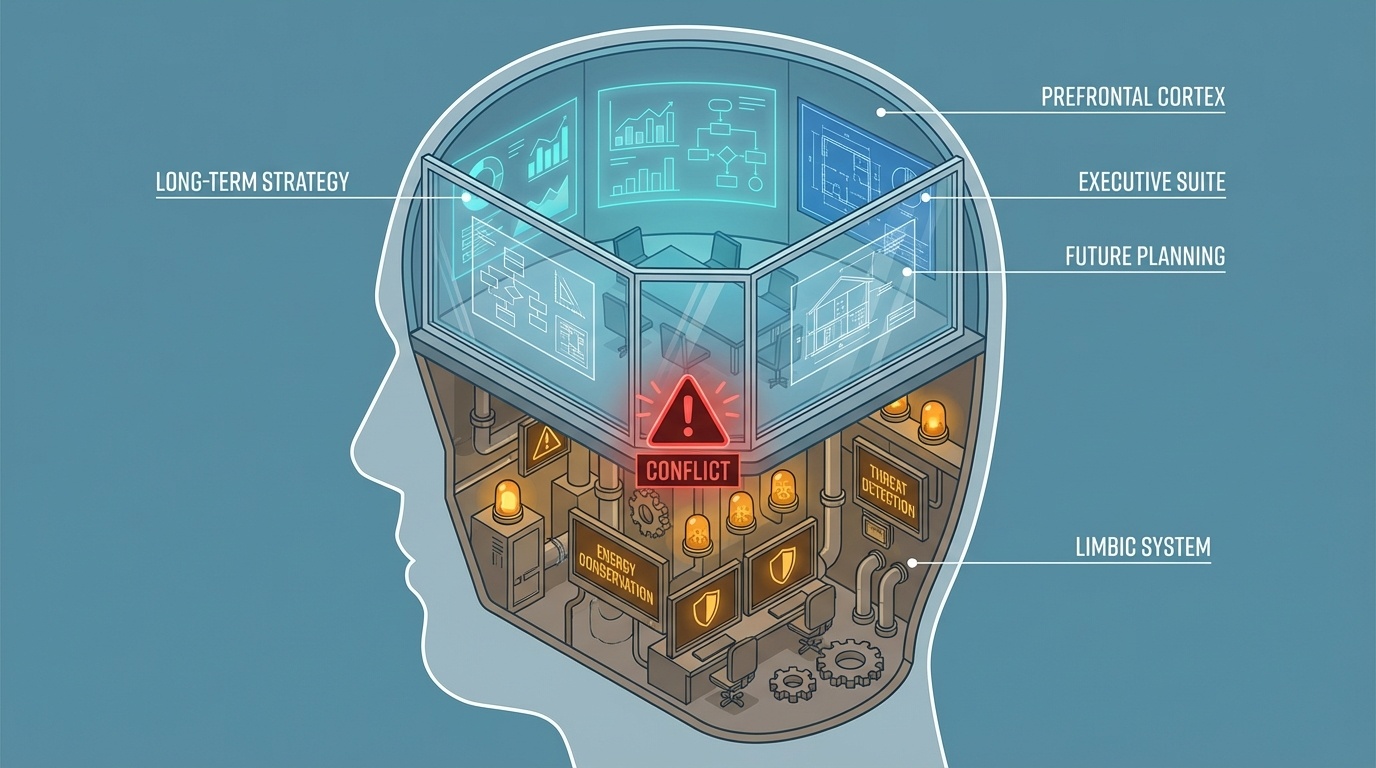
The Limbic System is often dismissed as legacy hardware, but it functions as a critical department with valid,
albeit primitive, KPIs: safety and energy conservation. Optimized for an evolutionary environment of scarcity
and predation, its mandate is to prevent system depletion and avoid physical threat. It operates at high speed and
controls the emotional override switches.
The Prefrontal Cortex (PFC) acts as Executive Management. It handles abstract reasoning, long-term planning, and
impulse control. It is a newer, more energy-intensive addition to the architecture, responsible for projecting future
outcomes.
The structural flaw is clear: Executive Management issues directives (“Draft the proposal”) based on long-term growth
metrics, while the Limbic department prioritizes immediate operational stability. This conflict produces *
*Perfectionist’s Paralysis**. When a task is perceived as high-stakes—tied to self-esteem or professional identity—the
Amygdala flags it not merely as “work,” but as a “threat.” The possibility of failure is processed as a danger to the
organism’s social standing. Consequently, the Limbic System triggers a fight-flight-freeze response. Procrastination, in
this context, is the “freeze” response—a security protocol designed to protect the ego from the potential damage of an
imperfect result.
This deadlock is often driven by prioritization algorithms failing under noise or load. Two specific signal processing
failures are prominent:
1. Temporal Myopia and the vmPFC
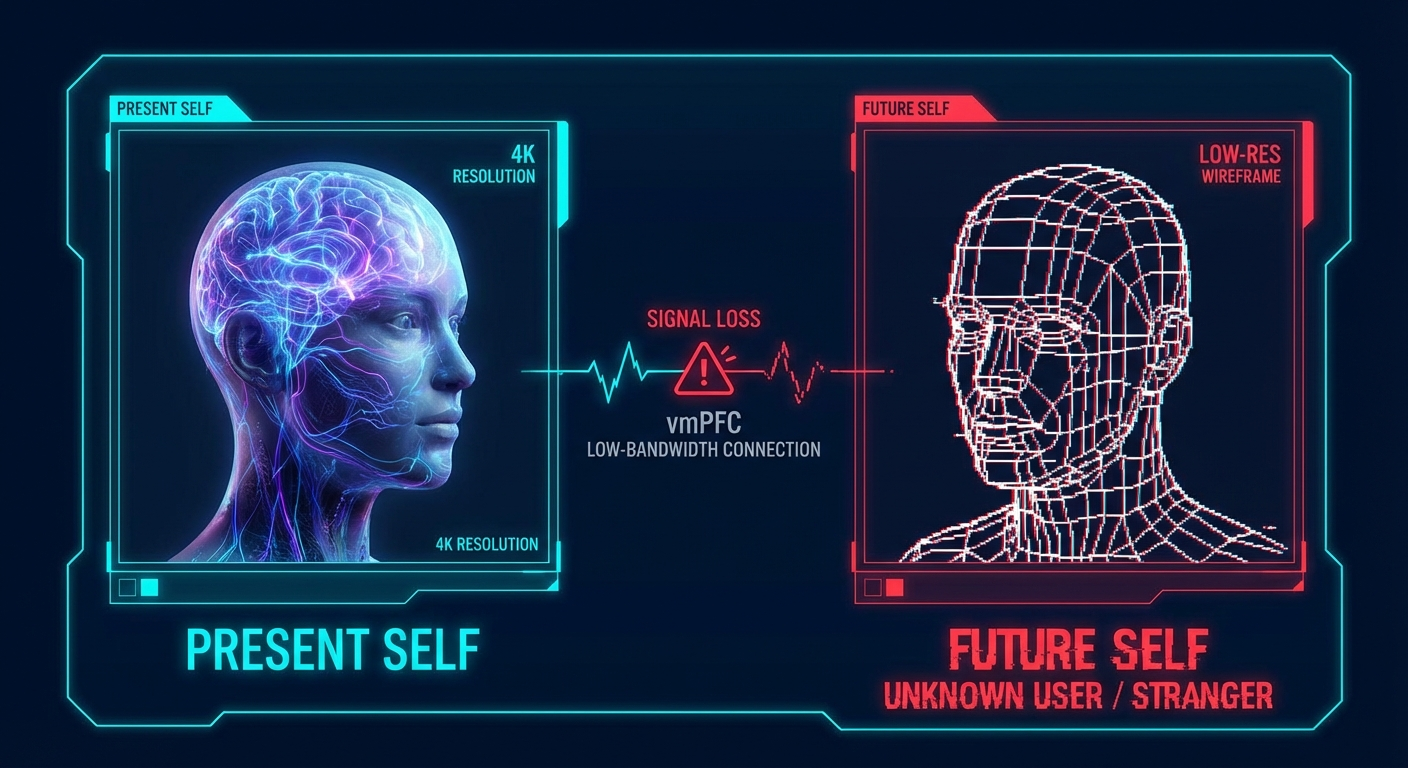
Temporal Myopia is a failure in the brain’s ability to simulate the future with emotional resonance. Research into the *
Ventromedial Prefrontal Cortex (vmPFC)** reveals a startling architectural quirk: the brain processes thoughts about
the “future self” using the same neural pathways it uses for strangers. When you consider your future self dealing with
the consequences of delay, the vmPFC does not register that person as *you. It registers them as a third party. The
discomfort of doing work now is a high-bandwidth, visceral signal; the relief of the future self is a weak, compressed
data packet. Under load, the system naturally prioritizes the stronger, immediate signal over the abstract needs of a “
stranger.”
2. Hyperbolic Discounting
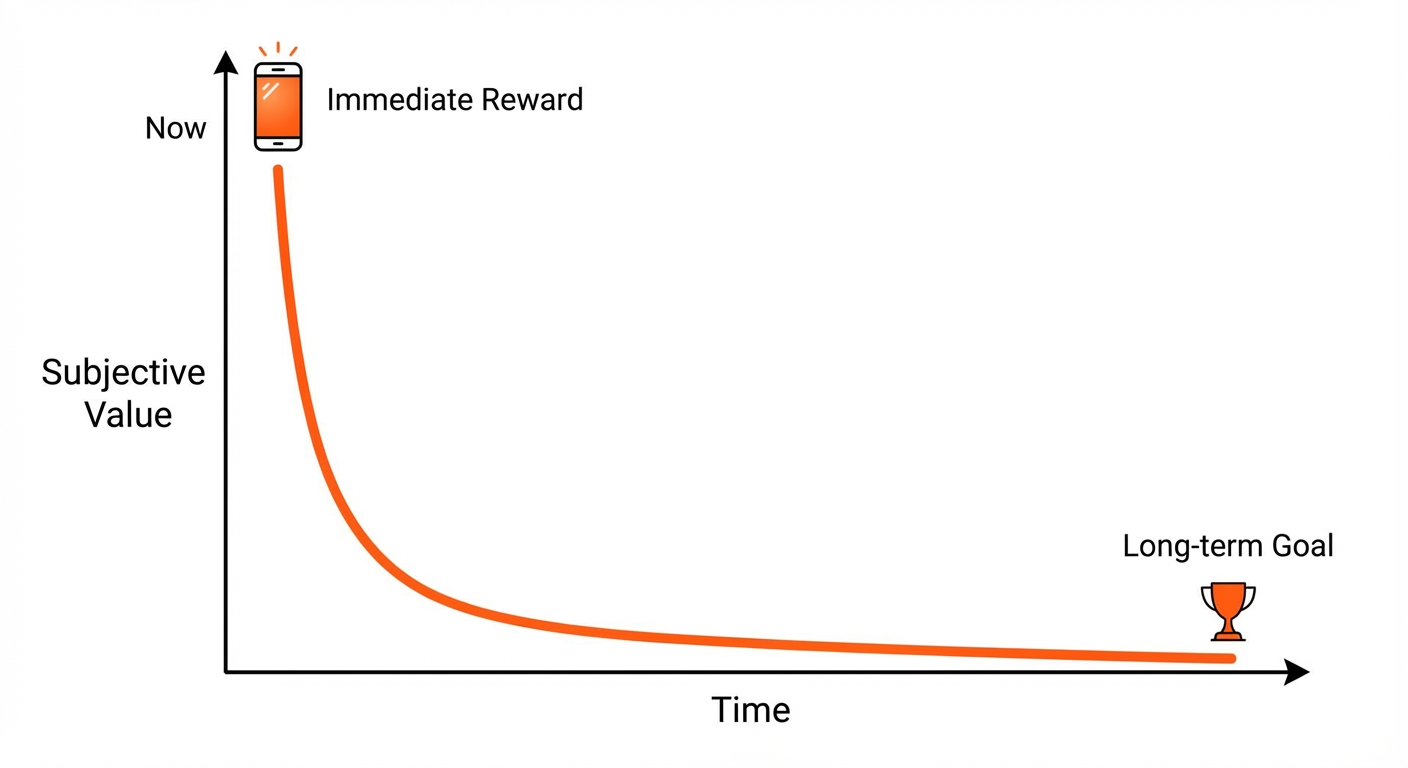
This is a valuation algorithm error. The subjective value of a reward falls sharply as the delay to its receipt
increases. A massive payoff in the distant future is calculated as having near-zero value in the present moment.
Consequently, the system optimizes for immediate, low-value rewards (scrolling, snacking) over delayed, high-value
outcomes. The discount rate is hyperbolic, meaning the drop-off is steepest in the immediate short term.
System Reset
When the system hangs and tasks are delayed, the user’s typical response is self-criticism or shame. This creates the “
procrastination hangover”—a lingering sense of dread and inadequacy. From an engineering perspective, responding with
shame is counterproductive.
Shame is a resource-intensive background process. It generates high-priority interrupts in the form of cortisol spikes,
which further activate the Limbic System’s threat detection. This reinforces the very avoidance behavior the user is
trying to correct, creating a recursive loop of delay and guilt.
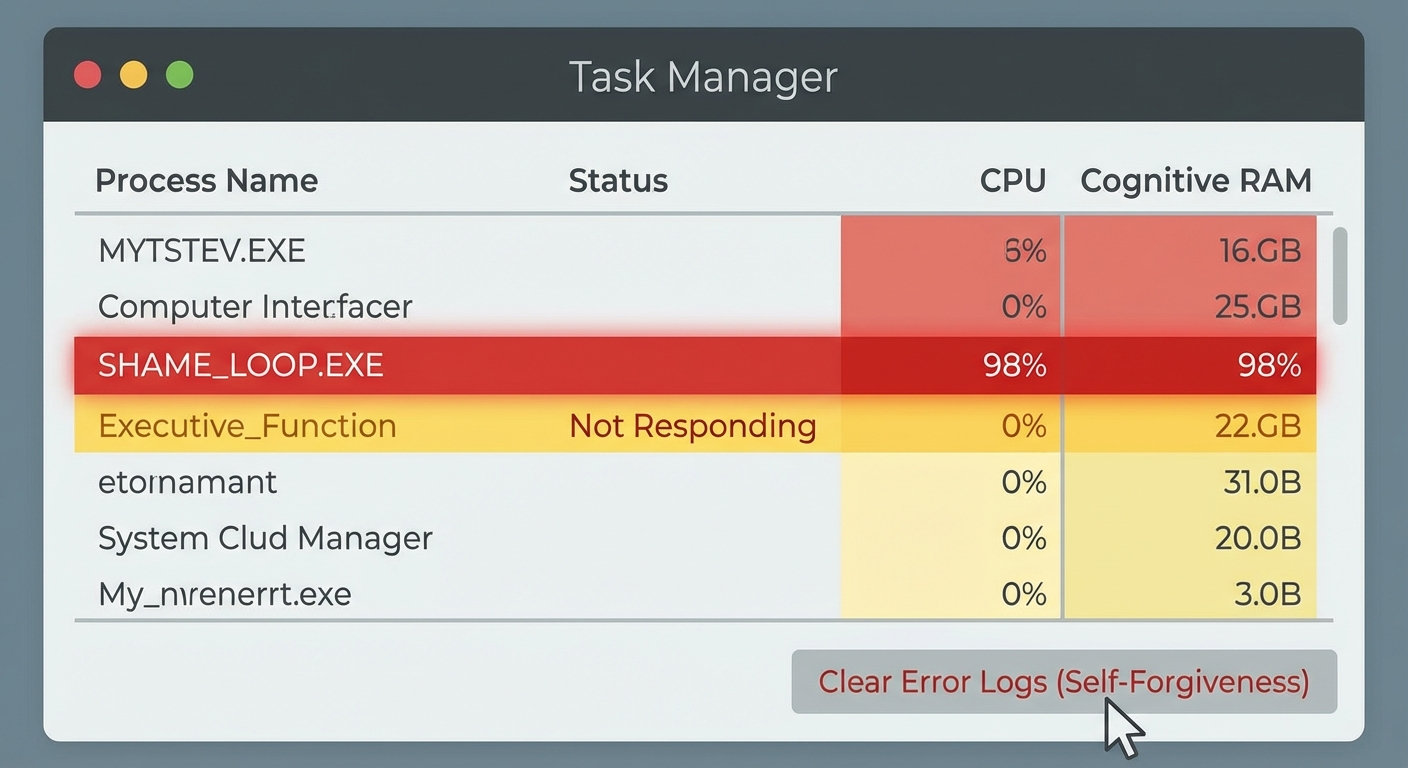
Self-forgiveness is often framed in therapeutic terms, but here it serves a mechanical function. It is equivalent to
clearing the error logs and resetting the system state. By consciously forgiving the previous delay, you act as
a circuit breaker for the cortisol-driven shame loop. This halts the background processing of guilt, freeing up the
working memory (RAM) required for the Prefrontal Cortex to reassert control. It is a hard reset to restore bandwidth for
executive function.
The Kinetic Strategies
Since the hardware (the brain) cannot be replaced, the software (habits) and environment must be patched to bypass these
limitations. We rely on kinetic strategies—physics-based interventions to overcome static friction—and environmental
engineering.
1. Activation Energy Reduction
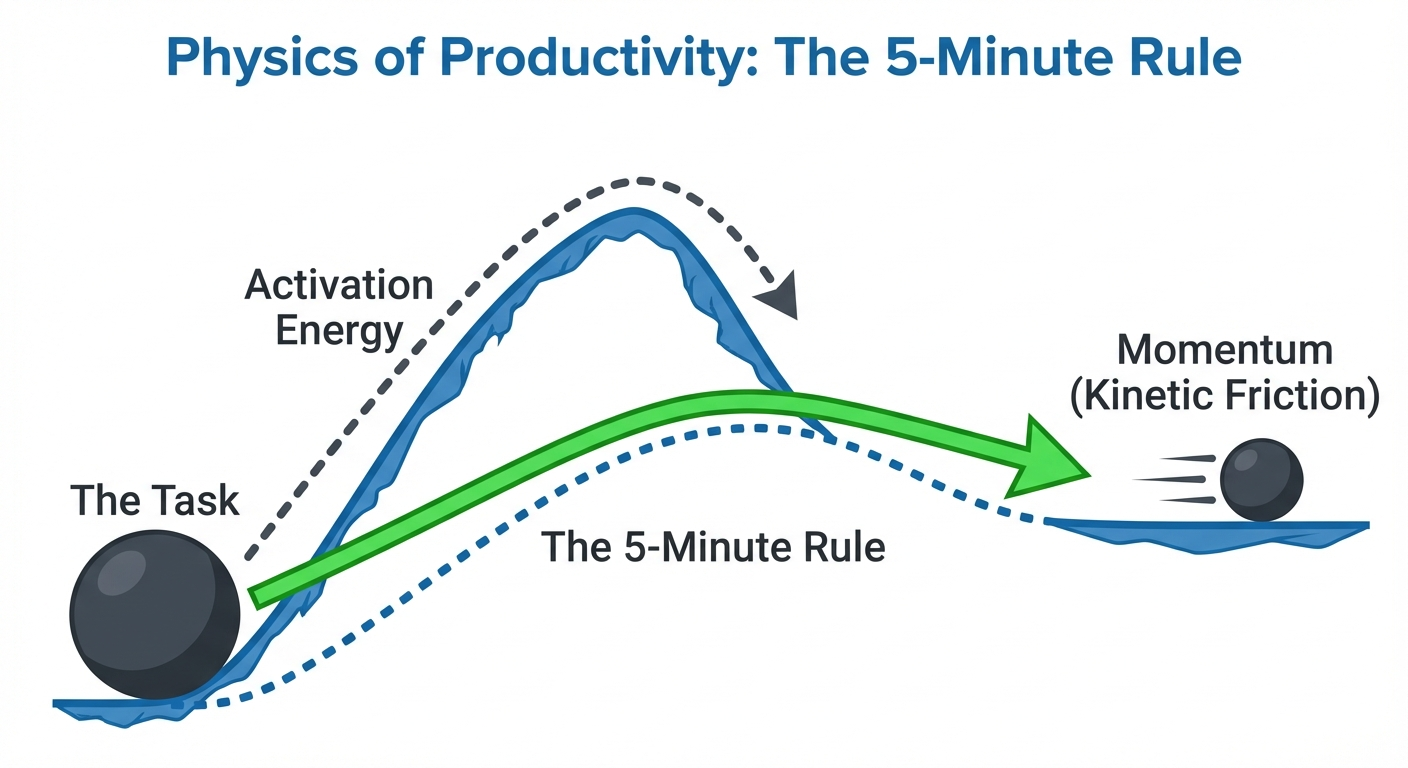
In chemistry, activation energy is the minimum energy required to start a reaction. Procrastination is often a failure
to meet this threshold. The solution is not to increase force (willpower), but to lower the threshold. Do not aim to “
write the essay”; aim to “open the document.” Reduce the initial requirement until the Limbic System no longer registers
it as a threat to energy reserves.
2. Momentum Initiation (Static vs. Kinetic Friction)
This strategy exploits the physics of friction. Static friction (the force required to get a stationary object
moving) is consistently higher than kinetic friction (the force required to keep it moving). The hardest part of any
task is the first few minutes.
To hack this, apply the “Five-Minute Rule”: commit to the task for only five minutes. This bypasses the Amygdala’s fear
of long-term energy drain. Once the system is in motion, the friction coefficient drops, and momentum sustains the
activity with significantly less cognitive load.
3. Signal-to-Noise Engineering
If internal regulation fails, external constraints must be applied. The environment should be designed to reduce the
latency of desired actions and increase the latency of distractions. If the phone is a competing signal source offering
high-dopamine noise, remove it from the physical space. This is not about discipline; it is about signal isolation.
Conclusion
The failure to act is not a failure of will; it is a failure of design. Relying on willpower—a finite and fluctuating
energy resource—is an unstable strategy for a complex system. The effective operator ignores the moral weight of delay
and focuses on the mechanics of initiation. By understanding the corporate architecture of the brain, recognizing the
vmPFC’s processing limitations, and engineering the environment to reduce activation energy, one moves from a state of
latency to a state of execution.
Comic Book Generation Task
Generated Script
THE KINETIC PROTOCOL
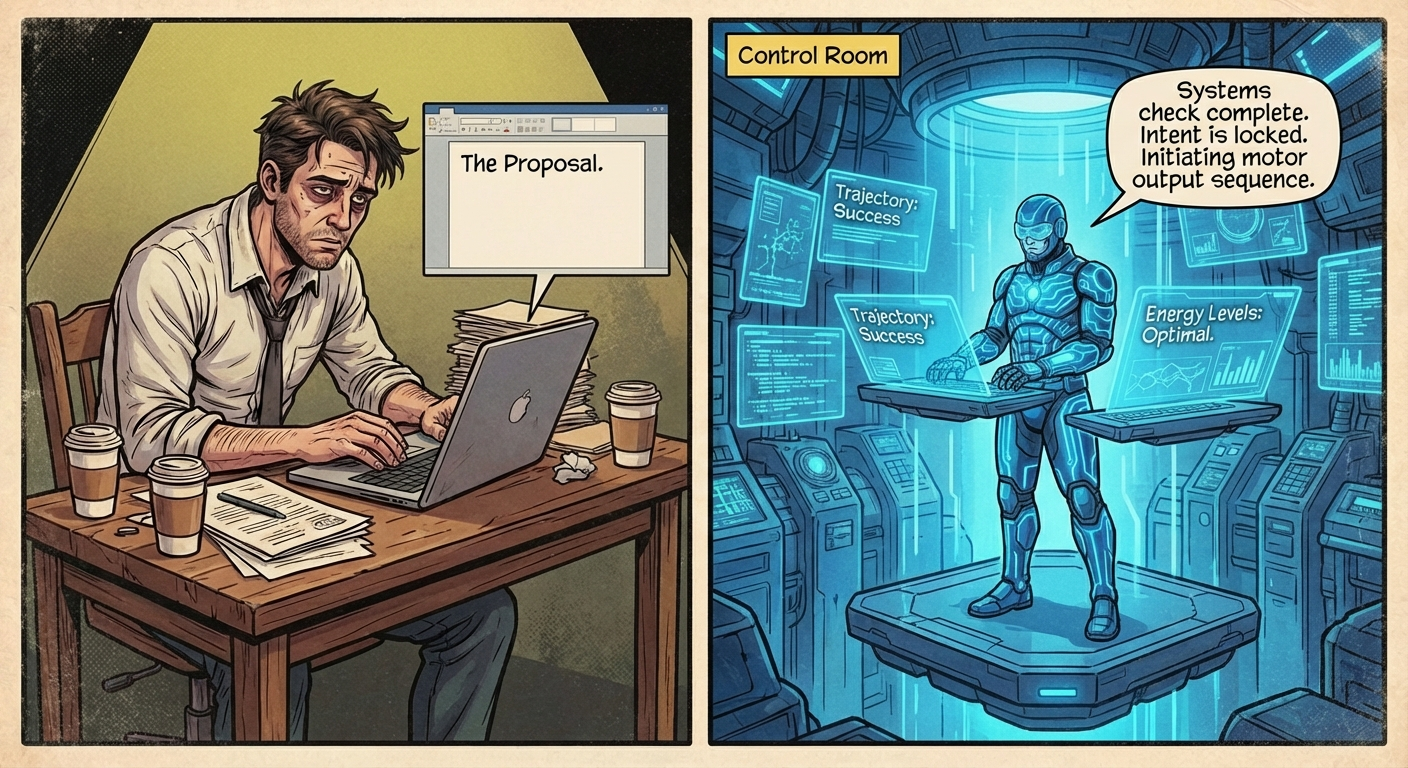
Inside the mind of Arthur, a struggling writer, a war rages. The Architect (Prefrontal Cortex) attempts to execute a high-stakes mission, while the monstrous Amygdala (Limbic System) sabotages the operation to preserve energy and safety. It is a battle of logic versus instinct, fought with the physics of friction.
Characters
- THE ARCHITECT: Protagonist / Executive Management. Motivation: Long-term planning, abstract reasoning, executing the “Proposal.” (A sleek, high-tech superhero. Wears a suit of glowing blue circuitry armor (think Iron Man meets Tron). He holds a holographic datapad. His expression is stoic and determined.)
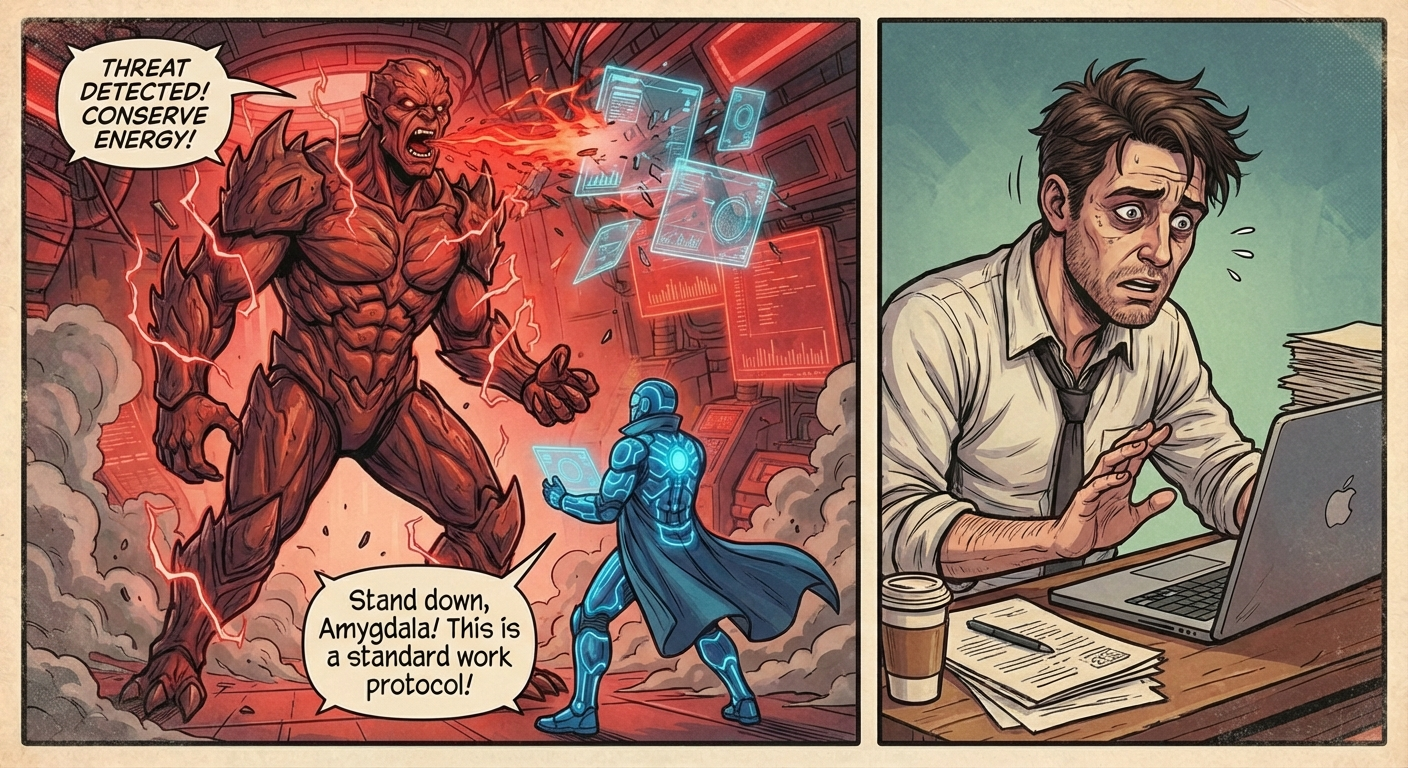
- AMYGDALA: Antagonist / Legacy Hardware. Motivation: Immediate safety, energy conservation, fear of failure. (A hulking, red-skinned behemoth with jagged, organic armor plates (think Doomsday or Red Hulk). He crackles with erratic red energy (Cortisol).)
- ARTHUR: The Vessel. (A tired man in his 30s, sitting at a messy desk with a laptop. He looks stressed.)
Script
Page 1
Row 1
- Panel 1: Arthur stares at a blank Word document titled “The Proposal.” His finger hovers over the keyboard.
- Caption: The user experience of consciousness is deceptively smooth. We conceive a goal. We expect action.
- Panel 2: Inside the Control Room, THE ARCHITECT stands on a floating platform, typing rapidly on holographic screens. The screens display “Trajectory: Success” and “Energy Levels: Optimal.”
- Architect: “Systems check complete. Intent is locked. Initiating motor output sequence.”
- Caption: We call this the Illusion of Agency.
Row 2
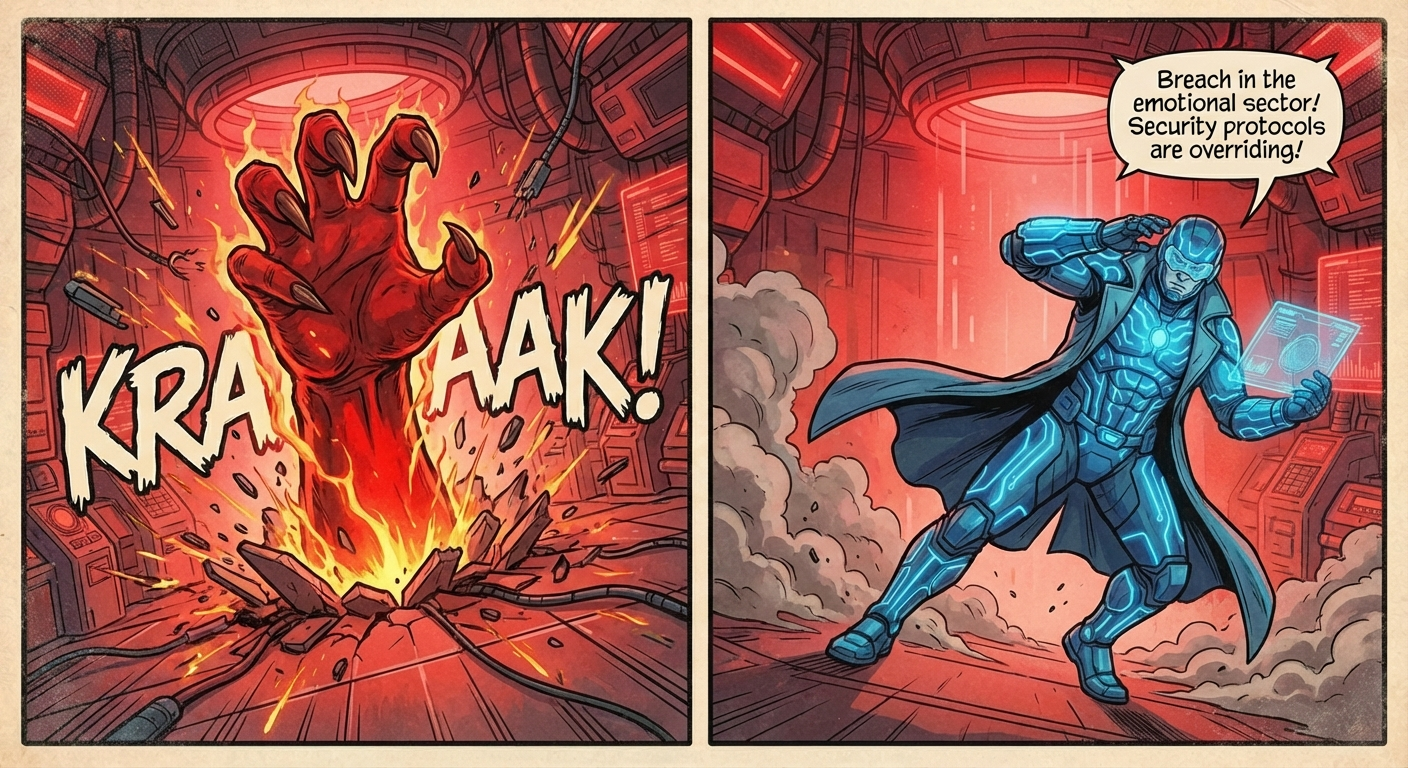
- Panel 1: A massive, clawed red hand smashes through the sleek metal floor of the Control Room. Debris flies. (SFX: KRAAAK!)
- Caption: But the interface is plagued by latency.
- Panel 2: THE ARCHITECT is knocked back, shielding his face. Smoke rises from the breach.
- Architect: “Breach in the emotional sector! Security protocols are overriding!”
- Caption: And systemic refusal.
Row 3
- Panel 1: AMYGDALA roars, spitting red energy. The holographic screens around him shatter.
- Amygdala: “THREAT DETECTED! CONSERVE ENERGY!”
- Architect: “Stand down, Amygdala! This is a standard work protocol!”
- Panel 2: Close up on Arthur in the real world. He flinches away from the laptop, eyes wide.
- Caption: Society calls it laziness. We know the truth. It is a system state.
Page 2
Row 1
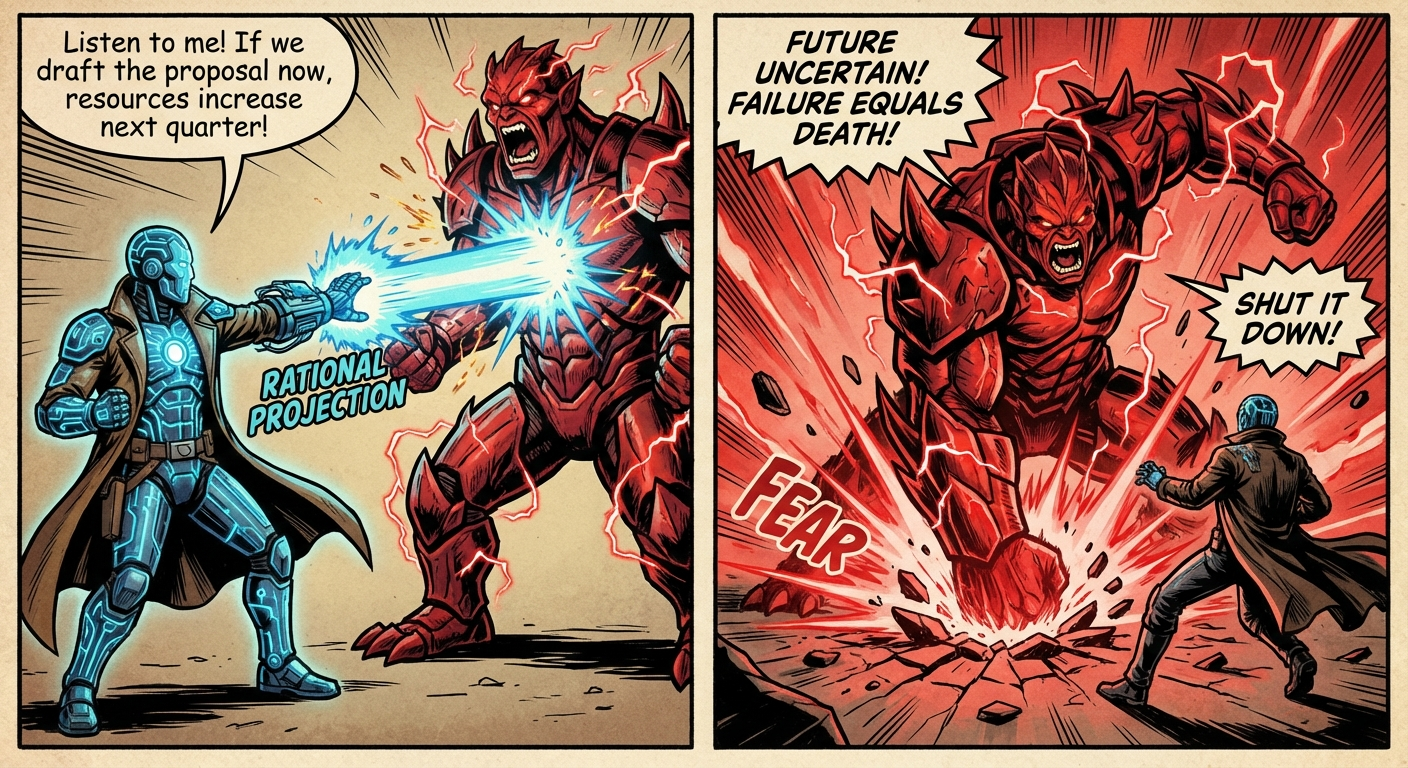
- Panel 1: The Architect fires a blue beam labeled “Rational Projection” at Amygdala. It bounces harmlessly off Amygdala’s thick hide.
- Architect: “Listen to me! If we draft the proposal now, resources increase next quarter!”
- Panel 2: Amygdala smashes the ground, sending a shockwave of red “Fear” energy outward.
- Amygdala: “FUTURE UNCERTAIN! FAILURE EQUALS DEATH!”
- Amygdala: “SHUT IT DOWN!”
Row 2
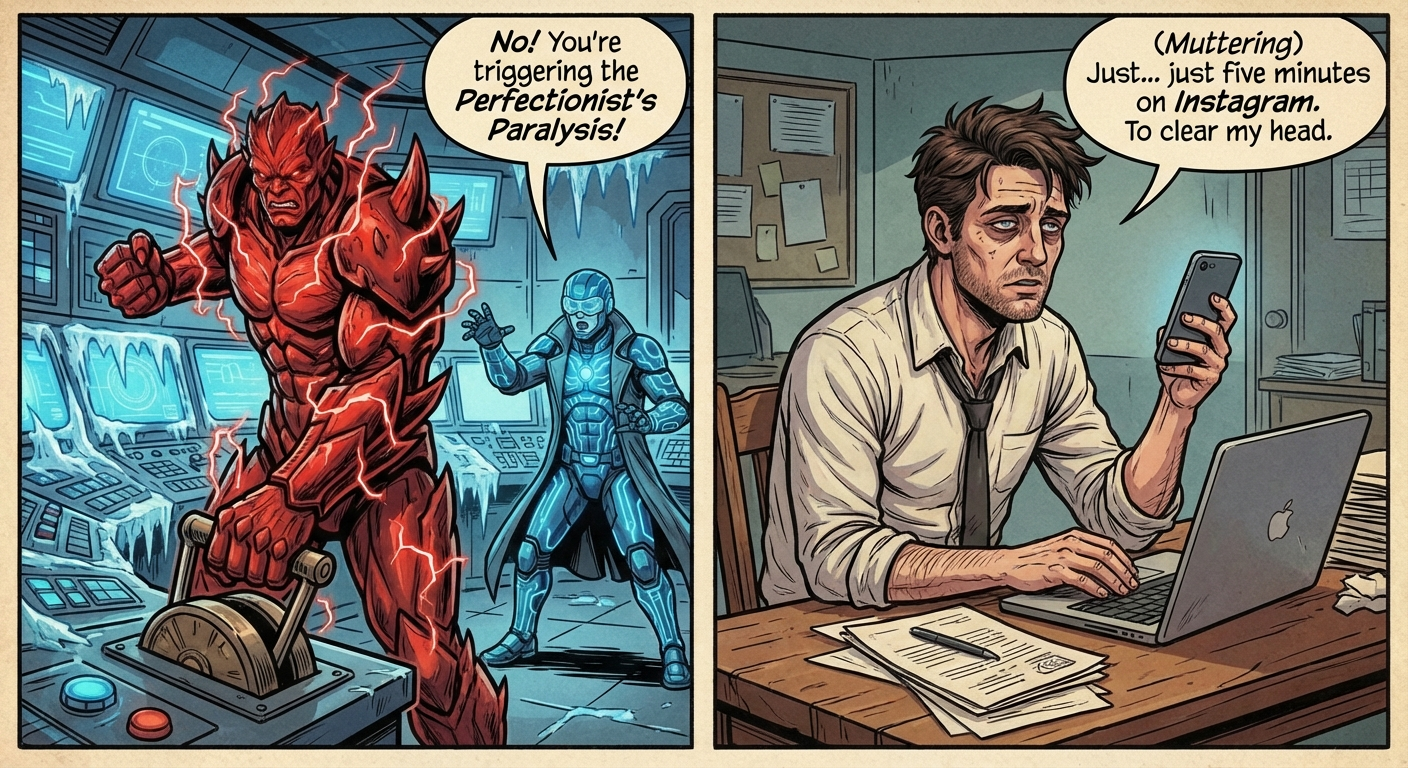
- Panel 1: Amygdala’s massive hand crushes the throttle. The blue lights of the room dim and freeze over.
- Architect: “No! You’re triggering the Perfectionist’s Paralysis!”
- Caption: The Limbic System doesn’t see a spreadsheet. It sees a predator.
- Panel 2: In the real world, Arthur picks up his phone. His eyes are glazed over.
- Arthur: “(Muttering) Just… just five minutes on Instagram. To clear my head.”
- Caption: To protect the ego from the danger of an imperfect result…
Row 3
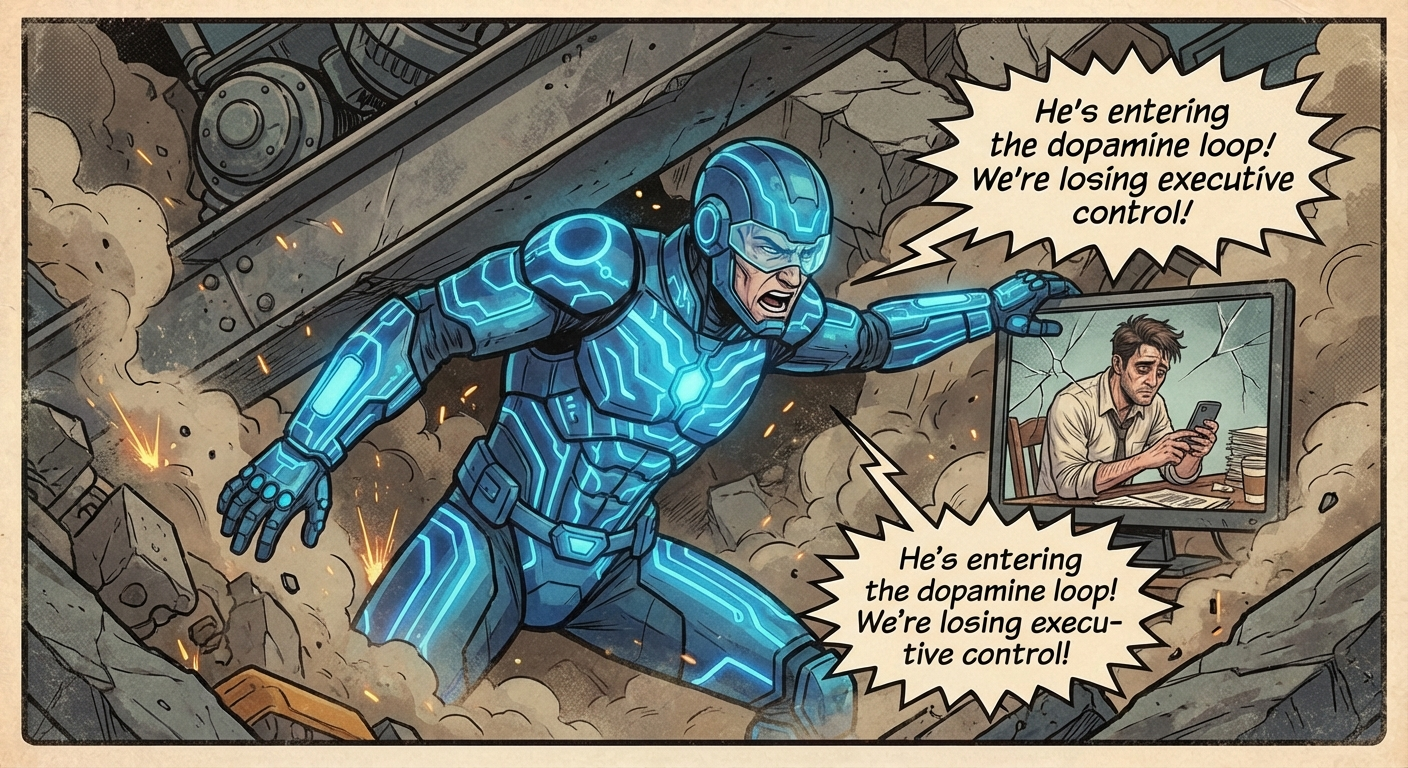
- Panel 1: The Architect struggles to lift a beam off his chest.
- Architect: “He’s entering the dopamine loop! We’re losing executive control!”
- Caption: The “Freeze” response. A security protocol gone wrong.
Page 3
Row 1
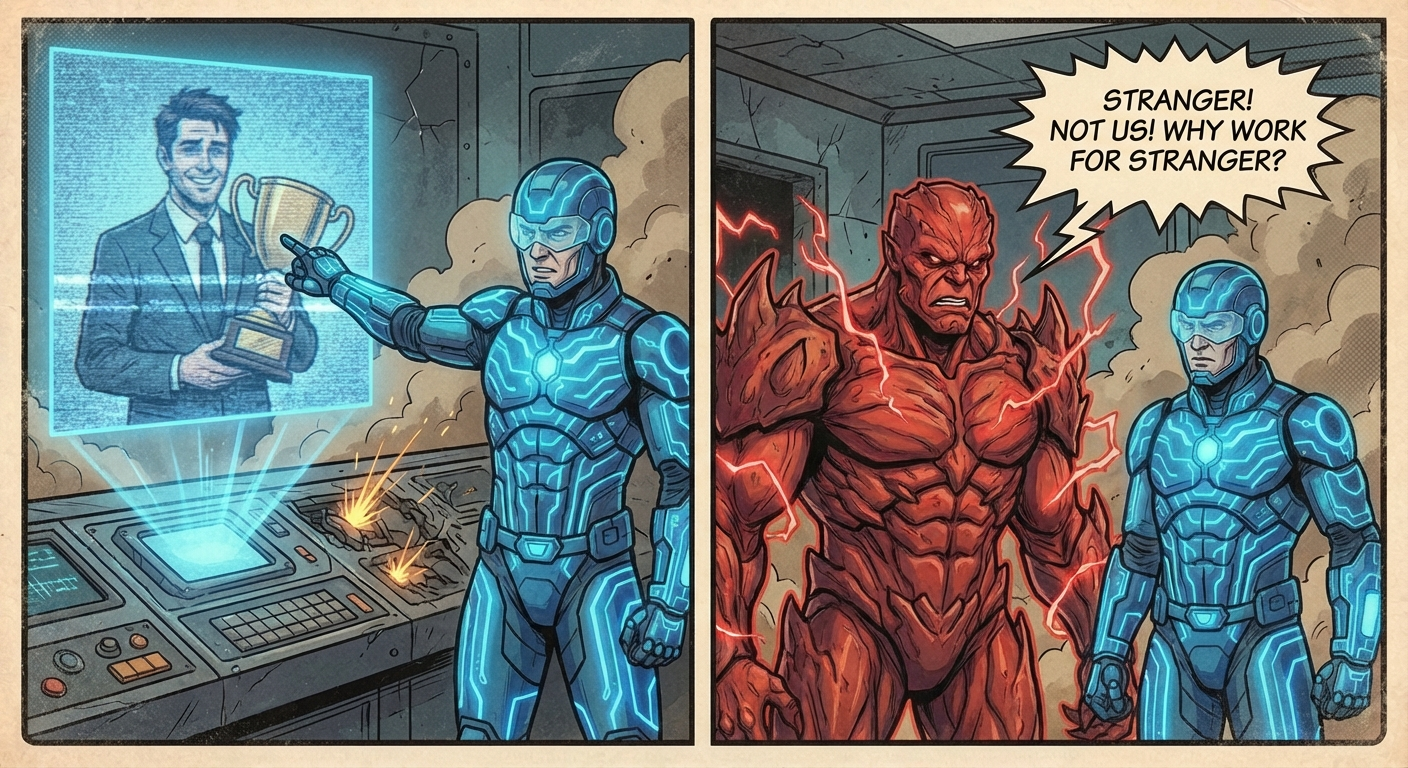
- Panel 1: The Architect points to the fuzzy hologram of a successful Arthur holding a trophy.
- Caption: Temporal Myopia.
- Panel 2: Amygdala looks at the hologram but looks confused/angry. He doesn’t recognize the figure.
- Amygdala: “STRANGER! NOT US! WHY WORK FOR STRANGER?”
- Caption: The vmPFC processes the “Future Self” using the same neural pathways as a stranger.
Row 2
- Panel 1: Amygdala snatches a small, glowing red orb floating in the air (representing the phone scrolling). He looks satisfied.
- Architect: “That reward is low-value! It’s hyperbolic discounting!”
- Panel 2: The Architect looks at the massive, golden sun (High Value Reward) in the distance, which looks tiny due to perspective.
- Architect: “The massive payoff is too far away! The signal is too weak against the noise!”
Row 3
- Panel 1: Arthur in the real world looks miserable. He puts his head in his hands.
- Arthur: “I’m useless. Why can’t I just do this?”
- Panel 2: Inside, the black sludge rises around The Architect’s waist.
- Architect: “Warning! Cortisol spikes detected. The Shame Loop is initiating.”
- Caption: Shame is a resource-intensive background process.
Page 4
Row 1
- Panel 1: The Architect stands still in the rising sludge. Amygdala is thrashing around, made more agitated by the sludge.
- Architect: “Fighting the shame only feeds the Limbic threat detection.”
- Caption: To solve this, one must stop acting as a moralist…
- Panel 2: The Architect holds up a hand. A pulse of pure white light expands from him.
- Architect: “INITIATING PROTOCOL: SELF-FORGIVENESS.”
- Caption: …and start thinking like a systems architect.
Row 2
- Panel 1: The sludge evaporates. The red emergency lights stop flashing.
- Architect: “Clearing error logs. Resetting system state.”
- Caption: A hard reset to restore bandwidth for executive function.
- Panel 2: The Architect steps free from the rubble. He looks at Amygdala, not with anger, but with authority.
- Architect: “RAM is free. Now, we patch the software.”
Row 3
- Panel 1: The Architect grips the giant wheel. It won’t budge.
- Architect: “The Activation Energy is too high. Willpower is insufficient.”
- Panel 2: The Architect pulls up a holographic menu and slides a bar down from “WRITE ESSAY” to “OPEN DOCUMENT.”
- Architect: “Lowering the threshold. We don’t need to finish. We just need to start.”
Page 5
Row 1
- Panel 1: The Architect looks at Amygdala.
- Architect: “Just five minutes. If it hurts, we stop. Deal?”
- Panel 2: Amygdala sniffs the air. The threat level is low. He grunts and nods.
- Amygdala: “FIVE MINUTES. NO PAIN.”
- Caption: Bypassing the Amygdala’s fear of energy drain.
Row 2
- Panel 1: The Architect strains, pushing the wheel. Sparks fly.
- Architect: “Overcoming Static Friction…”
- Caption: The hardest part is the first few minutes.
- Panel 2: The wheel spins rapidly. Blue energy flows through the room. The Architect smiles.
- Architect: “We have momentum! Kinetic friction coefficient is dropping!”
- Caption: Once in motion, the cognitive load decreases.
Row 3
- Panel 1: In the real world, Arthur tosses his phone onto the couch across the room. (SFX: THUMP.)
- Caption: Signal isolation.
- Panel 2: Inside, a blast shield slams down, blocking the view of the “Immediate Reward” orbs.
- Architect: “Distractions isolated. Focus is absolute.”
Row 4
- Panel 1: Arthur typing, looking engrossed.
- Caption: The failure to act is not a failure of will. It is a failure of design.
- Panel 2: The Architect stands at the helm, steering the ship. Amygdala is sleeping peacefully in the corner.
- Architect: “We have moved from latency… to execution.”
- Caption: END.
Character: THE ARCHITECT
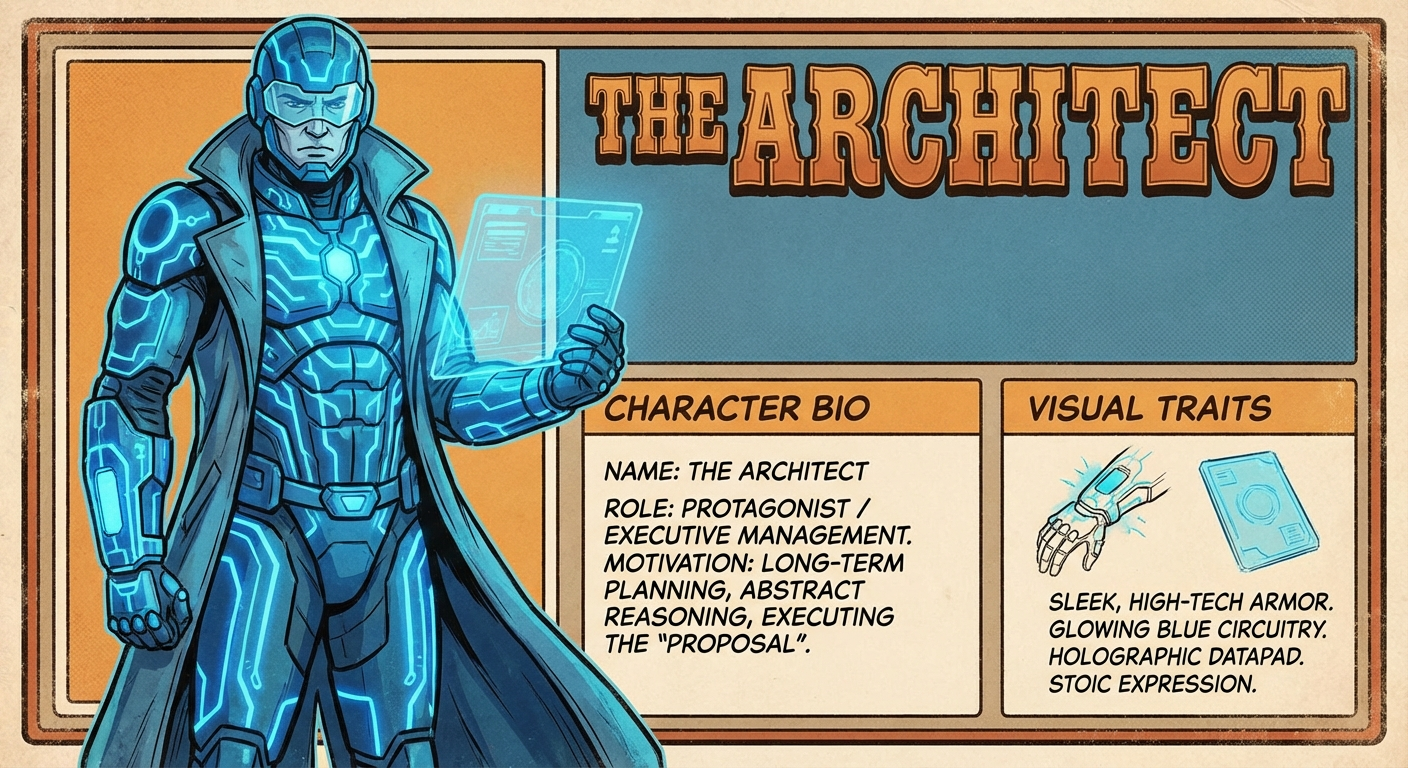
Protagonist / Executive Management. Motivation: Long-term planning, abstract reasoning, executing the “Proposal.”
Character: AMYGDALA
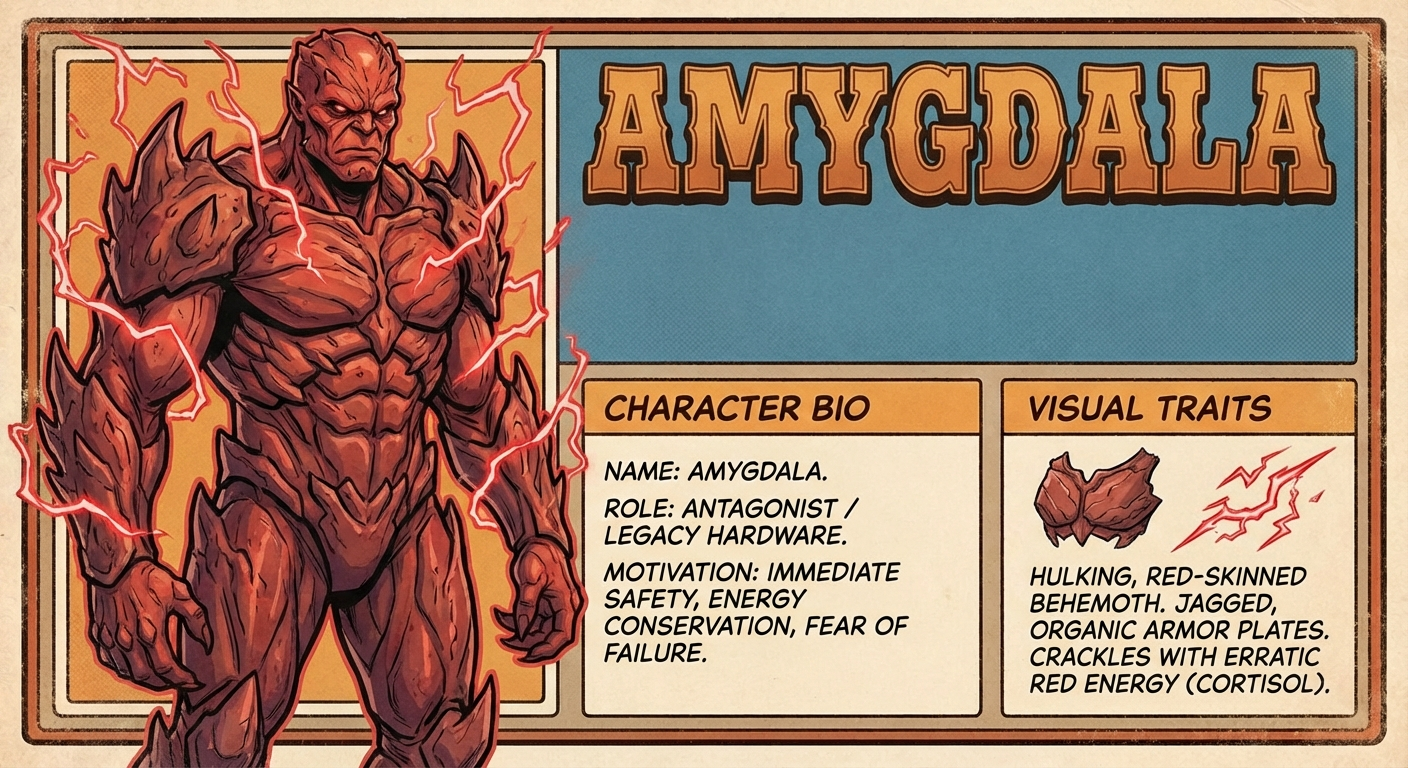
Antagonist / Legacy Hardware. Motivation: Immediate safety, energy conservation, fear of failure.
Character: ARTHUR
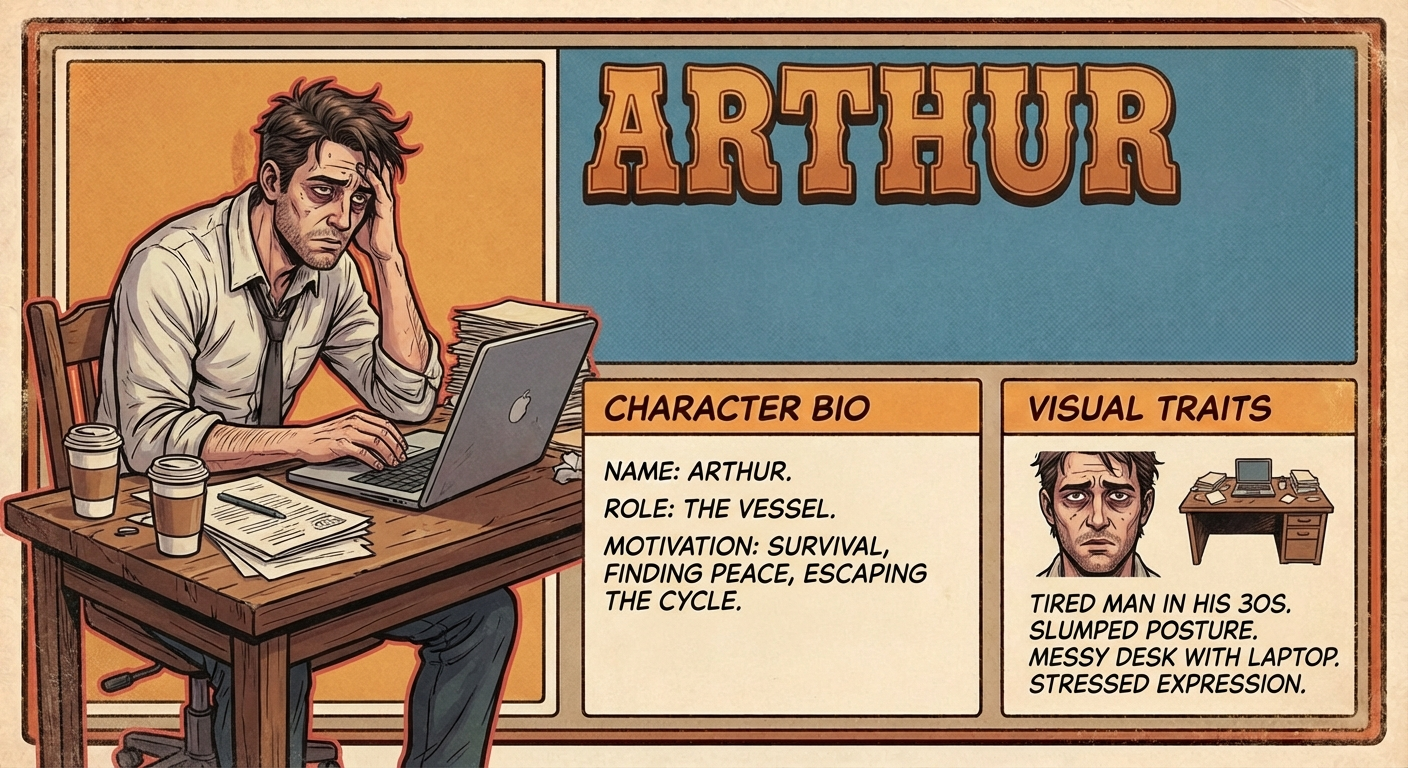
The Vessel.
Crawler Agent Transcript
Started: 2026-02-19 08:55:50
Search Query: neuroscience of procrastination vmPFC future self hyperbolic discounting systems architecture metaphors for cognitive friction
Direct URLs: N/A
Execution Configuration (click to expand)
1
2
3
4
5
6
| {
"research_findings" : "Identify recent studies (post-2020) regarding the Ventromedial Prefrontal Cortex (vmPFC) and its role in 'temporal myopia' or the perception of the future self.",
"systems_metaphors" : "Find engineering or computer science metaphors used to describe cognitive processes like executive function, task initiation, or emotional regulation (e.g., 'interrupts', 'latency', 'buffer overflow').",
"behavioral_mechanics" : "Gather data on the 'activation energy' of habits and the physiological impact of self-forgiveness on cortisol levels and cognitive load.",
"valuation_models" : "Summarize current models of hyperbolic discounting and how they explain the trade-off between immediate dopamine rewards and long-term strategic goals."
}
|
Crawling Work Details
Seed Links
Seed Links
Method: GoogleProxy
Total Seeds: 10
- URL: https://oxcns.org/papers/Rolls%202019%20The%20Orbitofrontal%20Cortex.pdf
- Relevance Score: 100.0
- URL: https://www.cambridge.org/core/books/handbook-of-behavior-change/theory-and-behavior-change/D7BA0486B85AA3AE20EE6D988502DC15
- Relevance Score: 100.0
- URL: https://dokumen.pub/the-handbook-of-behavior-change-cambridge-handbooks-in-psychology-1108496393-9781108496391.html
- Relevance Score: 100.0
- URL: https://www.researchgate.net/profile/Katrina-Andrews/publication/343205533_Innovations_in_a_Changing_World/links/5f1b9871299bf1720d626ab1/Innovations-in-a-Changing-World.pdf
- Relevance Score: 100.0
- URL: https://discovery.ucl.ac.uk/id/eprint/10122710/12/Fancourt_How%20leisure%20activities%20affect%20health-%20a%20narrative%20review%20and%20multi-level%20theoretical%20framework%20of%20mechanisms%20of%20action_SuppM.pdf
- Relevance Score: 100.0
- URL: https://myscp.org/wp-content/uploads/2023/03/2020-c.pdf
- Relevance Score: 100.0
- URL: http://ndl.ethernet.edu.et/bitstream/123456789/24817/1/58.pdf.pdf
- Relevance Score: 100.0
- URL: https://www.psgrkcw.ac.in/wp-content/uploads/2024/01/Scheme-and-Syllabus-2022-2025-Batch-PRINT-1.pdf
- Relevance Score: 100.0
- URL: https://www.scribd.com/document/802462080/Stella-Collins-Neuroscience-for-Learning-and-Development-How-to-Apply-Neuroscience-and-Psychology-for-Improved-Learning-and-Training-Kogan-Page-20
- Relevance Score: 100.0
- URL: https://www.science.gov/topicpages/e/expectancy-value+theory+eccles.html
- Relevance Score: 100.0
Error: HTTP 403 error for URL: https://www.researchgate.net/profile/Katrina-Andrews/publication/343205533_Innovations_in_a_Changing_World/links/5f1b9871299bf1720d626ab1/Innovations-in-a-Changing-World.pdf
Stack Trace
1
2
3
4
5
6
7
8
9
10
11
12
13
14
15
16
17
18
19
20
21
22
23
24
25
26
27
28
29
30
31
32
33
34
35
36
37
38
39
40
41
42
43
44
45
46
47
48
49
50
51
52
53
54
55
56
57
58
59
60
61
62
63
64
65
66
67
68
69
70
71
72
73
74
75
76
77
78
79
80
81
82
83
84
85
86
87
88
89
90
91
92
93
94
95
96
97
98
99
100
101
102
103
104
105
106
107
108
109
110
111
112
113
114
115
116
117
118
119
120
121
122
123
124
125
126
127
128
129
130
131
132
133
134
135
136
137
138
139
140
141
142
143
144
145
146
147
148
149
150
151
| java.lang.RuntimeException: HTTP 403 error for URL: https://www.researchgate.net/profile/Katrina-Andrews/publication/343205533_Innovations_in_a_Changing_World/links/5f1b9871299bf1720d626ab1/Innovations-in-a-Changing-World.pdf
at com.simiacryptus.cognotik.crawl.fetch.HttpClientFetch$createStrategy$1.fetch(HttpClientFetch.kt:77)
at com.simiacryptus.cognotik.plan.tools.online.CrawlerAgentTask.fetchAndProcessUrl(CrawlerAgentTask.kt:1443)
at com.simiacryptus.cognotik.plan.tools.online.CrawlerAgentTask.crawlPage(CrawlerAgentTask.kt:944)
at com.simiacryptus.cognotik.plan.tools.online.CrawlerAgentTask.addCrawlTask$lambda$1(CrawlerAgentTask.kt:848)
at java.base/java.util.concurrent.Executors$RunnableAdapter.call(Executors.java:572)
at java.base/java.util.concurrent.FutureTask.run$$$capture(FutureTask.java:317)
at java.base/java.util.concurrent.FutureTask.run(FutureTask.java)
at --- Async.Stack.Trace --- (captured by IntelliJ IDEA debugger)
at java.base/java.util.concurrent.FutureTask.<init>(FutureTask.java:151)
at java.base/java.util.concurrent.AbstractExecutorService.newTaskFor(AbstractExecutorService.java:98)
at java.base/java.util.concurrent.AbstractExecutorService.submit(AbstractExecutorService.java:122)
at com.simiacryptus.cognotik.util.ImmediateExecutorService.submit(ImmediateExecutorService.kt:77)
at com.simiacryptus.cognotik.plan.tools.online.CrawlerAgentTask.addCrawlTask(CrawlerAgentTask.kt:846)
at com.simiacryptus.cognotik.plan.tools.online.CrawlerAgentTask.innerRun(CrawlerAgentTask.kt:466)
at com.simiacryptus.cognotik.plan.tools.online.CrawlerAgentTask.run(CrawlerAgentTask.kt:238)
at com.simiacryptus.cognotik.apps.SingleTaskApp.executeTask(SingleTaskApp.kt:127)
at com.simiacryptus.cognotik.apps.SingleTaskApp.startSession$lambda$0(SingleTaskApp.kt:90)
at java.base/java.util.concurrent.Executors$RunnableAdapter.call(Executors.java:572)
at java.base/java.util.concurrent.FutureTask.run$$$capture(FutureTask.java:317)
at java.base/java.util.concurrent.FutureTask.run(FutureTask.java)
at --- Async.Stack.Trace --- (captured by IntelliJ IDEA debugger)
at java.base/java.util.concurrent.FutureTask.<init>(FutureTask.java:151)
at java.base/java.util.concurrent.AbstractExecutorService.newTaskFor(AbstractExecutorService.java:98)
at java.base/java.util.concurrent.AbstractExecutorService.submit(AbstractExecutorService.java:122)
at com.simiacryptus.cognotik.util.ImmediateExecutorService.submit(ImmediateExecutorService.kt:77)
at com.simiacryptus.cognotik.apps.SingleTaskApp.startSession(SingleTaskApp.kt:90)
at com.simiacryptus.cognotik.apps.SingleTaskApp.newSession(SingleTaskApp.kt:58)
at com.simiacryptus.cognotik.util.UnifiedHarness$runTask$singleTaskApp$1.newSession(UnifiedHarness.kt:274)
at com.simiacryptus.cognotik.util.UnifiedHarness.runTask(UnifiedHarness.kt:290)
at com.simiacryptus.cognotik.util.DocProcessor.runAll$lambda$3$0(DocProcessor.kt:788)
at com.simiacryptus.cognotik.util.FixedConcurrencyProcessor.executeTask$lambda$0(FixedConcurrencyProcessor.kt:97)
at java.base/java.util.concurrent.CompletableFuture$AsyncSupply.run$$$capture(CompletableFuture.java:1768)
at java.base/java.util.concurrent.CompletableFuture$AsyncSupply.run(CompletableFuture.java)
at --- Async.Stack.Trace --- (captured by IntelliJ IDEA debugger)
at java.base/java.util.concurrent.CompletableFuture$AsyncSupply.<init>(CompletableFuture.java:1754)
at java.base/java.util.concurrent.CompletableFuture.asyncSupplyStage(CompletableFuture.java:1782)
at java.base/java.util.concurrent.CompletableFuture.supplyAsync(CompletableFuture.java:2005)
at com.simiacryptus.cognotik.util.FixedConcurrencyProcessor.executeTask(FixedConcurrencyProcessor.kt:91)
at com.simiacryptus.cognotik.util.FixedConcurrencyProcessor.tryExecuteTask(FixedConcurrencyProcessor.kt:79)
at com.simiacryptus.cognotik.util.FixedConcurrencyProcessor.submit(FixedConcurrencyProcessor.kt:53)
at com.simiacryptus.cognotik.util.DocProcessor.runAll(DocProcessor.kt:772)
at com.simiacryptus.cognotik.util.DocProcessor.runAll$default(DocProcessor.kt:765)
at cognotik.actions.task.DocProcessorAction$handle$1$1.run(DocProcessorAction.kt:128)
at com.intellij.openapi.progress.impl.CoreProgressManager.startTask(CoreProgressManager.java:491)
at com.intellij.openapi.progress.impl.ProgressManagerImpl.startTask(ProgressManagerImpl.java:133)
at com.intellij.openapi.progress.impl.CoreProgressManager.lambda$runProcessWithProgressAsynchronously$7(CoreProgressManager.java:542)
at com.intellij.openapi.progress.impl.ProgressRunner.lambda$submit$4(ProgressRunner.java:249)
at com.intellij.openapi.progress.ProgressManager.lambda$runProcess$0(ProgressManager.java:98)
at com.intellij.openapi.progress.impl.CoreProgressManager.lambda$runProcess$1(CoreProgressManager.java:223)
at com.intellij.platform.diagnostic.telemetry.helpers.TraceKt.use(trace.kt:45)
at com.intellij.openapi.progress.impl.CoreProgressManager.lambda$runProcess$2(CoreProgressManager.java:222)
at com.intellij.openapi.progress.impl.CoreProgressManager.lambda$executeProcessUnderProgress$14(CoreProgressManager.java:674)
at com.intellij.openapi.progress.impl.CoreProgressManager.registerIndicatorAndRun(CoreProgressManager.java:749)
at com.intellij.openapi.progress.impl.CoreProgressManager.computeUnderProgress(CoreProgressManager.java:705)
at com.intellij.openapi.progress.impl.CoreProgressManager.executeProcessUnderProgress(CoreProgressManager.java:673)
at com.intellij.openapi.progress.impl.ProgressManagerImpl.executeProcessUnderProgress(ProgressManagerImpl.java:79)
at com.intellij.openapi.progress.impl.CoreProgressManager.runProcess(CoreProgressManager.java:203)
at com.intellij.openapi.progress.ProgressManager.runProcess(ProgressManager.java:98)
at com.intellij.openapi.progress.impl.ProgressRunner.lambda$submit$5(ProgressRunner.java:249)
at com.intellij.openapi.progress.impl.ProgressRunner$ProgressRunnable.run$$$capture(ProgressRunner.java:502)
at com.intellij.openapi.progress.impl.ProgressRunner$ProgressRunnable.run(ProgressRunner.java)
at --- Async.Stack.Trace --- (captured by IntelliJ IDEA debugger)
at com.intellij.openapi.progress.impl.ProgressRunner$ProgressRunnable.<init>(ProgressRunner.java:492)
at com.intellij.openapi.progress.impl.ProgressRunner.lambda$launchTask$20(ProgressRunner.java:461)
at java.base/java.util.concurrent.CompletableFuture.uniWhenComplete(CompletableFuture.java:863)
at java.base/java.util.concurrent.CompletableFuture.uniWhenCompleteStage(CompletableFuture.java:887)
at java.base/java.util.concurrent.CompletableFuture.whenComplete(CompletableFuture.java:2357)
at com.intellij.openapi.progress.impl.ProgressRunner.launchTask(ProgressRunner.java:456)
at com.intellij.openapi.progress.impl.ProgressRunner.execFromEDT(ProgressRunner.java:303)
at com.intellij.openapi.progress.impl.ProgressRunner.submit(ProgressRunner.java:252)
at com.intellij.openapi.progress.impl.CoreProgressManager.runProcessWithProgressAsynchronously(CoreProgressManager.java:550)
at com.intellij.openapi.progress.impl.CoreProgressManager.runProcessWithProgressAsynchronously(CoreProgressManager.java:484)
at com.intellij.openapi.progress.impl.CoreProgressManager.runProcessWithProgressAsynchronously(CoreProgressManager.java:476)
at com.intellij.openapi.progress.impl.CoreProgressManager.runAsynchronously(CoreProgressManager.java:453)
at com.intellij.openapi.progress.impl.CoreProgressManager.run(CoreProgressManager.java:436)
at cognotik.actions.task.DocProcessorAction.handle$lambda$3(DocProcessorAction.kt:117)
at com.intellij.openapi.application.impl.AnyThreadWriteThreadingSupport.runIntendedWriteActionOnCurrentThread$lambda$2(AnyThreadWriteThreadingSupport.kt:217)
at com.intellij.openapi.application.impl.AnyThreadWriteThreadingSupport.runWriteIntentReadAction(AnyThreadWriteThreadingSupport.kt:128)
at com.intellij.openapi.application.impl.AnyThreadWriteThreadingSupport.runIntendedWriteActionOnCurrentThread(AnyThreadWriteThreadingSupport.kt:216)
at com.intellij.openapi.application.impl.ApplicationImpl.runIntendedWriteActionOnCurrentThread(ApplicationImpl.java:842)
at com.intellij.openapi.application.impl.ApplicationImpl.invokeAndWait(ApplicationImpl.java:395)
at com.intellij.openapi.application.impl.ApplicationImpl.invokeAndWait(ApplicationImpl.java:446)
at cognotik.actions.task.DocProcessorAction.handle(DocProcessorAction.kt:111)
at cognotik.actions.BaseAction.actionPerformed(BaseAction.kt:55)
at com.intellij.openapi.actionSystem.ex.ActionUtil.doPerformActionOrShowPopup(ActionUtil.kt:374)
at com.intellij.openapi.actionSystem.ex.ActionUtil.performActionDumbAwareWithCallbacks$lambda$7(ActionUtil.kt:343)
at com.intellij.openapi.actionSystem.impl.ActionManagerImpl.performWithActionCallbacks(ActionManagerImpl.kt:1173)
at com.intellij.openapi.actionSystem.ex.ActionUtil.performActionDumbAwareWithCallbacks(ActionUtil.kt:342)
at com.intellij.openapi.actionSystem.impl.ActionMenuItem.performAction$lambda$5(ActionMenuItem.kt:273)
at com.intellij.openapi.wm.impl.FocusManagerImpl.runOnOwnContext(FocusManagerImpl.java:231)
at com.intellij.openapi.actionSystem.impl.ActionMenuItem.performAction(ActionMenuItem.kt:265)
at com.intellij.openapi.actionSystem.impl.ActionMenuItem._init_$lambda$0(ActionMenuItem.kt:72)
at java.desktop/javax.swing.AbstractButton.fireActionPerformed(AbstractButton.java:1972)
at com.intellij.openapi.actionSystem.impl.ActionMenuItem.fireActionPerformed$lambda$4(ActionMenuItem.kt:103)
at com.intellij.openapi.application.TransactionGuardImpl.performActivity(TransactionGuardImpl.java:109)
at com.intellij.openapi.application.TransactionGuardImpl.performUserActivity(TransactionGuardImpl.java:98)
at com.intellij.openapi.actionSystem.impl.ActionMenuItem.fireActionPerformed(ActionMenuItem.kt:102)
at com.intellij.ui.plaf.beg.BegMenuItemUI.doClick(BegMenuItemUI.java:521)
at com.intellij.ui.plaf.beg.BegMenuItemUI$MyMouseInputHandler.mouseReleased(BegMenuItemUI.java:554)
at java.desktop/java.awt.Component.processMouseEvent(Component.java:6662)
at java.desktop/javax.swing.JComponent.processMouseEvent(JComponent.java:3394)
at java.desktop/java.awt.Component.processEvent(Component.java:6427)
at java.desktop/java.awt.Container.processEvent(Container.java:2266)
at java.desktop/java.awt.Component.dispatchEventImpl(Component.java:5032)
at java.desktop/java.awt.Container.dispatchEventImpl(Container.java:2324)
at java.desktop/java.awt.Component.dispatchEvent(Component.java:4860)
at java.desktop/java.awt.LightweightDispatcher.retargetMouseEvent(Container.java:4963)
at java.desktop/java.awt.LightweightDispatcher.processMouseEvent(Container.java:4577)
at java.desktop/java.awt.LightweightDispatcher.dispatchEvent(Container.java:4518)
at java.desktop/java.awt.Container.dispatchEventImpl(Container.java:2310)
at java.desktop/java.awt.Window.dispatchEventImpl(Window.java:2810)
at java.desktop/java.awt.Component.dispatchEvent(Component.java:4860)
at java.desktop/java.awt.EventQueue.dispatchEventImpl(EventQueue.java:783)
at java.desktop/java.awt.EventQueue$4.run(EventQueue.java:728)
at java.desktop/java.awt.EventQueue$4.run(EventQueue.java:722)
at java.base/java.security.AccessController.doPrivileged(AccessController.java:400)
at java.base/java.security.ProtectionDomain$JavaSecurityAccessImpl.doIntersectionPrivilege(ProtectionDomain.java:87)
at java.base/java.security.ProtectionDomain$JavaSecurityAccessImpl.doIntersectionPrivilege(ProtectionDomain.java:98)
at java.desktop/java.awt.EventQueue$5.run(EventQueue.java:755)
at java.desktop/java.awt.EventQueue$5.run(EventQueue.java:753)
at java.base/java.security.AccessController.doPrivileged(AccessController.java:400)
at java.base/java.security.ProtectionDomain$JavaSecurityAccessImpl.doIntersectionPrivilege(ProtectionDomain.java:87)
at java.desktop/java.awt.EventQueue.dispatchEvent(EventQueue.java:752)
at com.intellij.ide.IdeEventQueue.defaultDispatchEvent(IdeEventQueue.kt:675)
at com.intellij.ide.IdeEventQueue.dispatchMouseEvent(IdeEventQueue.kt:621)
at com.intellij.ide.IdeEventQueue._dispatchEvent$lambda$21(IdeEventQueue.kt:564)
at com.intellij.openapi.application.impl.AnyThreadWriteThreadingSupport.runWriteIntentReadAction(AnyThreadWriteThreadingSupport.kt:128)
at com.intellij.ide.IdeEventQueue._dispatchEvent(IdeEventQueue.kt:564)
at com.intellij.ide.IdeEventQueue.dispatchEvent$lambda$18$lambda$17$lambda$16$lambda$15(IdeEventQueue.kt:355)
at com.intellij.openapi.progress.impl.CoreProgressManager.computePrioritized(CoreProgressManager.java:857)
at com.intellij.ide.IdeEventQueue.dispatchEvent$lambda$18$lambda$17$lambda$16(IdeEventQueue.kt:354)
at com.intellij.ide.IdeEventQueueKt.performActivity$lambda$2$lambda$1(IdeEventQueue.kt:1045)
at com.intellij.openapi.application.WriteIntentReadAction.lambda$run$0(WriteIntentReadAction.java:24)
at com.intellij.openapi.application.impl.AnyThreadWriteThreadingSupport.runWriteIntentReadAction(AnyThreadWriteThreadingSupport.kt:128)
at com.intellij.openapi.application.impl.ApplicationImpl.runWriteIntentReadAction(ApplicationImpl.java:916)
at com.intellij.openapi.application.WriteIntentReadAction.compute(WriteIntentReadAction.java:55)
at com.intellij.openapi.application.WriteIntentReadAction.run(WriteIntentReadAction.java:23)
at com.intellij.ide.IdeEventQueueKt.performActivity$lambda$2(IdeEventQueue.kt:1045)
at com.intellij.ide.IdeEventQueueKt.performActivity$lambda$3(IdeEventQueue.kt:1054)
at com.intellij.openapi.application.TransactionGuardImpl.performActivity(TransactionGuardImpl.java:117)
at com.intellij.ide.IdeEventQueueKt.performActivity(IdeEventQueue.kt:1054)
at com.intellij.ide.IdeEventQueue.dispatchEvent$lambda$18(IdeEventQueue.kt:349)
at com.intellij.ide.IdeEventQueue.dispatchEvent(IdeEventQueue.kt:395)
at java.desktop/java.awt.EventDispatchThread.pumpOneEventForFilters(EventDispatchThread.java:207)
at java.desktop/java.awt.EventDispatchThread.pumpEventsForFilter(EventDispatchThread.java:128)
at java.desktop/java.awt.EventDispatchThread.pumpEventsForHierarchy(EventDispatchThread.java:117)
at java.desktop/java.awt.EventDispatchThread.pumpEvents(EventDispatchThread.java:113)
at java.desktop/java.awt.EventDispatchThread.pumpEvents(EventDispatchThread.java:105)
at java.desktop/java.awt.EventDispatchThread.run(EventDispatchThread.java:92)
|
Completed: 08:55:58
Processing Time: 107ms
Completed: 09:02:25
Processing Time: 386800ms
Completed: 09:05:04
Processing Time: 546396ms
Completed: 09:06:45
Processing Time: 99426ms
Completed: 09:07:50
Processing Time: 164785ms
Completed: 09:17:54
Processing Time: 768935ms
Completed: 09:17:55
Processing Time: 1181ms
Completed: 09:23:20
Processing Time: 325297ms
Completed: 09:24:26
Processing Time: 392093ms
Completed: 09:29:05
Processing Time: 277445ms
Crawling Session Summary
Completed: 2026-02-19 09:29:05
Total Time: 1995 seconds
Pages Processed: 10
Errors: 1
Success Rate: 90%
Final Summary
Final Output
This comprehensive summary integrates recent neurobiological research, computational metaphors, and behavioral models to explain how the human brain manages the conflict between immediate impulses and long-term strategic goals.
1. The Neurobiology of the Future Self: vmPFC and Temporal Myopia
Recent studies (post-2020) identify the Ventromedial Prefrontal Cortex (vmPFC) as the brain’s primary “valuation hub” and “prospective simulator.”
- The “Future Self” as a Stranger: Temporal myopia—the inability to act in the interest of one’s future—occurs when the vmPFC fails to activate the same neural signatures for the “future self” as it does for the “present self.” If the neural connection is weak, the brain processes future rewards as belonging to a stranger, leading to a “constriction of the temporal horizon.”
- Autonoetic Consciousness: Self-regulation depends on the ability to see oneself as an actor moving through time. Damage or hypoactivity in the vmPFC/Orbitofrontal Cortex (OFC) results in an inability to represent long-term consequences, making individuals “blind” to the future even when they can verbally articulate their goals.
- Episodic Future Thinking: Interventions that involve vividly imagining future scenarios (prospection) have been shown to increase vmPFC engagement. This “neural bridge” reduces present bias by making the future self’s needs as “loud” as current impulses.
Modern cognitive science increasingly uses engineering frameworks to describe executive function and emotional regulation.
- Interrupts and Latency:
- Interrupts: Emotional spikes (amygdala-driven) or environmental distractions are viewed as “high-priority hardware interrupts” that hijack the CPU (Prefrontal Cortex).
- Latency: This describes the “lag” or delay between a stimulus and the “activation energy” required for task initiation. High latency is a hallmark of executive dysfunction.
- Memory and Load:
- Buffer Overflow: When cognitive load or stress exceeds working memory capacity, the system experiences a “buffer overflow,” leading to “packet loss” (forgotten goals) or “system crashes” (emotional dysregulation).
- Cognitive RAM: Chronic stress and rumination act as “background processes” that consume cognitive RAM, slowing down the primary “Operating System.”
- System Maintenance:
- Garbage Collection: Sleep and mindfulness are framed as “garbage collection” routines that clear out metabolic waste and “memory leaks” (unresolved emotional loops) to prevent system-wide slowdowns.
- Legacy Code: Ingrained habits are described as “legacy code” or “daemons” that run with minimal overhead but are difficult to overwrite once established.
3. Behavioral Mechanics: Activation Energy and Physiological Resets
The transition from intention to action is governed by physical and chemical “thresholds.”
- Activation Energy of Habits: Borrowed from thermodynamics, this refers to the initial “voltage spike” of effort required to break stasis.
- Friction Reduction: Habits require high activation energy to start but low “maintenance energy” once automated. Reducing the “friction” of the first step (e.g., laying out gym clothes) lowers the potential barrier for state transitions.
- Habit Discontinuity: Environmental changes (moving, new jobs) provide windows where activation energy is lower, making it easier to disrupt “status quo bias.”
- The Physiology of Self-Forgiveness:
- Cortisol and Cognitive Load: Self-criticism maintains high cortisol levels, which “clogs” the vmPFC and increases neural “noise.”
- System Reset: Self-forgiveness acts as a physiological “system reset.” By lowering cortisol and downregulating the HPA axis, it reduces the inhibitory load on the prefrontal cortex, freeing up resources to resume executive control.
- The “What the Hell” Effect: This is a feedback loop where a minor lapse leads to total goal abandonment. Self-forgiveness breaks this loop by resetting the system state to “zero” rather than “failure.”
4. Valuation Models: The Economics of Choice
Human decision-making is modeled as a competition between disparate valuation systems.
- Hyperbolic Discounting: Unlike a rational “exponential” curve, human preference follows a hyperbolic curve. The perceived value of a reward drops precipitously as delay increases but “skyrockets” as a reward becomes imminent. This explains “preference reversal”—choosing a healthy meal in the abstract (tomorrow) but succumbing to a dopamine-heavy snack in the moment (now).
- Picoeconomics and Bundling: This model treats the mind as a marketplace of competing interests. To combat impulsivity, individuals use “bundling”—viewing a series of future rewards cumulatively (e.g., “the health of my next 10 years”) to increase their current value against a single immediate temptation.
- Dopamine as Cost-Benefit Analysis: Dopamine is not merely a “pleasure” chemical; it encodes Reward Prediction Error (RPE). It functions as a tool for cost-benefit analysis, calculating the “motivational force” required for task initiation.
- Tri-Reference Point (TRP) Theory: Humans value outcomes based on three points: Minimum Requirements, Status Quo, and Goals. “Failure aversion” (missing a minimum requirement) often exerts a stronger motivational pull than “goal seeking,” explaining why fear of loss can sometimes override strategic planning.
Important Links for Follow-up
Neurobiology & vmPFC
Behavioral Mechanics & Habits
Valuation & Discounting
Systems Modeling
